The College Financial Health Show for February 25, 2025. A financial health and viability review.
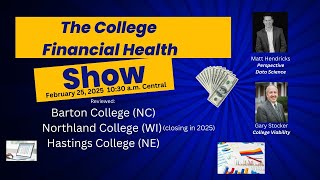
In this episode of the College Financial Health Show, host Gary Stocker (founder of College Viability) and analyst Matt Hendricks examine the financial viability of three private colleges—Barton College (NC), Northland College (WI, now closed), and Hastings College (NE). Using audited financial statements, IRS Form 990s, and IPEDS data visualized through the Advanced Financial Compass and College Viability apps, they benchmark each school against peer institutions. They uncover: (1) Barton’s unsustainable 27% endowment draw, flat endowment growth, and a misleading net‑income margin spike that masks a projected 11% loss once the draw is normalized; (2) Northland’s chronic deficits, negative cash flow, heavy reliance on endowment loans, minimal CapEx, and a failed $12 M emergency fundraising effort that preceded its closure; (3) Hastings’ turnaround, driven by 43% revenue growth, disciplined 8‑9% expense growth, modest endowment draws, but still lagging endowment returns (7% vs. 11% median) and a graduation‑rate below 50%. The hosts discuss the importance of benchmarking, the role of accreditors in market transparency, and how their tools enable colleges, boards, and prospective students to spot financial red flags early. They also showcase the College Viability app’s ability to compare graduation rates, enrollment trends, unfunded institutional grants, debt levels, endowment size, and program‑level market share, emphasizing the need for balanced academic portfolios.
Chapters
It's a Tuesday, so it must be time for the College Financial Health Show with Matt Hendricks and Gary Stocker. Welcome everybody. We have 3 colleges that we are looking at today, and I'll go ahead and get that started in just a minute. But for those of you joining us for the first time live, thank you very much for making the time to do that. We use college data We use college data from audited financial statements. We use college data from IRS Form 990s, and of course, from the National Center for Education Statistics and its IPEDS database. And we compare it. A big part of what we do is we compare your college to other private colleges, and it makes a difference. It's one thing to just look at the trends inside of a single college. It's a more important thing to look at trends as they compare to other colleges. Hi everybody, I'm Gary Stocker, founder of College Viability.
Now I'm Matt Hendricks. Uh, today we have 3 schools, kind of the normal routine. Uh, we have Barton College in North Carolina, Northland College, which just closed from Wisconsin, or just announced they're going to close, and Hastings College from Nebraska. Uh, I guess we have the whole pers— the whole, uh, spectrum here today. So Barton College had, um, initially I'll show you, look at their net incomes, look good, but then when you dig deeper, you see that they have a really unsustainable endowment draw that was bringing that positive. So I'll show you how to see that and get a sense of how big their deficit is right now had they had a normal endowment draw. Northern College, of course, lots of financial problems. You'll see what a closed college looks like about a year before closure. And, you know, the same issues. You see big deficits, big negative cash flow from operating activities. You'll see borrowing from the endowment, not a lot not a lot of cash and very short runway, not a lot of cash left to cover deficits sitting in accounts. And then the last college is really a positive case. I think they appear to have had many years of deficits but have recovered. And it's really an excellent story from what I could tell in my prep before the show. So Hastings College in Nebraska could be one of those cases where we, we all learn from, you know, what they did to balance their budget. I'll take you through that and we'll check if it was like a revenue side story, cost side story, or what. And then one thing I'm going to flag is that their endowment investment returns don't look very good. So they may want to look at the investment strategy there and what they have in their portfolio to at least match competitors or get sort of market value for their endowment. Um, so that's maybe worth a look. Again, the value of benchmarking— they may not know that their returns are poor. All right, so starting with— let's start with Barton College in North Carolina. Um, so I'm going to share my Advanced Financial Compass app and walk you through the financials here. If you haven't checked this out yet, do it. There's a lot of stuff in here that's free. Uh, we have a couple tiers now, but, um, you can do a lot with this, as you're going to see here in a moment. You can select the school that you want to look at, in this case Barton College, North Carolina. We can put a bunch of peer schools in here if you want to compare them to another school. You can put a bunch of different schools in here. I don't know who their peer set is offhand, but you can— it's just like really a sandbox. You can put different schools in here and they'd be represented by the green line. I'm not going to do that because I'm not sure what their peers are at the moment. But take a look, this is what I was looking at just a little bit ago. So they had some losses here, 2022, 20— '23 and '21, all negative net income margin, and then all of a sudden shoots up to +11%. So obviously I was curious about that and wondering how that actually happened. Turns out though, and I'll show you here, it's not what it appears to be. I'll show you their appropriation. So remember, Gary, the, the standard appropriation from your endowment is about 5% of the average value of the previous 3 fiscal years. And, um, they may have, have been operating with that in 2022, 2020. Doesn't appear to be the case in '21 or '23, and certainly not the case in 2024. That's a 27% draw. Um, that's massive. And very unfortunate because you're going to see what's going to mean for their endowment here. Let's just see percentage change because their endowment's not very big to begin with. See, I'm looking at here, their endowment, it doesn't look like it's changed a lot, but it's just really small, $26 million. The median endowment in the country is $65 million. But you use like $50 million, Gary?
I use $50 million for mine as a bare minimum.
So let me, I have so many variables in here now, so you really have to search. So we're going to look at change in endowment value since 2016. And you can see this big draw. They went shooting down here. Their, their endowment's basically flat since 2016 now, only up 1.8%. And that is going to be a huge problem going forward because now they're becoming way more tuition dependent than everybody else. That sort of manage their endowment in the proper way, the normal way. And so you can see the average endowment's up like 60% since 2016, and they're only up 1.8%.
And Matt, what does that red line represent?
The red line represents the schools that closed, right? These are 9 schools that closed in 2023 and 2024. And you see they're pretty much moving the same direction as the close set here. A lot of these schools, or maybe all of them, in fact, did exactly this, huge draws on the, whatever they could take out of the endowment, they would take out to try to survive as long as possible. So this is, you definitely don't want to be doing this, right? And this is really scary because it just makes things even harder the next year, right? To balance your budget next year. Now, at some point you have to go back to a normal draw, right? And when you do, you're going to have a lot less there, right? Their endowments. Not growing. So that means you're putting even more pressure on getting your net tuition revenue up. And let's take a look at that, by the way, net tuition revenue.
And Matt, while you're doing that, for those that have joined us live, the chat is open. Feel free to drop your questions in chat, and I'll of course share those with Matt or myself as appropriate.
Yeah, so I mean, you can kind of see what's happening here. They, they had some decent growth in net tuition revenue up to 2023, but it looks like '24 was a rough year for net tuition revenue. It fell sharply. And you can see in the dollar value terms too here, looks like it went to $16 million from only a million dollars, but it's pretty big loss. Let me see how big their operating revenue is. I mean, you can play with this all day long. So I'm just kind of showing you guys some of that.
And I do, man. I play with this.
This is becoming a quite complex. Um, which is good, but I mean, I want to make sure it's super rigorous and that you guys can do a lot with it. Um, but, um, that's operating— operating revenues are flat, so they, they've made up with it. It's probably some auxiliary revenue growth. I'm just kind of curious now. Let me check this. No, that's actually flat too. Yeah, I'm not sure what— oh, I know what it is. Check this out. This is really weird. Government grants and contracts. You see all these government grants and contracts back here in 2022. The median school was getting $2 million. 21, $2 million. That's COVID relief money. Look at that. They had zero and then all of a sudden they get it here. I double-checked this on their audit. They actually got their COVID relief in 2024, which is the latest I've ever seen. So you have a couple things here. You have this massive draw. That's an $8 million draw, and I can show you that on the, on the app. They also have $1.5 million coming from COVID relief. So if you get rid of those two, like, one-time things, which obviously you can't do that draw again, or you're going to be in really big trouble going forward, probably already in trouble anyway. And you're not going to get the COVID relief funds probably in 2025, I would hope. I mean, that's really late to get it anyway. So, I mean, you're really looking at, um, I'll just show you from their audit, their net income, even with the $8 million draw, $1.5 million, um, COVID relief, their operating income was $4 million. So if you take away a normal draw for them would be $1.5 million, which is about the COVID relief. So really take away the $8 million draw. Right, and don't get the COVID relief, take a normal draw, they're looking at a loss of about $4 million here on only a $36 million revenue. That's about 11 million or 11% negative net income margin. So it's a pretty serious situation. And so, yeah, serious financial problems here that they definitely need to look into if they haven't already started fixing this now. They need to get on it, of course. And the thing is, it's on top of 3 prior years, I believe. Did I say net income margin? 3 prior years of losses. Net income margin. So really what happened here, they have negative, negative, those aren't too bad though. And then minus 5%. And then I just told you in reality, the loss here was about minus 11%. All right, so this is not real. It's actually about here. So that's pretty significant, right? That's about as bad as it got for the schools that closed until the year right about when they closed. So this is a very serious deficit. All right, go on to the next one.
Yes, please.
All right, Northland College.
And while you bring that one up, this is the one for those listening in either live or watching the recorded version. Northland College announced in about March of 2023 2024, that they needed to raise $12 million in about 3 weeks or they were going to close. Well, in about 3 weeks they raised something like $600,000. I'm not sure the number. And yet it was a year later— it's now a year later— when they finally said, we just don't have the resources to stay in business. And what Matt's going to show you is this is a closed college, and watch how closely in many cases it mimics that red recently closed college line.
Yeah. Yeah. So this is net income margin that you're seeing right here. By the way, I think I forgot to zoom in a little bit more. I was zoomed in a little bit. Um, yeah, we're looking at huge losses here for a very, very long time. I mean, yeah, 28% loss, 15% loss. And I just told you 11 is a lot, right? But these schools is blowing that out of the water. Minus 21. Things got better actually for them in COVID, during COVID because they're getting grant funds. As I just showed you, the government grant revenue goes way up, but that money went away. And now they're back to massive losses. In fact, their worst loss ever in 2023 on a net income margin basis. So these are just devastating losses. Um, I can show you—
talking about those devastating losses, let's go back to that fundraising campaign last year. And I don't remember the details, but essentially they were trying to raise funds, Matt, just to meet payroll, just to keep lights on. And that's not really the ideal scenario to raise gifts, is it?
Well, yeah, unless you're going to do it for the next 100 years every year. Yeah, probably not realistic. I mean, they're looking at a $5.5 million loss here at the end of fiscal year '23. So yeah, what are they saying? They wanted to raise like $12 million and $12 million in 3 weeks without, without getting that. If you're not going to— if you're just going to get a one-shot $12 million, right. That maybe gets you just 2 years. And so it's like, even if they do meet the target, you have to get these— this has to go to zero or positive, or it just doesn't matter how much money you raise, right? Um, they're going to eat through $12 million in probably a year and a half at the rate they're going, if not faster. Um, and that's— it looks like they had appropriations are okay here, but what ended up happening is they're taking loans from their endowment again. So They just have massive liquidity problems. Remember with the Drew case, they took $64 million out of the endowment where their endowment on paper says $120 million, but really $64 million of it's gone. It's already been paid for payroll and it's a loan now. And that was a similar case here with Northland. I think they had like a $7 million loan at one point. The cash loss is really bad. let's show you net cash from operating activities here and millions of dollars. Whoops. Go back to home here. Uh, so in 2020, yeah, so the cash loss is $5 million. It's not just the, you know, this is not even including depreciation. So they had serious, so what they were doing is, is taking loans from their endowment, selling investments, and basically that money ran out. Is what happened. Um, so that's, that's the end. Um, so yeah, anything else I should cover on this, Gary?
Let's take a look at the CapEx. Let me take a quick look at the CapEx.
Yeah, yeah, if you see a school that's for about 6, 7 years in a row where they're not replacing their depreciation expense— and what I mean by that is this ratio of depreciation of, uh, CapEx spend spending on equipment, computers, stuff like that. If it's not at least as high as your depreciation rate in general for a very long time, that's going to mean plenty of deferred maintenance or just a lack of technology on campus and so on. In general, that's what it doesn't always mean. But this is a clear flag here that there's probably some maintenance issues, if not just a lack of new technology, probably poorly, poor quality technology and stuff like that.
And again, notice how closely it mimics the red line of the closed colleges.
Yeah. Okay. So yeah, all the signs are here. You got negative cash flow, negative net income, not investing in infrastructure, of course. Right. The thing about this, though, is we can predict this well before they close. Right. You can see this happening long before 2023, even when it kind of hit the media. Right. It's had been going on for a long time.
Yeah. And before you head out to Nebraska, let's just talk about predicting closed colleges. Well, Matt, you and I both know we don't do that. We don't predict. We're never going to say a college is going to close. We go over the data. You heard what Matt's talked about for the, for Barton and for Northland. We believe, I think strongly believe, that it's the listeners, the people who use this data, the people who buy these apps, look at it and make their own decisions, right? Um, because there's, there's so many factors. Again, Northland had out for, held out for a year. Could I have told you last year? I did. Yeah, they were in trouble in my podcast that I do. So it's, it's really, you have to look at all the data. It would be unfair for Matt and I to say this college is going to close, and we're not going to do it for lots of reasons, but the data is there. The data is there, Matt.
I just think it's unfair too. I mean, I'm an economist. I've studied how information works in markets as a class, right? Like, I thought it was the government's job or regulator's job to kind of make the information easier for consumers to consume, right, and make a better decision. And I just don't see that that's happening in market. Um, back here when they had a 28% net income margin loss, um, I would have hoped the accreditors would have raised some major red flags back here and warned, you know, people participating in this market, be it students, parents, uh, people deciding on whether they're going to take a job at the school, that that's a pretty risky choice. And I, I would be willing to bet a lot of money that they didn't make this warning back here, right? That's just basically— yeah. And so, um, again, I'm just really disappointed in the accreditors. Um, it's totally understandable that a board would keep that quiet and the president would keep that quiet, but I think it's the accreditors' job to warn students and say, hey, uh, might want to look at this, right? And this is the reason, right? I mean, that's the purpose of accreditation and regulations in general, is to provide better information to market participants. And I just think they're failing in that.
Yeah, it ends up that people like you and I are replacing that function. We are the ones saying, hey, be careful.
Yeah, so we're part of the market result here, right?
Right.
There you go. You need— I'm trying to fill it, um, but it could be filled by government regulation as well, but we'll do it until, until that's fixed.
There you go.
Um, Hastings College in Nebraska. So I think this may be one of the cases, Gary, where I really want to focus in and learn about what they did because this is quite remarkable. They went from being just as as Northland, actually worse. And have now— you see this steady increase in net income margin, and now they've had 2 years in a row where it's positive, and that's post-COVID relief. It's possible I'm missing something here. There could be something artificial, but that doesn't seem likely with 2 consecutive years and just given the trend here. And then take a look at the graph below. This was a massive endowment draw, but frankly, these are low, right? Since then, 2022, '23, and '24, all normal, low, low end of normal endowment draws. So that's not what's pumping this up. Let's take a look and see if we can learn more about how they've dug out of this hole. Do operating revenue and expenses on the two graphs, if I can type. Uh, there it is. Uh, I want to do change since 2016 so we get this scaled right. So you guys see this, that's a huge growth in revenue, 43%. So that's going to probably be the story, but let's take a look at expenses as well. Okay, well, two sides of the story here. Um, so couple things just to be really quick and make this as easy as possible. Revenue's up 43% since 2016. Excellent. And that's about the 75th percentile. So they've done better than 75% of all schools in the country since then. And notice they've really done a good job of keeping their expenses low as well. Expenses only grew by 8%, 9%. And most schools grew by 22%. All right. And in fact, 22% would have been cool with them as well.
Right.
Although they had to dig out of a big deficit, so it probably wouldn't have been cool. They just barely got out of their deficit with an 8% growth in expenses and 43% growth in revenue. Right. This is awesome. This is exactly what we want to see happen. We see way too many of the schools that are struggling, just, you know, expenses go up faster than other schools. It's completely ridiculous.
All the time. Yeah. Yeah.
And so I'll just say I've heard that from the Drew case too. They're, oh, we tried to cut costs and You know, I'll just say you didn't try hard enough, right? Because clearly when your expenses are growing faster than your peer set or other schools, you have a problem, right? You just, you're not doing a serious, making a serious effort at cutting costs. This is what a serious effort at cutting costs and keeping costs low looks like. See how it stays lower than the growth in the peer set and the median school? That is excellent. And, but if you're growing faster, don't tell me that you've been doing everything you can to cut costs. Okay. All right. So the, let's see what their net tuition revenue is. I'm curious about this. Net tuition revenue.
Interesting.
Flat. Okay. So this is, I just made a post about this on, on LinkedIn. The problem with focusing just on net tuition revenue is that it's it could be less than half of the school's revenue, right? And so I think people need to have a better understanding of where all the revenue comes from. And this, in this school's case, they probably have a big endowment. Let me just take a look. I have this in here now. I have shares, revenue shares. So let's take a look at net tuition revenue share of total revenue. I wasn't lying. I've got a lot of stuff in here. It's actually getting a little bit. So here it is, net tuition revenue as a percent of total unrestricted operating revenue. And see this school, this school, yeah, net tuition revenue is really important, but it's only 33% of their revenue. Okay. So it's not the end of the world if their net tuition revenue is flat, especially if they're doing a good job managing their endowment and getting their revenues growing in other areas. Let's take a look at Aux.
Yeah.
Um, there you go. I mean, yeah. So they're 26% of their revenues from auxiliary enterprise. That's, uh, like housing, food service, bookstore. Stuff like that. Athletics.
That does put them at some risk if enrollment goes down because yeah, it'll affect enrollment.
Yep. I'd imagine that their investment in endowment income is quite high. Yeah. So they get another 15%, you know, just from their endowments and investment income. And let's just see how their endowment is doing. So this school is lucky to have that. And the great thing about being, having a bigger endowment is that endowments are generally growing. Quite fast. So yeah, it may not be the end of the world, although this is what I wanted to flag. This is really interesting. Their endowment is not growing normally. You see that, Gary? It's only up 22% since 2016. Let's dig into that for a moment because that's unfortunate. If it would have grown normally, they would probably have massive surplus with their current spending rate right now because they're below the 25th percentile right there. Yeah, they're below. Yeah, this is one of the worst growth rates in the country here for the endowment. So there's a couple of reasons. One is this big draw right here, uh, certainly set them back, put them down here, but they've since still been flat. Um, so there's a few things that'll affect your endowment growth. One is the appropriations, one's the contributions. Let's take a look at contributions. So I have contributions to the endowment as a fraction of your total expenses here. And contributions look excellent. So that's clearly not the case. All right. So appropriations look normal, contributions look normal. What's happening then? The returns must be poor. And that is indeed the case. It may not look so obvious to you, but this is, these are poor returns here. Many years of poor returns. We've got a 7% versus a median of 11%. We have that one looks normal. This one is basically break even when the median school's got a +2.5. This one is 20 when the median school is 26. That one looks okay. I, I don't have this data point, but I did check it beforehand. It's below the median again. And then this one's just straight awful, 7.7% versus 11.2. So this school has a problem with their investment returns not being normal. They're low and they need to try to fix it as fast as possible to— unfortunately, they've already sort of been hurt by this significantly. But I would immediately, if you worked on the board finance committee, you need to look really closely at this investment portfolio and try to change it. I double-checked in their audit and you can dig in there. It looks like they have a lot of alternative investment kind of funds, which appear to be not performing very well compared to what other schools are using. So that's my advice for that school. I'll leave it at that, Gary. I don't have a lot more. This looks like an excellent case of sort of pulling out of massive deficits and getting to the positive last 2 years, at least.
Okay. So, you know, one of the when we do these shows, sadly, too many of the schools we review are financially challenged, and that's being nice. But when we see one like Hastings, and we've seen many, it's neat to see what's going on, and there's a positive. As a matter of fact, I made a note, Matt, I'm going to do a clip on Hastings. So in addition to posting the whole show today, I'm going to pull just the Hastings clips and post it and promote it as one— look, here's a college that's doing it right. And if those of you following the show either live on the recorded version, want to reach out to the folks at Hastings to ask what they're doing, please feel free to do so. So let's take a look. Let me share my screen and let's look at— excuse me— let's look at the 2025 College Viability App. It's ready to go out the door. All I have to do is the final details. And you see, you can see I have our 3 colleges up here, and I just start with graduation rates, Matt, because that's at the top of the list. Um, and we can see that these colleges Well, my minimum threshold is 50%, and only Northland, who's now closed, was at that threshold. So for all their success financially, the folks at Hastings still only graduate about 45% of their students after 4 years. Similar kind of numbers for Barton College. And again, if you can't graduate more than half of your students, you know, I call you not much more than a coin toss college for obvious reasons. Let's take a look at enrollment. And this is the full-time undergraduate enrollment for these 3 colleges. And we can see that for the most part they're flat. Barton is up a little bit, Hastings down a little bit. That has to be concerning them a little. And, and Northland was down quite a bit, almost 20% over the last 8 reported years, 2016 to 2023. And again, the College Viability App, you can select dozens and dozens of comparisons to use We can look at graduate enrollment. My apologies for the scratchy throat today. And you can see down quite a bit at Hastings, up just a little bit, up about a third, about, about a half at Barton College. Let's just look at a couple other items here. Unfunded institutional grants— how much of the store are these colleges having to give away? And you can see Barton has gone from $9 million to $17 million, so up almost $8 million in unfunded institutional grants. They're essentially providing $7 million, $8 million a year to students just to get them enrolled. Nothing wrong with that, Matt. We know they can do that. That's how colleges get students to enroll, with those discounts. But again, that's $8 million taken away from the potential revenue. Hastings College has been trying to moderate that. They're down a little bit, about a half million. And Northland College, in the dire financial position, we're still giving away more than $3 million in unfunded institutional grants. And again, I'll point out, merit aid— most scholarships are not not backed by actual money, backed by actual funds. They are just discounts, just like you, just like Matt, like you and I get buying a car or a house or clothes or computer, that kind of— it's outside of 12 months. And really, all the— both Barton and Hastings have substantial long-term debt. Northern has theirs down a little bit, but even then, they were looking for that fundraising effort last week. That would concern me a little bit because whatever the interest rates are on those, those colleges are paying that down And Matt, I know you track that in your app as well. And then finally, let's go down to the bottom, and I want to look at the endowment assets. And again, IPEDS changed its reporting format a few years ago, so we only have 4 years' worth of data. And we can see that, you know, Barton College at $50 million, Northland not much more than couch money, and only Hastings has an endowment of consequence. And again, you have $65 million, I think, is the median. I use $50 million as a bare minimum. And only Hastings has that amount in place. And I make the argument all the time, Matt, if you can't raise at least $50 million in gifts over the course of your entire existence, don't tell me, like Northland tried to do last year, that you can raise $50 million, or $12 million in their case, in a month. You just don't have the donors, the systems, and the processes in place to do that. And finally, we always, in 2025, look at majors. Colleges are cutting back. Matt, you and I know this. They're cutting back at public colleges, they're cutting back at private colleges. And what we've done here is we've created an app that lets users compare where college is strong at and where college is weak at. This is available at collegeviability.com. And all I want to show today is Barton College. This is one of the many ways you can use this app in addition to market share comparisons. I look up Barton College, I look at the years 2020 through 2023. The last available set of data, and I look where the colleges are strong. And like many, Barton is strong in business. Sports kinesiology is unique, but I like to make sure college is not too heavily weighted on a given major. And, you know, it's a subjective term, but I look at this a lot, and the folks at Barton starting to get a little bit too heavy on business. The kinesiology might not be bad, they might have a strong program, probably do have a strong program, But that's 30% of their graduating class comes from kinesiology. Boy, they want to make sure that they keep that faculty member. They want to make sure that they keep the technologies they have there because they've got a nice draw on that. And then I watch for trends. And just looking across the board here, looking at communication, and I'm just looking at percentage of the total market share. This is inside the college. So in 2020, 5.9% of the internal market share for communications and media studies at Barton College was 5.9%, bounced up, bounced down, and bounced down a lot. So if I am the provost, if I am the dean, if I'm the president, I'm the board, I'm looking at that, I'm asking the questions, hey, what's happening to our communication programs? Why are we seeing such a decrease inside the market share? There's also ways to look at this by major. And just quickly, I would do that. We're doing okay on time today, Matt. So I'm going to look at bachelor's degrees for 2023. Let's go to North Carolina because that's where Barton is from. Let's see how Martin does. And just some common bachelor's degree— we'll just do private colleges. And again, you can get this app, it's available at collegeviability.com. And I've got all of the private colleges in North Carolina. Let's take a look at some common ones. Let's look at accounting. And you can see over here the market share. Let me sort that. Those are strong market shares. You can see the percent market share of all privates in North Carolina. There's a cute little pie chart here. We've got a bigger one available for more clarity. You can click on those to see which college has which numbers. And again, you use this to determine, am I strong? If I am strong, should I look at securing maybe some business, some shared academics with some of these other colleges? And if I'm small—Shaw, Greensboro, Catawba, Pfeiffer—should I look at generating some revenue-sharing opportunities with other colleges Or should I look at getting out of the programs that may not be cost-effective because I'm paying more in salary and support services than I'm generating in tuition and fee revenue? So Matt, we do this every week. We look at 3 colleges usually. Sometimes it's slightly different. And it's— it's— I'm going to say it again, it's the comparisons. For those of you watching live and again the recorded version, the tools that Matt has created with the Advanced Compass We didn't even use a strategic compass today, which is a fabulous tool for individual colleges and my own college viability app and the college majors completion app. It's the comparisons, Matt, that matter.
Yeah. Um, compare to yourself over time, compare to your peer set. Um, otherwise you're just, you're just kind of guessing what a good value should be, right? Uh, right. I mean, like the case with the low returns on the endowment at Hastings, they may not know. That those are low. They're missing out on a 4%.
They think it's wonderful.
Yeah, they might think a 7% return in 2024 was normal and it was not very low. So yeah, there's no way to know that unless you're making comparisons. So that's why we do this.
Yeah. Yeah. So we'll be back again next week. We have 3 colleges. We post those colleges on collegeviability.com. We will have the recorded version of this out with some edits. Later today. For those joining us live and for those that make time to watch the recorded version, we're grateful for your time and for your guidance. If you have questions, I'll have a link to my email address. If you'd like a private demo of any of these products, including Matt's Strategic Compass or the Advanced Compass, drop me a note and I'll be glad to set that up with you. For Matt Hendricks, I'm Gary Stocker. Thanks for making time. We'll be back again next week with another episode of the College Financial Health Show.
More from Gary


What does it look like when a college increases both total revenue and total expenses?



College Financial Crisis? We look at the financial health of Bay Path U. (MA) and Coe College (IA)


Private College Financial Crisis? We look at the financial health of Hobart William Smith College


Financial Compass tutorial (Private college version.) Financial statements compiled 2016-2025.

