The College Financial Health Show for March 4, 2025. A financial health and viability review.
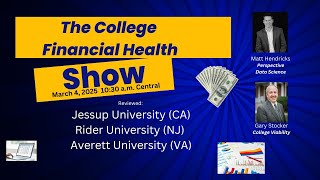
In this episode of the College Financial Health Show, hosts Gary Stocker (College Viability) and Matthew Hendricks (Perspective Data Science) analyze three private colleges—William Jessup University (CA), Rider University (NJ), and Averett University (VA)—using audited financial statements, IRS Form 990s, and IPEDS data. They walk through each school’s recent financial trends, highlighting key anomalies: William Jessup’s 2024 surge in revenue tied to a $23 million asset acquisition of Multnomah University, making its financial picture currently inconclusive; Rider’s chronic operating deficits, wildly inaccurate three‑year budget projections, large endowment draws (up to 9 % of assets) and a $15 million cash‑flow shortfall that leaves it with a short runway; and Averett’s bond default, dwindling unrestricted endowment cash (≈ $0.6 M left) and a $2 million operating cash deficit that threatens immediate solvency. The hosts also showcase the College Viability App, demonstrating metrics such as graduation rates, enrollment trends, tuition‑fee revenue, unfunded institutional grants, and internal major market‑share. They introduce a new four‑tier financial‑health rating system (sustainable, sustainable with concerns, unsustainable‑long runway, unsustainable‑short runway) and apply it to the three schools. Throughout, they stress that audited statements are the true “report card,” budgets are merely forecasts, and that benchmarking via their Strategic/Advanced Compass tools can surface hidden financial risks for college leaders, boards, and investors.
Chapters
It is Tuesday, so it must be time for the College Financial Health Show with Matt Hendricks and Gary Stocker. Hi everybody, welcome back to the show. We've got 3 more colleges to look at today, and some of them are inconclusive, some of them have some issues. We'll talk about that in greater detail. And those joining us for the first time, either live or via the recorded version, we use data from audited financial statements. We use data from the IRS Form 990s and we use data from the National Center for Education Statistics and its IPEDS database. So hey, it's always data that the colleges themselves have submitted. We just make it easy to compare. We make it easy to analyze. We make it easy to see which colleges are doing well, and there are certainly some, and which colleges are doing less than well. Hi everybody, my name is Gary Stocker, founder of College Viability.
Hello, and I'm Matthew Hendricks, founder of Perspective Data Science. Um, today we're walking you through, uh, 3 schools again. We have Jessup University in California— that's actually William Jessup in California— Rider University in New Jersey, and Averett University in Virginia. And so I think we have Interesting show for you today, starting with Jessup. I'll start with them. They're an interesting case. They just acquired a school, so it's a little bit tricky to understand what's happening. I'll kind of walk you through what I was looking at for the show. So this is William Jessup U in California. Their net income, I mean, this looks pretty bad in 2022 and 2023, then all of a sudden the surge in 2024. To a massive net income surplus there. They also had a massive surplus in 2020. So it's kind of all over the place. So I wanted to dig deeper on that. But another thing that sort of tipped me off that this is atypical is if you look at their net tuition revenue as share of their total revenue. Yeah, as a percent of their total revenue, this is really a good thing. I mean, seeing numbers go down, sometimes you're like, oh, that's bad. But this is their share of their revenue that's coming from net tuition, right? So they're becoming a lot less tuition dependent here. It looks like all of a sudden, out of nowhere in 2024, they have this surge in revenue and it's not coming from tuition. And I'll show you that as well. And then I'll kind of walk you through what happened. So operating revenue, we'll take a look at the change in operating revenue since 2016. It's this one right here. Again, we have this huge surge here and they go from plus 48%, which is good. I mean, the school's doing fine. And then all of a sudden, wow, 126, 127% growth in, in revenue. Let's see the expense side and change since 2016. And again, a big jump in expenses here. So I was really curious after seeing this, so you don't see this very often, really volatile sort of changes. In their financials. And remember, you can click and see the audits. I have that. This is, again, I put this in for me mostly, but I think a lot of people are using it. So yeah, definitely saves some time. So here's what, what their statement of activities looks like. There's this new line here that is huge, right? $23 million of revenue coming from inherent contribution received from acquisition. That's a new one, right? I've never really seen that. And turns out they acquired another school. They acquired Multnomah University in Oregon, and the assets they acquired from that, that school turns out to be $23 million. So, um, so it's a bit tricky to understand what's happening. You have this sort of big shock happening in 2024. But yeah, ultimately I think the school's doing well. I mean, obviously they acquired another school, so that school thought they were a decent enough partner to sort of hand place over to them. You can see here their net tuition revenue is going up after the acquisition, but their expenses shoot way up too. So, I mean, there's a lot of transition that's happening right now. So I think Gary mentioned, previewed at the beginning, that's kind of inconclusive and that this is the case. I just don't know exactly how this is going to shake out. Certainly looks like a nice surge of assets coming in. To William Jessup right now, and they're selling a lot of the buildings and things that they've acquired in this acquisition at the moment.
So, Matt, does this look like a straight merger? Does this guy— cash exchanged hands upon acquisition?
It looks— well, it's kind of tricky in a— is it? Yeah, it looks like they just got acquired. This school I can show you on the audit. Let me just do a keyword search here. Acquisition. So I, I started searching this down in the notes and this is how I did it. Okay, here it is. Yeah. So they acquired the school on May 2nd, 2024, really close to the end of the fiscal year. The school in Oregon and basically the assets they acquired are all of these $30 million. And it looks like they had to pay $7.7 million for something to get to acquire this school. So I guess they kind of bought the school in a sense.
I don't know.
I don't know the details. Sales here, just other than what I'm seeing right here with you all at the moment. So, um, I'm kind of curious what, what this was, if they had to pay off some of the debt or something like that.
Seems like an awfully small number though for that.
Yeah, they acquired a lot of assets, right? 20— yeah, basically they're— the net gain from the sale, from the acquisition, is $23 million, which is what you saw on the statement of activities above. Um, so really nice deal for William Jessup, uh, looks like at the at the moment. Uh, but again, it's inconclusive. It's gonna be interesting to see how this shakes out, how the two, um, universities come together, if they're even operating the other one. I'm not sure. Um, there's a lot of research that I didn't do on this case because I was really interested in the next case, actually much more interested. Uh, although this is a very interesting case as well, but the next one I've been studying for a while and I'm gonna switch into it now, right now. It's Roger University.
I'm gonna put Jessup back on the schedule for about a year out from now. We'll take a look. Yeah.
Yeah. We should check in and see how that's all shaking out. Should mention that I'm working with, um, other schools that are doing the same thing right now. They're using the Strategic Compass to identify acquisition targets like that. Yeah, so, uh, very interesting strategy. The Strategic Compass is beautiful for that because you can identify all the weird areas where spending is higher than normal, uh, which is what I'm doing with these clients. And, um, they can see, oh, this is a good target because, you know, we're going to eliminate a lot of those expenses through the acquisition and that kind of stuff. So, you might think about that. There's several schools using that strategy, right? Basically acquiring other schools to build up their own assets.
And then once, once somebody has used the Advanced Compass, then of course to drill down individually, the College Financial Health Strategic Compass looks, of course, in great depth at individual colleges. So that's another resource. Yeah, that's what we're using the Advanced Compass.
Yeah, so in this particular case, or several, actually more than one case, but they have a target in mind and then the strategic compass is used to kind of try to find all the landmines that they might not know about before they get in sort of really into the details of a deal. So another use case that I didn't even think about when I was designing that thing years ago and developing it still today. So here's the Here's Ryder. I, I put a preview out on this and I think it's a good case to look at, uh, because I see this a lot. It's not just Ryder, uh, where the budget numbers, um, are just not very accurate. Um, I would certainly hope that they could do a better job on their budget, and I'll show you the reason here in a second. Uh, but I'll just walk you through the financials, and they have a 3-year plan to get back on track, and it's already way off the rails, um, as far as I can tell. Just 6 months into a 3-year plan, which is really, I don't know, I don't think I would accept that if I were a board member or if I were a president or something like that. It should be a lot more accurate and better assumptions. And it's part of the board's job is to make sure that the budget is accurate. And there's an exercise they should do at least once a year, which is compare the budget projections to the actuals on the audit. If there's big differences or any differences, really, they should understand what those differences are. And how they can make the budgeting practices better. I've seen in a lot of cases firsthand that schools, a lot of schools, especially ones that run deficits for a long time, part of the reason is they just don't have a good handle on their budget. The budget's just not accurate and they're, they're making decisions based on an inaccurate budget, which just makes the problem far worse. Which is sometimes why you can see cases where universities are like, oh, we didn't know we had this big deficit. Well, it turns out budget was wrong for years, right? We ever went back and checked it. So, um, let's get into it. Here's Ryder, just a quick review on Ryder. Their, uh, net income is pretty, pretty bad. Um, net income margin— I got so many things in here now, I got to do a longer search. Net income margin. Okay, so yeah, another thing too is they, they, they want to talk about— I can show you in that document, they talk about COVID causing their problems? Well, to me, it looks like their problem started about 2018 or 2019. That's when that income went off the rails for them. You have an 8% loss here, 14%, 21%, 15%, 13%, 18%. Those are massive losses year in, year out. They have cash flow problems and they're well aware of this. But again, everything sort of went off the rails here in 2019. That was several years before COVID if you remember history correctly.
And Matt, for new viewers, can you step through the, the, the 5 lines there?
Yeah. So the blue line is, is Ryder, and this is their negative cash flow from operating activities. Although they have gotten a bit better here in 2024, it's nowhere near what they projected in their 3-year plan, as I'm going to show you in a second. The red is the series for a set of 9 closed colleges. The bottom dashed line is the 25th percentile. So below that line, you would be in the bottom 25% of schools. The median is here. So below that line, you're in the bottom 50%. This is the 75th percentile. Anything above that, you're in the top 25%. And, you know, in between those, I sort of use these percentiles as a gauge of like what is normal, right? You should be somewhere in that band really if outside of that band, you have— you're really abnormal on this metric. I think the way that they're— yeah, the way that they're trying to, to balance things out here is taking massive draws from their endowment. They got a 9% draw here. Again, this is 25th percentile right here is 5.5% draw. They're at— they're almost double that. And then a 6.7% draw in 2024. Um, you know, this is a really interesting thing though. There actually might be something positive to learn here from Ryder on this one metric. Let me show you their endowment growth. So with these massive draws, and all of these draws are really big, right, you'd expect their endowment to shrink quite a bit. But look, it's actually growing normally.
Interesting.
Slightly higher than normal growth. And so I was really shocked at that when I found that this morning. And turns out Let me show you their returns. Turns out they have excellent returns here compared to the median. 27% return there compared to 26. Uh, 6% loss compared to about 8. Uh, here's a 10%, 10.5% gain versus 6, and then slightly lower. And they also do a good job of— they get— must have a lot of donor support because their contributions are higher than normal as well in most years relative to their expenses. So sort of offsetting those really big draws by making, getting a lot of donor contributions and some massive returns here relative to, uh, just the median school. That's excellent. So we can learn from Rider. What's their investment strategy? It looks to be a bit better than what the median schools use.
Because we've had some colleges on the show that need, maybe need the guidance from their investment advisors because they've had some bad returns.
Yeah, I think some schools are overthinking it. They're involved in some hedge funds that are underperforming after you net out the fees. Doesn't look to be the case with Ryder, although they could be in a hedge fund that's just doing really well. I'm not sure. I didn't, I didn't dig it up. But yeah, that's, that's interesting. All right. The main thing I want to talk about, though, is how are they trying to get back on course? And they disclosed to their bondholders their sort of 3-year plan. a while back. And so there's a lot that is a bit off on this. So first thing is, if you read this part, the key here is that the expected deficit is $16.7 million for 2024, which turns out to be really wrong. All right. The actual deficit is $21 million, not $16 million. So they're way off there. And so they're trying to give a sense to their bondholders and other folks that read this document that they're somehow going from a $28 million loss, which is actually the loss, $28.2 right here in 2023 to about $16.7 in 2024. But it's nowhere near accurate. Right. So that's off by almost $5 million. So that's, that's one of the things that I'm flagging here. It's just that is not a very good projection. And one of the issues that they had, I'll just show you what their problems are here. So here's what they're projecting. And by the way, this is, was done on December 31st, 2023. So just 6 months to the end of the fiscal year and they end up being way off on their projection halfway through the fiscal year, which is really interesting. I would ask a lot of questions about it if I were a stakeholder at this university, certainly a bondholder or a board member. But interesting thing is I thought they're going to be way off on their revenue projection, but they're not. That revenue is really close to what they actually get, actually underestimating the revenue a bit. You can see where they're way off. Their operating expenses are nowhere near their actual expenses. All right. So part of that is that they pulled out depreciation. And Gary, we've talked about this, Gary, right? The depreciation should be in the budget. So there's no reason to pull this out. I can see why they did it, though. They want to show the cash difference. Okay. So add this back in and you're still way off. You're still about $4 million off, right? Even adding the $12.7 into the $125, you're still way off of the $141. So where's the difference? So take a look here at their labor expense, $73 million, and I'll show you their actual labor expense. And this is the part that's really confusing to me. It should be, you know, December 31st, should have a good handle on what your labor expenses are going to be. Um, their actual labor expenses turned out to be $76 million almost. I don't know if you guys can see that. I'll zoom in a little bit. So they're off by about $3 million here compared to what their actual was. I'm not— I don't have an explanation for that, although I would say I would just ask like, what happened there? How were you halfway through the fiscal year and get your labor expense off by at least $3 million? About $3 million. That's not ideal. All right. What happened to cause that? And just to give you a sense of how far off their estimates they are, they weren't projecting a, a labor expense this high. I mean, they were expecting their labor expense to be $74 million in 2027, and they're already way beyond that in 2024. So they're just like way off their plan already, just 6 months into a 3-year plan. And just to show you, so this is what they're projecting out going forward for their cash flow. And I could compare, I could show you basically this is not reality, right? They actually, their actual cash flow here is barely better than it was in 2023, not this $11 million difference, right? So basically, the long story short, the reason I want to flag this is that this is really common, right? It's not the first time I've seen this. And it's a big problem if you have just not making good assumptions. What happened with these projections to be so far off in just 6 months? Those are questions to ask, and I just want to make sure that boards know that they have this responsibility to make sure that the budget is matching reality, right? And so already this document is nearly— I don't want to say too strongly— it's nearly useless at this point, right? It's— these numbers are not happening. This one did not happen. And almost certainly these numbers are not happening. All right, so we should probably readjust here and figure out what the real projections are going to be with the actual values and understand how the projections got off so much. Um, just to show you, they're projecting a negative $6.6 million cash flow here from operating activities, essentially, although there's something different that I'm not sure why. Again, another question: why is their cash flow different from the net cash on the on the audit. But here's the reality. So remember, I said $6 million, they're actually about a $15.2 million deficit here still. All right. Which is a lot of money. As we're going to talk about a little bit, they only have like $20 million left, I think, in their unrestricted endowment. So yeah, things are running— they're running, running out of cash pretty fast here, especially at this rate of $15 million a year. All right, so again, quick reminder, the key takeaway here, make sure your budget is accurate. There's best practices. You can read about this from NACUBO and other places. The best thing that the board should do is every year go back, double-check the budget versus the actuals on the audit, make sure that they can be reconciled and that they're matching. If they're not, change up the way you guys do the budgeting. All right, AVERITT. Okay. Let's go to net income first. Net income margin. Okay. So again, we've got a school that's got big deficits here, '21, '22, '23. And these are pretty significant. I didn't know anything about Averitt. The cash flow is also really alarming. I didn't know much about them, but I was thinking, wow, they must be in serious trouble at the moment. So I Googled them quickly and yeah, they're actually in default on their bonds. At the moment. Um, so they have a negative $2 million net cash from operating activities, uh, which is a lot because I think their revenue is pretty small. Let me check that again. Revenue, um, net tuition revenue, total unrestricted operating revenue in millions. Yeah, $38 million total revenue and they got a $2 million cash deficit. I mean, it's not completely catastrophic at this point, but they are in default. They have a negative cash from operating activities. And just let me show you a little bit about their runway, although I don't have their 2024 audit. So let me show you what their endowment looks like. So one way I get a sense of how big the runway is just to take a look at the endowment value and see how much cash they have left that they can pull out. And you can see at the beginning of 2022, they had $2.3 million of unrestricted cash in the endowment, unrestricted assets in the endowment. And that's the money they can just take out without like asking the attorney general or asking donors. Right. And it looks like they basically took it all out for the most part. They took out $2 million, $1.9-ish out of the $2.3 million that was there. So there's only $600K left. Remember their cash flow from operating activities is negative $2 million, last check. So if 2024 looked like 2023, they're probably out of cash right now. Um, at least this unrestricted cash they can take out, then they're starting to dip into the restricted money. And remember, if you've watched any of the previous shows to get this money, it's a lot trickier, right? They need to write themselves a loan, which needs to usually be approved by a judge or attorney general. They need to ask the donors to reclassify some of the money. All of that is really messy and it's not clear that how that's going to actually work out. Or they can try to get loans from the private sector, which may be an option, but in some cases, a lot of cases like this, just not an option. But I'll pass it back to you, Gary. I think I probably went longer than I should have anyway, but interesting stuff today.
Oh, Matt, you are the master of concise financial presentations. So, but I do want to go back. I want to go back and talk about the budgets for a bit because that's come up regularly on the show. If you had a soapbox, you'd regularly get on top of that soapbox and talk about the budgets. Really, budgets aren't much more than dartboards— educated guess, informed guesses about what we think it should be. It's really, Matt, the audited financial statements that are the true report card on college finance. Is that a fair assessment?
Yeah, yeah. And you'll see a lot of schools, um, referring to their budget as if it's like something sacred or something. It's not. The, the sacred document is the audit, right? And those are the results that you want to move, right? If your budget is not reflecting what's on the audit, that's a problem, right? And in fact, I've seen schools say that, right, to sort of respond to criticism. They say, well, our budget doesn't include this, that, and the other thing. Well, that's a big problem in itself. It should include those things, right? The whole point of the budget is to try to predict those values that are on your audit, right? Ideally, they would predict perfectly. and it should be easy, or at least should be able to reconcile the two documents, right? That's the purpose of the budget is to try to hit your targets on the actual audit, the true values, right? And if it's not helping you get those numbers that you need, then there's probably something wrong with your, your budget.
And we've had a college here in St. Louis who claimed based on their budget that they had turned around their awful finances. And that's really making a strong statement on future values that may or may not come true.
Yeah, at this point, I don't, I don't care what they say about their budget. I just want to see it on their audit. Unless their budget has been accurate in the past at predicting what happens on their audit, I'm not going to listen to what anybody says what their budget says because in my experience, they've never really been accurate. Although I've seen good examples, right? Most really well-run schools, their audits and budgets do normally align almost perfectly.
Okay. Wait, let me share my screen. Let's take a look at the 2025 College Viability App for executive analysis. And I've got our 3 colleges there. And Matt, you're going to be stunned to see that I start with graduation rates because we always start with graduation rates. And I make the case and you see this on the College Viability App and it has some 2,700 public 2- and 4-year colleges and private 4-year colleges. And colleges are paid, Matt, to graduate people. And interesting, I'm going to start with Rider because we just spent quite a bit of time talking about Rider finances, but yet they do a better job than most in graduating over half their students. And you've heard my threshold before: if you can't graduate more than 50% of your students, you're not much more than a coin toss college. Well, Rider consistently does that, and the concerning part about that is they're doing something really, really well graduating students that more than half of colleges don't graduate them in 4 years or less. And yet they continue to have what I would characterize as chronic financial problems. We look at Everett, Everett, and you know, they haven't really even touched 40% once in the last 8 years. They're not, you know, they're borderline 30% kind of graduation rate. I make the case that colleges that can't even graduate 40% of their students aren't much more than tuition collection agencies because they're not graduating students. And Jessup is in the ballpark, we'll give them credit for that. They're in the ballpark for graduating students. Let's take a look at undergrad enrollment because again, that's a leading indicator. Although all the media stories focus on enrollment numbers, that's really just a secondary indicator. It's the tuition and fee revenue that comes from that. And we can see that Everett has been able to grow their enrollment, interestingly, over the last 8 reported years, and yet their finances as we'll talk about here when we wrap things up in a minute, their finances, huh, not good. We can see Rider has dropped about 20% enrollment over the last 8 years, and Jessup, you know, a handful, a couple handfuls per student. And again, when we look at them, most colleges have had a decreasing undergrad enrollment, um, over the last 8 reported years. A quick look at the graduate enrollment, and Everett has started some graduate programs, probably late to the game, and you can see the numbers on the right-hand side. The down arrow, of course, indicates a negative trend, and these are for the years 2016 to 2023, the last reported data. And then one thing that, that, man, is kind of an inside baseball story that we talk about almost every week is something called institutional grants or unfunded institutional grants. And these are what most folks recognize as merit aid most scholarships, and they are unfunded. So it's different, you know, the Matt Hendricks Accounting Scholarship, where Matt donates $1 million to Tulsa University— that's funded. And then they use, you know, that university uses the earnings from that to pay for scholarships. The unfunded is simply a discount. And we talk about that regularly. We're going to continue to talk about that regularly because this is revenue that colleges forego. There's nothing wrong with that. They're welcome to do that. It certainly is a reflection of the market that colleges have to discount tuition to get students to enroll. But we can see in each of our three colleges today that over the last 8 reported years, each has had substantial increases in unfunded institutional grants, merit aid, scholarships, whatever you want to call them. They're welcome to do that. That's good for the students. I had a student reporter on yesterday looking at the college she was going to. It was in great financial shape And I was explaining this to her and she was unaware that that's what colleges do. I say you shared the same story with her. They're welcome to do that. It's great for the students for sure, but it's not always great for the colleges themselves. And I'm going to go down, I want to look at tuition fees because this is kind of a secondary reflection of what Matt just talked about. And look at Rider, they were at $98 million in 2016 in collected tuition fee revenue. They're down $27 million to $71 million in 2023. Clearly, one can make the diagnosis, financial diagnosis, they're facing intense pressure on tuition prices and they're having to, and they're having to discount those prices. So the revenue is down lots. Interesting, Everett is up, not quite a million, about $800,000 per year, give or take. And even William Jessup has been able to grow tuition revenue a little bit over the last 8 reported years. And week in and week out, we don't see positive numbers here. We more commonly see negative numbers. And that, of course, that's a reflection of the intense pressure that colleges face on getting students to enroll and the price they charge. And then finally, just looking at the endowment, and you've got it from the audited financial statement. I pull the data from IPEDS. And, you know, my, my minimum threshold for an audit for a, for an endowment is $50 million. And we see that Rider is, well, in excess of that. You've got concerns about their endowment draw. We talk about that regularly. But really, both Everett and William Jessup, with such small endowments, not much more than college couch money in either cases. And it really shortens, Matt, the runway these colleges have in dire financial times. And then finally, in this year, we've started adding the College Majors Completion app, and I've got our 3 colleges, our 3 universities up. And what we look at this one for is we look at the percent of majors inside a college, or the market share, if you will, inside Everett College inside Jessup, and we've got Rider down below. And we look at the numbers here and we see what percentage in 2020 through 2023, what percentage of internal market share a major has. These are bachelor's degree programs. And we look at accounting, we look at kinesiology. Um, interesting, nothing in business. Interesting, nothing in business. And we see if it's too heavy. And we can see that in 2020, Everett was really heavy in kinesiology. 30% plus of their internal market share was in kinesiology. Look how much that's plummeted as a percentage of their— the numbers haven't changed that much, but the percentage has changed. So in some ways they might be doing a better job, Matt, of balancing the students they bring in and the majors those students declare. I wanna look at that in more detail, but that's interesting. We do the same thing for Jessup, William Jessup. We look at the bottom, business management, psychology, sports kinesiology again shows up. And again, you know, a little heavy on these two. You have to worry that if a college loses a faculty member or if an approximate college decides to offer better deals on the business program or on the psychology programs, colleges that are too heavy are going to take a heavier hit on that kind of stuff. And then interestingly, Rider. Nice balance, really. I always look at the higher numbers. Nice balance. For all of their higher-end market share programs internally. And you can see that none of them even exceed 20%, right? Yeah, none of them even extend 20%. What I would question, and I'll just use Ryder's example as backup here, why is Ryder in the fine arts business? Why are they in the econ business? Why are they in the philosophy business? Why are they in the public policy business? They've got, they've got next to no volume here. And then when we look at the other component of majors, Let's go to New Jersey. We'll just use that as an example. I'm going to go to New Jersey. I'm going to do just privates. The sector is going to be privates in New Jersey, and we'll just look at one major here. Let's look at accounting— always starts with that. So we can see that in private colleges in New Jersey, Rider, all right, decent market share. You can see the ones that do have a decent market share. You can see the ones that are just kind of tagging along. We look at these numbers, essentially multiply by 4 to get the number of students enrolled in those programs, 4 years of programs. It's not a great comparison, but it gives you kind of a ballpark. So Rider has 120, 160, 40 times 4, right? 160 students more or less in their accounting program. Let's look at anthropology just for an example. We can see again the numbers show up. Let's scroll down a little bit. Let's take a look at philosophy. And again, all this does is compare market share. We can see the actual market share here. We even made it easier to use with a prettier and bigger graph. So I can click on these and see Fairleigh Dickinson has 17— has 7% of the market share in accounting-related services. So we bring these items up, Matt, because they offer us the chance again to compare colleges. And week after week, month after month, show after show, Matt, you and I make the case. It's the comparisons that matter. And there was a social media post from one of our friends last night. Talking about a college who says, I don't need comparisons, Matt, they're wrong.
Yeah. Yeah. I mean, uh, it's pretty easy to see. So when I was teaching econ for 12 years, like that's the golden rule of economics, right? Compare the benefit of doing something versus the cost of doing something. So let's just start on the cost of benchmarking. Extremely low, right?
Right.
I mean, you can buy our tools. You can just do some benchmarking yourself. It doesn't cost very much at all. All right. The potential benefits are massive, right? You can uncover problems in your enrollment funnel, problems with your investment strategy. Does Averitt know that their expenses exploded right when they started running deficits? Just to know that you're facing really an expense side problem is massive, right? Then you know where to look, right? And then you can drill even more. Oh, it turns out our staffing is way higher than everybody else. Why is that? We have a lot more contractors than everybody else. Why is that? I mean, like, none of these things would be discovered if you're not doing the comparisons. So to me, it's a no-brainer. And I put that in the post. Cost is tiny. Benefit is potentially life-saving to your university. I mean, not, not exaggerating at all.
So Matt, we're adding a new component to the show this week. And I've had many, and I'm guessing you have too, folks say, well, Gary, Matt, you do a good job of comparing the financials, but you don't ever tell us the status of a college. Now, before I share what we're going to do, we're never, ever, ever, ever going to say a college will close. We're not smart enough, we're not good enough, and that's not fair because there's so many factors that come into play. But we are going to start offering our own college financial health rating, and we're going to— we have 4 categories. One is sustainable, and that about 1 in 3, 1 in 4 colleges that we view looks easily sustainable. The second one is going to be sustainable with concerns, probably okay, but here are our concerns, and we would list those. The third is going to be unsustainable— an unsustainable financial path based on the data that you see with a long runway to correct those issues, 5+ years. And the final one, of course, is going to be those colleges who exhibit what we believe, based on our experience, our expertise on the data, is unsustainable with a short runway to correct, less than 5 years. So Matt, you and I before the show went over the 3 colleges, you had Jesuit University as inconclusive. Briefly, why so?
Yeah, I just can't, I can't make a conclusion there. They just acquired another school. A bunch of assets came in because of that. It's not clear to me what their operating margins are going to look like after that all sort of settles out. So maybe next, next audit we'll have a better sense of what that's going to look like. So yeah, to me they look fine. They look sustainable before the merger and they're probably going to be sustainable after. So I think they're in decent shape.
So Rider University, you have them as unsustainable, short runway to correct, less than 5 years.
Yeah. Well, you saw it. They have a $15 million cash deficit from operating activities. To cover that loss, you have to either do big draws on your endowment or take out new loans. I think I actually forgot to bring that in. They took out a loan for $5 million last year to cover their operating loss, $4.9 or so, at 12.5% interest. I mean, that's like running the place on a credit card. They don't have a long runway. As I showed you, their unrestricted net assets were almost out, right? And a $15 million loss. Got a couple of years. It'll be— it's a question of, you know, one of their schools in their same state, Drew, has been drawing, taking major loans from their endowment. They may go down that road, assuming that the attorney general is going to let them do that, same as Drew did. So maybe they can extend it that way. But But yeah, it's, there's a lot of unknowns on, on term in terms of what they're going to be able to do.
And then the final college, Everett University, you also have, we both have as unsustainable with a short runway to correct less than 5 years.
Yeah. They have a $2 million loss, which is not massive, but their, their revenue is pretty small compared to that. They're running out of assets. I showed you their unrestricted assets are on their endowment are almost gone. Then the big wild card with them, which you never know what's going to happen, is the bondholders are clearly upset, right? They're in default on their bonds. They're violating the covenant. So that brings a lot of stuff into play, right? Some very abrupt, you know, putting the bond to the school. I haven't read the agreement, but, you know, those kinds of things can happen now, right? They probably have a very short runway to just get back in compliance with the bondholders' covenant. Right? Um, so yeah, so we've—
we wrap the show up almost the same way every time. This is the Moneyball era for higher education. The Oakland A's started the whole thing back in the early 2000s. The data is there. The colleges themselves are submitting the data. Matt, you and I are just part of a small cadre of folks, higher entrepreneur— higher education data entrepreneurs, looking at the data and doing the comparisons. So whether you're a college leader or a board member, faculty, staff, community leader, a bondholder, bank, the comparisons are there. There were— there are many strong colleges, both public and private, absolutely. Yet there are way, way, way too many that we can document have a financial path that looks problematic at best. Use the data. Don't use the data, but it's there for your consumption. We make it available in lots of forms and fashions. And so it's there for your consumption. So, Matt, as always, a pleasure. For Matt Hendricks, I'm Gary Stocker. Thanks for joining us for this show. We'll be back next week with 3 more colleges on the College Financial Health Show. Thanks. We'll talk again next week.
More from Gary


What does it look like when a college increases both total revenue and total expenses?



College Financial Crisis? We look at the financial health of Bay Path U. (MA) and Coe College (IA)


Private College Financial Crisis? We look at the financial health of Hobart William Smith College


Financial Compass tutorial (Private college version.) Financial statements compiled 2016-2025.

