The College Financial Health Show for February 18, 2025. A financial health and viability review.
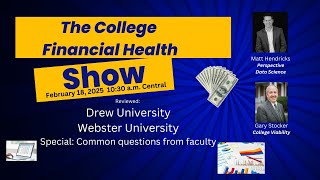
In this episode of the College Financial Health Show, hosts Gary Stocker (College Viability) and Matt Hendricks (Perspective Data Science) revisit two colleges they examined in the fall—Webster University and Drew University—using 2024 financial data. They critique the lack of financial transparency at both institutions, dissect recent audit findings, bond agreements, and endowment borrowing, and explain why these issues matter for students, faculty, staff, and community stakeholders. For Webster, they note a still‑large net‑income deficit (‑15 % after a modest audit‑driven improvement) and a precarious bond repayment schedule that could be called in early, despite a recent amendment that reduces the immediate cash outlay. For Drew, they reveal a decade‑long negative net‑income margin (‑19 % in 2024), a shrinking endowment (from $165 M to an effective $64 M after $64 M of restricted‑fund loans), possible bond‑covenant violations, and dramatically inflated expense categories—especially institutional support, auxiliary enterprises, IT, and vendor contracts. Using regression‑based peer benchmarking, Matt shows Drew is overspending by roughly $12–$16 M relative to similar financially healthy schools, with specific red flags in vendor contracts (e.g., a $2.2 M CampusWorks contract versus peers’ $0.6 M) and part‑time staffing. The hosts propose concrete remedial actions: renegotiate or terminate overpriced contracts, right‑size faculty and staff, sell assets to pay down high‑interest debt, and improve budgeting practices (including depreciation). They also field faculty questions about endowment borrowing, bond mechanics, and runway calculations, offering analogies to personal mortgages and emphasizing the urgency of transparent, data‑driven decision‑making. The episode ends with a call for higher‑ed institutions to be upfront about finances because lives and livelihoods depend on it.
Chapters
It is a cold Tuesday in both St. Louis, Missouri, and not quite so cold in Tulsa, Oklahoma, where both of the presenters originate from the College Financial Health Show. Hi everybody, welcome back to another episode of the College Financial Health Show with Matt Hendricks and Gary Stocker, doing a little bit different show today. We're going to focus— kind of rerun Tuesday. We're looking at colleges that we looked at last fall, both of which had some issues, but now we have some 2024 data to look at that. Matt will start that discussion off here in a couple of minutes. And again, I'll remind viewers, whether you're watching live today or looking at the recorded version, our focus is on transparency. The focus is on financial transparency. And Matt and I were talking before we started recording the show today. You know, there are too many colleges that aren't transparent with their finances, but in all honesty, I know I don't know that I hold them completely accountable for that, because if we were running a college, we might be less than transparent too, just to protect our business. But one of the concerns I know both Matt and I talk about regularly is students and their families and faculty and staff, they need someone watching out for their interests. When colleges aren't being transparent, that's their decision, that's fine. Matt and I are here to be transparent for everybody. Hi everybody, I am Gary Stocker, founder of College Viability.
And I'm Matt Hendricks, founder of Perspective Data Science. So yeah, as Gary mentioned, we have a bit different episode today. We're going to look at Webster University in St. Louis, revisit that case, and then we're going to revisit the case of Drew University. And really the focus of today's episode is going to be less about— obviously we already had a previous episode where we pointed out some financial concerns at both of these schools. In the case of Drew, at least today, I want to focus the presentation on policy ideas and things I see in the data that they might, that might present some opportunities for them to balance their budget and really understanding what the issues are and how they might get back to financial sustainability. So it's about finding solutions rather than pointing out the problem, both of which are important, but rather be part of the solution here today. So I'll briefly talk about Webster though. As Gary mentioned, there was some news about Webster and we'll cover that. So I'm going to share my screen and just recap once again where we're at with them and what the 2024 data looks like. All right. So here's the Advanced Financial Compass, and I already have Webster selected here. And so here's the— what we pointed out last time, we didn't have 2024 data yet, but they have some massive deficits. So they're -31%. 31.5% net income margin, which is pretty catastrophic, especially when you consider the 9 schools in the set of closed schools in their last year of life was about -19%. So severe financial hardships at Webster. And so there are a number of things that happened since our last episode. A couple that I'm going to focus on. One is Their new audit came out and they were able to reduce their deficit to cut it percentage basis, cut it in half basically. So there's a 15%, 16% negative net income margin. And so that's great. I mean, I, I don't want to take anything away from that, but then it was a bit premature in my opinion to start talking about how this is a recovery because clearly you can see that's still pretty close to what closed schools had in their last year of life, right? They still have a massive challenge to get back to a normal net income margin, which would be a positive number. And so there's a lot of work still to do here. So that's one thing I wanted to point out. Another is that they appear to have dodged a major bullet with their bondholders, although it's probably not as big of a dodge as you might hope for or expect. So as far as I understand it, the bondholders of their 2015 series bonds, which has about $20 million left, they had the option or would have been coming up in April of 2025, just a few months from now, to call that loan. That was part of the bond agreement. So they could have called in the full $20 million and required Webster to pay that back immediately. and they reached an agreement with the Webster administration to not call that full amount in April. Instead, what they've agreed on is, uh, something that I've posted before. Um, okay, so they came to an agreement with the bondholders to not call the full $20 million. Um, but what they did agree on was to call immediately $3 million and then in February get another $2 million. So they're going to get $5 million already, right? They should have paid a few days ago this extra $2 million. So that's $5 million. And then in May, another $1.7 million. So quite a bit less than $20 million, but still requiring a lot of cash to be paid here. That's where we're at, $5.6 million, $6.7 million this year rather than $20 million.
Okay.
Another part of the agreement is that they attached— I believe 2 and 3 here are attaching more collateral to the loan to protect the bondholders and They also have this payment schedule, accelerated repayment schedule. Again, next year they're going to be having to pay 3 more payments that get them pretty close to the $20 million, $3 million, $3.8 million, and $4.6 million, 3 different payments next year. And they still retain the right to call the entire bond, remaining bond again in January of 2026. So this is still a really difficult proposition, I think. Um, all this cash needs to be paid, and, um, it would be important to check if they did make this payment, uh, 2-3 days ago. So, um, double-check that that was made on time. Um, so yeah, it's, it's not all roses, of course. There's still serious challenges here for them just to pay back all these loans, uh, including the, this accelerated repayment from their bonds. But I'm going to pass it back to you, Gary, and see what you think about the Webster case.
So of course, Webster University is in one of the suburbs of St. Louis. I got both my master's degree and my doctoral degree from Webster many years ago. And the issue again is a focus on transparency. We're going to see that with Drew when you get done with the Drew presentation as well. And Webster is welcome to spin stories anything, any way they want. This is America, you know, free speech is still pretty much protected. But they're not they're protecting the college, and that's fine. They have that fiduciary responsibility. But Matt, like I said in the opening, you and I are here to, to provide that financial transparency for students and their families, for faculty and staff, and for community, and for, for community leaders for these places. And Webster is using the debt, and he's a good example. In our— before, in our recording, before we start recording, and Webster is trying to spike the football. I'm stealing this from Matt Hendricks. Spike the football before scoring a touchdown. All of their projections are based on future results that are not promised. And I'm concerned that this spin is really taking it too far because you saw the numbers that Matt just showed. You saw the challenges with paying back the bond. And even in the stories here in the local St. Louis Post-Dispatch, Webster is saying their 2024 audit predicts they'll be okay in 2025. Well, ladies and gentlemen, boys and girls, audits don't predict the future. They report the past. So whether the reporter messed up on that, Matt, or whether Webster just spun that on their own, they're trying to say we're fine based on future results. And Matt, they're not there yet, sir.
Yeah. Yeah, there's a lot of unknowns still. That's not their only debt, too, by the way, that, that bond that I just showed you. So there's a lot of work to do still there. I mean, I hope they survive and, you know, I'm glad that they're doing better. Which was, you know, the significant improvement in that income margin, but it's still not where it needs to be, of course.
So not scored the touchdown yet.
Yeah. Yeah. So I just, yeah, it's a bit early and it could be way too early. All right. So there's a lot still to happen. The put option is still in play for these 2015 bondholders. So, I mean, anything can happen still.
And one has to wonder if when we look at the 2025 audited financial statement about this time next year, I guess they're going to be slow in getting that out. If the results are not what Webster is touting from the mountaintops, what if they are abysmal or not where they thought they were? And what happens then? I don't know.
Yeah. And I was a bit skeptical of, you know, schools that struggle financially. One of the issues I've seen over and over again is just their budget is not accurate at all. Right. It doesn't predict anything that you see on their audit with any kind of reasonable accuracy. So if they're talking about future results and relying on their inaccurate budget to make those projections, You need to be really skeptical of that. The chances of a bad budget being accurate are pretty low.
And even on the enrollment piece, and to go beyond the Webster story, and again, on my Monday podcast, This Week in College Viability, I talk about all the times colleges in trouble say, well, we're going to increase enrollment. And I kind of giggle like that during the podcast because, Matt, you and I both know that that is difficult to do in a declining market. And even if you're able to grow enrollment, we've seen colleges close with growing enrollment because they have to discount tuition, their main source of revenue, so much that they can't meet payroll, they can't keep the lights on and stuff like that.
Yeah, it's kind of a pet peeve of mine. I think it's partly there's a tendency to want to grow enrollment because then you don't have to make difficult decisions on the cost side, right? Sort of like put that off, put that off and say, we're going to grow out of this, which is fine. It's possible to grow out of it. But is it like, it's a lot more likely that you're going to balance your budget if you do stuff on the revenue side and the cost side. So I always would say, hey, let's also lean this thing out and right-size it for what you are right now. If you do grow, great, then you can grow your expenses back. But to put all your eggs in the, we'll grow out of this basket, is really irresponsible in my opinion.
All right. Well, I'm going to put my Webster baseball bat aside now and you can go ahead and move on.
All right, let's go back to Drew University. All right, I'm gonna just quickly recap the financials here at the Advanced Compass and then show you guys some strategy. Uh, we'll talk strategy. All right, what the strategic compass— so again, this, this tool right here is mostly focused on getting a sense on financials and benchmarking your financials just to get a sense of what do you look like, do you have problems. And, um, as we mentioned in our previous show, Drew has serious problems, um, dating well back before 2016. It's been at least a decade since they've had— it's probably much, much longer since they've had a balanced budget. Their net income margin has been negative and a large negative number for at least 9 consecutive years. And they appear to show some progress here, but this is quite possibly just COVID money that helped them. So what's happening now is they're regressing back to where they were in 2016, which was already a big hole. So we're at a negative 19% net income margin in 2024. And the problem I have with this is this school has been doing this now for well over a decade. They've almost used their entire runway, which was quite long way back. But that runway is quite small now, and I'll explain why. You can kind of see why the way they've been surviving is basically eating away at their endowment. But as bad as this looks, it's not even nearly this good. It's actually twice, twice the decline, really. And let me show you what I mean by that. Um, so endowment— let's take a look at their endowment value. All right, so they used to have 100 at their peak, $165 million here, and their endowment has shrunk to $126 million. Now, this doesn't look too bad, right? But the problem is this is $127 million, half of this endowment. $64 million of it is really not there. It's a loan they wrote to themselves. So in reality, this endowment is now down here at about $64 million, about the median of all schools, all nonprofit schools. So they went from being like a really well-endowed school relative to the average nonprofit to now their endowment is about the same size as the— actually, it's worse because it's there's a big part of the endowment that's a liability now rather than an asset. But if you just net out the liability, their endowment's about $64 million or so and some change. So that's how they've been surviving. And so they don't have a lot of runway left because the way they've been taking the money out of the endowment is by writing themselves loans. Now, Typically, these loans need to be approved by a judge or the attorney general in most states, and in many states, not allowed at all to take loans from your restricted endowment fund. So they're in a very unique situation where they have over $64 million drawn, you know, borrowed against their endowment to pay for payroll and stuff like that. And there's a big risk, I think, that perhaps the Attorney General decides to start, like, watching this more closely and regulating this. This is a massive, massive, um, pool of restricted endowment funds, which is not supposed to be available to the university at all, right? They're just supposed to have access to the growth on that restricted money. Um, so there's a lot of questions there, whether the Attorney General changed their mind. Uh, there's also, um, bondholders may become very upset. All right. As I mentioned in the previous episode, they appear to be violating a bond covenant. And it appears to me, and I think most reasonable people that I've talked to about this and all reasonable people I've talked to, that they attempted and maybe were successful at sort of hiding the fact that they violated this bond covenant by changing the way they present their investment assets on their endowment. And without the change, it would have been very clear to see that their bond covenant was violated. But with the change, it appeared that their investment assets were big enough to meet the ratio required, the investments-to-debt requirement that was part of their bond covenant. So it seems that their bondholder has not noticed, or just has— maybe they've noticed and just don't care. I don't know what the story is there, but There is a bond covenant violation. I've talked to several people that agree with me on that, and it has not been sort of exercised by the bondholders. So interesting questions there as to how the bondholders are going to respond, the AG is going to respond. I mean, this runway is getting very short. And on top of that, I've heard of that $64 million that's left in the endowment. A lot of it is not very liquid. I don't know that personally. I know from an expert I talked to that knows about the investment assets that are held in the endowment and says some of them are completely illiquid. So very short runway here, especially considering the fact that this loss— I'll just show you their loss, net income, instead of percentage basis. This is a $15 million loss, right? And so everything I just told you, they really only have $64 million left in the restricted endowment fund, and that's how they've been drawing on that every year. Best case scenario, the Attorney General just lets them keep drawing on that. You know, how long does it take $15 million loss to eat up for years.
Yeah.
Or it doesn't take all that long.
Right.
So there's a lot of things that are moving quickly for them now. And again, if this is not all liquid, I mean, it's not even a question of whether they can write themselves a loan if they can't access the cash. Right.
Right.
So there's a lot of, a lot of unknowns here. What's known for sure is that they have to get this up to here. Right. This has to be a positive number and as soon as possible. All right, so I want to focus today's episode—
go back to that for a second. Look how much lower they are than that set of 9 closed colleges.
Yeah, there's a $15 million loss, right?
That's just not—
the 25th percentile is a $3 million loss. So I mean, this— they may be one of the worst. I mean, this whole series here is probably the worst in the entire data set. I haven't verified that, but I would be shocked if there's another school that has more losses over this 9-year period than Drew. Okay, so how do they get back to at least zero on net income, right? They're at negative $15 million. It's got a $15 million deficit to close. And by the way, this includes depreciation, and it should. All right. I don't want to get into this a lot, but you have to cover your depreciation at your university, right? And it should be in your budget. And so if your school is not budgeting for depreciation, start asking questions, right? Why? How are we going to cover all of the computers that wear out and roofs that wear out? How is that not in the budget? Right. If you're not including depreciation in the budget, that, that is not included in the budget then. So what's the plan to cover that replacement? Okay, soapbox there. So let's get to—
Matt jumped on his soapbox there.
Yeah, I mean, it's just annoying. And a lot of people say it just needs to be balanced cash-wise. It's not true. It needs to be balanced an accrual basis. Okay, so here's the strategic compass. I'll zoom in a little bit for you guys. All right, so long story short, basically what I see here is a school that has a serious spending problem, and you, you can make your own conclusions. I'm going to show you all the data and show you all the analytics here, but basically they have a $16 million or $15 million deficit, and what I'm about to show you is that their spending is about $16 million higher than what normal spending would be for a school like Drew. And I'll show you how to get to that conclusion. It's kind of fancy, not super fancy analytics. It's just regression analysis. I think at this point most people have taken that in like high school. All right.
I hope.
Okay. So here's, here's what this dashboard is going to do. It compares Drew to peer sets. All right. So I have several peer sets. One is the KNN peer set, which we've talked about in the show a lot. This is a machine learning algorithm that picks peers based on about 40 characteristics of the school and then picks the schools that are most similar to Drew, the 40 or 35 most similar. All right. I just clicked on this. These are the KNN peers. All right. 35 schools that are most similar to Drew on a number of dimensions, about 40 dimensions. This self-peers list is Drew's own self-reported peer set, right? They reported their own peers to the Department of Ed, and this is the 15 schools they thought that they should be benchmarked against. So they're there. These are the peers that are from New Jersey. So we can do a more like regional analysis. And then I have another toggle here for peers that have strong finances in that they do have a positive net income margin and have had that for at least 2 years, the last 2 years. And they didn't achieve a positive net income by drawing more than normal on their endowment, right? So normal endowment draw and a normal net income, a positive normal net income. So there's a bunch of schools that have strong finances that look a lot like Drew. All right. And that's this set.
Okay.
So let me, um, that's the peer set. All right. We can go into a lot of detail, but, um, there they are. And I'll just show you, it doesn't really matter a whole lot which peer set you pick. All right. So let's start with expenses. So the key thing right away is I have for every type of expense, I have their actual expense. And then their expected expense. This is like a prediction of what their spending should be given their characteristics and if they're going to be sort of normal in the peer set. So let me address where the expected value comes from once, and we do it hundreds of times in this dashboard. So basically it comes from multiple regression analysis. All right. And on this axis we have total expenses. This axis we have students, number of FTE students. This axis, total operating revenue. Alright, so all this is, is a visual representation of what linear regression does. This is a multiple linear regression where the dependent variable is total expenses, and then X1 is students, X2 is operating revenue. And what the regression will do is show you the average spending for any combination of students and operating revenue. And that average spending is that plane that it fits to the dataset there. Okay, so you may have noticed that the red dots here are Drew, and I can zoom in a little bit. Those red dots off the plane like that, that's Drew's problem that I'm about to talk about. They're off the plane. The plane is where they should be if they're going to be average for the peer set and given their revenue and students, and they're well above the plane. All right, and you can see it right here. Their operating revenue is $79 million. Their predicted spending given that revenue and their students, they're about 2,300, 2,200 students. Their predicted spending is $78 million. All right, just below actually what their revenue is, which is exactly where you should be. All right, so that's this result up here. All right, so their expected spending is $79, their actual is $91. The difference is $12 million. Okay, so that, that's what I want to focus on. This spending is too high by about $12 million. Notice that's pretty close to balancing their budget, although some of these schools in the peer set do have problems with their budget. If you just select only the schools that don't have problems with their budget, you can see that their actual deficit compared to that set is about $16 million, and that's exactly what they need to, to balance their budget actually. All right, so interesting that those numbers line up. So here's where this becomes useful. You can dig deep and figure out where is the spending off. And here's the worst one, institutional support. This is like upper administrative functions of the university typically. It includes the president's office, provost's office, all of the VPs, all of the upper-level institutional-level spend. That's $8.4 million higher than normal when compared to this set of schools that have strong finances that are similar to Drew. All right, the next worst is auxiliary enterprises. This is including like athletics, Well, I've got a whole bunch down here. Athletics, housing, dining, bookstore, parking, any kind of faculty clubs, sometimes like radio stations or something. No, that would be public service. Never mind. So that's in there. So we can figure out, you know, these are the buckets we need to look at and disentangle and figure out what's in these buckets that is causing these spending categories to be so much higher than normal. Same with student services, $3.5 million high, academic support, $4.3 million high. And so I can show you again what's included in those. Academic support is your dean's offices, IT, and I'll show you some evidence on IT in a moment. Library staff, maintenance costs for the library, any museums, advising can get out of hand, and that might be another issue that I'll show you in a little bit. The student services office is a lot of like administrative stuff, including the registrar, counseling. And so it— what I'm about to show you could be in counseling or student services. We need to disentangle that if you're working there and want to make a serious effort at finding out where these are. Student health services, stuff like that. Okay, so big picture, we've got a bunch of buckets that are really high. Overall spending is incredibly high, about $16 million. In fact, if we just right-size these spending buckets, they would be back to a normal budget. So the task really suggests we need to figure out, disentangle what's in these different buckets and understand what, where cuts can be made to become normal. You can get more insight into what you might find in those buckets by looking at the natural expense classification. So you can see one of the, one of the areas that they're high is interest. All right. So they do have loan that they're paying like 7% on. That's the bond I was talking about. It would be amazing if they could pay that off. Right. And I know they have a land sale going on, so I would recommend that that money goes straight into paying that bond off to get this $2.6 million back potentially. It may be a bit more complicated than that, but this interest expense is something they need to address. And selling assets and paying off that debt is one way to do that. Another one that's a— usually when I see schools that have massive overspend, it's usually in payroll, and you don't see that here. That they've only— they're barely high on wages and benefits, which is very interesting. So where are they high? They're high on maintenance and operation of plant. So there's a lot of stuff in here, all the maintenance, all of the grounds crew maintenance, the building maintenance, that's all going in there. And it's really high. So we need to unpack why that would be high. And that would load into all of these different categories, including instruction, if they did the accounting correctly. And then this last group is all other national classification. This is a big spending group, about $26 million. This is mostly, in my experience, vendor contracts, right? There's some other stuff in here, but the biggest one by far in my experience is vendor contracts. and they're high by about $4 million. So you kind of get a sense of where you need to look right now. You need to look at like maintenance kind of stuff. Obviously the debt could be— is a problem. Then maybe vendor contracts, and those vendor contracts will load into some of these and it will make all sense where some of this extra spending is. Another one that we already talked about is on their 990s, they report some detailed expense items, and I benchmark that. right? That's one of the things that's unique about this platform. And so their IT spend is very high, $4.3 million, and their expected value is $1.5 million. So there could be about $3 million here. And it's quite possible that that's explaining this academic support overspend, right? As I mentioned, IT would show up in academic support if they do the accounting normally, right? It's not always the case though. Another thing to check into, really low-hanging fruit here, if your insurance policy is just not competitive. You can take a look at that. It could be about $100K or so there. There's maybe another million here in advertising and promotion. They might have gone overboard on their spend. Maybe a vendor again, and I think I'll show you some of that evidence here in a second. Advertising and promotion. Double-check that it's paying off. Their enrollment's like flat, right? So we don't know the counterfactual, but maybe they— hopefully they've done some testing to understand like what how sensitive their enrollment is to these investments in advertising. Okay, so let me give you a little bit more deeper cut into where some of this extra spending on maybe IT and the vendor contracts is showing up. Okay, so first of all, there's a very interesting thing here. I suspect part of the problem that Drew's had going way back is that they, they had a ton of independent contractors, way more than normal. So you can see here that the peak in 2013, they had 55 contractors paid at least $100K. That's a lot for a school like Drew. And you can see the peer mean is about 19. So they're more than double, I mean, close to triple what a school normally has for that, for kind of vendors. They got it, appears it went back down, but it's always been really high. But then there's this peculiar shift here in 2021. They go from 44 to 6 in just one year. And I suspect that that's not correct. I think this is inaccurate reporting on their 990, and this should be checked. The reason I think it's inaccurate is because, one, that's a massive drop in one year, which you don't normally see that big of a drop. Another is when you look at the reports that they do have here in this 6, It doesn't even include a food service vendor, and I know for a fact they do have a food service vendor. So this is really interesting that they're only reporting 10 contracts now. Um, I suspect that is an error in reporting, and they should double-check that. My gut tells me that they're still way up here in reality on the vendor contracts, but that's something to check. And if that's indeed the case, they seriously— they would have a serious vendor contract issue still today that has not been fixed. All right, so, um, yeah, there, there's lots of things to look at here. Remember I said IT spending was high? They have this contract with Campus Works that's $2.2 million. That is a really odd contract. You may not see that actually with any of the peers. Campus Works, Uniada, is it Juniada? Yeah, they have a Campus Works contract, but it's $600K. It's not $2.2 million, right? So in the same year. So these are the kinds of questions I want them to ask. Do we need this CampusWorks contract, for one? And two, is it even, um, competitive? Like, why is another school here paying only $600K and we're paying $2.2 million? I mean, what's the cost-benefit analysis here? That's really what it comes down to. $2.2 million, it needs to generate at least that in revenue, right? Um, BDO. So this is for accounting services and it's again $1.2 million. I'll just give you an idea of what normal schools pay for accounting services. Normally they just hire an account, uh, like an auditor, right? And they pay about $200,000 to $300,000. That's typical. Okay. They're paying $1.2 million for accounting services. Again, not normal. This needs to be looked at very closely. It could be part of the problem here. And it looks like they've done it multiple years. Not normal. Okay. All these things that look at— in fact, my recommendation to them, just based on what I'm seeing here right now, here's another one. Marketing. I already said marketing was high, right? That's $500K for just marketing. And again, their marketing spend is much higher than normal. Double-check that this is reasonable for one. See what other schools spend on marketing. You know, you may be in the ballpark, you may not be, but you need to double-check these things and see if it even makes sense. Is that market even working? Basically check if you go to zero, what's our expected enrollment going to be? If it doesn't change that much, you probably can drop it, right? Yeah, lots of stuff. Legal services, it's not common to have that. Their endowment's almost $60 million now, right? Do we need that expense? I mean, these are the kinds of questions. And again, notice the food service vendor is not in here. That food service vendor should be in here. And I'm assuming they're getting paid— that food service vendor should be at least $4 million, about $4 million, and it's not being reported. So why is that? And what else isn't reported here? Okay, so long story short, they need to go through, in my opinion, all of the contracts and throw out the ones they don't need. All right, remember the context here. This school is near death. They need to, uh, renegotiate all the contracts that they do need down. All right, and they all need to be at least what their peers are paying, if not less. All right, you have a lot of leverage, right? What your leverage here is, if they don't reduce it they're not going to get— the vendor's not going to get paid either way, right? So that's one thing they can do right off the bat. Another thing that you notice, although it's— take a look here. Their spending on staffing looks normal, but there are some opportunities in staffing I've found in the dashboard, and I'll just point some of those out. So this is a detailed benchmarking of staffing, and you can see they're high. They're a bit high on management staff. Uh, it's only 3 workers, but there could be an opportunity there. The bigger opportunity, and what— from what I found, was with part-time staff. This group right here, they have 37 part-time staff in this group of SOC code 21, 23, and 27. That's 17 more than normal. And if you compare that to the set of Strong Finance Group, it's way higher than normal, right? They have 26 higher than normal. For this group. So who's in this group? Let me break that out. This is counselors, that's 21. So again, remember the academic support and institutional support can include— well, academic support and student services can include some counseling, that those kind of folks that could be explaining that, right? So social workers, religious workers could be in here as well in 21, social workers, legal staff in 23, And then marketing is 27. So if they got a bunch of in-house marketing staff as well, could be in 27, but this could also be coaches and scouts. All right. And remember auxiliary enterprise expenses were really high. Uh, could be the case that coaches are out of hand, but you would need to go to your HR office, get the entire list of everybody employed at the university and focus in on this group of part-time staff with these codes 21, 23, and 27, and understand whether you ask whether you need that many. right? And keep in mind, the average school for of your peer set that's financially viable is 11, not 37. So those are some options on the faculty side. Unfortunately, I see some options here too that I'm sure will be painful to some faculty to see, but I have to include everything. The number of faculty they have appears to be high, and this— let's compare to the strong finance group. So they're expected to have about 125 faculty. They have 146. And you can see the big difference here is their junior faculty looks about right, same with associate. There's a little bit high, but they have a lot of full professors compared to normal. And so they, it appears to be a strong candidate for a buyout here to buy out some of these faculty and maybe actually hire some more contract faculty. But overall, just reducing the size of the faculty a bit. I mean, I was a former faculty member and I don't like when this happens, but it does, it happens a lot, right? And so this may be one option as well to do a buyout and don't fill those positions, or at least fill, if you're going to fill some of them, fill them probably with contract faculty. All right, so that's on the expense side. I think I've covered pretty much everything on the expense side. There's lots of opportunities with contracts, staffing. You got to look really closely at what's in this maintenance. Maintenance is really high. In our conversation with some folks that know more about this than I do, they said there is a possibility they understand what the maintenance cost is, but they need to have internal discussions about that and understand why that's so high. All right. On the revenue side, and I focus a lot on the expense side because here's the deal, the revenue side actually looks pretty strong to me. Overall, they're about $3 million low on revenue compared to expectation. The same analysis here, right? Let me just show you where this is coming from. It's right here. So this is just a simple regression of how many students you have versus what your expected revenue will be. And you see Drew's like right on the regression line, right? Very normal revenue for their size. This school up here is Bard. I mean, they get a lot more revenue from their endowments. They have a big endowment and you can see why they're up there. They're a big outlier. But the cool thing, you can take Bard out if you want. You take Bard out, their revenue is probably quite normal, in fact high. But there could be some opportunities here. I'm not saying they don't have to do anything on the revenue side, but it's— their opportunities are lower and they take a lot longer to fix. Right. And like I said, this is— there's got to be a serious sense of urgency here to get this under control. And as soon as possible within one fiscal year, if it's possible. And the only way I know of to do that in one fiscal year is to cut costs. All right. So why are they low on net tuition and fee revenue and high— they're really high on auxiliary enterprise revenue. We can dissect that. Net tuition. I mean, it looks pretty good here in terms of price. The— they may be low for the low-income students. I mean, there could be an opportunity there to increase the low, low-end price, but, you know, it's probably working against their values, but at the end of the day, they still have to continue their mission. So you may look at the pricing scheme here. That price for low-income students is very low, about 30% low. So there may be an opportunity there. Another thing is the reason their, their auxiliary enterprise revenue is so high. I can see it right off the bat. They just have a lot of housing, right? That's very strong housing. 1,500 beds for only 2,200 students. That's far above normal. So that's going to be good for auxiliary enterprise. We can dissect the whole thing and take a look at their room and board price. They also charge a high price for room and board. That doesn't surprise me given that they're in New Jersey. So explains their auxiliary enterprise revenue being very high and it offsets their lower net tuition revenue. But I, you know, at the end of the day, I don't see big problems with this. Also, their enrollment looks good. Yeah, it has grown. So I just, I don't know if they can expect to do much better than that, right? They have stable enrollment revenues, look pretty good. It's just really, to me, they need to focus on that cost side and get that under wraps. It's a complete mess. Um, $16 million high is one of the worst I've ever seen. So, um, yeah, um, I think I'll leave it with that, Gary. Um, I'm not saying don't do anything on the revenue side. Like I said, there's probably some opportunities to optimize the price here. This is a really big price drop-off. Uh, normal price drop-off is only like $1,000. So take a look at your need-based aid. It might be out of whack. That would be the recommendation there. But I'll pass it back to you, Gary. Again, I'm all about solutions today, not piling on these schools that are struggling. Hopefully we can help them at least direct the conversation to where it needs to go. And my opinion is to go on the expense side and look at all of these things. There's no reason why you can't just set up a committee and go through all of the contracts, right? Every one of them and just start throwing out the ones you don't need. I mean, when's the last time they did that? I don't know if they've ever done that. Ask, right?
Well, you know, Matt, this is the time part— time of the show when I would do— to bring up the College Viability App and the College Majors Completion App. I'm going to pass on that today. We like to keep the show under 45 minutes. But we have been getting a lot more questions, Matt, as you well know, from faculty who are concerned about their, their college, their disciplines, their compensation, even their lifestyle. And so what, what we, what we I thought we'd do today is just answer a couple of those, ask and answer a couple of those questions we've seen from faculty in the last couple months or so. And the first one I'm going to give to you, and you talked about colleges giving themselves a loan. Drew is our example today. What does it mean for a faculty member when their college is borrowing against either the unrestricted or restricted endowment funds?
Yeah, I mean, For a faculty member, I'm not sure if it matters a whole lot, but you should be a bit nervous because basically what that is meaning is that the school can't get a loan from the very efficient financial markets we have in the country, right? So Drew's not able to get a normal loan. So I'd ask questions. Why can't we just get a normal loan from a bank? All right. And so why are we taking, why are we sort of raiding our restricted endowment fund, which has all sorts of legal implications that we don't know? The ramifications of, right? At this point, it seems Drew has been able to do this, but it just takes a new attorney general to change that in an instant, or a donor to get upset and file a lawsuit, right? Like, they have a very strong case that they're not using the restricted money that they donated in the way that it was restricted to be used, right?
So an example of that we've teased about before is the Matt Hendricks Accounting Scholarship. You donated $1 million to a college. To provide scholarship funds to accounting students. Well, a college decides, well, we're not going to use that Matt Hendricks million dollars for scholarships, we're going to use it to keep the lights on. That's just kind of a silly example, but nonetheless proves the point. The next one, I've got one more after you. I'm going to ask and answer this one myself. We've had faculty members and others ask, I don't understand the bond, what's going on with that? And, and I guess it's a crude but reasonable analogy, it's just like yours and my mortgage. You know, we borrow from a bank. You can consider the bank a bondholder. They're holding yours and my mortgage. And as long as we make our mortgage payments, the bank is happy. But when you and I quit making mortgage payments, it's called kind of violating a covenant. And at some point, the bank's going to reserve the right to say, "Hey, you violated the covenants, the rules. You're not paying us your principal interest. We're taking our house back." And that's the same thing that's going on with bonds, even though it's a crude analogy. That's what's happening for those trying to understand that. It's just like yours and my mortgage. And the last one, Matt, is the runway. And you regularly talk about long and short runways. And we've had faculty ask, Matt, how do you come up with whether a college has a long runway or a short runway?
Yeah, I mean, the really crude and simple way is just look at how big their loss is, right? At least maybe just focus on the cash loss. And how many years they can keep covering that the way they've been covering it. Right. Or, you know, other things. Right. Yeah. And the way they typically cover it is they're— we can see in Drew's case, they're writing themselves new loans every year from their endowment. It's not even clear to me if they're getting approval from the attorney general. Maybe they are. Again, most states, that's not even an option. In fact, University of the Arts closed in neighboring state Pennsylvania, right, with never taking a loan from their endowment. And by the way, the restricted endowment, endowment was $62 million, about what is left in the Drew restricted endowment minus the loan. Right. So it's just a question of how long they can keep doing that before they run out of money or in Drew's case, before the bondholders say that's enough or before the attorney general says that's enough. There's a lot of ifs in these is really crude. But, you know, you don't see a very long runway when you do that calculation for Drew.
I guess I'm going to wrap up this, the show today, Matt. It's just talking, going back to the financial transparency piece. And I talked about that already twice today. And for colleges, again, they can do whatever they want and they're going to, and that's fine. But that's why you and I are here and a small cadre of other higher ed data entrepreneurs to say, hey, be upfront because there are lives at stake here. Lifestyles at stake here for faculty, students, their families, and others. And, and we're here to share the whole story. We have no prejudices, no biases. We just report the data and listen to our conversations. We focus on the data. If we have opinions, Matt, they're few and far between, and they're always based on the data. Financial transparency is an important part of where higher education is now. This market has gone under, has undergone, and will continue to undergo substantial financial and operational challenges. It's a market adjustment. Every other industry, Matt, that I can think of has undergone substantial consolidation in the forms of closures, mergers, and even acquisitions. And that's where we are in higher education. It's a market scenario. There are too many colleges, Matt. There are too many college seats, and there are not enough customers, students willing to pay whatever discounted tuition rate there is out there for those seats. So with that, our theme is always going to be financial transparency. So for Matt Hendricks, I'm Gary Stocker. Thanks for those those that watch live. Thanks for those that watch the recorded version. We'll be back next week with more, with more colleges on the show. And it is the College Financial Health Show. For Matt Hendricks, Gary Stocker, good day.
More from Gary


What does it look like when a college increases both total revenue and total expenses?



College Financial Crisis? We look at the financial health of Bay Path U. (MA) and Coe College (IA)


Private College Financial Crisis? We look at the financial health of Hobart William Smith College


Financial Compass tutorial (Private college version.) Financial statements compiled 2016-2025.

