The College Financial Health Show (Premier Episode) August 7, 2024
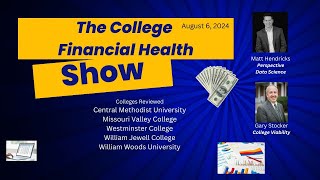
In the inaugural episode of the College Financial Health Show, hosts Gary Stocker and Matt Hendricks introduce two complementary analytics tools and apply them to five private colleges in Missouri (Central Methodist University, Missouri Valley College, Westminster College, William Woods University, and William Jewell College). Matt’s app scrapes audited financial statements and IRS Form 990s to generate cash‑flow, net‑income‑margin, debt‑to‑revenue, line‑of‑credit usage, and other profitability ratios, benchmarking each school against national private‑college medians. Gary’s College Viability app draws primarily from IPEDS to track enrollment trends, 4‑year and 6‑year graduation rates, tuition‑and‑fee revenue, endowment size (including a $50 M threshold and per‑student endowment), and unfunded institutional grants (discounts). The analysis shows Central Methodist University as financially robust (positive net‑income margins, low debt, but an unusually high cash‑reserve ratio). The other four schools exhibit negative net‑income margins and cash‑flow deficits, which they cover by maxing credit lines, issuing new debt, borrowing from restricted endowment funds, and drawing down cash reserves. All four also display multi‑year enrollment declines, modest or declining tuition revenue, and varying graduation rates (Central Methodist ~40 % 4‑year, Missouri Valley ~30 %, the others ≥50 %). The hosts argue that prospective students and families should prioritize financial health—especially cash‑flow sustainability, enrollment trends, and graduation outcomes—over traditional factors like campus amenities. They also discuss systemic issues such as reliance on unfunded institutional grants (tuition discounts) and board governance that may allow chronic deficits. The episode concludes with a call for data‑driven decision‑making and promises future episodes covering other college sets.
Chapters
It's the College Financial Health Show with Matt Hendricks and Gary Stocker, and it's August 6th, 2024. Each episode, we will look at a set of private colleges and we'll share data from multiple sources and offer our analysis and recommendations. It's important to have this data in this day and age because many colleges, particularly private colleges, particularly smaller private colleges, and even more specifically, private colleges in non-urban areas face severe financial challenges. Hi, my name is Gary Stocker.
I'm Matt Hendricks, founder of Perspective Data Science. Today we're going to look at 5 colleges and universities in Missouri and take you through their financials and our different apps. Okay, so I'm going to share— Gary's going to share his College Viability app and data from IPEDS. I'm going to share a different app that is designed to look at key financial metrics from audited financial statements and IRS Form 990 filings. This data has a couple of advantages over the IPEDS data, which is usually analyzed in higher ed. One is that it has key variables that IPEDS doesn't have, like cash flow, which is extremely important, as you'll see in a little bit. Also cash on hand and other metrics that that are very important for financial health. Another thing is the data is a year newer, right? We have through fiscal year 2023 and we will have through fiscal year 2024 in a couple of months. So I'll take you through that. You can see that app popping up here right now. So what this app does is take that data from Form 990s, from audited financial statements, and sort of creates ratios for all the private colleges in the country, and so which allows you to make comparisons to, you know, what's normal for a private school nationwide. And you also see a band around the median. You see the top 75%, bottom 25% tile cuts, so you can see sort of if your school's in sort of the normal range for various metrics. As far as the metrics we have on this app, We have the 2 key financial checks, right? Really, these are just like profit, right? Everybody understands what profit is. So in, for a nonprofit, of course, we have a different name for profit. They don't, they're not supposed to make profit. It's called net income usually. So it's the difference between your operating, in this case, it's the difference between your operating revenues and operating expenses. All right. And of course, schools are going to be on different scales. So I divide that by their operating revenue to put everybody on the same scale. So that's called the net income margin in this first graph. Second graph is looking at cash flow. Not all of your expenses are going to be having— you don't have to pay all of your expenses in, in a, in a given year. For example, if your computers depreciate during the year, you don't necessarily have to replace all or pay that depreciation that year, right? Eventually you have to replace the computers, but you don't have to do it in, in that particular year. So another way of looking at the profit is actually looking at the cash movements. And we look at net cash from operating activities. And again, I divide it by operating revenue to put everybody on the same scale. So this, this will typically be a little bit better than the net income margin just because you have expenses that you don't have to pay every year. So we also have— so one of the issues you're going to see is when, when a school runs a negative cash flow from operating activities, it really puts them in a situation where in order to pay their bills, to pay payroll, they have to get cash from somewhere else outside of their operating operations. So which means they have basically 4 options. You can borrow money from a bank or a line of credit, or you'll see borrowing from their own endowment funds. Another option is to sell some of your investments, sell some of your endowment assets, sell buildings, sell real estate. So you have that option. Another is if you have cash reserves, which all of these schools will have to some degree, you can just draw down your cash reserves and pay the bills that way. I think that's it. Did I miss any? I'm not sure. I may have missed—
Yeah, let's take a look at those 5 colleges.
Yeah. Okay. So let's take a look at Central Methodist University. Central Methodist University. All right, so Central Methodist is a good one to start out with because it actually looks pretty healthy financially, actually quite healthy. Uh, what you're looking at here is all these net income margins are positive. Um, never have a negative net income margin from fiscal year 2016 through '23. Uh, so that's good. They do have a net income, uh, net cash that goes slightly negative here, but I was looking, it looks like some of their, um money that they're owed hasn't come in yet. So that's what's causing that. No big deal. And their endowment value to expenses looks healthy. Again, they're in this range here. They have a bigger than median size endowment and it's growing normally. Their appropriations for endowment expenditure or for to support operations from their endowment looks normal. Again, looking at how it compares to the median, their expenses or investments relative to their expenses are growing and higher than normal. That's great. One issue that I did see, though, is that they hold a lot of money in cash right now. I mean, it's kind of nitpicky, but they probably did miss out on 20%, probably far more than that in investment income if they would have just held the normal amount of cash reserves, which is about 20%, 17%. Of your expenses and cash reserves. They hold almost 80%, 93% in 2022. So that's, that's abnormal. So they should definitely look at that. And their debt is really low. So they actually almost have only like $4 million in debt. I think it's very low. All right. So this is a school that looks really healthy. And so that's a good one to start off with. And then the other 4, I'll just say, I'll just sort of give you the results. The other 4 are all running cash deficits, right? And the way that they're covering these is that, as I mentioned, 3 of them max out their line of credit with the banks that they work with. 3 of them issue new long-term debt notes or bonds to cover the costs. Actually, there's notes. Um, 3 of them borrowed from their endowment funds. So basically, it's a way to convert your restricted endowment funds to unrestricted in a sense and sell the the assets and generate cash, and then two drew down their cash reserves. So I'll kind of walk through those quickly and you can see how you can use this app to see what's happening with these schools. So starting with Missouri Valley. So again, here's the problem showing up here. We got a negative net income, negative cash flow from operating activities. So as I mentioned, the way that they cover their their loss there in order to pay payroll and so on is to issue debt, right? So their debt-to-revenue goes up quite a bit. And another thing that they did, let's double-check on my notes here. They issued debt and they also maxed out their line of credit. So that's also showing up here with this debt number and they drew down their cash reserves. About this, this move from here to here is about a million-dollar reduction in their cash reserves. So that's what that looks like. And you can see this in the app for Missouri Valley College. And I'll do the same thing for the other schools here. Westminster College. Westminster. There are 3, so be careful. There's one in Missouri is the one I'm looking at. Westminster College has deficits for the last 3 fiscal years. Small in '21 and '22, but very big in '23, and then negative cash flow in all those years. Again, how they cover their expenses, they're doing a number of things. They, I believe, issued a bunch of debt.
Yep.
Again, this is another school that maxed out its line of credit. Yep. Maxed out the line of credit, borrowed $8.5 million from its endowment restricted funds. So you should see their investments fall off, which you have in this graph here. Basically, they're selling their down assets, selling investments, turn it into cash. Yeah, that's basically it for Westminster. And then the key with these things is they can't do this forever, right? You can only do this so long. It's not sustainable. So William Woods is another— William Woods. Again, doing fine until fiscal year 2023. Big, big loss in '23. They have negative cash in '22 and '23. How'd they cover it? Well, you can see one thing they did is increase their endowment appropriations, right? They're pulling more cash out of their endowment than is normal. I think that I saw this was like 6.9%. It's not Actually, no, this is 10. There's a different school. So yeah, they take out a lot like a one-time draw out of their endowment, I believe, which is abnormal. Another thing they did here is again borrow from their endowment. William Woods, let me double-check, but that's what they did. Yeah, they issued $830K in new debt and borrowed $4 million from their endowment and sold about $5.6 million in investments is why you see in this decline here compared to the median school. All right. Last one, William Jewell College. Again, the same story. You're going to have deficits and how do they cover their expenses? William Jewell, this school has had a lot longer track record of deficits. They go back to at least 2020 where you got negative cash flow, negative net income. So they've been struggling for quite some time compared to the other schools. And you can see how they're dealing with it. They're drawing an abnormally high amount from their endowments. What else did they do? They maxed out their $4 million line of credit. So you can see their debt-to-revenue is higher. They maxed that out. They drew down their cash reserves by $2 million. Cash equivalents. Yeah, their cash on hand now is below normal for their expenses. And they issued a $5 million note as well and borrowed $3.5 million from their endowments. That's why you're seeing decline in investments and increase in debt. Okay, Gary, uh, why don't you show us what you see in your College Viability app? I'll throw the screen back to you.
Yeah, I want to do that. Before we do go to the College Viability app, just a couple of questions. We looked at 5 Missouri colleges, uh, and for those watching and listening in, we'll do a different set of colleges each and every episode. Westminster College, William Woods University, Central Methodist University, William Jewell University, Matt, and Missouri Valley College. If you were going to be looking at a college for your own use, which of those would you be comfortable putting on your consideration list, and which of those would you be hesitant to put on your list?
Um, so yeah, you probably, um, I, I mean, I have a 6-year-old daughter. She doesn't have to think about college for a while, but I definitely don't want her to go. I don't want, I don't want to go if I'm a student to a school that's going to potentially close while I'm there. So, you know, that's a 4 or 5-year span. Schools that are running massive negative cash flow, it's very rare for that to happen for one, um, and consecutive years is extremely rare. And to be to the point where you're maxing out a line of credit is also a pretty rare response. So these schools are fairly desperate, right, at this point. So I honestly wouldn't go to the 4 that are maxing their line of credit and borrowing from their restricted endowment funds. I don't feel comfortable with that. Clearly they can still turn it around, right? But I don't know if I'd give them the benefit of the doubt at this point. But Central Methodist is doing great financially. There's no concerns there, right? So if you base the decision based on financial health, of course, avoid the 4 is my opinion. Opinion.
Yeah, and of course we would never tell anybody which college to choose, but one of the arguments that you and I make, Matt, in conversations with others is in this day and age, you know, historically we've all looked at the college and the campus and the tuition and the majors and the faculty, but with so many colleges, 4 out of 5 that we're looking at today, in what's fair to say substantial financial stress, you and I both make the case that families and students looking at colleges in 2024 and beyond should really start with the financial health, because the risks of choosing a college that closes— and maybe we'll talk about that another day— is not worth the trauma. And the data that we present, both from your visualizations and the College Viability app that I'll show now, make that worth a worthwhile investment. So let's look at these same 5 colleges. All right, so we're looking at these same 5 colleges, and you can see them on the right-hand side, the same 5 that Matt went over. And I want to look, just look at a couple of the reports. And this is the 2024 Private College Viability App. It's the high-end version for executive analysis. This is for college leaders, consultants, board members, banks, insurance companies to look at the financial health of colleges. Let's look at the enrollment, all right? So one of the things, MET does more of a real-time cash analysis. You know, if you don't have money in the bank to buy groceries, that's a big deal. That's kind of what MET is focusing on. I'm looking in the College Viability app, and there is a version for students and families. I'm looking at trends, right? And we're looking at these 5 colleges, same ones Matt talked about, and the data is for the last 8 years. So the case that I make, Matt, and for those listening in, is that if your enrollment has gone down for a period of time, and the number we use is 8 years, don't tell me that you can turn it around tomorrow. And really, we see for 4 of these 5 colleges, Their enrollment trends have been really bad, really negative, really downward over the last 8 years. Only Central Methodist is down just a couple handfuls. And you can see the percent change. If you and I owned a coffee shop, Matt, and our customer volume went down over 8 years, we're not going to keep that coffee shop open very long, are we? Yeah. Go ahead. I'm sorry.
Or something like that.
Yeah. And one of the things that I harp a lot on, on the media that I talk about is graduation rates. And I focus on 4-year graduation rates. Although I track 6-year graduation rates on the app as well. And I make the argument that if you can't graduate at least half of your students in 4 years, you're not much more than a coin toss college. You can flip a coin to see if any individual student is going to graduate or not. So let's just look at the data for these 5 colleges from 2022. You can see the trends and patterns across all 8 years. I'm going to sort from highest to lowest, and we can see that William Jewell and Westminster and William Woods graduate at least half of their students. Now, we saw that both Westminster and William Woods, Matt, had financial issues, but to their credit, they're still graduating at least half their students. That's not a fabulous number, but it's better than less than half. But let's look at Central Methodist, which was your one financially healthy college. They barely graduate 40%. If you average those 8 years, it's probably going to be around 40%. So for every 10 students that start at Central Methodist University, Matt, only 4 graduate after 4 years. And don't even get me started on Missouri Valley. I make the argument, if you can't— they're averaging around 30% over the last 8 years. If you can't even graduate 40% in 5 and 4 years, I don't even call you a college. It's gonna be a whole bit harsh, Matt, so be ready. I don't even call you a college. I call you a tuition collection agency. Let's look at expenses like tuition fee revenue. This is kind of an inside baseball thing, as is what Matt talked about. And so this is the revenue, total revenue that these colleges collect from tuition and fees, tuition and the room and board fees, those kind of things. And we see 4 of the 5 have over the last 8 years, their tuition and fee revenue has gone down over 8 years. Now some go straight down, some go up and down. Over the course of 8 years. But if your business is, is, is over that trend, not bringing in as much money, you're seeing the kind of issues that Matt talked about with his graphics. This is kind of a historical indicator that leads into what Matt's talking about. And after we look at tuition and fees, I want to get 2 more. I want to get the endowment. And again, I have at College Viability a minimum threshold for an endowment, and that minimum threshold is $50 million. I don't care what the size of your college is. If you haven't generated $50 million in your total existence, then you don't have the systems or processes in place to do so, Matt, or you don't have the donor base willing to, to invest their donations or their charitable giving into your location. There's two ways to look at this. Endowment assets per student. Let me just sort this from 2022, and we can see that Missouri Valley has $7,000, almost $8,000 per student. Where Westminster College has almost 10 times that much. Now, this complicates what Matt talked about a little bit because it suggests that Westminster is, is more wealthy. But as you'll recall, one of the things Matt talked about is the good folks at Westminster College are borrowing from that endowment. And that may be another day we can talk about that impact on, on the endowment assets per FTE. But let's go back to the original premise. If you can't generate $50 million— let me sort this again— in, in, in endowment revenue. Sort it one more time. Let's see the highest on top. We see Westminster, Central Methodist, and William Jewell are above that $50 million threshold. Both William Woods and Missouri Valley are substantially below that. And the reason I point that out is one of my analysis pieces, Matt, is colleges are tending to say, hey, we're running out of money, let's have a fundraiser. All right. If it goes beyond coffee and cupcake fundraisers, these folks, in this case William Woods and Missouri Valley, don't show a capacity over their entire existence, Matt, to raise anything close to any amount of, of, of endowment funds that they need. And then one final one that I want to show, and this is one that is again kind of an inside baseball, it's called unfunded institutional grants. Again, inside baseball kind of number. And I'll talk about both the funded and unfunded. Let's look at the funded scholarships. So these would, for example, would be, uh, the Matt Hendricks Technology Scholarship, right? Matt Hendricks gives $1 million to a college. That's a funded scholarship, right? They use earnings to pay tuition. What I want to focus on though is the unfunded version, and these are effectively discounts.
Yep.
Say that again. These unfunded institutional grants are discounts Nobody is transferring, you know, $20,000 from one account to another account per student. It's just discounts. Colleges are forgoing revenue in exchange to get your student to enroll, and as a result, they don't generate the revenue they needed. And we see that reflected exactly in what Matt was showing you earlier. They don't have the cash because there's so much pressure on tuition revenue because of all these discounts. Fine for the students, Matt. It's really good that the students get the discount. But the bottom line on that is the colleges themselves then lack the revenue to, to be able to do— to have the cash needed to stay in operation. So with that, Matt, offer just kind of a big picture assessment from what you and I both talked about today.
Yeah, I mean, so clearly all of these schools are under pressure it, you know, in terms of enrollment from what you just showed. And I think that one of the things I take away is that, you know, they vary in terms of how well they're able to deal with it. Obviously Central Methodist has systems in place and clearly a board that is mindful of, of managing its resources, maybe actually even too conservative by keeping so much cash on hand, whereas the some, you know, the other schools, I can't remember the name off the hand, the one that had run deficits for 6 years in a row, 4 years in a row. You got to wonder, you know, why they can't seem to, you know, require a balanced budget, right? Like, to me, it's the problem with the board and how it's, uh, how it's, uh, approving budgets. Maybe it's approving a budget that's balanced at the beginning of the year, but the budget is completely wrong that's still on the board. They have to make sure that the balance is correct or that the budget is correct. It's making a correct prediction, and if it's off, you need to change it during the year. So to me, it just comes back to how are these schools operating? Is the board doing its job well, making sure that the school is staying within its means? And there's a huge variation in that across schools.
And I think my assessment goes to the graduation rate. And again, colleges are paid not to offer courses. They're paid to get a diploma for you and I to do the diplomas you and I have earned over our careers, over our lives. That's what we paid for. And I would say to those watching this video to look at that 4-year graduation rate, you can also look at the 6-year graduation rate. And if a college isn't graduating half its students, be concerned. Be really concerned about you paying for something You know, it's kind of like buying a car. You buy a, you buy a regular car for money and you get 4 tires. Well, in this case, you're buying a regular car and you're getting 2 tires. You're only getting half the tires you need to be able to get that entire car moving. And that's the analogy that I would make for these colleges that can't graduate even half of their students. And the big picture across the United States, Matt, both public and private colleges, not even half of all colleges in the United States graduate even 50% of their students in 4 years. That's the hidden tragedy. And we may talk about that in the coming weeks as well. Okay.
So you, you just saw apps that use data from multiple sources. Gary's app relies primarily on IPEDS data from the Department of Education. Lots of great rich enrollment data, all sorts of stuff in that dataset that's been used for many years. You also saw my app that brings in data brand new dataset really from scraped audited financial statements that I've never seen anyone have this data before. Maybe totally brand new to everybody and I make it freely available to use this app on my website. So please take advantage of that. But that dataset, that app is using script financial statements and IRS Form 990s to, to populate. So very rich data. We're not making this stuff up. And really, it's, you know, the, I think the interesting thing that Gary and I both see when we look at this data is that a lot of times you'll expect, you know, a school to have one issue or, you know, the reason for their problems is this, but a lot of times you find something totally different in the data. And if you're open to discovering what's really happening, data can be really powerful. In that sense.
So to the listeners, this is the college Moneyball era. The data is there to make significant observations, and you saw that in general today and for 5 specific colleges in Missouri. And you can make observations, you can do analysis, and you can do predictions. And that's what we did today, and that's what we'll do in coming episodes. Until next time, my name is Gary Stocker.
I'm Matt Hendricks. Thanks for watching. Uh, we'll be back with another episode next week, and if you have any questions, comments, feel free to reach out to us in the comments or send us emails.
More from Gary


What does it look like when a college increases both total revenue and total expenses?



College Financial Crisis? We look at the financial health of Bay Path U. (MA) and Coe College (IA)


Private College Financial Crisis? We look at the financial health of Hobart William Smith College


Financial Compass tutorial (Private college version.) Financial statements compiled 2016-2025.

