The College Financial Health Show with Matt Hendricks & Gary Stocker for October 22, 2024
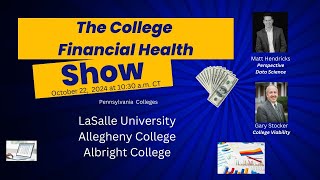
In this episode of the College Financial Health Show, Gary Stocker (founder of College Viability) and Matt Hendricks (founder of Perspective Data Science) examine audited financial statements, IPEDS data, and IRS Form 990s for three Pennsylvania private colleges—LaSalle University, Albright College, and Allegheny College. They benchmark each school against national percentiles and a set of recently closed colleges, highlighting key financial health indicators such as net‑income margin, cash‑flow from operations, endowment size and draw rate, unrestricted net assets, capital‑expenditure versus depreciation, enrollment trends, tuition‑revenue changes, and audit‑issued going‑concern or emphasis‑of‑matter notes. LaSalle shows a 15 % net‑income loss, a large cash deficit, an unsustainably high 15 % endowment draw, and a shrinking unrestricted‑asset ratio (0.3 × expenses). Albright is in even deeper trouble with a 62 % net‑income loss, 84 % decline in unrestricted assets since 2016, a 54 % drop in tuition revenue, and questionable use of restricted endowment funds. Allegheny, by contrast, posts a 6 % net‑income margin, a normal 4 % endowment draw, a growing endowment (+43 % since 2016), and capital‑investment ratios above 1, yet it has lost 41 % of net tuition revenue, offset by a surge in private gifts and stable expenses. The hosts discuss enrollment declines (30‑40 % over eight years), graduation‑rate trends, the role of institutional grants (both funded scholarships and unfunded tuition discounts), and program‑completion data that signal potential academic‑program closures. Throughout, they urge college leaders, faculty, staff, students, and community members to use their free benchmarking tools, scrutinize audit language, and act proactively, warning that more college closures are likely if financial realities are ignored.
Chapters
So it is October 22nd, 2024, and it's time for the show. It is the College Financial Health Show with Matt Hendricks and Gary Stocker. And this is a show that does data. It does college financial health data. And we bring the data from multiple sources, from audited financial statements, from IPEDS data, sometimes from IRS Form 990s. And who is this for? It's for college presidents, college leaders, board members, faculty, maybe even staff, community leaders, because it lets you see how your private college is doing on its own and even how it's comparing with others. And hey, my name is Gary Stocker, and I'm the founder of College Viability.
Hi, I'm Matt Hendricks, founder of Perspective Data Science. Today we have 3 schools again, uh, all in Pennsylvania. We're looking at LaSalle University. I think I pronounced that— did I pronounce that correctly?
I think you're good, Matt.
Okay, good. Allegheny College.
Allegheny.
Yeah, Allegheny. Okay. And Albright College, all in Pennsylvania. Um, let's see, what's the key takeaway here? We have 2 that are in serious trouble, um, with no sign of a turnaround, and another that may have actually turned things around, although in ways that you wouldn't really expect. And so it's a really interesting case to look at. Their net tuition revenue is a complete disaster still, but they have other revenue sources that are sort of filling the gap. And so I'll show you that. A lot of people don't understand all of the different revenue sources that universities have. So it's interesting to see how they're making ends meet without having that tuition revenue. All right. So let's get into it with the benchmarking first. Again, this is going to draw heavily on audited financial statements. It's all audited financial statements, actually. And I'll start in with LaSalle. Did I say LaSalle or LaSalle?
LaSalle. Yeah, LaSalle. We'll have a pronunciation guide practice afterwards.
Yeah. So again, if you haven't seen this app, you got to check it out. It's totally free. Just kind of get you started with benchmarking. More than started, really. It'll point to some serious problems if you've got them and get a good sense of overview of your financials, your sort of trends on your endowment draws and all that stuff. And I'll show you that right now. So let's start with net income and cash. This is, uh, not good. Um, again, the red line, if you haven't seen the previous shows, these are closed colleges. There's a set of 9 closed colleges listed here. Those are schools that have closed in 2023 and 2024. You don't want to be close to those schools. You want to be— I'm probably the only person that will ever benchmark you against Schools you don't want to be like, but it's super valuable, right? You don't want to be like these schools. And as you can see, LaSalle is being just like them. In terms of net income margin, they have a 15% loss here. That's really bad. You can see the median is a loss, but 1.4%. They're in the bottom, probably 1 or 2% here of schools in the country. Just by guessing, looking at this. This is the 25th percentile right there. They also have a cash deficit. It's really, really big, but we got to keep in mind here, this is one of those schools that has, let's see, I pulled it out. They pull their endowment draws out of their net cash from operations and put it into net cash from investing activities. About half of schools do that. So you need to be careful with this metric. This should usually look a little better than net income, and you see in this case it looks worse. The reason is there's endowment draws in this, no endowment draws in this, which pulls it down even more. The way I like to see the accounting is that they keep it in, right? In which case they would have an $8 million loss still. So it's still bad, but not nearly as bad as what's reflected here. Okay. So just keep that in mind. So yeah, serious problems here. Again, net cash was negative even with the endowment draws and the endowment draws, I believe, are way too large. And I'll show you that right now. So, let's take a look at— I'll whip up two things here, show you the sense of how big the endowment is, ratio of endowment value to expenses, and then how big their draws are.
All right.
So first of all, on the top graph, you see their endowment size relative to expenses. It's a pretty small endowment. Their endowment's smaller than their annual expenses, which is really low. The median school is about equal and many, many schools way above. Sort of a huge right tail with the endowment sizes. But take a look at the second graph. This is their appropriation. Again, a normal value for appropriation, a sustainable draw on your endowment is about 4, 4.5%, maybe 5% on the top end. Some schools get around 5%. They're at 15%, totally unsustainable. And you'll see that reflected in how their endowment's been growing. It's not growing. I'll show you their endowment change in endowment value over time. A normal endowment since 2016 has grown about 45%. All right. Their endowment shrunk by 12%. And a big reason for that is those draws I just showed you. They're just way, way too big. They're bigger than the investment gains and the contributions that they're getting. So their endowment is shrinking. You don't want to do that. So the school's in a tough spot there. As you'll see, it's really important that this grows normally. You're going to see a school at the end of this presentation that has sort of survived and had a balanced budget essentially because their endowment grew a lot. All right, so I'll show you their capital expenses. Let's do unrestricted net assets first. So that's the change, and then I'll do the value here so you can get to see both. All right. So on the bottom graph, I've got the ratio of unrestricted assets to expenses. Again, a normal value is up here like 1.2. They're at 0.3. They're almost to zero unrestricted net assets and threatening to go negative soon. The actual value I think I pulled out here— I didn't pull out the actual value, but they're getting really close to going negative.
Right.
Which again is a very serious problem. Banks aren't going to like that. Bondholders are not going to like that. I should have checked if they have some bonds. I was a little bit cramped for time, but take a look at their change in their unrestricted net asset value. It's decreased by 53% since 2016. This school is, you can see they're worse than the red line on most of these metrics. They're heading in completely wrong direction. Look, look at one other red flag is if they're not investing in their assets, their physical assets at their institution. I'll zoom in a little bit. So this is the spending in the cash flow statement. You can see how much they're spending on computers, building upgrades and things like that, maintenance, right? Replacing shingles, broken windows, stuff like that. And then I take that value, what they've spent on property, plant, and equipment, and depreciate and divide that by the depreciation rate. So you get a sense of are they keeping up with the loss in value of their mostly technology, right? A lot of this is computer depreciation. And you can see that you really want to be above 1, right? That's sustainable. You're, you're basically, that means your capital stock is increasing relative to depreciation, and they're almost always below 1. All right. So what you would probably see if you were around this campus is you'd see a lot of things in disrepair. It may be a little—
holes in the roof, Matt, holes in the roof.
Yeah, possibly even leaks in the roof. Probably sidewalks that are not looking good, maybe dangerous even, potholes, bad and old computers, a lot of stuff that doesn't work properly, windows that don't open. Stuff like that. It's just not, not good. All right. And one example is a classroom that I taught in probably had 90-year-old desks in it. I mean, that's a little bit of an exaggeration, but they were awful. My big football, Division I football players couldn't even like fit in these things. Did it for 12 years, you guys. I mean, that's the kind of stuff that's going to happen if you're not investing in capital expenditures at the appropriate level. Okay, so let's take a look at net tuition revenue. Again, you don't want to be close to this red line and they're tracking right with it recently. They're down 36% on net tuition revenue since 2016. It just goes on and on, right? The operating revenue. Operating revenue is down 17%. Expenses, you can see all this stuff that you can see here. Operating expenses. Their expenses are down 12%, 13%. Um, sorry, 12%. And their revenues— oh, I was looking at the wrong number. Their revenues are down way worse than the closed schools, 28%. So revenue down 28%, expenses down 11%. You can do the math there, pretty simple, right? Um, that's getting a lot, lot worse, a lot worse. Okay, so some things off the app that I checked out on these guys and went into their audit. Of course, there's a going concern clause in their audit. Their auditor is very concerned about their ability to continue going forward. So I actually copied some of the texts from the audit. You should check this out if you're at this school, if you were any way connected to this school, listen to the auditor there. They really don't like to put this in audits. Trust me, right, Gary? We don't see this very often.
That's right. We don't see this very often.
No. And so they highlight, you know, significant losses in cash flow and net assets, just like I just showed you on the app. And so they've raised substantial doubt over the university's ability to continue as a going concern. And then they, you know, there's like a presentation from the management, like we got this really long plan to try to turn things around. And the auditor's like, okay, they might survive another year. That's basically what I'm summarizing. Of what has happened. Um, they may survive longer than another year. I mean, they do have, um, let's see, did I have it in here? No, not quite. Um, I, I was a little rushed to get chart— get set here, but I, I mean, I got a sense that maybe there's— they only have a couple years left at the current trajectory, maybe less, but it's a wild guess. Um, they really need to turn this around, and as you know, it's not easy to turn around net tuition revenue. It takes a long time. You know, even you make, make all the right moves today, you're not going to see all of that come, uh, that revenue and change for another 5 years. Right. So you got to survive 5 years just even if you're doing everything perfectly. I don't know that this school has that kind of runway, but, um, I'd be happy to talk to them, bring them on the show and see, you know, hear about how their plan, they think their plan is going to work and how they can last, um, long enough to get that NTR turned around. And I hope they do, right? I don't want to give the impression that I don't want this school. I don't want any school closed, really, assuming they're giving a quality education. Okay, so I like to check out how did they actually pay the bills in their last year. You saw that they had a big net cash deficit. It turns out to be $8 million when you put the endowment draw back in. And then on top of that, they spent $5 million replacing computers and making necessary repairs and stuff like that, although not nearly enough, right? Their depreciation is higher than $5 million, but they're sort of doing the minimum, it looks there. So how do they get that? They need the $13 million basically to cover that in cash. They're not getting that from operations, so they got to get it other places. So they got it from selling some properties. It looks like $4.2 million. And then they did have some cash reserves, which they drew down massively to something less than $10 million, I believe, if I look, double check on the audit. But yeah, they massive drawdown in their cash reserves to, again, you can't do this every, every year. It's not sustainable. That's the key here. It'll be really interesting to see 2024, how they, how they make things, how they pay their bills in 2024. I mean, they're starting to get these, a lot of these schools we looked at, Gary, are getting really close at the end, right? Like we see 2024, how do they do it in 2024? It's gonna— I'm really curious on some of these cases.
Yeah, me too.
Um, okay, so another school that's in very, very serious trouble is Albright College. And so I'll move on to that one. Albright College. And I'll start with the net income and cash flow. And again, um, this is perhaps one of the worst that we've seen, Gary. Um, this is one I actually flagged in a LinkedIn post a few weeks ago, and of course people like, oh, I don't think that's fair. It's totally fair. This school is way worse than schools that have closed, okay? And most of the schools on that list were that case. Um, and so you've got a massive 62% loss here, net income margin, cash -28. That again, this is what it should look like, right? This should be worse than the cash, net cash number, right? If it's not, then they're probably pulling out the endowment draws, but they're not in this case. So you got a massive cash deficit, massive net income loss there. I'll just go through everything again. Endowments. The endowment size is not great and you can see it shrinking relative to their expenses. Their endowment. Appropriations are massive, right? Again, the school's just pulling all of their resources to basically survive today, but it's going to kill their long-term prospects. And you can kind of see the writing on the wall here with some of these, right? Um, I'll show you their endowment value change. Once again, really important to benchmark these things because look at their endowment value has grown. And you might be tempted to say, hey, that's fine, right? Our endowment grew by 3% since 2016. That's terrible. I mean, that's like, again, worse than the schools that have closed. You're in way, way below the 25th percentile, right? The average school has grown 45%. Okay. And honestly, I think that's terrible. You could just buy an ETF. And have crushed that, right? I don't understand what the investment strategy is with some of these schools. Just buy the SPY ETF, all right? You're going to do probably better than this top 25% of schools. But, you know, they want to pay Wall Street to do something else and be overly conservative and take massive fees, I guess. So there you go.
There's some sarcasm there, Matt.
Yeah, this is, it's just irritating. Anyway, there's that. Okay. By the way, there's a study done by Yale that you could virtually no hedge fund beats the market in a consistent basis. So there you go. Take that.
Surely we digress.
Yeah, digress a little bit. Okay. So, but that's the least of my worries on higher ed, right? I mean, 45% is good enough, but this is not. 3% is not. Yeah. Okay. Unrestricted net assets. I think this school is close to going negative on this again. Unrestricted. Yeah, very close to going negative here. Again, worse ratio than the schools that have closed. Just look at the change over time.
Yeah. Trending really down.
Yeah. Change in unrestricted net assets. Their unrestricted net assets have basically— well, they shrunk by 84% since 2016. That is Oh, it's really sad. I mean, basically the current administration is just taking all the assets from the school, pumping them into operations, and, you know, kicking the can. I mean, I'm not sure, you know, maybe this school can't survive and they know that. I don't know. That's certainly not, uh, looking like there's much of anything happening here to try to save it. And this is the thing that really irritates me because, well, let me show you the net tuition first before I get into what really irritates me. The tuition revenue is down 54%. Okay, let's take a look at revenues and expenses. Now, what you expect a school that's really, really struggling, right, to do a serious amount of cost cutting, right? I mean, that's their job, right? Try to save the school. That's definitely the board's job. And you can see why an administration might be reluctant to cut costs. It's not necessarily in their interest to do that, right? They don't have an infinite time horizon, but the board should. Think as if we have an infinite time horizon and we need to save this school. We need to cut costs, get in revenue, get inside of our revenue, but it's not happening. So this is what irritates me. So here's operating revenue on the top graph, expenses on the bottom graph. These are change over time. Okay, so no shock here. Their operating revenue is down 31%. But here's the part that really irritates me. They're proceeding on the expense side as if there's nothing wrong. Their expenses are keeping up with every other school out there, up 14.6%. That shouldn't happen. And that— I mean, I don't know everything that's happening in this school, but that definitely does not look right to me. And if I worked there, if I were a board member, I would be very uncomfortable with that. That is not right. Any school that's struggling and has a massive drop in revenue like this, They have to cut costs. And for whatever reason, they've decided, no, we're going to just go as if everything is fine.
And just even look at the closed colleges, man. At least their red line shows they're trying to manage.
Even the schools that closed really did put up a fight. Some of them put up a long fight and some are that we've seen on this show have not closed. I've been fighting for over a decade, right? I've gone negative unrestricted. I mean, we talked about Drew. I mean, it's hard for me to see a path for them to survive, but man, they really have done everything. A lot, right, to try to survive this far. In fact, maybe— I don't know if I should say that, but, you know, drawing so much on their endowment, there's actually a question whether that is going to be standing up in the legal arena.
Yeah.
Yeah. Okay. So I'm talking about Albright, this school. Again, there's stuff off the audit that I looked at. Again, irritating. Why aren't they cutting expenses? I mean, maybe they have an explanation for that, but the reason for this app, the reason for benchmarking, marketing is that you can come up with the right questions to ask. And that's the first one to ask. Why haven't we been cutting expenses? Maybe the response is that, oh, we're going to try and invest here and there and there and there and get our net tuition back up, but it's not working, right? So why are we still doing it, right? That's the follow-up question.
Okay.
So again, also concerned from this auditor, although they don't say anything about going concern, they put a special section in the audit called emphasis of matter, which I don't know if I've ever really seen. They say, you know, things are really bad. They borrowed $7 million from their restricted endowment funds. And as you know, Gary, there's, there's litigation ongoing right now about whether it's even legal to use restricted endowment funds as collateral, let alone taking it out of the account and spending it, right? That's totally different. And using it as collateral, at least it stays in there, right? And right, in theory, until the school is totally done. Um, but this school and a lot of others, not just this one, have actually taken the cash out of those restricted accounts.
Oh yeah.
Right, and sort of wrote themselves a loan where it's not like it's not clear who's actually the cosigner or who's the opposing party on the loan. Right. Certainly not the donors putting a loan agreement together with them. At least I've never seen that. So lots of questions there.
Okay.
So how did they make ends meet? Part— so they had a $10, almost $11 million cash deficit from operations. They spent another $4 million on plant, which again was— I didn't show you the CapEx, but it's not enough to keep up with depreciation. So where did they get that $15 million? Roughly, they got in two sources. They sold $7 million. They took a special draw from their endowment and sold $7 million of investments. You saw the endowment value just plummeting, and they drew $6 million from the line of credit.
That's a big line of credit.
Yeah, that's one draw. They have more outstanding than that. That was okay last year. Okay, so All right, those schools are depressing. Let's look at Allegheny. Gany— well, this one's better, and I'll show you why. Here, let me just refresh and go to the start. Allegheny. All right, there it is. Is it Allegheny or Allegheny?
I'm going with Allegheny because that's the Allegheny River, is my understanding.
Sorry if I butcher the name of your school. I'm sorry about that. Um, Trying my best here, but here's why I think this is— there's some optimism here. The school had some deficits even during the COVID years, which is interesting. You see most schools were doing quite well here, but maybe they got their COVID money a little earlier. Um, it's interesting, but anyway, they've got a 6%, um, net income, positive net income from operations in 2023, which is really, really good. That's higher than over probably 80% of schools in the country last year in 2023. And that's excellent. But you look at the cash flow, I was a little concerned about this, but don't be concerned. Again, this is another school that pulls the endowment draw out. They have a really big endowment. And I did the math. It looks like they got an $18 million normal endowment draw and their endowment draw is normal. So if you put that back into cash flow from operating activities, they have a positive $3 million cash from operating activities. That's excellent. That's perfect. They're good to go.
All right.
So everything looks good on those really key metrics. Honestly, after that, a lot of stuff doesn't matter a whole lot other than if you are, you know, if you're getting to this positive number by just taking huge draws on your endowment, that's a problem. Or if you're not investing in your assets, again, that could be another issue. But I'll show you, they're doing it. Their endowment draws look fine. Endowment draw is perfect, right? 4.12, um, 3.8. Those look good. Um, the endowment is growing. Let's show you that. Unlike the last one we saw, their endowment is growing perfectly, just with everybody else in the country. Although again, I think you could do a lot better than that. 43% is really close to the median. Um, so there you go. Capital. They're investing in their capital assets at the appropriate rate, it looks like to me. So you got several years above 1. It's perfect, even during the COVID years. Interesting. A little bit lower here recently, but they did have these big investments here, so they should be over this. I mean, since about this point, they've been— it looks like mostly over 1. So that's good. Uh, probably we'll see that most of the buildings look decent. Um, they have They have up-to-date technology, probably. But you know, those are long-term trends. You have to double-check. Let's take a look at net tuition revenue though. This is where the story gets really interesting. You saw that they were balanced budget, had a positive net income, but here's where things got interesting. I was like, what the heck? So they've lost 41% of their net tuition revenue. How the heck are they balancing the budget? And It's really, really interesting actually, and I'm going to go, I'm going to draw you right to the audit to show to 2 audits, the 2016 audit and the 2023 audit to show you these results. And I hope you can see. So let's just compare line by line here. You see their net tuition revenue is right here, $36 million in 2016. This is 2016. And in 2023, it's $21 million. That's a massive loss. It's a 41% loss of net tuition revenue. So how is it possible that this bottom line right here, the revenue, is actually $10 million higher than it used to be? Um, that's the interesting question. And so take a look at it line by line, and there's big differences with gifts. Take a look at private gifts. $16 million in private gifts, $10 million unrestricted, $6 million unrestricted, $10 million restricted. These restricted gifts eventually show up down here with net assets released, right? So there's been a surge in gifts to this school. Lots of donor support, and you can see the difference here. It's only 5, and now it's 16. So big increase, $10 million increase in gifts basically since 2016. And another thing is this is their endowment draw. $17 million here and $8.7 million here. Again, why is that? Their endowment grew a ton, right? It grew, uh, 43%. So, um, and their endowment draws are normal. Um, so that's all good.
Got about a quarter billion dollars in the endowment.
Yeah, it's pretty big endowment, uh, for a school less than $100 million in revenue. I mean, it's not huge, but it's definitely helping. So basically the story here is really interesting. Although they've lost like $15 million in net tuition revenue, they've gained $10 million in gifts on a consistent basis. You go back multiple years, they're way higher, and their endowment draws are much bigger because their endowment's grown quite a bit. So, yeah. That's how they're getting by, even though they lost 41% of net tuition revenue. They have a balanced budget. Their revenue is actually higher than it was. It's actually up 13%, and they've kept their expenses the same. Basically, expenses here 77.6 and expenses here 79. That's, I mean, hardly an increase. Although this may be an issue, right? You got lots of inflation, uh, hard to imagine that they're keeping up with, uh, cost of living adjustments with that kind of change in expenses. So that could be problematic for them. I'm sure it is. But at least about— they have a balanced budget. They're not sort of heading for closure, at least not in the near future. All right. All right, Gary, that's what I have for these schools. I'll pass it on to you.
So, so, Matt, we met, you know, making our virtual trip to Pennsylvania today. And you've heard me talk before. I've got 4 high-risk states, 2 in the Northeast, Pennsylvania and New York. And then Iowa and Wisconsin in the Midwest, upper Midwest. There's a lot of colleges, both public and private, in the state of Pennsylvania. And, you know, we, we try and get a balanced set of colleges. We inevitably find more, more colleges with unsustainable financials than we do colleges with positive. We've seen that over the history of the show. When you see, like, for example, the first two for both LaSalle and Albright, Does that portend not just that they have an unsustainable financial path, but if we looked at 3 other private or 10 other private colleges in Pennsylvania, are we going to see the same patterns just because of the supply and demand there?
No. I mean, we, well, one of the best schools we've looked at is Haverford, right? And that school is probably right down the street from these schools. Totally different story, right? I know they have a big endowment and all that, but they've clearly done more than just survive on the endowment. They've done something to spur demand for the school. So there's lessons to be learned there. If you're one of these schools, perhaps the reason you've lost 41% of your net tuition revenue is they've gone to Haverford, right? I mean, they've gone to other schools like that. It's not like the school— these students disappear. They go to other schools. Yeah. I mean, you're not going to see a 41% decrease in net tuition revenue because of the enrollment cliff. That has nothing— that's— there's nobody's talking about any kind of anything close to those numbers, right?
Yeah.
They're going to different schools. You're losing market share is what's happening.
And I guess, you know, we have a large number of listeners, watchers, viewers of this show, and some of them, I'm sure, are faculty. And if this message to faculty doesn't— doesn't it have to be something along the lines of the data that we're sharing in the College Financial Health Show is from the college itself. It's analyzed independently by you and me. You really have to give serious consideration to what Matt Hendricks and Gary Stocker are saying on this show because it's not good. So don't just let yourself believe what your college administrators are telling you. Yes, you mentioned one of the folks, um, the college at LaSalle, the auditors listed a going concern. And so a going concern by definition is We're not sure the college will be able to survive for the upcoming year. That's a big, big, big deal. So if you're a faculty, if you're staff, if you're students and families, if you're community leaders, this is a red flag. You know, Matt and I will, will, will never say this college is going to close. There's other factors that come into play, and Matt does a good job of, of saying that. But when we're sharing unsustainable and the reasons why it's unsustainable, Matt, you gotta, you gotta take that seriously.
Yeah, exactly. So I was a faculty member for a long time. And this is how I got in this business. All right. I don't know if I've ever told the whole story and I'm certainly not going to do that right now. But yeah, that basically, that's how I ended up in this position. I was, it wasn't just me. It was a whole group of faculty at the University of Tulsa that took a big interest in what was going on and took seriously the responsibility of shared governance and ran with it. Right. And we found all sorts of stuff that weren't expecting to find and turn that— played a big part in turning that school around, to be honest. And I'm proud of that, right? And certainly there's probably other people that think that, you know, we probably did bad things. But honestly, in the long run, it was tough love for that school. And you should probably think about doing the same at your school.
Yeah, and think about if you're faculty, if you're staff, if you're a community leader, or other stakeholder, board member, reach out to Matt and I. Either Matt's got some other tools, so do I, that you can use to help compare, analyze, and compare your college. If you're from LaSalle, if you're from Albright, if you're from Allegheny, or any of the colleges we have reviewed previously or will review in the coming weeks and months, we'll be glad to give you time on the show. So our contact information is always in the show notes. This is serious stuff. This is serious stuff. We don't want anybody that listens to what— listens and watches to this show to look back and said, I wish I coulda, shoulda, gonna. Reach out to us now. Join us to say, hey, you know, if you dispute what we're talking about, hey, you're at the top of the list. We'll get you on the show. But trust us, we're going to show you the same data we looked at. And if you are, for example, from LaSalle and you got a plan on your audit financial statement that says we're going to fix everything, Well, history always suggests future patterns, and we're going to confront you with the data. You can share that you have plans. God bless you, go get them. But if your history is not good, if the pattern is unsustainable, keep in mind one of the things Matt said. Best case, if you fix everything correctly today, best case is 4 years, and more likely it's 5 or 6 or even more than that in some of those scenarios. Matt, would you agree?
Yeah. Yeah. I mean, it's a really slow dynamic process with, with how enrollment works, right? You're really only, you know, shifting in and out at most like 20, 25% of your students, right? So it takes at least 4 years, probably in most cases 5 or 6, like Gary said, to really realize any change that you make today. Right. And, and also understand that any change that was made 4 years ago is still actually impacting potentially your current net tuition revenue, right? So there is a really slow-moving systems.
Let's go ahead and move on then. Let's go ahead and grab a look at the series of college viability apps. And we've got our 3 colleges in the 2024 college financial— the 2024 college viability app for executive analysis. And as that data comes up We have our colleges, and of course, because the server reset, I'm going to grab those again. For our Pennsylvania colleges, and those are Albright— Albright. See if I can do a better job pronouncing them than Matt did. And LaSalle. And of course, we always start with enrollment. Matt, as he said many times, as I reinforce, is pulling data from the audited financial statements. He's got some technology, he's got some skills that go out, scrape that data from the internet. There might be other people doing that, Matt, but I'm not aware of it. My data always comes from iPads, uh, through the College Viability app. All, all its iPads data. And my focus is on where these colleges have been for the last 8 reported years. And we're going to start with enrollment. And this really almost always, Matt, mimics what you've talked about. It just reinforces that if there's a good trend, it has been a good trend. If there's a bad trend, if there's an unsustainable path that Matt Hendricks talks about, we can see it started a long time ago, and that reinforces that 4+ years to fix things. And look at these 3 colleges in the full-time equivalent enrollment. That's the one I use for comparison. It's the best, best route. They're all down 30 to 40% over the last 8 reported years. Okay. And again, the last reported year was 2022. The 2023 data will be out in the next 2 or 3 months. Don't tell me, well, it's old data. Yeah, I will cede you the point. It's not 2023 and 2024 data, but it's a pattern, Matt. It's a trend. And don't tell me it's old because you don't like the trend. And you can see all of these are down substantially, and they're all in the same kind of enrollment range. Um, La Salle's a little bit larger than the other two, but not appreciably so. And so graduation rates— and again, Matt, it's been interesting, the colleges that you and I pick, most of the time when I'm doing reporting outside of the College Financial Health Show, The colleges have pathetic 4-year graduation enrollment, uh, graduation rates. Yet when you and I pick colleges, more than not, not always, they have decent. And that's what we're seeing this week. You started off with LaSalle, and they're graduating 55-ish percent of their students after 4 years. Trust me, that's way ahead of most. Allegheny, which has the stronger of the 3, graduating 60%, more than 60% over 4 years. Look at the one that Matt really— I think he said he was distressed with. That wasn't the word that you used, but look at—
yeah, I think Albright. Yeah, it's probably one of the worst.
Look at it. It's what was 50%, and that's at best a backhanded compliment. But look at the pattern, down 9%. Now only 40 out of every 100 students that started at Albright 4 years ago, only 41 of them graduated in 2022. And I know others went to other colleges and graduated, but as I just posted, Matt, right before you and I did the show, it's the trend that matters. This is not a good trend on graduation rates at Albright. Let's take a look then next at the endowment value. And Matt referenced those, but I always track the values. And let's— we'll leave the FTE, the per FTE alone for now. The bottom of the screen, and I'll scroll off to the right, we can see that, um, And again, the minimum threshold at College Viability is a $50 million, 5-0 million, uh, endowment. You can have whatever number that you want. That's the one that I chose. And really, all 3 of them are above it. But look how much Allegheny is, as we talked about, a quarter of a billion dollars plus. And it's not just the value of the endowment, it's the spending of the endowment. And Matt, as always, does a fine job of pointing out colleges that are drawing the earnings from that endowment at a higher rate than they should be. To be sustainable, and even pointing out those that are grabbing restricted endowment funds, those that should be for dedicated scholarships, and using those to make payroll and to keep the lights on. Not good, Matt, as you've talked about many times. Let's look at tuition and fees. Those typically mimic enrollment trends, and that's exactly what happens here. Again, Matt told you this already. He told you from recent audited financial statements. I'm looking at the last 8 reported years And for all 3, not a good trend. Does that mean each of the 3 will close? Absolutely not. Tuition and fees is an indicator that there are issues. And look at the trends. Let me scroll over a little bit more so you can see what the actual percentage is. Look at those changes. And again, I'm going to reinforce because it's important. If each one of these colleges has fixed everything perfectly, Matt, right this instant, that doesn't turn around for at least 4 years. And if you want to challenge that, Drop us a note, we'll invite you onto the show. Maybe you've got a plan that we're not aware of, but this is not a good trend. Even though it doesn't indicate a college will close, Matt, it's certainly not a positive development.
Yeah, that's right.
And how did they get there? Now let's take a look at the institutional grants. And again, the funded ones are those are dedicated scholarships. You know, the Matt Hendricks Computer Scholarship for $1 million. That's what a funded scholarship is. The Gary Stocker Pickleball Scholarship, you know, for $2 million. That's a funded scholarship. What we want to look at are these unfunded— what's called unfunded institutional grants. Of course, they're discounts. These are essentially dollars for dollars that colleges forego to get students in the door. And there's a— there's different patterns for these three. Both Albright and LaSalle are trying to get a handle. They're, they're giving away— I'm going to use that word, it may not be the best word— they're giving away less dollars in 2022 than they did in 2015 to get students in the door. You can see the numbers right there. You can see both are about right, right at 50%. Allegheny, which has had comparative success, Matt, based on what Matt talked about, has had to raise their— increase their, their, their unfunded gifts to about $10 million, up about 25, 26%. Colleges, Matt, are certainly welcome to do that. But as I've shared before, and I will share again, it's a reflection of the market. Many times colleges will, will lower that unfunded tuition discount in the form of merit aid, lower merit aid, lower scholarships. But we see that reflected where? In the enrollment. And we saw that with these colleges here. Look at all 3, they were down. I showed this screen before, and 2 of the 3, Albright and LaSalle, decrease their unfunded institutional grants, merit aid, if you will. Allegheny increased theirs, yet all three showed a negative trend on enrollment. And finally, let's take a look at— see if my server reset on this one, Matt. Let's take a look at program completions. And Matt, while this one loads, I'm seeing more and more literature online about colleges not necessarily closing, not necessarily having unsustainable financial paths, but certainly having to cut back on programs because they can't afford to have programs, low enrollment programs. And that's what we're going to look at now. And these are our 3 colleges, and I briefly go over this every week, and I always start off with biology. And look at the 3. Each of them have modest numbers. They certainly generate some decent tuition revenue from each of the 3. And you can see if there's any positive or negative trends on the bachelor's side. Nothing of great substance here. None of the three offer biology majors on the graduate level. I always look at business and marketing because almost all colleges focus on that. In this case, Allegheny does not. Yet of the three, interestingly, Matt, they had the best financials, not the perfect financials, but both LaSalle and Albright, you know, decent numbers for those kind of items. But let's take a look at each of the individual three as I wrap up my part of the show today. And we do this each week. This gives you a quick screenshot. And again, pause the video when you're watching this, pause the video and look at the volumes. You can see where colleges are strong in terms of program completions. And this is at the program level, Matt, not the majors level. And LaSalle is strong in health professions, both on the undergraduate and graduate level. Business, probably equally so. Education, more so in the master's degree. And here's why I point this out. If you're a math and science major, you know, Matt, that's a real low number. If you're a philosophy and religion major, Matt, that's a real low number. I got to remember to spell correctly religion. It's— you want to be careful. If you're a student looking at this or a faculty member looking at this, these are the programs, Matt, that are at increased risk of closure, even if they have College 101 algebra. As part of the core curriculum, if they've only got 2 math and science majors or other low numbers, I would encourage you look at other colleges. Look at that college that has 20 or 30 or 40 math and science majors, or the same number for religion, or the same number for English. The others are modest numbers, but again, if a college is in trouble— and we talk about colleges in trouble all the time— be careful about choosing those low enrollment numbers because you may show up at a college and find out some period of time later they decided they can't sustain that program, that major for your student. Albright, same thing. I won't spend as much time. They have really the only thing really strong above 100 is business. They've got a decent number, although still relatively small, in graduate programs. You can pause the video. I forgot about this— strong in psychology. If you're looking at psychology major, as a psychology major, and you want to forego the financial challenges that Albright is facing, you know, they appear to have a decent, above decent number of psychology majors. And lastly, but certainly not least, is Allegheny. Same screen, pause the video to look at those. They're not playing at all at the graduate level. You can see where they're strong, really nowhere in general, and where they're weak. And these are just 16 of the top programs. There are others that we don't include in the College Viability Report. So, man, I wish we could show 3 strong, financially healthy, sustainable private colleges every week. It's not realistic. It's not going to happen. This is a tough market. And this is the only show, Matt, that I'm aware of that, that gets blunt and shows the data. Ours is— do we have opinions? Yes. Are we blunt on occasion? Yeah, maybe a little bit. But this is the data. This is the data that the colleges themselves put in their audited financial statement. They paid for the audited financial statement. These are accounting professionals that are showing the stuff that Matt's using. The colleges themselves submit the data to IPEDS. Matt, tough, tough market, sir.
Yeah, well, I'll just say, I want to reiterate the market share piece. If you're, if you're hearing, if you're at one of these schools and they're talking about the enrollment cliff, this is a non-starter. This is not— you're not going to lose 40% of your students right now because of the enrollment cliff. For one, the enrollment cliff hasn't even started. The small, uh, classes we're seeing coming through K-12 are in 9th grade right now, starting 9th grade, 8th grade, 7th grade, and so on. They haven't even showed up yet. All right. Other schools in your state, probably just down the road, have increasing enrollment. All right. If it were enrollment cliff, you would all, you'd see across the board, right? What's happening is a change in market share at your school. Your school is losing students to its competitors for for who knows what reason. And the thing is, you can find out. We have tools, Gary and I have tools to drill through your enrollment funnel, look at your net price, understand what is happening. Why are some of your competitors taking your students, right? It could be that your price is too high, as we saw last week with Des Moines. I'm 99% sure their price is too high. Other schools have issues with other parts of their funnel. They're too selective when they really shouldn't be. You know, these are some— not paying attention to transfer students. I mean, those are things that can be fixed. All right, you need to figure it out instead of just blaming enrollment cliff when it's not that, right, with no evidence that it's that. So use the data is what I'm asking, right?
Absolutely.
Yeah. And I— for the tools to understand why you're losing students so you can fix it, right? If you're just going to blame the enrollment Cliff, there's no solution for that, right? I mean, yeah, you still have the issue that you have to outcompete other— everybody else that is experiencing the same cliff, and you're losing right now. You're losing 41% of your students. That's crazy.
And while you and I will never say college will close, there will be more college closures. There will be a lot more college closures. Use what we provide, act on it, don't act on it, reach out to us. Don't reach out to us. But this is a service. This is something that Matt and I put together on our own. We're sharing that week in and week out. It's there to be used. It's there to serve as a resource to at least provide a balanced perspective. Too many colleges, Matt— most colleges, in my estimation— provide rosy pictures when the picture is more thorns than flower petals, and then blame things that they can't control, right?
Which, you know, it couldn't be, oh, that we're just not setting our price correctly. Right? It can't be that. It's got to be the enrollment cliff or some other thing that we can't control. Oh, it's got to be just like a change in demand for higher ed. These people don't like higher ed anymore. None of those things are probably explaining what you're seeing at your school.
All right.
To be frank.
So, Matt, would you be willing to go virtually to the state of New York with me next week?
Yeah, let's do it.
Okay. So I'm going to work hard. We're going to find a strong, financially strong private college in New York. We're going to use that as one of the 3 that we find. But I'll be honest with the viewers, it's tough to find, tough to find a lot. And we probably won't have 3 strong because it's more important for us to give a heads up, a warning to those leaders, board members, faculty, staff, students at the colleges that are in trouble than it is for us to give attaboys to the colleges doing well. So let's wrap this up. This is the Moneyball era. We've got the data. Use it, don't use it, whatever you want to do. We're here to provide the data that you need to, to, to do comparisons, if nothing else. And so with that, Matt, let's call it a wrap. For Matt Hendricks, I'm Gary Stocker. We'll look forward to doing this again next week. Thanks for all making time to join us. We'll talk soon. Take care.
More from Gary


What does it look like when a college increases both total revenue and total expenses?



College Financial Crisis? We look at the financial health of Bay Path U. (MA) and Coe College (IA)


Private College Financial Crisis? We look at the financial health of Hobart William Smith College


Financial Compass tutorial (Private college version.) Financial statements compiled 2016-2025.

