The College Financial Health Show with Matt Hendricks & Gary Stocker for October 8, 2024
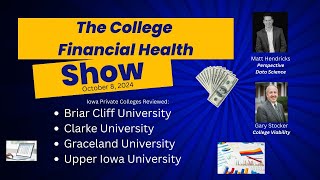
In this episode of the College Financial Health Show, hosts Gary Stocker (College Viability) and Matt Hendricks (Perspective Data Science) examine the financial health of four private Iowa colleges—Briarcliff University, Clarke University, Graceland University, and Upper Iowa University. They walk listeners through the data sources they use (audited financial statements, Form 990s, IPEDS), explain key financial metrics (net‑income margin, cash‑flow, unrestricted net assets, capital‑expenditure‑to‑depreciation ratio), and flag red‑flag trends such as missing audits, negative margins, declining tuition revenue, and under‑investment in facilities. Each school’s profile is detailed: Briarcliff shows missing 2023 audit, persistent negative margins, and low asset coverage; Clarke has mixed cash‑flow but still below the cap‑ex benchmark; Graceland suffered a 2023 $7 M operating loss, sold unrestricted endowment assets, and faces a looming covenant breach; Upper Iowa mirrors Graceland’s decline, with a 45 % tuition‑revenue drop, a USDA loan covenant violation, and dwindling unrestricted endowment. The hosts discuss broader systemic issues—weak accreditation oversight, the role of USDA and private lenders, high‑risk states, and the need for data‑driven “Moneyball” monitoring. They conclude with recommendations (monitor cap‑ex ratios, graduation rates, endowment thresholds, consider program consolidation) and a forecast of increasing college closures in the coming months.
Chapters
Well, welcome back. It is the College Financial Health Show with Matt Hendricks and Gary Stocker. Welcome to the Tuesday, October 8th episode. And for those of you joining us or watching this for the first time, this really is the only show that looks at the financial health and even the viability of private colleges throughout the United States. We share data from a lot of different sources. We share it from audited financial statements, we share it from Form 990s on occasion, and of course we use the National Center for Education Statistics and its IPEDS database. Who should listen to this? Who should share this? Who should watch this show? It's certainly college leaders. It's certainly college board members. It's for faculty and staff so you understand what's going on at your college maybe. And it is certainly for students and families because, As we all know, colleges continue to close. They will continue to close in the coming months and years. And it's important to choose colleges that are going to be successful. Hi, my name is Gary Stocker, founder of College Viability.
And I'm Matt Hendricks, founder of Perspective Data Science. Today we're going to Iowa. As Gary mentioned last time, we're looking at Briarcliff University, Clarke University, Graceland University, and Upper Iowa University. So we're going to pack 4 in. None. We don't have any really positive cases here. It's sort of varying degrees of not so great in my opinion, all the way to really big concern. So we'll just jump into the data and show you what we're looking at. Have some new things for you today, some new data I put up on the app that we use every time, and I'll highlight what that data, how you can use that data, why it's important. So let's start with Briarcliff. Right out of the gate, you see there's some missing data. I went to try to track this data down. So the fiscal year 2023 audit is not here in my database, and it's not in the federal database either, which is a big problem because either that means the federal system didn't load it, which probably is not true, but it probably means they didn't submit their audit on time. and it's not available on their site either that I saw. So that may sound like a, not a big deal, but it's a huge deal because there's, that's required by Title IV, uh, to get your Title IV funding as a school, you have to post your audit within 6 months of the end of your fiscal year or 1 month after your audit is complete, whichever one is earlier. Um, and you can see that's not happening now. They should have posted their audit at least by January or so, December of 2023 or January '24. And right now we're October '24. So yeah, that's a concern. So unfortunately I can't say a whole lot about recent data. I have up to fiscal year 2022, but things are not great before '23. You can see their net income margins are negative, negative, Negative, negative, one positive, and a bunch of negatives. So that's a, that's obviously a concern. As we mentioned before, that means their revenue is not covering their expenses. Cash flow also negative most of the time. Again, big concern here. Another thing I'll show you is their unrestricted net assets are really, really low. Starting to get a lot of variables in here now. To show you a trick, you can start typing the name So unrestricted net assets relative to expenses is much lower even than the schools that have closed. And I'm assuming when we get 2023 data eventually, this will keep tracking below the red line. Remember the red line, there's schools that have closed. Okay, let me show you the net tuition revenue, then I'll show you the new stuff I have on here. I'm going to the next school. Net tuition revenue, although not as bad as the schools that have closed, it's down 6% by fiscal year 2022. Notice they had a big spike here. They're up 25%, and that's totally reversed to this point now. And now they're down 6% relative to 2016. So again, as we mentioned in the past, this is difficult. What causes this sort of momentum is that every year you're enrolling a class that's paying less than the one that just graduated or left, right? And so to turn this around, you have to consistently enroll a bigger class or one that pays more, or both, than the class that came in 4 years ago. You have to do that 4 years in a row basically to turn this back around and get back to where you were. It takes a lot. All right, so that's, uh, not good. Here's what's new on the dashboard. I'll put it in the top graph so we can see it up here closer. So what I have here is, uh, from the cash flow statement, we have 2 very important numbers that are kind of buried, and a lot of people don't probably pay attention to them, but you should, and I'll explain why. One is purchases of property, plant, and equipment. Call it capital expenditures, but this is purchases of important stuff like computers, desks, furniture, building repairs, repairing roofs, replacing flooring, all of that kind of stuff, networking equipment. And so it's really important that schools are investing in that every year because all of that equipment, roofs, flooring, it wears out over time. Computers only last for like 5 years, right? If that. So all of these things depreciate and need to be replaced every year to keep your sort of equipment assets at the university up to par. And one of the things that happens at schools that are struggling financially is that they don't replace that equipment. They don't repair the floors, they don't repair the roofs, they don't repair windows that don't work, et cetera. and you end up getting what's either called deferred maintenance, or you just get poor equipment, inoperable equipment, and leaks in the roof. Leaks in the roof. So this is what it's going to look like. So here's what we need to see. So in the data, a school like that looks like the blue line and the red line. Ideally, you would be close to the median here. Notice the median is always, except for the COVID years, always right above 1 or right at 1. That means that they're replacing their equipment at a slightly— actually accumulating new equipment slightly faster than the depreciation rate. All right, so really close. You need to be above 1. Schools that are struggling will always be below, below 1 for the most part. You can see the red line always below 1, and same with Briarcliff. So what are you going to see? What does this actually mean? Many years in a row of negative, of below 1 ratio here of capital expenditures and depreciation is going to mean that you're going to see leaky roofs, you're going to see carpet that looks nasty or reeks. You have flooring that's broken. You're going to have maybe old computer equipment or computer equipment that doesn't work, overhead projectors that don't work, paint that's coming off the wall. Walking paths that have big holes in them or potholes in parking lots, windows that don't work, lots of stuff. And I know this from experience. The school that I was working at for 12 years was doing this very thing. And now it's very real to me after looking at these numbers. Like, I taught in classrooms where the projectors didn't work. The, the dry erase board was falling off the wall. Windows wouldn't open. Carpet reeked, the Wi-Fi connection never worked or was unreliable. That, those are big red flags, right? Because those are the things that are going to be put on the back burner when there's no cash. There's no cash to cover those things, right? And so you need to watch this ratio. Okay. So we'll see that from virtually every school that's struggling. And this is a massive red flag. You'll see that they're always, almost always below 1. Okay, let's go to the next one. Clark University. Clark. By the way, the school I worked at, they just recently turned that around. Their budget got better and they— massive investment in capital expenditures the last— sure, as soon as I leave, right?
What's that tell you, Matt?
Yeah, well, I mean, they knew the new president came in and of course knew that it was a mess. And prioritize that. I mean, I got to hand it to them. They— I didn't agree with everything that they did, of course, and I thought they were too slow, but they did do the right things eventually. All right. So here's net income margin for Clark University. And for the most part, I mean, there's a couple of years, the COVID year, they got a lot of money, but they have a bunch of negative net incomes here. I don't like this. I mean, this is not comfortable for me, especially the most recent year. Once COVID ran out, they're now in double-digit net income losses, net income margin loss. That's concerning. Although they have a positive cash flow here, so they may be one in the situation where their budget's not basically covering depreciation, but they are still cash positive if you don't um, if you don't cover your depreciation, which is actually a lot of schools are in that situation. But that probably means— yeah, it probably means they're not keeping up with their buildings or their equipment, as I just mentioned. So let's look at CapEx again. And, and again, you want to be above 1. They're not above 1, only a couple times above 1, although they fixed it in 2023, which is probably Why? Actually, that's not a correct statement. This is interesting. So their worst year financially, they actually invested a lot in CapEx. This is really interesting.
So, Matt, we have a— I'm going to jump in here. We have a question from a viewer. Is the question— question is the positive cash flow, does that include any endowment draws, Matt?
Yes. So the— so actually it's Yes and no. About 50% of schools keep their endowment draws and net cash from operating activities. About half take it out. That's why I put in the notes down here. And this was actually a big confusing thing at the University of Tulsa when I worked there. We have a big— they have a really big endowment, $1.4 billion. And so they get a ton of money from the endowment. And there was a lot of— there was laser focus on the fact that our net cash from operating activities was negative every year and a big negative number. Well, come to find out once I started studying this, that, oh, we're just one of the schools like Harvard, MIT, and lots of others that don't include their endowment spending in that part of the cash flow statement. So you need to be careful, double-check at your school. If your school— typically what you'll see is your net income margin will be slightly better than your net cash from operating activities. That's the typical, right? That would mean that's the typical accounting where your endowment's going to be— your endowment spending is included in the net cash from operating activities. If you find that your net cash is worse than your net income margin, then that probably means your endowment money's not in there. All right.
So, okay, thanks.
So you have to be careful. That's why I like to look at both of these, because sometimes you can get a false read from just one. This one's far more reliable, by the way, the net income margin. But the cash flow, there can be some quirky things. Take a look at net cash from investing activities. If that's always a really big number, pretty sure 99% of the time that means that the school's endowment draws are in that section instead of the operating activities section. That's pretty technical for a Tuesday here, but, uh, yeah, talk to your CFO, make sure that they understand that which version they're doing because it makes a big difference. It actually caused a lot of heartburn at the University of Tulsa because we thought we had this huge loss every year, but it really wasn't that. It was our accounting wasn't what we expected. So caused some issues. But, uh, anyway, double-check that. Oh, where was I going? So, right. So Clark, Clark is not covering again. If you're at Clark, you work there, you're a student there, take a look at the infrastructure. Chances are it's not, you know, up to par, but, you know, that's going to be subjective. Take a look at that. Here's the thing that is very concerning about to show you net tuition revenue. Again, Clark, not as bad as the schools that have closed, but they're down 13% on net tuition revenue since 2016. And you can see this sort of momentum building here again every year, getting a little bit worse. Again, it's a concern. It's difficult to turn that around. It's probably going to be the 4 or 5-year thing again to turn that around.
So I want to jump in on this and look at the slope of the red line there. Is there any way that you could look at the slope, that we could look at the slope of that line and better anticipate when a college might run out of cash from, from net tuition?
Yeah. Yeah. I think so. I think the best way is like I was, we were showing before was to actually go into the details of how net tuition revenue is generated. I don't really like, like extending lines off the graph here, although it's really tempting to just say this is going to go like this, but it really depends on, I mean, it just depends on stuff that's easy to measure. Like how big is your freshman class? How many kids left, right? Transferred out. How many kids graduated? You know, once you have those numbers, what do they pay on average? Then it's really easy to get your net tuition revenue, right? Yeah.
Okay.
So I prefer that approach, but you certainly could extend these lines out. All right. So Clark, I'll just say this. So Clark is— let me show you the unrestricted net assets. I mean, I'm certainly concerned for Clark, but their unrestricted net assets, even with the 13% drop down on net tuition revenue, they're kind of hanging in there a little bit. Their unrestricted net assets are down 3%. Maybe that's a little strong. We have inflation, of course, a lot of inflation that's accumulated since 2016, but they're certainly not down that negative 55%, which is what the closed schools had. So I guess everything's relative, right? We've looked at a lot of schools here on the show that are complete disasters. So Clark looks pretty good to me compared to those. I'll just say that. All right. All right. The next two, not, not, it's not the case. Or they don't look good. So I'll say both, both schools, Graceland and Upper Iowa, have similar things going on. They both have massive drops in net tuition revenue. And I'll show you those. They both have cash problems, of course. They both have potential problems with violating bond or loan covenants, which is a huge problem, right? Because that's what will kill the school if the creditors decide they're going to call the loan, right? And they're also both using either asking donors to unrestrict funds or asking the Attorney General to unrestrict funds. They're pretty desperate. I would say Upper Iowa up here is more desperate than Graceland, but they're both doing and experiencing similar things. So let's start with Graceland. Graceland, Lamoni.
Okay.
So they have good years here, but they followed up with a massive loss in 2023. And at first I was looking at this, it's like, oh, maybe that's just a blip, but it's not. There's a huge problem. Let me show you their cash flow too. So before we go on, They have a big cash loss here in 2023 as well, even worse than the schools that closed. And I verified this is $7 million. All right. So you got to find $7 million that's not coming from your operating revenue. Right. Again, that means you got to borrow or sell stuff. And how'd they do it? They sold $4 million in investments. They borrowed $1 million from a line of credit, a credit line of credit, by the way, that they're paying 8% interest on. So basically a credit card. And they drew down their reserves about a lot. Their cash reserves went down $8 million. That's because I think what they tried to do is, yeah, they spent $6 million on property and equipment. So they're trying to keep that property equipment value up, which is good, right? They're trying to keep their computers and their buildings working and everything. But that means they basically had a $7 million loss from operations and they had to come up with another $6 million. So they had $13 million to come from other sources. They got $8 million from their cash reserves, $4 million from selling investments, which were restricted funds that became unrestricted. I think that was the case. Let me double-check my notes here. Took $4 million out of unrestricted.
Okay.
Sorry about that. No, that was all unrestricted. They took $4 million out of their unrestricted endowment and sold it. All right. They only have $12 million left. So just to put that in context, they do this 2 more years. I mean, they do the same thing next year. They don't have cash reserves now, so they can do this like one more year. All right. So 2024 might have been their last year. They could have done this thing, the same strategy. So it would be really interesting to look at the 2024 audit. The thing that really concerns me about this school is their net tuition revenue fell 20% in one year. All right. That is a massive drop. I mean, just like it's difficult to make net tuition revenue go up over time, it's similarly difficult to make it go down that much in one year. Yeah, let me show you net tuition revenue. It's not going to show up exactly as 20% here, but look at how sharp this drop is. You see, they were at a positive 2% in 2019, and now they're far below the negative schools. I just wanted to double-check. So they're down 46%. This is probably maybe the sharpest decline in net tuition revenue I've ever seen. This is sharp. I mean, this drop here from here to here is 20% on the 2022 value, right? That's a massive drop. I mean, basically to get that kind of drop, you basically don't enroll a freshman class, right?
At all.
You return your juniors, seniors, and sophomores.
Yeah.
That's a massive drop. Like, like I said, there's momentum in these things, right? It's hard to make it drop 20% in one year, but they managed to do that. It's really hard to make it grow 20% in one year. You basically have to double your freshman class to do that.
Okay.
So this is what concerns me. It's going to be really difficult to turn around. I worry that maybe that's exactly what happened is their freshman class just didn't, didn't get a freshman class or everybody's just leaving.
Um, or they're giving away the store to get students in the door.
It could be that everybody's bailing. Uh, this, yeah, it could be that everybody's jumping ship and this will be impossible to turn around. So, um, those are just guesses on my part. I need to look in the paid app that I make. I would need to look at exactly what has happened here. There could be a lot of things, could be all different class students leaving. Could be just no freshman class. And those have different implications for what their future looks like. All right. So I did mention they have a potential violation of a debt requirement. It's on their audit on page 23 or 33 if you want to look at it. They weren't in violation at the end of 2023, but they were going to be if they continued on the same path for 2024. Which they probably did. So there's a possibility now that their loan is going to get called, and that would probably be the death of the university. But you never know. These, these places are really resilient. We'll see. They might work something out. But I would really stay away from this school if I were a student or a parent. Same thing with Upper Iowa. Let's go to Upper Iowa. Same thing. It is massive drops here in net income. Uh, look at their net tuition revenue, Gary. It's tracking almost perfectly, actually slightly worse than the closed schools, down 45%. They had a 9% cash deficit in 2023. I can show you that. Um, again, they're, they're not keeping pace with their infrastructure here. In fact, worse than the closed schools for the most part. So my guess is if you went to Upper Iowa, you would see buildings that had needed serious repair that is not happening. Lack of equipment, old computers, lack of technology in general, probably. Yeah, it's not, it's not a great place to be in. I mean, just their, I had their, their operating revenues are down 32%. Yeah. So it's just their capital stock. So their assets, have fallen over 22% since 2016. That's just like the value of their buildings and computers and library books and all that. So yeah, this— the school's in serious, serious trouble, and it is violating a bond covenant. I'll just pull this over. Um, so they have— so they took $4 million. They were able to get donors to release the restrictions on it. Um, and you can see that movement here in their endowment. They took $3.3 million of restricted endowment funds and got it unrestricted. That's great. The donors, that's really nice of them. But, you know, they still only have $9.7 million in unrestricted endowment funds at the end of 2023 and massive deficits that don't look to be turning around anytime soon. So it's just going to delay things. And, you know, the scariest part that they're facing is what I've mentioned here. Although this is really weird, their loan is not from a private sector like bank or bondholders. It's from the government, the USDA, and they're violating their covenant on that loan. And so it's not clear to me what the USDA is going to do. They probably won't be quite as aggressive as a private sector bank or a bondholder, but something to watch here. They're probably going to bring some heat on the USDA at this point. We'll see how they respond. Bonds and how this will shake out. But, um, yeah, this school's in serious trouble. Anytime they're violating covenants, um, that's a huge problem because, you know, they can call the loan and then it's lights out. Okay, so Gary, there's two schools that for sure are in really serious trouble. We just talked about Higher Learning Commission. Is there a creditor? And as you know, we've been seeing this over and over again. They say nothing. There's no probation on either of these schools. If you look at what they've got on their site, it's just the same stuff. They, they approve accreditation and then once in a while ask for additional information, but that's about it. There's nothing, there's no real signal out to the marketplace that anything is wrong with these schools. Um, and again, I don't, I guess I don't understand what their purpose is then if they're not going to do that. So it's like they're consulting, right? I mean, I don't know. We have lots of consultants, including me. I mean, yeah.
So, so, so we've, you know, we've beaten the accrediting agency horse to death and we'll continue to do so because they're wrong. They're not getting it done. If they want to come on the show, Matt, and say, you know what, it's not our responsibility to tell the public when colleges are going to close, look, let's extend an open invitation. Reach out to Matt, reach out to me. Our contact information is all over the place. I'll include the show notes. We'll have you on. Tell us that it's not your responsibility to tell the public that a college is in dire financial straits. Now, Matt, we had a user jump on and say that Graceland is up for reaccreditation in 2026-2027. Matt, they may not make it till 2026-2027. And it's just— it's a— I'm speaking bluntly here— it's a travesty. That, that the, the folks who are paid to do this are not doing it. And it turns to folks like you and I, data entrepreneurs in higher education, to say, hey world, these colleges, here's the facts behind their finances. Matt, we've talked about enrollment in this last couple months. We have all these positive enrollment announcements, and I'll bet you a cup of coffee, uh, 100 cups of coffee, make it serious here, 100 cups of coffee, that the closed colleges in the future are going to be some of those that said enrollment is great. Oh yeah, they don't have the finances to support whatever that enrollment is. And then one other thing on these colleges, um, we talked about the $75 million taxpayer dollars at risk at Upper Iowa. Um, they were at risk at Iowa Wesleyan, I believe, in other places. A viewer said that the USDA has loaned 7 Iowa colleges millions of dollars over the last, uh, over the last several years. And there's an article about that, I'll pull that up later. Going concern— did you see any reference in the audited financial statements about going concern? If you would quickly explain what going concern Yeah.
So I did a quick search, ongoing concern. So I didn't see anything outside of the standard boilerplate from the auditor saying, oh, the management's supposed to comment on whether they are going to live for another year. But there was nothing beyond that that I saw. Although the audit from Upper Iowa did mention their plan to try to turn things around, which looked like it involved firing about 60 people. Yeah, I don't—
okay.
I don't know if that's enough to balance the budget if they're making like $60,000, $70,000.
And again, let's make the case, you know, the accrediting agencies, their revenue source is the colleges they, they review. And auditors, one of their revenue sources is the colleges pay them to do the audits. And, and, and, and maybe you and I are onto something. Maybe you and I are onto something that others are as well, and that it's going to take private sector shows like this, private sector analysis like this, to warn the world, to warn students, to warn families, to warn faculty and staff that their college is in financial trouble. Um, let's go ahead and let me share my screen here, and let's take a look at— let's take a look at colleges. Let's take a look at— we're in Iowa this week, right? So there's the credit colleges. Thank you very much, Matt, for raising your finger and saying, Gary, what are you doing there? Um, let me change the view here so we can see both of us. And yeah, most of them are down. Um, actually all 4 are down. And again, there's an 8-year trend. And if your trend is for 8 years, Matt, don't tell me that you can change it in 6 months or 12 months or 2 years. You just can't do that kind of stuff. And after enrollment, we always go— and Matt always teases me about this— we go to graduation rates. And I'll give my brief sermon on graduation rates, Matt. Is that okay? Yeah, you go to college to graduate, not just to take courses. And again, this is a— this we're looking at— let's look at the 2022 data. So here at College Viability, our minimum threshold for 4-year graduation is 50%. And look at the numbers for these 4 colleges. Just Clark University in 2022 is barely over it. They've got a more successful history than the others. But look at Upper Iowa, look at Graceland, look at Briarcliff. Not just for 2022, look at the average. For all those years. Um, the 4-year average is 41% in 2022 for these 4 colleges. If you can't graduate students, if you can't graduate at least half of your students, you're not much more than a coin toss college. If you can't graduate at least 40% of your students, Briarcliff and Graceland, the Gary Stocker version, you're not even a college. You're just collecting tuition and doing something with it. So anyway, 4-year graduation rates, we track 6-year. I'm not going to show that today. I want to take a look at endowment values because again, mine is a historical indicator, and I'm going to scroll down here to the end of the fiscal year. And the minimum threshold— let me get all the way over here— we have a minimum threshold here at College Viability of $50 million. We make the case, Matt, if you can't— if you haven't in the entire life of your university raised $50 million Don't tell me you can raise $20 million in the next 2 years. You can't. You don't have the systems, the processes in place. You don't have the gift givers in process, in place. You just can't do that. And so we see of the 4, only 1, and that's Graceland, is just a little bit over, uh, that $50 million threshold. The others, not much more than college couch money— $20 million, $30 million, $20 million again. That's another indicator, Matt, that the history of these colleges, not just what you've done since 2016, But even longer term, the history of these colleges is not positive from completions. And again, for the 4 colleges over 8 years, Briar was essentially flat, $5,000 more in 2022 than they had in 2015. And the others, this again, this is a historical reflection of what Matt Hendricks shares from Perspective Data Sciences work that he does. This just confirms that these colleges look at Upper Iowa, I mean, this is just in fee revenue. And again, if you're going down over 8 years, don't tell me you can turn it around tomorrow. And if you listen to all the shows, Matt, that we do, Matt has said if you, if you, if you start turning around today, Matt, it's what, at least 4 or 5 years?
Yeah, yeah, it's a slow process.
Yeah, yeah. So that's the trend that just reinforces this. We'll kind of wrap— when we do the wrap here in a couple minutes, we'll talk about what these colleges can do. And let's take a look then at something we added a few weeks ago. And let's take a look at program completions. And so for program completions, this is going to show the data in terms of colleges. It's like it's reset on me again. So these are our 4 colleges. And let's look at biology. And then we've got, we've got 16 common programs from the National Center for Education Statistics. And we're going to look at each college individually here in a second. But these 4 colleges, really, they're all kind of dabbling in biology. Those are not strong numbers anywhere. And if we click through these, we can quickly compare. I won't do all of them. Business and Marketing, Upper Iowa clearly focuses on this. And that you and I talk, talking in show prep, that a lot of these majors that Upper Iowa does and other colleges as well are really, they're really kind of income risky majors for their students. Certainly some business and marketing majors and management majors do well, but as a class, that's typically kind of a risky income major. And yet many of these colleges focus on those easy to offer for themselves, but kind of risky income opportunities, challenges for colleges and for students themselves. And let's take a look at education. And again, you know, Upper Iowa kind of focusing on this on the undergraduate level. We track the graduate level as well. Not strong numbers. Here's, here's my solution, Matt. Let's, let's drop a note to the 4 presidents of these colleges and say, why don't you get together and consolidate the academics that you offer? Be strong in more areas and be strong in any areas instead of just dabbling in some of the areas as well. All number. And then finally, we'll summarize this and let's look at all the data. This is from the College Viability App. It's just my own summary sheet for the show and just kind of compare Pause the video if you want to, to look at these numbers. You can compare these colleges across all these fields. I'm not going to do that now. And again, we've talked about this before, these colleges and their institutional grants, tuition fee changes, all these. Pause the video to look at the colleges that you're looking at. They're not good, Matt. Total expenses are up $2 million at Briarcliff. Tuition fee revenue is down. Matt, we picked 4 colleges in trouble today. What do you think?
Yeah, I mean, it's the same. I like to have some that are positive just because it makes you feel gloomy about the whole sector when that's not really true, right? We're just focused on a small subset usually that are struggling. And, um, yeah, it's, uh, it's interesting. It's also sad. Uh, there's some comments too from Josh Morrison that I wanted to bring in. He checked, it looked like there is a tuition reset that happened at Upper Iowa, but The year didn't seem to line up with the data that you showed. Looks like they did fiscal year 2023. I'm not sure if your institutional aid was from fiscal year '23 or '22.
'22.
Yeah, so maybe an off a year. But so they did try reset. It seems really common to try that, although I haven't seen many cases that it really seemed to work or even change the trajectory of net tuition revenue at all. Of course, I mean, if you're an economist, you would hope that wouldn't be the case, right? We assume consumers are like making decisions based on the actual out-of-pocket expense, not what the sticker price is. So it may change your applications a little bit though. So that may be a potential. There was another thing. Let me see. Yeah, I'm really, I'm really curious on how this is going to play out with the USDA. They should get a hold of us. I mean, if you're at the USDA and you're worried about these loans, which you should be, perhaps we can give you some guidance on how to put these schools back on track and so they can pay these loans off and survive. It's worth a shot. What they're doing right now is not working. So, yeah, try it out.
And then, you know, we again, during our show prep before we went live today, You know, for a long time I've, I've categorized 4 states as high risk for college closures, and they are New York, Pennsylvania, Wisconsin, and Iowa. Now, I shared with you, and I'll share with the listeners, with the, with the viewers today, that I'm being nice. That number of high-risk states could easily triple. But I want to try and focus on the states, 2 in the Midwest, 2 in the, in the Northeast, where the general observation is those are high-risk regions. And, and, you know, those Title IV fund checks are now starting to show up at colleges in October. And I did this, I talked about this on the This Week in College Viability show yesterday. And Matt, you and I both know when those checks come or those deposits come, whatever they look like, there's going to be CFOs that look at that number, look at their balance sheet, and run down to the president's office and say, hey, president, we're not going to have enough to make it through December through May, whatever the case may be. And I still, Matt, truly believe we will see about 2 college closure announcements per month starting in October, as early as October, through the rest of this academic year. Do you agree or disagree?
Yeah, I don't know about the numbers, but I know some of the schools that we looked at on here, it's hard to see how they— I mean, I'll be really curious to see the 2024 audits, and we'll do shows on those when they come out. But, you know, on the trajectory that they're on, I mean, you just saw one today that, you know, looked like they maybe had a year to continue on that trajectory. And then after that, it didn't look like there was a path at all. So I think you're right. We're going to see a surge. And a lot of those— that surge is probably going to be caused by banks and bondholders and the USDA maybe saying, hey, we can see that you don't have a path to pay your loan back. We want to call it now. and that will be it. And then let's not blame the bondholders and banks then when that happens, right?
Yeah.
Like, it's not their fault.
Yeah. Good point. Great point. So, you know, and, and, and to wrap this, this show up, Matt, I had somebody last week challenge me on using the concept that we are in the higher education Moneyball era. They said, well, nobody knows what Moneyball is. Well, I will, I will see the point that not everybody knows what Moneyball is. And for those that don't, it's using data to make predictions, using data to make analysis. And indeed, there's no way around it. Higher education has its own Moneyball era, whether you know what the term Moneyball originated from or not. And it's folks like Matt Hendricks, it's folks like Gary Stocker, it's folks like Ashley Kern and Rebecca Mazzone and others who are looking ahead, looking at the data to say, hey, you're doing well in some cases, or hey, you're not doing so well. So college leaders, if you're listening to this, if somebody sent this to you, if you're watching it live, And you say, well, that's not right. Well, it is because it's the data you submitted either through your financial statements, through your, your IPEDS data submissions or other, other really through most of those, mostly those two items. So for Matt Hendricks, I'm Gary Stocker. Matt, of course, is with Perspective Data Science. Gary Stocker from College Viability. Let's do this again next Tuesday and we'll look forward to speaking with you then. Take care until then.
More from Gary


What does it look like when a college increases both total revenue and total expenses?



College Financial Crisis? We look at the financial health of Bay Path U. (MA) and Coe College (IA)


Private College Financial Crisis? We look at the financial health of Hobart William Smith College


Financial Compass tutorial (Private college version.) Financial statements compiled 2016-2025.

