The College Financial Health Show with Matt Hendricks & Gary Stocker for October 1, 2024
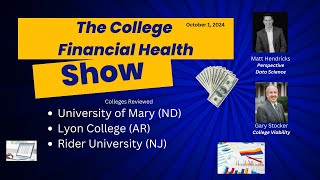
In this episode of the College Financial Health Show, hosts Gary Stocker (College Viability) and Matt Hendricks (Perspective Data Science) examine the financial health of three private colleges using audited financial statements, IRS Form 990s, and IPEDS data. They present a positive case study – University of Mary (ND) – which has turned around its net‑income margin and grown net tuition revenue by 42% since 2016. They then contrast this with two distressed institutions: Lyon College (AR) and Rider University (NJ). Lyon shows a –112% net‑income margin, a $17 M operating loss, dwindling unrestricted endowment assets, and reliance on asset sales and bank loans. Rider exhibits a 13.8% net‑income loss, negative unrestricted net assets, a “substantial doubt” going‑concern audit note, and a projection to halve its deficit within two years that hinges on unrealistic enrollment‑yield improvements and a large reduction in financial‑aid discounts. The hosts discuss accreditation signals, cash‑flow sustainability, endowment draw‑down rates, tuition‑discount strategies, enrollment yield, program completions, and the broader policy context of regulator and accreditor transparency. Viewer questions about public‑agency oversight and the reliability of institutional projections are addressed. Throughout, the episode emphasizes data‑driven analysis, the utility of the College Viability dashboard, and the need for consistent multi‑year trends rather than single‑year “bright spots.”
Chapters
It's the College Financial Health Show with Matt Hendricks and Gary Stocker for the first day of October in 2024. And as I said before, this is the only show that looks at the financial health and viability of private colleges across the country. Matt and I share data from multiple sources, including audited financial statements, IRS Form 990s, and of course data from the National Center for Education Statistics and its data and its IPEDS database. And we also offer our analysis and recommendations. Now, who is this useful for? It's useful for college leaders, for faculty, for staff, students, families, and of course community leaders. Hi, my name is Gary Stocker, founder of College Viability.
Great. Hi, I'm Matt Hendricks, founder of Perspective Data Science. Today we're looking at— I'll do it in this order— University of Mary. They are a good case. I'll show you. They have substantial growth in net tuition revenue and never any— well, recently no deficits. And then we have two schools that are struggling financially. One is called Lyon College in Arkansas, and the other is Rider University in New Jersey. I'm going to spend most time on that one because that's a bigger school that is struggling. And I have a lot more detail about what their plan is, and we can talk about whether we think that plan's going to work or not. All right, so let's get started. I'm going to share my screen, share the app we always share to start the show. So let's start with the good. University of Mary in North Dakota. And again, why do I think this is good? Look at the top graph here. This is net income margin. These are actually two net income margins here that are probably too big, right? 13%, 15%. And they followed it up with 2.5%. That's a normal net income margin. So that's perfect. And you can see they had several years of negative net income before that. And so they've sort of not in serious financial trouble, but definitely not where you want to be hovering prior to 2021. So how did they do it? If you look at the bottom graph, you can see pretty clearly how they've, they've basically grown their way out of this situation and into this one. Their net tuition revenue since 2016 is up 42%. It's one of the best in the country. So substantial growth and they sort of grew their way out. All right. So this could be another case where we look, Gary, where we look at what do they do to grow, grow their Net tuition revenue, so much. Every school, I mean, that's my job to figure this out. Every school I look at is different. Some of them are simple things with changing application strategy. Others are, you know, marketing, branding, that kind of stuff, just changing where they're recruiting. There could be a lot of explanations, but there's not a lot to look at there because that school is doing well. So let's focus on the ones that are not. The next one is Lyon College in Arkansas. And when I pulled this up this morning, I was like, oh man, my AI must be wrong, right? That's hard to believe, right? A negative 112, negative 112% net income margin. That would mean that their loss is in fact bigger than their revenue. And so I was like, man, that can't be true. Unfortunately though, it is true. This is, that's Ryder. Let me pull up Wyandotte College. Sorry, I thought I had this on the right page. So this is their 2023 revenue, operating revenue of $15 million, unrestricted operating revenue of $15 million. Their expenses are $32 million. So there you go. They lost $17.2 million. It's more than their revenue.
Wow.
I mean, that's the first time I've seen that. So the AI extracted the data correctly, extracts this line, extracts this line, and then we can—
Congratulations on that, Matt. Yeah.
So the AI is rarely wrong. Usually, I mean, sometimes I'm like, oh, that can't be right. And then confirm that it actually is. It's like, wow, okay. So they had a $17 million loss in 2023 unrestricted operating income, operating activities. And then if you look at their cash flow, they had a loss the previous year as well, $4.8 million. So 2 years in a row at least. Pretty bad outcomes. And let's take a look at their cash flow. And they still have a really similar size negative cash from operating activities. So this is really serious. Again, it means they have to borrow to keep the place open. All right. And or sell assets. Right. Those are your options. Sell stuff or borrow. And they did both. You can see the selling stuff part right here. This line means they sold $14.1 million in their investment investments and they purchased $1.5 million. So what happens is there's purchases and sales, right? Some people donate money to go to the endowment, so they buy some stock, but they're ultimately selling some as well to cover their costs here. So the looks like net of $12.5 $12.5 million or so sales of investments. You don't want to be doing that every year, right? You can only do that so long. And in fact, they can't do this very long. They only have about $38, I believe, million. I could go down to the bottom, but $38 million or so left in unrestricted endowment assets. So it gives them a runway to do this consecutively for about 3 or 4 years perhaps. So that's a concern. All right. So again, selling assets and they also borrowed, right? So they have— this wasn't enough, right? $12.5 million is not enough to cover the loss, right? They need more money. Where do they get the extra money? They were able to find a bank that would give them a loan for $6 million, almost $5.9 million. So that's how they covered the rest. And they also drew down their cash reserves a little bit. So Clearly not sustainable. -114% net income. That is a first for me. And you can see what's happening to their net tuition revenue. It's just, it's down 26%. I mean, we could go on and on. This school is in pretty rough shape. Also, their net assets went negative. Again, I can show you on my, my app, but I'll also show you in the audit where you can find that. Part of what I want to do with this show is just to help people understand what they need to look at on these audits.
Yeah. Yeah.
So if you go to the balance sheet, that statement of activities, balance sheet. So net assets without donor restriction. This is really crucial because this is money they can use without going to a judge and asking for a restriction or going to the donors or going to a judge to try to get the cash. This is really the pool of money you need to sort of bail yourself out when you're in trouble. And It's negative for them, really concerning, uh, basically serious liquidity problems if they continue to run deficits. Not clear how they're going to sort of do that unless they continue to find banks that are willing to give them money. All right, um, so as before, Gary, we, we talk about, um, what their accreditors are saying, and it looks like the HLC just visited them in 2023 and reaffirmed their accreditation. They did ask for a lot of more information though about their— mostly about enrollment, it looks like. So I didn't even look at enrollment, but it must be down quite a bit.
I'll look at that, Matt.
Yeah, perfect. So again, it's frustrating. I want HLC to send that— the minimal signal is the probation, right? Send a clear signal that, you know, this is a school that's in serious trouble. But they don't do that, right? They just ask for more and more information and reaffirm accreditation. Okay, so that's Lyon College in Arkansas. Let's take a look at Rider, Rider University in New Jersey. And you can see a similar situation here. Really big negative income, net income losses, 13.8%.
Now, what's that? What's that red line for?
Yeah, this red line once again is schools that recently closed. I pulled out a bunch of schools that closed in either 2023 or 2024. And that list is here. And so it's just basically benchmarking against, you know, schools that actually did close. What does that look like? And you can see they're slightly better than the schools that closed in 2023, but they're actually worse than 2021. And their net tuition revenue is down 28%. Again, similar to Lion, Lion College there.
And similar to the colleges that have closed.
Yeah, exactly. And another thing there, I'll show you the unrestricted net assets went negative. They're negative unrestricted. This is the ratio of unrestricted net assets to expenses. Expenses are negative, never negative. So this is only possible if unrestricted net assets went negative. And that's what happened again, way worse than the schools that closed. This looks similar to Drew. Remember, Drew is fairly close to this university. Unrestricted, negative unrestricted net assets. Again, what does that mean? I think what it means, what it should mean if the accounting's done correctly, is that if they sold everything on campus, they still wouldn't be able to pay back their creditors with unrestricted funds. They would have to use restricted funds. And I think legally it's yet to be settled whether that's going to be an option. There's actually legal cases ongoing where borrowing from the restricted funds is questioned, let alone actually using the restricted funds to cover liabilities. It's very different. Okay, so how did they pay their bills? They had a big loss. I can show you that here again. Operating cash flow, big negative, negative cash flow from operating activities. I can pull up their audit here for you. That's Lion College again, Ryder. Um, so they lost $17.7 million in 2023 and negative cash, negative $21.8 million. All right, so how are they covering that? Well, one thing to note is they don't need to cover this full $21.8 million. All right, some of this is stuff they don't necessarily have to pay for today, but it is an expense accrued this period. So depreciation is one example. Your equipment gets older, wears out, but maybe it still works, right? You don't necessarily have to replace it yet. So that's that cost. And they're clearly not going to cover that this fiscal year. So what they actually do is they draw $8.5 million on a line of credit and they draw down their cash reserves. And I'll show you both of those. You can see both. So there's not much going on in investing activities. They sold a little bit like almost $2 million or so, $4 million or so in investments. Not serious. They got most of their money from financing activities. This is coming from their line of credit, $8.5 million line of credit. And then they drew down their cash reserves, almost $6 million from $13 to $8.
Okay.
So that's how they covered 2023.
All right.
So another thing I noticed on their audit is their auditor notes quote, a substantial doubt about the university's ability to continue as a going concern. And if you're— if you, um, read audits like Gary and I do, most audits say nothing at all, even in really severe cases. And, and for an auditor to say that in the audit, it's pretty significant, right? I know that's a little subjective, but, uh, whenever an auditor goes that far in an audit, I take note. So that, that's something that's on page 28 of their 2023 audit if you want to check that out. Okay. So they clearly have massive deficits in 2023. Question is how they're going to deal going forward. And let me show you their plan going forward. I found this in their disclosure to their bondholders. And so basically they're telling their bondholders everything's going to be okay eventually, right? We've lost— they gave them this projection I believe in February 2024, which they should have had their FY 2023 results long before that, but for some reason they didn't. Could be another question to ask. Why didn't they have their FY 2023 results in February of 2024? Anyway, they're pretty accurate. They actually lost $17 billion here, not $16 billion. But their projection going forward is to cut that in half and then go balanced within 2 years. And this is what they're giving again to their bondholders.
Is that delusional, Matt?
Yeah, that's what I was going to get to. It's like, I mean, I want to give them the benefit of the doubt, but take a look at how they're expecting to achieve this. A lot of it's coming from a $4 million growth in net tuition revenue. And I'll show you the trends on that and we'll talk a little bit about what would have to happen for that to be true. The thing that's— so you can see a little bit more of what they're expecting to happen. They're expecting enrollment to be pretty steady, it looks like. Um, they did increase their sticker price a little bit, so you'd expect this to go up even with constant enrollment. But the thing that concerns me is I, I don't see a lot of cases where schools are reducing the financial aid package for current students. Oh yeah, and they're talking about a substantial reduction in financial aid here in '24, um, over $4 million or almost $4 million. So question is, is that only going to be on freshmen? It's not clear to me. I mean, again, if I were a bondholder, I'd want to ask a lot of questions about exactly where they're getting these numbers because, you know, these are projections. I don't know how they make the projections, if they're actually basing it on real enrollment numbers and what the students are actually paying. I suspect it's not, and I'll show you why in a second. But notice what they're expecting by fiscal year 2026. We're going to get to $90 million. In that tuition revenue somehow and $162 million from just the sticker. Severe, like serious reductions in the discount rate is what they're planning here. And then some continued cuts. But I want to focus on this. Let me just show you what we know about their enrollments and show you basically, I suspect their projection of growing that tuition revenue is a little bit overly optimistic. At least not at this rate. And I'll show you why. Okay, so let's take a look. Actually, before I do that, let me, let me show you this. I found this. This is their fall 2023 incoming class, right? So they had 804 freshmen and 219 transfer students come in. And they, they, the article is basically saying this is an amazing number, right? It's 27% higher than fall of 2021. And the president says they're excited to witness such incredible growth, right? So this would be comforting to a bondholder. And when I read this, I was like, oh, that's great. Let's take a look. Let's take a look at— put this in context of where they need to be to meet those targets and in their historical context. So first of all, let's take a look at that freshman class. By the way, before I drop out of this, this is their FTE enrollment over the last 12 years or so. No sign of this turning around, right? It has flattened a bit, so maybe they are doing some things correctly here at the end. But let me show you their freshman class and their transfers. Oops, this is on my paid, um, app that I make, and I do report as well. But, uh, new first-time students, here we go. Okay, so what did they say? 200 Or 800, right? 804. Was that what I had? 804, I think, is right. So, so it is better than their previous two freshman classes, right? 779 in 2023. The problem with it is basically 2022 is a complete disaster. Only 632 freshmen. But here's the thing that, again, I want to hammer this home. 804 freshmen would put you here, right? While that's better than your previous two freshman classes, the school is going to shrink. Why do I know that, Gary? The class that's graduating had 863 students, right? So they lost a class that had 863, and they're bringing in a class of 804. So the school is going to continue to shrink, right? That's how this dynamics works, right? Again, it's And this freshman class is going to be here for the next 3 years. This class is not going to get bigger. So they have that problem to overcome. And so an 804 freshman class, while the article, you know, the president says this is great, that's fine. That's their job. But I hope in private this president understands that 804 is a complete miss, right? They're not going to make their projection. On that budget, if they do that for the next 4 years, the school will shrink. All right. And I'll show you that on the simulator here in a second and show you what they actually need to do to get to their projections. But, um, they're currently not, no sign that they're going to get there. Uh, let's take a look at that transfer ins. Transfer is also a complete mess, right? What did they say? 200 and some transfers. That's just a normal transfer in. Number for them. It's not something to put in a news article and it's not, it's not big. So again, that's, that's the problem. So let me show you. So I have a page on the dashboard that helps people make these projections going forward because the math is a little tricky, right? You lose a class that came in 4 years ago, you gain another class. You also have attrition. You also have transfers in. You also have, you know, people graduating at different times. There's a lot of things to put together. And So I created a model that accounts for all of that. And what the model says is the red line, right? And you see it's backtested. All these red numbers are calculated based on their retention rate, their applications, their yield rate, graduation rates, and so on. And it's completely separate from what actually happened. So the model is pretty accurate here, especially in these more recent years. So it's backtested. We call it backtesting. So what's going to happen if they continue to do what they just did in fiscal year 2023? Is they're going to shrink, right? They're going to shrink. And it's not good, right? They're going to continue to shrink. They'll have a slight bump here. Why do you suppose that happens, Gary, in 2026?
Because those freshmen go away and they've got a new class coming in.
That tiny freshman class graduates finally, right? And they get a bump here just because the new freshman class is about 800, right? So this is the dynamics they're dealing with. And you can see the problem they have here. It's all about their yield rate. It's completely Terrible. All right. I don't know. 9.9% yield is very, very, very low. The average of their peer set is something like 15 or 16%, and that's still a bit low. All right. So the only way they get back to where they need to be is to get their yield rate up to about 14%. You see what I did there? 15% yield rate. That's a normal yield rate for them, by the way, and totally doable if they do, if they are effective, right? But notice, even if they do that, they have to do that for 5 consecutive years, right? Every year bring in about 1,000 freshmen, right, with a nice yield rate. And if they are successful and do that for 5 consecutive years, only by 2027 or 2028 does their enrollment get back to, you know, where it used to be. Okay, so why am I bringing this up? I think the reason is their current trajectory, even giving that, you know, the '24 fall, '23 fiscal year '24 freshman class a little bit bigger than the previous one, but not nearly big enough to give you these numbers. You're not going to have a 14% increase in net tuition revenue by 2026 unless you make massive changes to that freshman class and do it consecutive years. All right, so that's the point I want to make. I don't think they, I don't think they, when we see the fiscal year '24 budget, that this is going to be accurate. I bet their net tuition revenue actually was flat or went down in '24, and certainly again not on track to meet these two. So, yeah, I like this case because you can see the plan and you can see the potential they're making projecting forward. And also you see a bit of the spin, you know. I hope, at least I hope it's spin. I mean, I, I, I really would be concerned if the president really indeed thought that this was a good number because it's not enough.
Interesting.
Okay, so, um, yeah, this school's in rough shape. Again, looking at $17 million per year in losses. Uh, what do you suppose the Middle States Commission on Higher Education thinks about their Operation?
I'm thinking crickets, Matt.
Yeah, same. It's same. We always see they, um, they visit the place, they ask for more information, visit, ask for more information, and all the while not doing any kind of formal sanctioning or anything like that to make people aware of what's happening. Um, so again, I would be, uh, if I were a bondholder, I'd start asking a lot more questions about those projected enrollments and net tuition revenues. Um, and see exactly where those numbers are coming from. Again, they probably need freshman classes of about 1,000 students, not 800, to get to that. But that's just sort of off the top of my head. But yeah, yeah, yeah. All right, Gary, what do you think? I'll stop sharing.
So, so we had a couple of a comment and a question from viewers, Matt. And the first comment was they really like your red line for the closed colleges and it provides a good base of reference, which we knew that. We had another question about what the public agencies are doing. Is, is there— do you have any information? Because I know I don't— that the US Department of Education is looking at why regulators don't— aren't more aggressive in these scenarios?
I mean, if I were a senator, especially, you know, somebody connected to like Education Committee or something, I would just bring them in, right? Bring them into Congress and ask questions. There's going to be a lot of schools that are going to close that never were ever mentioned as a probationary candidate or anything. It seems to me, maybe I'm wrong, maybe the, maybe these accreditors are not supposed to warn the public.
I don't know.
I thought they were, right?
I thought that's why you and I are here. That's why you and I are here, right?
So at least get them in front of Congress and ask them, you know, why when these schools are completely off the rails, right? I mean, again, it's not— it's hard to imagine the financials getting worse, right? There's not a lot more that could happen other than them closing. Why is there no warning at all going out to the public? Yeah, I can't answer it, and I'm not sure they can either.
So a couple of follow-ups. And of course, University of Maryland, we try and do a positive one most weeks. We don't get them in every week because there's a lot more colleges in trouble. Than those that are doing well, like University of Mary up in North Dakota. Lyon College, um, if you— and I'll show this on my College Viability app here in a second— they had a gift of about $30 million in 2020, and it looks to me like they're riding that gift probably into the sunset, because once that gift goes away, uh, and they're drawing down that endowment— and you saw the reasons for that— I don't think it's going to go anywhere. The folks at Rider, are they doing much of an endowment draw?
Yeah, I think so. I just forgot to show it.
Um, I know we see that weekly, many of these colleges to keep the cash positive, right? Drawing from their endowment.
Yeah, I could share. Let me see. Let me pull it up first and then I can share. Yeah. Yeah. Oh yeah. 8.6% draw in 2023. Again, that's 8.6%. That's double what should be drawn out of an endowment.
And again, the point you made before, once you would draw against that endowment, it's not just that it shrinks the principal, that principal is lower, so you get fewer, lesser of a return in subsequent years. It's just, it's not a good scenario. So the going concern, I wasn't aware of that for, for Rider College. And you know, I've talked about this both during the show and off the show, um, you don't see that very often. Matter of fact, I did a recent little research last year of 7 colleges that are closed, and only 2 of them had in their most recent audited financial statement any reference to going concern. So I don't know what auditor is doing. I've posted about this asking that question. It's not good that auditors aren't giving the, the community a heads up. Um, I don't know what's going on with that. And then the, the comparison, and you did, you showed your, your paid version of the dashboard and, and the projections out for 5 years on enrollment Is it fair to say that it's likely the folks at Rider were engaged in dartboard projections as opposed to doing true data analytics like you do?
Yeah, there's a possibility that they looked at, oh, our freshman class spiked up a little bit, we just continued that line up, right? That's probably what they're doing, but it's not, that's not how it works, right? The only way that line continues to go up is if you continue to improve your yield rate and applications and so on and all that. And, um, the— what I showed you for the projection going forward assumed that they just immediately fixed it, right, and held it there for 5 consecutive years, right? That's what it requires. Um, you can't just have like one good freshman class and say, oh, we did it. You got to do it 5 years in a row, right? It's, uh, it's a tough order.
Interesting. All right, let me go ahead and share my screen. I'll go through the College Viability app. And let's take a look at the 2024 private college version of the College Viability App. And you can see that I have our 3 colleges. And again, the, the, the, the yin and yang of this is Matt does essentially real-time projections with his visualizations. And I'm looking at the last 8 years. And, and Matt, you've heard me share this, say this before. If something goes up the last 8 years, that's a good trend. If something goes down the last 8 years, that's a bad trend. Don't tell me you can fix it tomorrow. And you've reinforced that with the example of Rider. And other colleges that we've touched base on previously, that you have to show a trend over more than just one year. So we can see Lyon College is down 200 students over the last 8 reported years. University of Maryland, not surprisingly, is up. And you can see Rider's down 1,000 students over the last 8 reported years, down 20%. Matt, that's a trend. And for anybody at Rider University or any other equivalent college to say, hey, we had a great single enrollment year Hogwash. You need a consistent pattern. This is— I don't know if it's down every single year or not, close to it— down almost every single year for the past 8 reported years. Not good. Not good, man. I don't know what I should show next, right?
Yeah.
So, so, you know, I, you know, I don't often talk about the graduation rate, do I, Matt?
Yeah, well, I think you've talked about that a couple times on the show.
Okay, here's the case I'm making. It's interesting because most of the colleges, you know, I've done over the first 2 months of the show have shown decent 4-year graduation rates. And when I do my general reporting, that's, that's a rarity. But again, this week we have 2 of the 3 colleges— they're not exceptionally great, uh, 4-year graduation rates, but they're above my college viability minimum of 50%. And you can see both Mary— University of Mary and Rider are above that 50% threshold. Uh, they've both grown their 4-year graduation rate over the last 8 years. But look at— right, look at Lion after 4 years in 2022, and it's about the same average, a little bit higher than that, maybe 32, maybe a third of Lion College students, students that started Lion College 4 years ago, 2019, graduated from Lion College 4 years later. Matt, you've heard me talk about this before, but if you can't graduate 50% of your students, you're a coin toss college for obvious reasons. If you can't even graduate 40% of your students, Matt, I make the case you're not really a college at all. You're really not much more than a tuition collection agency. And with that, I'll move on. You talked about admissions yield.
Mm-hmm.
Again, we can see, I see this all the time, almost all the time. The general trend in higher education is the admissions yield. And of course, that's a percentage of students that show up after accepted, trends downward almost everywhere. Not universally so, but mostly. And you can see these 3 colleges have about the same rate of decrease on admissions yield over the last 8 years. University of Maryland doing a better job overall, but even their change is down 10 points over the last 8 years. It's worthy to note because some of these students are just applying to more places, so that's gonna naturally drag down the admissions yield. But I make the argument that many of these students, when accepted at the end of the day, choose not to go for whatever reason. And again, these yields are down and that's not good for the industry as a whole because that means, of course, fewer and fewer students are going to any single college or to any, any, any, any set of colleges. The endowment values, you know, my minimum endowment value for private college is $50 million. And again, all 3 of them are right at that. Lyon is a little bit better, but they had that $30 million gift back in 2020-ish kind of time period. But look what happened from 2020 to 2021. Looks like they're using it, Matt. Mm-hmm. Look how much that's down.
Yeah, well, it was a bad year for the stock market, so they're all down a little bit, but Yeah, there's also the outsized draws that are happening. Yeah.
And the argument that I make is, you know, Lions raised $100 million. I'll give them credit that they have a pattern. Uh, Rider University has $70 million. Don't tell me that you can raise another $70 million in a year or 2 years or 3 years. That it just doesn't— it's not realistic to do that. If you don't have a quarter of a billion dollar endowment today, you're not going to have a quarter of a billion dollar endowment tomorrow. You just don't have the systems and processes in place to do that. When we look at institutional grants, I noticed we had one of our viewers talk about this, unfunded institutional grants. Look at the bottom of the screen. And of course, these are typically merit aid. They're typically most scholarships. They're discounts. Same kind of discounts you and I get when we go to retail outlets, we buy a car, all those kind of things. And we can see that Lion, and I'm always concerned about colleges that doesn't, that don't even report data into the IPEDS system, doesn't even report this. Um, Rider University is up $14 million over the last 8 years, 26%. UMary, interestingly, is up almost double, um, from $10 million— more than that, $10 million to $17 million. So they're both are giving away discounts and they're just foregoing revenue. You and I know that to get students in the door, and that's fine.
There's one thing that's really interesting about the Rider trend. If you look at 2022 versus 2021, that big drop there You'd be tempted to say, oh, that's— they did something great there. Actually, it was a tuition reset, and it didn't work. Their net tuition revenue continued on the same trend.
It rarely works. It rarely works. So institutional grants, something to look at. And then I would take a quick look at retention and then look at tuition and fee revenue, and then we'll look at program completion. So, you know, Not real good at Lyon. That's not going to be surprising. Not bad at both Rider and UMary. And again, it begs the question, especially with the quality piece, and both Rider and UMary graduate a lot of students. University of Maryland is doing well. You've talked about that. I certainly concur. But somebody like Rider who's still, who's graduating a decent percentage still struggles financially. And I talk about this all the time on my Monday podcast. I post about this. I think you and I have talked about it before. It's really disconcerting. They're not just colleges who can't graduate anybody, like Lyon and hundreds if not thousands of others are struggling financially, but good colleges. Bradley University in Peoria, Illinois dropped below 5,000 students for the first time in 30 years this year. They're a fine college. They graduate 70% of their students in 4 years. That really, really concerns me. And, you know, I probably need to talk about that someday, that even the good colleges are struggling financially.
And personally involved in a project where a top, probably top 10 school in the country was struggling financially for a bit. It's not— yeah, just because you're a great school doesn't necessarily mean your expenses are less than your revenue.
Yeah. And then to reinforce what, what Matt has talked about, and I have as well, this is the tuition fee revenue for the last 8 years. Line is essentially flat, down a little bit. Look at Rider. They are down $26 million and change. And look at you, Mary, they've grown their tuition-free revenue. To me, Matt, I don't know, what do you think about that? If you can grow your tuition-free revenue in a tough market, what does that tell you about a college?
Well, they're doing the right things. I mean, I don't think it's rocket science, but you know, do you have to understand the dynamics? You've gotta know where you are, you have the opportunities in your pipeline, right? Like I think by default, a lot of folks want to focus on yield, but it might not be yield. Maybe your yield is normal, you just have really low applications or you're being overly selective. Like there are sometimes very easy tweaks to make that just for whatever reason don't happen. Maybe Mary did that. My cousin actually just graduated from Mary a couple years ago. I should ask her what happened. I, I never got around to it. I didn't realize actually that the school grew so much. So now I'm, now I'm curious.
And then the final thing that we do each week is we look kind of ahead a little bit based on programs, and we bring the data from IPEDS, the National Center for Education Statistics, and we look at programs. And these are the 16 most common programs. There are others that list, and we look at completions, program completions. So I always start with biology. You can see the 3 colleges that we have, and again, they're all similar at the undergraduate level. A couple of them aren't playing at the graduate level. That's fine, that's a business decision they make. Business admin— business marketing and management— we typically see all colleges with decent numbers comparatively. And Rider again is clearly focused on both the undergraduate and graduate market. University of Mary has been even more successful on the graduate side as opposed to the undergraduate side. And Lyon, because they're a small college, they don't graduate much at all. And the last one I want to show here is math and stats. And here's why. If you look at the numbers for really all 3 colleges, they are small numbers. And I can remember my college days, and I took college algebra and probably trigonometry or something like that. And I know that every college has a math requirement. Call it college algebra, and that's it. And I know the same teachers that teach the junior and senior math classes also probably teach the freshman and sophomore math classes. But boy, if you're a student or a family member, Matt, and you're looking at a college like Rider in 2022, they had 2 people complete the math and stats program. Boy, if I want to major in that, I, I would, I would want to think about finding a college that graduated 20 or 200 or 2,000 math and statistics graduates, because they're going to have that high-level capacity, those resources, the faculty to be able to get students to where they want to be. Not college that graduates 2 or 6 or 7. And you can look at that. I'm not going to go over all these, but you can look at all of these available. And of course, this version of the app is available online at collegeviability.com. This is where you can, especially if you're a family member and a student, look at this stuff. Don't go— be careful about going to a college that has a low number of program completions, graduations if you will, in a program. Because if finances get bad, Matt, you and I both know what's going to happen. That's the program that's the major that's going to be cut.
Right.
Matt, questions, comments?
Yeah, I guess one of the things that just sticks in my mind is the projections they're making and reducing the discount rate. I think I need to do more research on how many schools have actually been successful at reducing the discount rate. And whether that's, you know, like a viable strategy.
Yeah.
It may work in some cases. In fact, the University of Tulsa where I worked, I argued that they should do that. Exactly that. Um, we didn't realize it until we started digging into the numbers, but our school is one of the cheapest schools in Oklahoma, and we had the problem that everybody assumed we're the most expensive in Oklahoma. We're actually cheaper than most of the, like, regional schools you never heard of, right? Um, and the reason was massive discounts, um, which of course it was, it was well-intentioned. They're trying to get the best student in the area, but has to be watched, right? Can't just give away an entire class of revenue, right? And expect things to be fine.
So, and I have seen with the college viability data, the colleges that have had their unfunded institutional discounts, unfunded institutional grants gone lower and their tuition mimic that. I'm sorry, their enrollment mimic that. So they lowered the amount they were trying to, they lowered their discount amount, but the enrollment Didn't respond. It still continued to go down. So I don't know. It'd be interesting to see what your research is on that. So, Matt, thanks again for doing this. You know, and for those watching either the live version or the recorded version, this is the Moneyball era. This is the college Moneyball era. The data is out there to do exactly what Matt and I and a very select few others are doing to look at colleges, in this case private colleges, on an individual level, their finances, their enrollment, the projected trends that Matt showed you on his paid app. And college leaders, if you're out there and you say, well, that's not right, well, you submitted the data, you submitted the audited financial statement, you submitted the IPEDS data. We're just putting that data you submitted into our apps for analysis. So draw, you know, ignore the data, use the data, you know, whatever you want, but it's real data. And as we move forward and look at predictives, and Matt showed you an example today, Trust me, Matt, I think that's something we'll probably use on the show.
Yeah.
Yeah. So again, thanks for joining us. We're grateful for your time. Next week we're going to be looking— Matt, would you mind going to Iowa with me next week? Love it. Excellent. We're going to go to Iowa and we're going to look at Briarcliff University, Clarke University, Graceland University, and Upper Iowa University next week on the October 8th episode of the College Financial Health Show. For those joining us Thank you very much. We are grateful for your time, and we'll see you next week.
More from Gary


What does it look like when a college increases both total revenue and total expenses?



College Financial Crisis? We look at the financial health of Bay Path U. (MA) and Coe College (IA)


Private College Financial Crisis? We look at the financial health of Hobart William Smith College


Financial Compass tutorial (Private college version.) Financial statements compiled 2016-2025.

