The College Financial Health Show with Matt Hendricks & Gary Stocker for September 17, 2024
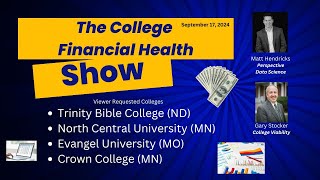
This content was created by Gary Stocker. This content was uploaded by Gary Stocker. This is a YouTube episode titled "The College Financial Health Show with Matt Hendricks & Gary Stocker for September 17, 2024" (published 2024-09-17). It is a hosted data-driven show (podcast/video) featuring Gary Stocker (founder, College Viability) and Matt Hendricks (founder, Perspective Data Science) analyzing the financial health of four private, mostly religious, colleges: Trinity Bible College (ND), North Central University (MN), Evangel University (MO), and Crown College (MN). The episode covers audited-financial-data analysis pulled by an AI (College Viability app), focusing on net income margins, cash flow, endowment usage, enrollment and graduation rates, tuition discounting, program completions, and institutional grants. Key takeaways discussed: Trinity is financially strong, North Central is in serious distress, Evangel is marginal but improved, and Crown shows moderate strengths; hosts also preview future episodes and a planned LinkedIn Live on Oct 1.
Chapters
It's the College Financial Health Show with Matt Hendricks and Gary Stocker. It's a Tuesday, so it must be September 17th, 2024. Welcome back, everyone. Thanks for making time to listen to the show. We think it's the only show, the only broadcast out there that covers the financial health and viability and much, much more of private colleges. Across the country. And it's a show for college leaders, for faculty, for bank leaders, for insurance companies, for consultants, because we really look at the financial data. And you'll see Matt's stuff is fabulous. And we look at the historical trends as well so we can make the case that colleges aren't just having trouble today. They've had trouble lots of yesterdays and in the future days as well, most likely. Hi, my name is Gary Stocker. I'm the founder of College Viability.
And I'm Matt Hendricks, founder of Perspective Data Science. Today we're doing 4 schools instead of 3, and they're all requested schools. Smaller— they're sort of smaller religious-affiliated schools in the upper Midwest for the most part. So we have Trinity Bible College in North Dakota, North Central University in Minnesota, Evangel University in Missouri, and Crown College in Minnesota. So the quick takeaway from what I've seen basically looking at the data is two of these are in good shape, one's in really good shape. It's— there's kind of like all the way across the spectrum in this one. Uh, we have two that are not so good. One is quite poor and the other one's sort of on the edge. Um, so we'll start with the good. Start with the— I'll show you my updated app. I changed a few things on the app. I added more, um, more variables and made it less cumbersome. But it's still same navigation. This is the app where we always are benchmarking the financials of universities. All this data is from audited financial statements. The data is scraped using an AI that I've trained to basically read the audits and pull the data out that I want. Alright, so we're going to start with Trinity Bible College and Graduate School in North Dakota. And you see the difference here is before I had a full range of graphs just like pre-populated. Now I just have 2 graphs and you can pick what you want to display on each graph. So right now we're displaying our bread and butter, the net income margin. Basically, if you have a positive net income margin, there's not a lot to worry about, right? If you have extra money at the end of the year, you're putting money away in your endowments, you're investing, you're keeping up with your buildings, I'm assuming. everything should be fine if you're having a healthy net income margin. You can see the school again, this is Trinity Bible College. Uh, they have massive net income margins. And as you've seen on the show, we usually worry about these numbers being low, right? These are quite high. In fact, these are probably in the top 1 or 2% in the country. Uh, very large net income margins. And the same thing is true for their cash. Surpluses. So I don't want to nitpick, of course, but these are again nonprofits. You don't want to necessarily have these to be high. Ideally, they would be in this range down here. When they're high like this, it could indicate that potentially you're underinvesting in your mission. But this is a very small school. I'm sorry about that. This is a small school, and I'm sure they want to build a reserve. I also talked to somebody inside this institution, and they're investing in buildings and building a another college and stuff like that. So they're probably keeping a cushion for that kind of stuff. All right, so this school is in great shape. There's not a lot to look at other than that, but I'll show you some of the new capabilities. Um, let's just take a look at their operating revenue, and I'll just show you what I was talking about. Um, there's now the capability of looking at relative to 2016, what's the percentage change in a number of variables. I did net tuition revenue, operating revenue, and total expenses. And you can see this school is at 65% here. That means in 2023, their operating revenue is 65% 5% higher than it was in 2016. That's excellent. Um, again, this school is doing quite well financially, nothing to worry about, at least as far as closure goes. And I did find out they're doing this despite not being in the Common App, which is, uh, I found that to be, uh, usually schools that are not in the Common App are really struggling, uh, with their enrollment, but the school is sort of bucking that trend. That's really interesting case. Um, so, uh, that's Trinity Bible. We'll go to North— uh, let's go to, yeah, North Central. We're going to go from the best to the worst. All right, the worst on our list today, North Central University in Minnesota. Okay, so why is this the worst? Again, it looks a lot like the ones we've studied in previous shows. Basically, it's not good if you're tracking with the schools that have closed, right? And so they're tracking here with the net income margin, which is troublesome, uh, 13.5% Net income loss here, 2% there, and an 8% loss here. And if you look at their cash flow, it's also negative. And I did dig into them because their numbers were looking a bit depressing here. 2 years in a row of pretty significant losses in cash from operating activities. I think these, these ended up being around $3 million, I believe. I checked in the audit. Let's double-check that. I'll bring you— this is worthwhile. So it's like $2.3 million. They lost $800K net cash in 2022 and $1.5 million net cash loss in 2023. And again, keep in mind, this is just cash expenses that they're not covering. They're not even covering, of course, their depreciation, which is another $2.2 million. So this is a pretty dire situation again. And it's always worthwhile, in my view, to figure out how do they actually pay the bills if they didn't even have enough cash to cover their cash expenses, let alone their depreciation. What's kind of interesting, the school is trying to keep up with their depreciation expense, which is good. But again, you got to get cash for that. So not only do they need cash to cover this stuff, they got to cover their depreciation expense with this building investment here. So where are they getting all the cash? They took $2 million. Looks like they maxed out a line of credit. I didn't double-check that, but, you know, it's a pretty round number there. So that's fairly decent guess that that's maxed. The other thing that they did is they used to have a decent amount of cash on hand. They had $6.5 million in their bank account at the start of fiscal year 2022, and they've just drawn that down. They drew it down to almost $4 million. So they basically drew down their cash to $1.8 million. So you got $2 million coming in from the net, the line of credit, and $4 million cash drawdown. So you can't do that anymore, right, Gary? And this is the— I mean, maybe you've got another year here to draw down and cover things, but it's going to get interesting now that they don't have cash on hand. If they keep, you know, another deficit like this and they're going to be in serious trouble. So worth keeping an eye on here. North Central University. And again, Gary, I just checked right before the show. HLC is their creditor. I don't see any indication that they're flagging them for their financial issue here. Again, I wish that wasn't the case. I wish there was more warning going out to folks, but it's the way it is, right?
It is what it is.
That's what we're doing. That's what we're doing.
That's exactly right. That's exactly right.
Right. So hopefully, you know, this is worthwhile, this half hour out of your day to watch, you know, how to analyze these schools financially and get a warning out to folks. All right, another one not so good but better than North Central is Evangel in Missouri. So Evangel University in Missouri.
I think that's between you and me, isn't it?
Yeah, I don't know for sure. I mean, yeah, I think it's down in Southwest Missouri somewhere. Yeah, I'm in Oklahoma. Uh, interesting, I'm from Minnesota originally, so we're looking at a couple Minnesota schools today. It's kind of interesting, this to see those. I wasn't even familiar with these schools to begin with, but, um, now a little bit of knowledge here. But so this, this school is better than North Central, but you can see that a pretty rough year here net income-wise in 2023. Um, I don't usually don't get too excited about that until, you know, like 2 or 3 years in a row where they're doing that. Um, there's, especially with these small schools, there tends to be lots of volatility in net income and cash flows and stuff like that. So it's a little bit quick to jump to conclusions on that.
But, and Matt, tell us again what the red line is for on these charts.
Yeah, this red line is a set of 9 closed schools. So just trying to give people, because nobody's going to on their own benchmark themselves against schools that have closed, right? So I'll just go ahead and do it for you. And it's really useful to do that stuff, right? Not just benchmarking against schools that you want to be like, but also benchmarking benchmarking against the schools you don't want to be like.
Great point, great point.
And so, right, we're benchmarking this red line, or the schools that didn't make it, right? And their last year of survival was 2023. You can see what they look like. And just to show you again, uh, what you don't want to be like, one thing you of course you're going to want to watch, your net tuition revenue. If you're one of these small schools, and you can see the schools that closed, it's a pretty common thing here. They, yeah, 1, 2, 3, 4, 5 years in a row of declining net tuition revenue, and then it, then it levels off. You know what that's happening right there? If you study dynamics at all in mathematics, that's just that there's a dynamic system here where you've got a class coming in, right? Your freshman class comes in and then you have a bunch of students leaving your school every year. So you have this dynamic process, your graduates and the people, the students transferring out. If your incoming class is smaller or pays less than the class that's graduating, then you get this negative effect on net tuition revenue, right? And if it happens 5 years in a row and then flattens out, it's just simply a shock that happened back here, probably that was never corrected, and it just keeps going on until you get to steady state. So that's for the math nerds out there, but you see this a lot in these dynamic systems. If you can't turn it around in year 1 or 2, it's really difficult. And then of course, it's the same on the way back up. It's going to take probably 5 years or so to get this to go back up, even if you're doing everything perfectly. All right, that said, so the blue line again is the school we're looking at here, which is Evangel. And they did look a lot like the closed set here, but they were able to fix their problem, right? They were able to catch it early. And start turning it around here in 2019 and actually get back to sort of leveling off at a new steady state that's clearly better than the closed set, that is still down 12.5%, but not as bad as the 34% that the closed set experienced. So this is again net tuition revenue, and we're looking at percentage changes compared to 2016. So, but there, you know, were able to keep their balanced budget for a while, at least until 2023. So it'll be interesting again, watch this school. They're not in great shape financially, but in my opinion, better off than North Central. All right, the last one, another Minnesota school, and this one looks okay to me. Let's double-check how I feel right now, just doing this on live on the show. Um, yeah, I'm not sure why I thought it looked okay. So we have two— okay, this is why we have two years, two years in a row here of negative net income, but they're not massive. This is a 3% net income loss and this is a 2% net income loss. Of course, you don't want negative, but those aren't massive numbers. And then I think the thing that convinced me that things should be fine for them is that their cash flow looks really good. So they've got a lot of cash coming in. Coming in. So what could be causing this? I'd have to dig deeper into the their audit to understand how they have negative net income and a positive cash flow. Sometimes it happens because they're— the way they do the cash flow accounting, but I doubt that's the case where they pull the endowment income out. There's also issues with timing where, you know, there's revenue that you've earned or haven't earned and you've already been paid for. So there's difference in timing there. But I think the school is doing okay. There's a couple other things that I looked at. Let's take a look at net tuition revenue. This is the main reason I think they're okay. Their primary income source here, they're one of the best in the country in terms of growth and net tuition revenue. This is a +16% net tuition revenue gain since 2016. That's excellent. So that's perfect. Part of their net income loss here is because they've been kind of growing quickly and some growing pains, it looks like. So for example, they've increased their spending quite a bit in the last few years here. This went from -2 to +8, so 20% increase in expenses in just 2 years. That's pretty sharp. So that's probably a little bit more aggressive than they maybe anticipated, which is causing that. But this school is growing and it's maybe some growing pains that we're seeing showing up in the data. All right, that's all I have for these schools, Gary.
So Matt, I have one question. In a lot of the previous, probably all the previous shows that we have done. You were tracking endowment usage, endowment utilization. That didn't come up today. Now we're going to look at the actual endowment values here in a couple minutes, but what's going on with these 4 colleges where their endowment has not really come into play?
Oh, I, I think I checked a few of them offline and they had very small endowments, so I didn't really bother with it, uh, live on the show here. But you can double-check that for me, um, in your section. But yeah, I thought these schools are more tuition dependent than the ones that we've studied in the past, I think. And, uh, so I was focusing mostly on that.
And, and does it tell you something that these are, these are highly religious colleges, more than, than most of the others that we have done? Are they living hand to mouth successfully? So in really 3 of the 4 cases with what you'll see in a minute are really pretty small endowments.
Yeah. Yeah. I think that's safe to say. I, yeah, I didn't study in detail their donor base, but, you know, that's something I should probably add to the app. Some schools have, you know, unbelievable donor support, others not so much. And so it would be interesting to dig into that here. I didn't, I didn't do that offhand.
Okay. Because I would worry that with, with a couple of bad cash flow years, a couple of bad enrollment years, a couple of high tuition discount years, there's nothing in the piggy bank to provide support outside of bank loans and those kind of things.
Yeah.
Yeah. All right. So let's go ahead and move on, Matt, to the, to the 2024 Private College Viability App. And again, there's two parts to this show. Matt really shows almost real time. He pulls data as he talked about. He's taught his AI how to pull the most recent audited financial statements. And of course, the College Viability App uses the last 8 reported years of data from the National Center for Education Statistics and its IPEDS database. And so we can see here for the 4 colleges that Matt talked about, we're going to look at the, at the 8-year trend. And if you've watched the show before, you know, we're going to draw some conclusions on this. And we can see the 4 here. And we note the fact that really 2 of the 4 have had decreases in their 8-year enrollment, not monster decreases. You can see the percentage on the far right-hand column. And 2 have had You know, Crown has done a decent job of growing. Matt just talked about that. Trinity, you know, 52 students over 8 years, that's 5 students, 6 students a year, something like that. So that's a trend that we're looking at. If you've watched the show previously, you've seen some of these numbers, Matt, that are really, really big. We're not seeing that for these 4 colleges. And Matt, it probably speaks to the fact that religious colleges tend to draw a student population that is more, um, more dedicated, more loyal to the colleges than we might see from other places as well. So we've done enrollment. And Matt, what's the next thing I'm going to show graduation rates. Graduation rates. Gary always does graduation rates. And again, we're going to see some— overall, they're disturbing numbers, and maybe we can talk about this on another show, but look at the 2022 numbers, each of the 4 colleges. And again, here at College Viability, our minimum threshold for percentage of students graduating in 4 years is 50%. If you can't graduate at least half of your students in 4 years, we call you a coin toss college. You might as well toss a coin to see if any individual student will graduate or not from your college. You can see North Central is just barely there. And if you look at the last 8 years of data, Matt, maybe the last 4 are reliable. I wonder about the previous 4 because they're all over the place. And we see that on occasion. The data submissions either are submitted by folks who don't know what they're doing, they put the wrong fields in, all that kind of stuff. But here's the case. Let's look at Crown College just on top. Alphabetically. We'll just go with that. And in 2022, if you started at Crown College in 2019, for every 100 students that started there in 2019, only 46 graduated in 2022. And again, the caveat is I understand that some of those students transferred elsewhere and graduated from those colleges, but the comparisons matter. Trinity Bible, they were on your list of okay colleges Right?
Yeah. Financially, they're doing quite well. But it sounded like it was mostly graduate enrollment that was growing there and sustaining the graduate school.
But on the undergraduate level, and that's what this tracks, you know, that's miserable. And you've heard me say it before and I'm going to say it again. If you can't graduate at least 40% of your undergraduate students, I, I, I don't even consider you a college. I consider you more of a tuition collection agency, and that's not good. We, we, you and I went to college, do millions of others to get that degree, to get that diploma. We don't go just to take courses. And then let's take a look.
Can you check, can you check the 6-year graduation rate? I'm just kind of curious if maybe there's some kind of like missionary thing or something like that. No, pretty similar trend. Same thing.
It's a pretty similar trend. Yeah, it really is. Okay. Again, the threshold I have, Matt, is 70% at 6 years. We don't often look at the 6-year rate and really none of them meet that. But think about that. You started at one of these 4 colleges 6 years ago, so it would've been 2017. And in the case of evangelists, you know, more than half graduated. That's 6 years later. Only 61 out of every, every 100 who started at Evangel graduated 6 years later. Yeah. Ouch. In so many ways. Let's take a look to kind of tie into what you're talking about, tuition and fee revenue. And again, we've seen other colleges, if you look on the far right-hand side, the 8-year change mat. Uh, you know, Trinity is essentially flat over 8 years and Crown, you know, a little bit higher, but not much. And Evangel and North Central are down a couple million, but we've seen a lot worse scenarios. Mm-hmm. But you have to wonder, Matt, again, let me ask you a question on this from your perspective and what you look at is if, if these folks continue to lose tuition and fee revenue at that pace of about, it's like about three quarters of a million dollars, about half a million dollars a year or something like that. $250,000 a year. Is that something they can survive with? No.
I mean, I think North Central's in rough shape. And on a percentage basis, do you have percent up there? Can you go to the right a little bit? I mean, this is a massive loss. Yeah, it's like 20. And if you go out another year, it's even worse.
Yeah.
You can't lose 20% of your net tuition revenue when you're a tuition-dependent school and expect good things to happen, of course. And North Central is definitely feeling the strain now, digging into a line of credit and tapping into their reserves. Yeah, it's concerning for sure.
The last thing I want to look at here is something called— we're going to go inside baseball, right? You talk technical stuff all the time, Matt. Now it's my turn. We're going to look at institutional grants. And on the top, it's funded. And again, we've talked before, a funded grant would be the Matt Hendricks Computer Information Systems Scholarship. Matt donates $1 million, and they use earnings on that to fund somebody's tuition. And really, all of these are not even college couch money. They're so small that they don't have any, any substantial funded scholarships. On the unfunded, on the bottom piece, this is really the discounts. And so we can see really of the, of the 4 evangelists, If you look at the 2015 number, they offered 12, almost 13 million in discounts. Merit aid is typically called— sometimes it's called scholarships. And if you look out to 2022, they're at $18.5 million, so up almost $6 million. And colleges, Matt, are welcome to do that if they have to discount tuition to get students in the doors. You know, every, every business does that. They have to play with the pricing. But again, that, that feeds back to what you saw on on, on, on your charts, on your visualizations, Evangel was okay. But do you have to worry, Matt, much about them continuing that pattern to give to essentially forego revenue to get students in the door?
Yeah, I mean, at the end of the day, it matters, um, how fast the sticker price is going up too, um, not just the discount. It's actually, you have to look at them together. A lot of schools will increase their, you know, sticker price by 20% and then, you know, increase the, increase the discount by 30%. So really they've decreased the price of the school, but it looks on the outside like they've increased it. It's really confusing, unfortunately, for families and students. Uh, but you need to really pay attention to the discount because it's some— in some cases, you know, you can see right here, um, I don't see the discount rate, but you know, you're looking at 50% or higher in a lot of cases.
So, right, right. The average tuition discount rate in 2023 was getting close to 60%, as I recall.
Yeah, yeah.
So the last thing I would look at— I'm sorry, go ahead, Matt.
Yeah, I was just going to say, it's, it's not what you— the sticker price really doesn't mean a whole lot. It's like going to a used car lot and they put a $100,000 sticker price on a used car, but you know, you can haggle with them. And it's basically like that in higher ed. But on steroids.
And the last thing we, we, we show each week is, is something that's relatively new. Although I think we've shown it in all our shows, and this is in large part for students and their families, but for college leaders and faculty as well. We take a look at program completions, and this is at the program level, and I have 16 different programs at the National Center for Education Statistics tracks. And what I want to do is take just a quick look at each of these 4 colleges to get a feel for the kind of areas they focus on. So let me just kind of go there. So I'm going to go in and I'm going to drill in on each of these 4 very briefly, Matt. And I'm going to look at their offerings across both bachelor's degrees and master's degrees. And if you want to look at this closely, just pause the video. And you can see that Evangel is really, you know, they play in a lot of areas. Their strongest numbers are in business and education on the undergrad side. And looks like they have a nice strong program, relatively speaking. On the education side at the graduate level. They're playing in psychology, they're playing in business. The reason we bring this up, and you'll see this for the other colleges, is as a student, as a family member, you want to look at this kind of data. Because for example, if you're looking at computer science, CIS, at a bachelor's degree, and there are only 4 students that graduated in that program, that program level, from 2022 from Evangel, if Evangel has financial difficulties in any area They're gonna look at the low enrollment numbers. And so you'd want to be careful if you're looking at math and science as a major. You'd want to be careful at a college like Evangel that offers, that shows so few programs, so few students graduating from those programs. Let's quickly look at the others, Matt. Let's look at North— that's not the North Central that I want. Let's look at Crown College. And we'll see the same kind of display. And again, just very quickly, you can pause the video to look at this. Really, Matt, I don't know about you, but I don't see anything that sticks out here except they seem to be relatively strong in the, in the graduate programs in philosophy and religion. And that makes sense because it's a religious college. And even psychology probably ties in with that a little bit. I don't know about the business piece. There's probably more to the story to that on the graduate level. But if you look across, Matt, the undergrad, the bachelor's degree programs, you know, they're playing in a lot. But not really doing strong in any of them. And while the finances for Crown were okay, right?
Yeah, Crown was okay.
Yeah, you'll— you just, from an individual perspective, be careful. You know, colleges have to pay the bills, and if they're looking at something— social sciences, visual and performing arts— that has 2 students or 3 students, that's an area where they're realistically and logically going to look to cut programs. And week in and week out, Matt, you and I see this. Colleges are cutting programs, they're laying off faculty. And this is— quickly add Trinity, same thing, and then I'll wrap this up. Again, same thing. I'm not sure they knew how to enter the data here, Matt, because there's next to no data at all listed on Trinity.
Yeah, well, so remember you saw that they weren't graduating, so that these are completions. So they're They may have kids in these majors, but they just don't make it.
They're not graduating. Yeah. So again, students and families, you know, this is the kind of data to look at. If you're a faculty member and you're looking at areas to grow, this would be valuable to you because it's, it's, it's multiple years of data. I'll just go back to that one screen. You can see we have 3 years of data here. The 2025 version will include 4 years of data. And, you know, if, if you're looking at adding some business marketing and management and you're in the vicinity of Trinity Bible, that's something to think about. But if you're looking at that in the vicinity of Evangel down on, I believe, Southwest Missouri, you know, less of a, less of an area there where there might be an opportunity. So Matt, what kind of questions do you have for me as I turn off the share here?
Um, yeah, I mean, this question that came up last show about graduation rates, the 23% graduation rate, just, uh, that's pretty depressing and I'm not sure What would even cause, like, again, are they just sort of treating the school like a 2-year school and transferring to some state school that's nearby? I'm not sure about the, what the market looks like in North Dakota where, where Trinity is, but it's kind of an interesting question of what's happening there. Are they sort of embracing the 2-year college route? Are they trying to—
I don't think so. Yeah, when I posted some social media stuff over the weekend and even in yesterday's This Week in College Viability podcast, I talked about the— it appears that colleges over the last month have— many of them have said, we are fabulous, we've got great enrollment. But if you think back to last May or the Mays prior, or even coming to next May, there are precious few colleges as they graduate students say, hey, we graduated 34% of our undergraduate students. So I think, you know, what concerns me the most, Matt, I'd be interested in your thoughts on this, is colleges focus on enrollment. The data and the media shows that they don't focus on graduation, Matt. Yeah.
Well, I think most people will be shocked seeing your numbers. I think a lot of people assume, even folks that I interact with that are in higher ed, right, assume that, you know, students are going to show up, they're going to stay for 4 years and leave. It's not like that, right? Like a lot of them stay for 5 or 6. A lot of them leave before they even get to 2. I mean, there's a pretty strong flow all over the place. And then there's also folks that forget about transfer-ins, right? So it's interesting to say the least, but I think most people in the public would be shocked to see these graduation numbers. Only the really elite schools, almost 100% graduation rate at 4 years, right?
You know, you and I've talked about this before, and I think we've talked about it on the show. This is the college moneyball era. And for those not familiar with the term, back in the 1990s, the Oakland A's baseball team made data their niche, and it has evolved everywhere now. All sports teams at all levels, I think, focus on that. And higher education, you and I are examples of what are called, what I call data higher ed data entrepreneurs. We're using data to help not just the colleges, but the consumers, the students and their families make more informed decisions. Because Matt, you and I both know in the coming weeks we're going to talk about colleges that are doing well for sure. And there are many. We're also going to be talking about colleges that are not only doing well, but I'm going to steal your words before I let you wrap it up. You call them practicing unsustainable practices, Matt. Yeah.
So, so who are we looking at next week? We're doing Webster University.
So next week we have Webster University, we have Guilford, and it looks like we're going to be doing Hendrix University or Hendrix College.
Hendrix College. Yep. I think we have some good stories to talk about there. I know Hendrix for sure is one that I want to look at just because they're a school that, that definitely did not look good financially for a while and they've turned it around for the most part from what I can tell. So it's a good story. And maybe, you know, the real benefit, the benefit of Moneyball is that you can learn from your data, right? And one of the best ways to learn is to find schools that have survived financial crises and ask them, just talk to those people, ask them, what did you guys do to sort of turn it around? and there's a lot to learn from, from these schools. I do it all the time with, you know, metrics on finding schools that perform better for like student test scores and stuff like that. Uh, just ask them, what do you guys do? What, what's different at your school compared to mine? So I'm looking forward to that.
And now before we get off the air for today, uh, again, thanks to everybody for listening. I'm going to give you a heads up that on October 1st at 10:30 Central Time, Matt and I will be doing our first ever LinkedIn Live. We'll be doing that through YouTube. Um, so if you've got that on your, on your calendar, on your schedule, it'll be a fascinating one because you're going to hear us live. And what's novel about that is you'll have a chance to ask us questions either through chat or through video as well. So put that on your calendars, October 1st, 10:30 AM, 10:30 AM, the first ever LinkedIn Live version of the College Financial Health Show. For Matt Hendricks, I'm Gary Stocker. Thanks everyone for listening. We'll look forward to talking to you again next week with 3 new colleges. Thanks again, take care, and good day. Mm.
More from Gary


What does it look like when a college increases both total revenue and total expenses?



College Financial Crisis? We look at the financial health of Bay Path U. (MA) and Coe College (IA)


Private College Financial Crisis? We look at the financial health of Hobart William Smith College


Financial Compass tutorial (Private college version.) Financial statements compiled 2016-2025.

