The College Financial Health Show with Matt Hendricks & Gary Stocker for September 10, 2024
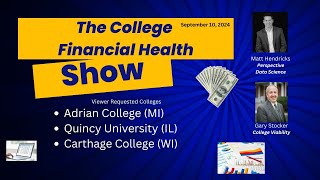
In this episode of the College Financial Health Show, host Gary Stocker (founder of College Viability) and data‑science expert Matt Hendricks (founder of Perspective Data Science) dissect the financial and academic health of three private colleges—Quincy University (IL), Adrian College (MI), and Carthage College (WI). Using audited Form 990s, NCES data, and the College Viability benchmarking app, they reveal that Quincy is in severe financial distress: consecutive negative net‑income margins (‑8.5% to ‑23% 2021‑2023), a $4.4 M cash deficit covered by credit‑card borrowing, bank overdrafts, and rapid depletion of unrestricted endowment assets. They critique the lack of decisive action by regional accreditors (HLC, Middle States), arguing that accreditation oversight is too timid to signal risk to students and families. By contrast, Adrian and Carthage show balanced budgets, positive cash flow, and healthier endowments, though both fall short of a 50 % four‑year graduation benchmark that the hosts deem a minimum quality threshold. The discussion expands to enrollment “spin”—schools tout rising headcounts while tuition discounts erode cash, making enrollment a poor proxy for financial health. They also examine expense allocations (academic vs institutional support), program‑completion numbers across majors, and endowment size as a proxy for institutional resilience. Throughout, the hosts position themselves as independent data‑driven watchdogs, urging transparency, better IPEDS tracking of student outcomes, and more aggressive accreditor intervention. The episode concludes with a preview of next week’s schools (Trinity Bible, North Central, Evangel, Crown).
Chapters
It's September 11th, and it's another episode of the College Financial Health Show where we look at the financial health and viability of private colleges across the country. We use data from audited financial systems, from the IRS Form 990s, and of course from the National Center for Education Statistics and its database. And bring it all together in a way that nobody else does. And today we're going to add something. We're going to add a theme. And this is the time of year when the college public relations machines are in high gear and they're telling us about how great their enrollment is. And today we're going to answer that age-old question: does enrollment mean financial success? Hi, I'm Gary Stocker, founder of College Viability.
Hey, I'm Matt Hendricks, founder of Perspective Data Science. Today we're looking at Quincy University in Illinois, Adrian College in Michigan, and Carthage College in Wisconsin. The takeaway from these three, in my opinion, is one is in very rough shape and the two others are in fine shape financially, and I'll take you through why I make that assessment. All right, I'm going to start with the, the, the rough one first. I'll share the benchmarking app first that we use every episode. So we're starting with Quincy. That's the one that's in rough shape. Quincy University in Illinois. And you can see why I think it's in rough shape. Again, they're the blue line here. This is their net income margin by fiscal year. They had a negative 8.5% loss in 2021, negative 11% loss in 2022, negative 23% loss 2023. So they're getting worse, and again, they're worse than the schools that have recently closed here, that set of 9. Um, another thing that is very, very alarming— of course they have a negative cash flow, and it turns out this is about a $4.4 million cash deficit that they covered using credit cards basically, um, and, and also overdrafting on their checking account, which is really interesting, the first time I've ever seen that, um, and pulling a lot of money from their endowment. So all of that's there. But the most alarming thing, again, for this school— we saw two schools last week where their unrestricted net assets went negative. Well, that actually happened for Quincy in fiscal year 2023. That's very alarming. Again, it suggests that if they were to close, even after, like, selling everything, they may not be able to pay back their creditors. I guess it would depend on the legal decisions around restricted endowment funds, if those can be used to pay back creditors or not. And I'm not actually sure that that is like settled case law. So it's very interesting. We'll have to watch this for schools that start closing that have negative unrestricted net assets. Okay, so that's what they look like. Again, they have massive deficits. So let me show you something that's really interesting on their audit. So this is the first time I've ever seen this. So one of their liabilities is a bank overdraft. So basically, so they have 3 lines of credit and a bank overdraft. So things are not going well at Quincy. I mean, maybe their enrollment's doing better, but it certainly hasn't shown up in the bottom line yet. You see, they've had a bank overdraft. Again, the first time I've ever seen this on the liability sections of an audit. They have almost $500,000 in overdraft their bank. So hopefully their bank is being nice to them and not charging them massive fees for that. But it's interesting inside of this line item here, they have 3 lines of credit and you can see they drew an additional $3 million or so on that in 2023. That was to cover their $4 million cash loss from operations, this $300K draw as well. And then they also drew down their investments. You can see all this right here in the balance sheet. So their investments went from $24 million to $19 million. That was basically— they pulled— and what was it? They pulled $3 million or so from their unrestricted endowment, which there's only $3.5 million left in their unrestricted endowment. And just a little history on that as well. This school recently went to the attorney general in, I believe, 2020 or '21 in Illinois and asked them to unrestrict a bunch of money that was supposed to be restricted for scholarships. And so they unrestricted that in 2020. Uh, their unrestricted endowment fund was up to like $6 million then, and now it's back down to $3 million. So basically they're burning through this, what was formerly restricted endowment funds. Um, so again, Gary, we focus mostly, mostly on like students and, you know, parents, you know, of course the staff that work at these schools, but they're also donors. When you think about like, if you're going to give a restricted donation to this school, I don't think that you should really, uh, be confident that that restriction is going to be held. Uh, this school certainly is going to the Attorney General to unrestrict endowments, funds to be used for, uh, whatever they feel like, right? Basically is balancing the budget. So, uh, something to keep in mind if you're going to give a restricted donation to this school, it may not actually be going to what you want.
Yeah, and we're seeing that more and more, Matt, where colleges are sometimes asking those donors to release restrictions and sometimes they're not asking at all. And of course, that's not good in either case. But in the second case, when they're just doing it on their own, that's a risky proposition, Matt.
Yeah. And it's interesting, even in the, the auditor's going concern sort of clause, they're like, yeah, the school's losing a lot of money, but they do have the option to go to the attorney general and unrestrict a bunch more assets. So basically that's part of their strategy right now. It sounds like at least the auditor is saying, making it sound like it's not really a big deal. I think that's a pretty big deal, right? What kind of confidence can you have sitting down with your donors and saying, hey, this is going to go to a scholarship when, you know, it may or may not go to a scholarship and they have a history of actually not putting it there. So that's another thing to think about. So again, negative assets, they're running the place on lines of credit and a bank overdraft. And again, there's this question of what's their accrediting agency doing? What are they saying? Are they signaling to the market that there are problems? Problems. And again, I just don't think there's enough happening. I can show you by pulling this over. This is the HLC record for Quincy, and they're doing some stuff, but it's not very obvious, right? They had a comprehensive evaluation in 2024. So basically, Quincy University in Illinois, they are running big deficits right now. They are covering those deficits by unrestricted endowment funds and using large draws from their endowment to cover the loss. They're also using lines of credit, 3 of them, and overdrafting on a bank account. So the question is, I mean, one question we've had, Gary, in the past is, are the creditors doing enough to sort of signal to the people that are participating in this market, particularly students and their families, that, you know, one of the schools under their umbrella is in serious financial stress? And at a minimum, what they can do without sort of killing the schools, put them on probation, right? At least send a signal to the people that, you know, things aren't right. But, you know, one of the beefs that I think I definitely have with HLC and Middle States and others, they seem really reluctant to do that. Even the probationary tag, you can see what they've done. They just did a comprehensive evaluation last year in 2024. So they're seeing all the stuff that I just showed you. They have already seen that.
Yeah.
Negative net assets, the whole bit. Overdrafts, all of that. And, you know, I would suspect that that would be an automatic— I would argue that should be an automatic probation. Right. But it's not. They went with continued accreditation with monitoring, which is a really subtle thing. Like most market participants are not even going to know that's happened, I would imagine. And so basically it looks like in 2025, over a year from now, a year and a few months, they're going to have to talk about budget and finances again with HLC, which, yeah, you know, who knows if they'll even— like, if, if they don't turn it around, they may not even be around by the time that this review is going to be done. So it's irritating. Uh, I wish HLC and Middle States would do more, and other accreditors, to, uh, not only warn the public but to also push these schools. Like, who, who's gonna make them do— balance their budgets if the accreditors are not even gonna do it, right?
So Um, you know, and, and you know why you go to the next college. Let me just talk about that. You and I before, in our, in our pre-show meeting this morning, we're talking about some social media exchanges that both of us engaged in this weekend. And it begs the question— I won't go into the details on those, Matt— but it begs the question, who are the accrediting agencies protecting? The colleges, Matt? Certainly, with what you've talked about, well, you know, I've talked about before, they're not upfront with the public. On the financial challenges of Quincy University and other places. Are they protecting the students? Now, what started this whole social media conversation over the weekend was one, the president— I'll be honest, the president of Middle States essentially wrote a self-serving piece that said, we're here to take care of the students. Well, Matt, I can make the argument, and I'm guessing you would concur, that in the case of Middle States, I think HLC mostly, and maybe the other accrediting organizations, their focus is not on protecting the students at these colleges. Their focus, Matt, I think, and I think I'm right, is on protecting the colleges. Is that right or wrong? I don't know.
Yeah, I think that's right. Um, yeah, man, so lots of questions I would have if I were a congressperson. For sure, I would be asking serious questions about why— I mean, maybe the incentives are wrong. Maybe the accreditors have an incentive to accredit the schools, right? Which is a problem, right? They should be sort of agnostic to whether the school is accredited or not. If you're going to sort of judge these schools, you need to be sort of separate and willing to drop the hammer if it's needed, right? I'm not sure if that's happening. Okay, so I'll be quick on the next two colleges. So clearly Quincy's in very rough shape. Again, most of the schools we've seen have closed, have not gone to negative unrestricted net assets. They did it before that, probably forced to do that by their creditors, their banks or their bondholders, but for whatever reason, their bank is a lot more patient with them, which is nice, but you just don't know how long that's going to last. Yeah, right. So Adrian College, again, the biggest thing I'm looking for, for financial health for a school is whether they have a balanced budget. Basically, are they ever able to consistently bring in enough revenue from their operations to cover their expenses, including depreciation, right? I'm including non- cash expenses. Uh, you have to maintain your buildings, you have to repair roofs every once in a while, right? So, um, and both of these schools are doing it. Adrian's doing it, Carthage is doing it, and Carthage has a lot of assets and a big endowment on top of it. So I'm not worried about them at all closing. I think you're safe to join either of these schools, to be honest. I'd send my daughter to them. So, um, I mean, based on the finances, you know, there's a lot more to look at, but I mean, I'm not gonna be worried that it's going blows on my daughter, basically, is the idea, um, thinking. Um, so let me pull my notes back over here and get you guys on the app. Um, so Adrian College, it's in Michigan, and, um, you know, I'm looking at a longer history. Of course, they had a really rough 2022, but they followed it up with a good 2023, and they had a fantastic 2021, of course, because that's the COVID relief year. So, you know, this, this negative blip right here could have been just them spending all of this money that they got from COVID relief, which is totally normal. And you can see they have a long history of keeping their net income positive. So this is perfect, right? This is a school that's clearly able to manage its budget and bring in enough revenue to support its operations. Cash flow is always positive. That should be the case, right? Cash flow should never go negative because it's not even including depreciation. If your cash flow is negative, it means not only are you not covering your cash expenses, but you're not even covering like non-cash expenses like depreciation. So that's great. Yeah, the school looks good to me. I have no concerns. You know, they have a lot of liabilities, but it's fine if you have a balanced budget, you can do it. All right. The next one is even in healthier shape. Carthage College in Wisconsin, which is good. I mean, I really like these cases because it's not like— because people like to generalize, right? Like, oh, every school in Wisconsin is going to close. It's not the case, right? There's a lot of small schools out there that are doing very well, and I'm really glad that we have some cases here that are doing fine. Again, consistently positive budget here, net income. This is excellent. They did have a rough patch, but it looks like they fixed it. That's exactly what the board and the administration is supposed to do, right? Oh, we had a couple of years that weren't great. Let's fix it. And bam, you fix it, right? You see how they're right in with the schools that closed. But the difference here with Carthage is that they fixed it. These schools didn't.
Yeah, interesting.
And again, always positive cash flow. That's great. And here's their big endowment. Their endowment's almost twice the size of their expenses, which is excellent. Endowment appropriations are perfect, about 4.5% allocated to operations. It's great. They have higher liabilities, but that's just because they have a lot of assets. You can see their unrestricted assets here. Remember, Quincy was negative. This school has twice as many unrestricted assets as expenses, right? And Quincy was negative. So that means, again, roughly, this— liquidate this school, they could pay back all their debts with their unrestricted assets and have twice that left over, right? So, much of a different story here. So that's— these are good stories, and I'm really happy to share these. But I'll pass it over to you, Gary. What do you think if you want to go into the enrollment story on these schools.
Go ahead. Well, I do. And I want to go back to the theme that we have for this week, and that is we pick 3 colleges and for the most weeks we agree to pick 3. Sometimes we may do 4. If it's really bad, maybe we'll pick 2. But the theme this week is, is colleges are saying not universally, but way, way, way too often that we are great because our enrollment numbers are great. For this year. Now leave aside that many of them qualify those enrollment numbers as to be unrealistic, but in each of our three cases today, we have Carthage, we have Adrian, whose enrollment numbers went up and their finances, financials justify that. Quincy, the same thing, had a positive beginning of the year announcement about their enrollment, and as I recall, it was highly qualified. But as you shared, and I will share here in a minute, on the College Viability App They're not healthy. I, it's accreditors aren't doing their job. Board of trustees and college leaders are not doing their job. Certainly the Department of Education is not doing their job to point out not just the financially weak Quincy Universities of the world, but the others that we've pointed out in recent shows on the College Financial Health Show. Matt, I worry that you and I are the only ones out there trying to wave these flags saying don't buy all the PR. Some of it's legit for sure, but much of it is just spin. Now, in, in the Monday podcast I do on This Week in College Viability, I say all the time, spin all you want, colleges. We all do it. We all spin our stuff. There's nothing wrong with that. But Matt, you and I, among a small number of others, are trying to say, hey, colleges, you spin, we're your quality control mechanism. We're the quality control mechanism that says, hey, not so good, boys and girls. And, and yes, we have two examples of financially strong colleges today. Um, we have more those that are weak, Matt, that you and I show than those that are strong, but we try and do a reasonable balance. But if your college is in financial trouble, Matt, you and I might be the only ones doing that in a timely manner. And, and I appreciate your expertise and guidance. But boy, it concerns me that not enough folks recognize that the Quincy Universities of the world, they're spinning something that's not legitimate. Matt, is that fair?
Yeah. Well, I mean, they certainly are, oh, their school, right? Their best, right? And so that's why we, this is exactly, this is sort of sparked the conversation too about having the accrediting agencies. You have this conflict of interest, right? You have the, The board and the president, they're always going to say their schools are great and they should, right?
Right. Right.
That's why we have accreditors because the accreditors are supposed to sift through and say, okay, that's actually not true. This school is completely broke and may close. Right. And you know, all of that's totally great. But the problem is if the accreditors are not doing that, I feel like we have to do it. Right. And that's why we're doing this show. Right. There's just the information gap is pretty large right now. And I want to make sure that, you know, when you read these, also look at these other things, right? I've also seen schools that, you know, they actually have been record enrollment year after year. Problem it looks like is the kids aren't paying any money to go there, right? The school's going broke. Their net tuition revenue is decreasing even though the school's getting higher enrollment, which is even worse, right? You need more buildings, you need more faculty to service these kids, and you don't— you have less money. It's like, it's insane. Right.
And you've heard me lovingly taunt the credit agencies, and I call them I-doters and T-crossers because I think they just focus on inputs. Ryan Craig had a big story on that this weekend with college rankings. I had that on Monday's podcast. But there's another factor to consider, and that's, you know, Quincy University may or may not close. Their finances are strong, but it's not necessarily that it may or may not close, but clearly they don't have the financial resources to provide what I would consider a quality college experience because they're, you know, they're, they're overriding their checking account and they're borrowing from multiple sources. So it's not just they may or may not close. You and I will never say a college will close. We just talk about their finances and we compare them to others. But boy, it's sure easy to say that they probably are not in a position to provide the quality kind of education that we see maybe from the Adriens and from the Carthages. It's just, That's, I think, just as important. But let's go to the College Viability app. So let me go ahead and share my screen. So I'm— this is the 2024 Private College Viability app, and I brought up my favorite topic, Matt, and that is 4-year graduation rates. And we've got 2 of our 3 colleges we're reviewing in this show that are reasonably financially strong, at least by comparison. Let's look at the graduation rates. All right. So for these 3 colleges, look in the bottom right, the average graduation rate in 2022 is 46%. At College Viability, we have a minimum threshold of 50%. Matt, we think you should be able to graduate— a college should be able to graduate at least half its students in 4 years. It's a sad commentary, but that's our minimum. And really, 2 of the 3, including Quincy in financial trouble and Adrian not so much in financial trouble, don't even meet that threshold. Now, if somebody were to say, all right, of the 3 colleges you're looking at today, Gary, which one would you recommend? It's an isolated question. It's easy answer. Look at it. It's Carthage. And Matt, it's because they graduate folks. And even Adrian, with decent finances that you showed, doesn't even graduate. It looks like the average is somewhere around 40%. So for every 100 students that go to both Quincy and Adrian, in this case the numbers are the same in 2022, for every 100 students that go there, Matt, 60 of them don't graduate in 4 years. And you've heard me say before, and I'm going to keep saying it, if you can't graduate at least 40% of your students in 4 years, I don't know that you're a college. You may call yourself a college, but you're more of a tuition collection agency. Let's look at more comparisons. Now I'm going to bring up a version, uh, it's kind of my Gary's customized version of the 2024 Private College Viability App, and this executive analysis version, because it gives us an easier way, Matt, to look at the data. So these are the graduation rates. We just talked about those. You can see the 2022 version of that kind of stuff, and you can see the actual raw data for all these colleges. Pause the video as appropriate to look at those for the colleges you're interested in. But I want to look at the bottom. I want to look at the 8-year changes, and it shows us that Adrian has been able to grow its enrollment. Quincy is essentially flat, down a couple students, and Carthage, even though financially healthy, has, you know, had struggled to get students to enroll. You can see the numbers, and it's down on the full version of the app. It shows the actual percentage. Grad students, 8-year changes, you can see, do I have grad students? Yeah, all 3 have, you know, a decent number of graduate students. And Adrian's grown theirs, Quincy's flat, Carthage is essentially flat over the last 8 years. And just, just give you a feel. And the admissions yield, which is a percentage of students who show up once the college accepts them, you can see that's up a little bit, Adrian. Flat at Quincy and down a little bit at, um, at Carthage College. These are all indicators. These are essentially the equivalent— these are essentially the equivalent of the Kelley Blue Book. These are comparisons. We are kicking not the tires of college, we're not kicking the tires of cars now, we're kicking the finances, the financial tires, if you will, of colleges. These are comparisons that you can draw. Let's look at the revenue and expense. Now keep in mind that this is data— is 8 years worth of data. Matt showed a similar kind of number on the financial piece. And let's just look at a couple things. So in 8 years, the total expenses, um, the change in total expenses for these 4 colleges was up $10 million for Adrian, up $4.5 million, $4.2 million for Carthage, and up $4.5 million plus for, for Quincy. Let's go over here and look at the revenue. Now, to Quincy's credit, their total revenue is up. They still have issues, as Matt talked about a few minutes ago. The total revenue is up for Adrian, not as much as their expenses, but it's up. But even Carthage— and man, I'm going to be answering your comments on this, and I'll pause here in a second to give you a chance— but their total revenue was down $36 million, going on $37 million over the last 8 reported years, 7 years of revenue here. What does that tell you? Are they— they can live with that? Is that what that's telling you based on what you said earlier about Carthage?
Yeah, I'd like to dig into that. Um, I mean, I've seen schools that are excellent at just maintaining a balanced budget no matter what the revenue does, and they may be one of those schools. And, you know, that's exactly what I'm at. I would really like every school to be that way. Of course, you don't like your revenue to fall that much, but you need to be able to adapt your budget and still be balanced when that happens. Right. And they're clearly doing that.
Okay. And then a couple of things on this summary screen, the endowment. And again, you've heard me talk about math, the minimum I have. You can have whatever minimum you want. The minimum endowment I have at college I built is $50 million, $50 million. And really neither Adrian nor Quincy do that. And really, I guess you can consider the endowment a savings account. That's kind of what colleges are using it for. And if it's not $50 million, I make the case that a college doesn't have the capacity. If they haven't raised $50 million over their decades, and in some cases centuries of existence, they can't do it on short notice. So Quincy in financial trouble, they're at $23 million in 2022. And if they tell us we're going to raise $40 million in the next 2 years, man, uh, yeah, it's not going to happen because they haven't raised that much in decades and not centuries.
Did they say that? I'm just kind of curious.
No, no, no, no.
It's actually shrinking.
The college up in, in northern Wisconsin, Northland. Um, had raised $6 million over its existence. And in March of this year, I think they said they wanted to raise $12 million in a month, right? They raised that $1.5 million. So I'm right.
If you're likely to shrink, they're just pulling so much from it.
And that's another point that you've talked about as well. So anyway, the endowment is just an indication of your capacity to earn gifts. And really, two of these three haven't shown a big capacity to do that. And on the expense side, we talked about that a minute ago. But a kind of a different spin. And Matt, you and I haven't looked at this before, even though I've had it on my summary screen. This is this expenses for academic, institutional, which is essentially management, instruction, and student services. Now, what I look for here is big disparities. All right, not any big disparities, although Adrian's not spending a whole bunch by comparison on academic support. Look at their spending on institutional support at Adrian compared to the other two. Yeah, I'm not drawing any conclusions on this, but it's, it's fair to say they're spending a lot of money on non-academic talent, especially compared to the other two. Instruction expenses are relatively the same. Student service expenses, for the most part, the same. Carthage is a little bit down. And then you can do the same thing per, per student. And again, look at the numbers. This should jump up and slap folks in the face at Adrian College. $600 per FTE for academic support, $11,000 for institutional support. Either they are heavy on top or they don't know how to enter the data, Matt.
But in either case, I suspect, so there's some schools that will incorrectly put their program's office in one of the, I can't remember, is it supposed to be, I think it's supposed to be institutional support, but they'll put it in academic or vice versa. But yeah, there can be some messed up.
It can be, but still it provides a fair question for you and I and others to ask, why is that number so high? Right. It's a data entry error. That's fine. Fix it.
But if it's not a data entry error, and you can add them up and still see they're high. I mean, on combined academic support and institutional support, those are, that's, I still consider all of that administrative spending. That's your deans and your upper admin. And it's high at Adrian and they're low on instruction. So that's a huge red flag for me. Um, especially if I were a faculty member there, right? It was actually one of the issues that I raised at my previous employer, right? Which led to a whole mess of issues.
Again, it's data. We, as we talked before, higher education is in the moneyball era where data means something, data's available. You and I, among others, are using that data to make the case that colleges need to do better. And then lastly, let's just go back and quickly look at program completions. And we've just done this a couple of weeks. It's a new app that we have here at College Viability, and it shows the number of programs in these 16 areas you see on the right, complete at each of these 3 colleges, right? So let's just take a quick look at a couple of these. I want to go to biology because it's always an easy one to go to. And we can see each of the 3 have, you know, some decent numbers. They're not, they're not materially significant in the overall scheme of things. Let's look at business and marketing because most colleges have big numbers there. We can see Carthage does well. This is the bachelor's side. This is the master's side. Looks like Quincy might have been making a big push to get a few more on the graduate side, not a big number. I want to look at computer and CIS to see the high end of these colleges. And, you know, Adrian's not playing, which is fine. That's a decision they can make. But both Quincy and Carthage, Matt, I would make the case, are just dipping their toes into computers and CIS and probably don't have the faculty expertise— pure speculation on my part— don't have the resources that a college that has dozens or hundreds of bachelor students completing or master students completing CIS. None of them are playing in master's. And then I want to take a look at visual and performing arts on the other end of the scale. All right, Carthage again, you know, decent numbers. Quincy's really not playing there. Um, I don't— that's a real small number. And it looks like, um, Carthage has a handful of folks on the visual performing arts. Here's why I bring this up, Matt. If you're looking at a major, if you're looking at— let's use communications as an example. I'll just click on communications, and you're a journalism major. You can go to College Navigator, or you can look at the College Viability app, the program completion version of it, and look and see which of these colleges have strong numbers in those programs. The reason that you want to do that, and this is especially for students and their families, if the numbers are low, you want to be really, really, really careful about selecting that college is because, Matt, in this day and age, as you well know, it's the low number programs, it's the low enrollment number majors that are being cut. And the last thing you want to do is select a college with a major that has low enrollment and they decide to cut it while you're there. The trauma that that causes, has caused, and will continue to cause is nothing that we want to speak on. So Matt, questions for me?
Yeah. So I, I'm intrigued by the, again, the really low graduation rates. We, we don't have the ability in IPEDS to see where those kids go.
No.
I think if you're working, if you're listening, working in the federal government, think about changing IPEDS so we can actually track where a lot of these kids are going. Are they going, are they quitting higher ed? Are they going to a different school and getting a degree? I think those are very different outcomes, right? Like, some of these schools appear— are clearly 2-year schools, right? Or like junior colleges masquerading as 4-year institutions. Like, barely any of them are graduating. Where are they going? Are they just kind of treating that school like a 2-year, like, do some general eds and then go to the big state school? Or what? Are they just totally getting put off by higher ed by that school? I think if you're one of those schools where everybody's getting put off, that's, that's a very bad situation, right? It's a bad, that's a bad school to have in the market. Whereas if the school is more like a 2-year stepping stone, clearly not great, but maybe much better than, you know, totally turning students off from higher ed at all.
Right.
So this is the thoughts that came to my mind that there's a really important missing data here. To track. I know we can do it. It's the Clearinghouse can do it, but we can't get access to that data.
Right. Right.
Public. I've asked them before.
And, you know, I, I make the point on this that I recognize the fact and generally acknowledge that I didn't do that today, that I realized some number of these students go somewhere else and graduate. That's fine. But what it does provide is a reasonable comparison. If only 40% at Adrian and, and Quincy graduate in 4 years and Carthage was at what, 60%, whatever that number was, that's a valid comparison.
I've actually seen that school.
Carthage has systems and processes that Quincy and Adrian don't. That's the argument that I make. Yeah.
Talk about spin though. I've seen schools actually argue that, I mean, even though we're not graduating the students, they're going to other schools and graduating. So like, we're good. I don't, I don't, I definitely don't wanna defend that position, but I really would be concerned if your school is so bad that it's making all the students not want to do higher ed at all. Right? Yeah, that would be a huge red flag.
So, so, so, Matt, the theme today was public relations and reality. I guess I'm kind of restating it here. And again, colleges are welcome to spend enrollment any way they want, but enrollment that I talked about in Monday's podcast on This Week in College Valuability, enrollment is not fungible. Banks frown on students showing up and saying, hey, we're the deposit for our college. Utility companies don't like to see students show up at their door as the equivalent for cash because they're not. Enrollment only means you've got bodies there and the costs associated with that. As you mentioned a couple minutes ago, it is the tuition revenue and the, and the associated fee revenue that comes from those students that make a deal. And in this market, Matt, the tuition discounts are so heavy to get students in the door that increasingly colleges don't have the cash, as you could also capably demonstrate, to, to meet payroll, Matt, and to keep the lights on. Right. Yeah.
And it could actually be their strategy, right? Like, oh, let's just bring in a freshman class where barely anybody pays anything, advertise it like, oh, we're growing and super healthy, and sort of trick the consumer into thinking that Everything's great, right?
Like, that's why we're here.
We're trying to call them on it, right?
And if so, that's a sad, sad commentary. I'll let you take us home, Matt.
All right. Um, so yeah, yeah, exactly right. Um, so anyway, thanks for watching us today. Um, if you have questions, uh, please reach out. We'll put our contact information in the, the bottom. Gary, we're going to mention the schools we're going to talk about next time.
You know, let's do the colleges that we're going to be doing next week. So now, before we sign off, let me go ahead and give you the colleges we're going to look at next week. And we're going to be looking at Trinity Bible College, we're going to be looking at North Central University, Matt, Evangel University, and we're adding a fourth next week, Crown College. So Trinity Bible, North Central University, Evangel University, and Crown College are on our list for next week. Matt, I look forward to going over those with you.
Yeah, sounds great. Those are all requests, by the way. So, uh, again, send your requests and questions, comments, uh, we're happy to respond. So thanks. So I'll see you guys next time. For Gary Socker, I'm Matt Hendricks.
We'll see you next time. Mm-hmm.
More from Gary


What does it look like when a college increases both total revenue and total expenses?



College Financial Crisis? We look at the financial health of Bay Path U. (MA) and Coe College (IA)


Private College Financial Crisis? We look at the financial health of Hobart William Smith College


Financial Compass tutorial (Private college version.) Financial statements compiled 2016-2025.

