The College Financial Health Show with Matt Hendricks & Gary Stocker for October 15, 2024
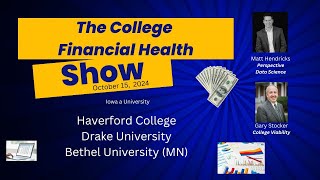
Gary Stocker and Matt Hendricks analyze eight years of financial data from three private colleges. Haverford turned around after five years of losses by raising tuition $22k above peers and cutting admissions by 23 percent. Drake and Bethel show persistent deficits, with Bethel's net tuition revenue down 22 percent since 2016 and relying on a 6.4 percent endowment draw to stay afloat.
Chapters
Hey, it's October 15th, 2024. It's time for the show. No, it's not professional baseball, the show. It is the College Financial Health Show. This is the only show that looks at the financial health and viability of private colleges, and we share data from multiple sources and offer our analysis and recommendations. Who's this show for? It's good for college leaders, for faculty, students, family, and other stakeholders. And today we're doing our first live broadcast. We are live today from Indianapolis, Indiana, where I am attending the American Association of University Administrators on the campus of the University of Indiana in Indianapolis. Hi, my name is Gary Stocker, founder of College Viability.
Hi, I'm Matt Hendricks, founder of Perspective Data Science. Today we have a good story with Haverford College in Pennsylvania, uh, and then others that, uh, two others that are not, not so good, but, um, not nearly as bad as we've seen in the past. So we have Drake University in Iowa and Bethel University in Minnesota, and I'll start by bringing you through the key financials on our benchmarking app first. Starting, I'm going to start with the good, the good case first, which is one that I identified just by looking at the data and trying to find schools that appeared to be struggling for a number of years and then have suddenly turned it around. And Haverford was one that came up. And so I've only recently started looking at them and trying to figure out what they did. But so I have some, I can, some insights I can share, but other things I think we need to ask the the people that were on the ground there and see what their impressions were. But here's the reason why it was flagged. Let me zoom in a little bit. Um, it was flagged because it had negative net income for 1, 2, 3, 4, 5, 5 consecutive years, and then all of a sudden— oh, 6 consecutive years, sorry— and then all of a sudden 2 positive years here in 2022 and 2023. Um, so that's Essentially a turnaround there, many years of negative net income and followed up with positive net income in '22 and '23. Actually, those years were rough on most schools, so that's great. So that's their net income. Their cash looks really bad here, but that's not the case. This is one of those schools again that pulls their endowment draws out of net cash from operating activities and puts it in net cash from investing activities. And so if they put the, they did the accounting the other way where they kept it in operating activities, these would all be significantly positive, looking really good. So that's no worry there. Another thing to note here, this school, while they were struggling, let me show you their endowment draws. This is something that Gary and I have been looking at, you know, struggling schools, one thing they'll do is pull more from their endowment than they should be, than is sustainable or advisable. And they were doing that for all of those years where they had those negative net income, they would— those net incomes would have been much worse had they not made these massive draws from their endowment as well. But notice they not only fixed that, their net income, but they also fixed it while pulling their draws back down to where they should be. So that's excellent. Again, great story here on a school that's clearly rebounded financially. So how did they do it? Let me show you a little bit about the high level of what happened financially for them and how they've turned this around. Was it a revenue story, expense story? Well, it's all revenue really in their case. You can see their net tuition revenue here is up 46% and surging recently. I mean, this is going from 13% up to 46% up in just 2 years, and I'll show you why that's happened. Has a lot to do with their price. So I'll give you some detail on that, but it's all about revenue here. Their operating revenues are up. Search this. Operating revenues, I've got down here, up 37% since 2016. And let's compare that to their costs, expenses. Expenses are up only 28%. So the school is growing, but essentially the revenue went up 36%, costs up 28%, and there you get the closing budget gap. Another thing that's nice about this school is the CapEx spending. We mentioned last time just keeping up with your, you know, replacing old computers, making sure there isn't deferred maintenance, things like that. It appears the school is doing a good job of keeping up with their capital stock. And the reason I say that is they're, again, the blue line, you want this to be above 1 almost every year. And that's mostly the case for them. And in fact, far higher back here. They might have been investing a lot in buildings back here, which was happening while they were struggling financially, which can be—
they probably don't have any holes in the roof. Matt?
Probably not. Yeah, probably not. So this is all great. And so the question I had and the reason I wanted to find this schools like this is to figure out, okay, what did they do? How did they turn this thing around? And I'll say one thing I did find I found this back in 2016. This is right when, you know, they'd been running deficits for several years and all of a sudden I found this plan that their board put out, which is absolutely amazing. And so I want to emphasize this because we talk a lot on this show about how, you know, the HLC or middle states, the creditors aren't really doing their, their bit.
Yeah.
But honestly, um, and I had, I had a note from one of my old econ professors back in the days, like, you guys need to focus more on the boards. And like, yeah, that's exactly right. I mean, at the end of the day, it's the board's responsibility to make sure the school is running well, especially financially, and is sustainable. And I want to make sure that's, that it's not lost on this show. It is the board's job to do that, right? I think some boards that I've— it seems like some boards don't really understand that they're in charge, for one. Um, and for two, they don't really seem motivated to act even if they do know they're in charge.
They're just kind of Absolutely right.
And, and I think both of those things are not happening here. This Haverford board clearly, just by this, putting this post out, I think they clearly understand, at least some of them do, they understand that they're in charge and that they, um, have a responsibility. And let me just highlight something that was part here, this first part. They've actually bolded it. I didn't do this.
This was—
this, this statement right here is amazing. And I want to emphasize a few things on it because it is a bit subtle. And I have it here. So that statement that I just showed you, it says right out of the gate, in order to ensure Haverford's mission of academic excellence in perpetuity, which is the fiduciary duty of the board of managers— they call themselves the board of managers— that is huge. They know that they're stating, they know that this is their job, right? It's not the administration's job. It's their job. All right. The college is developing a multi-year plan to achieve operating equilibrium on a full accrual basis. This is also huge. It seems really subtle, but it's huge because it says it means that they want the school to be balanced in terms of including also depreciation expenses. A lot of schools will go, we'll just operate on a cash budget and make sure the cash in, cash out is balanced.
That's most of them, right? That's most of the colleges we look at.
Yeah, that's not, that's not sustainable because you're going to have deferred maintenance then. There are a lot of things that are accrued today, expenses accrued today, like, you know, older roofs, computers that wear out, things like that that you don't necessarily have to replace today, but the cost was incurred today. And so that's what they're saying here is that we're going to do a full accrual basis. We're going to account for all of those costs in the budget. That's brilliant, and that's the way it needs to be done. Okay, and then the third part here that is amazing, This board knows that they're in charge. We're going to make the final determinations about the best plan forward. Yeah, we get input from everybody, but we're in charge, not the administration. All right. And that is, I think that a lot of boards can learn from that. If you're going to be a board member at a university, read this over and over again. This is how a board should act, right? You know that you have these legal responsibilities. Chief among them to make sure the place is running sustainably. Don't, don't let the administration sort of make those decisions. If they're not doing it, you need to step in and do it. And it appears that that is what the Haverford board did in this case. So they have this long plan of, uh, of what they were going to do, but I'll just show you. We can see what, what actually happened and what, what this school did, and I'll show you that on the paid version of the app here that I have. Built for them because I was so curious. So let me go back to— so this is the paid version of the app. And I want to highlight what really did happen with this school. So as you already saw, their net tuition revenue surges. And you can see here in around 2014, their FTE student enrollment— these are all undergrads, by the way. Starts to increase in 2014. They made this announcement here in 2016, and there's a distinct change that happens here. Let me show you applications. One thing that's really shocking about this school, when I was looking at, okay, how did they actually turn down their— or turn around their enrollment? The board made the announcement here, that reading that I just did. Notice what was happening with their applications. It was falling relative to their peer set. So my guess is something bad happened back here in 2013. They made some kind of wrong choice, probably. Yeah, that affected their applications or, and/or demand for the school. Uh, maybe it was a marketing issue, maybe they just required too much of on the applications. Who knows? Um, I'd have to look back, and this is where the people on the ground could help us. They were definitely going astray here. And you notice even though their applications were down here, enrollment was going up. How do you suppose that happened, Gary? I'll show you in a second, but basically it just became less selective, right? They just admitted a lot more of these kids, which is one way to grow enrollment, but it's not ideal, right? What happens here though, at 2016 on, is totally the opposite. They get this surge of applications going up and in fact exceeding their peers then. And they become more selective. And still grow enrollments. And they also charge more. All right. So there's a huge shift that happens right when the board decided this is enough, we need to do something. And I'll just, just to show you those points, I can kind of show you it here. We look at the, if we look at the, the movement from, so what I'm showing you here is on the app, you can see all of the enrollment funnel parameters right here. And I'm going to highlight a few of them from 2013 to 2016. That's that range where right here where the apps are kind of falling off, right? Notice their freshman class gets a little bit bigger, gets 7% bigger in 2016 relative to 2013. But how did they do it? They admitted 7% more applicants, right? So basically they grew their enrollment by basically one admitting a far higher percentage than they used to. And they had a slightly increased yield, which is also probably because they're admitting more kids that sort of, this is their aspirational school that they're getting into, right? So interesting that that's how they grew enrollment here was mostly by admitting a higher rate. Notice, compare that to the next 3 years after 2016. So 1, 2, 3. Notice the total turnaround, 35% increase in apps, 23% reduction in admit rate. So they became way more selective, had way more applications in just these 3 years compared to the 3 years prior. That's amazing. And so I can't explain what they did. I looked at, you know, whether they hired some contractor to do marketing or something like that. I'm not sure. But I can say we need to figure out what they did and it'd be cool to get them on the show to figure out what happened here. I mean, it could be many things. It could be just a change in the admissions office, a change in marketing. Marketing, uh, could be like putting more people on the ground in different high schools. Who knows? A lot of ways to generate a lot more applications.
Uh, but selectivity piece is interesting that they could grow and become selective. I don't know that I've seen that before.
Yep. So yeah, here's the math: 35% increase in apps, 23% reduction in admit rate. You still get a growth in undergraduate enrollment. Notice also that there's this growth in transfer-ins as well, although it's tiny. Uh, you know, I don't bring in a lot of transfers. 25 Yeah, but, um, it's still notable, right? Maybe something happened on the marketing side or something like that where you get this sort of across-the-board jump. Uh, really interesting though to check that out. Let me show you one more thing here on their, their recent surge in net tuition revenue. I'm going to show you net tuition revenue per student compared to their peer institutions. Notice back here in 2016 when the board was like, hey, we got a problem. Their price was higher per, on average, per student than their peer institutions. But look at it, and it's only a gap of like $5,000 here per year. Now it's off the charts. The average kid at Haverford is paying $51,000 today compared to $29,000 at the peer institutions here. That's crazy. And this surge here is, is just Oh yeah, that's exponential.
So, so clearly, clearly, Matt, before you go to the other two colleges, Haverford is doing something right. Here's my question. Is that replicable by other colleges? And if so, what would they need?
Yeah, that's the thing. That's why I want to figure out what they did. I mean, maybe it is, if it's just a matter of better marketing. I mean, anybody could do that, right? Um, uh, so I guess we need to find out what it was. It could be a lot of things. Uh, maybe they don't even know, right? I mean, that's pretty common. I mean, this happens a lot where like, oh, you guys did this. What? You got to know what happened, right? No, nobody has any idea what happened.
So I'll tell you what, if you're from Haverford University, reach out to us and there'll be show notes. Oh, include our email contacts. We'd love to have you on the show to tell us about your success.
I'll say one thing they did to get this is there's a surge in, uh, international student enrollment. And as you know, international students pay full price for the most part, right? So that could be a lot of this. But, um, yeah, lots of things to look at here and very Good success story. And again, I want to emphasize that although the board may not have been involved in making all these right choices, they, they made the administration make a plan, right? And they were clearly going to stick to it. Um, and that's great, and that's what needs to happen at all of these schools. You can't— it's not like a social club, right? Yeah, you're not—
it's sad. That appears to be the case, right?
You may be friends with the administration, but you need to also be willing to hurt their feelings, right? This is about making the admit— the— it's about something bigger than that, right? You need to make sure your institution is sustainable. All right, so that is Haverford. Let's take a look at Drake. Okay, Drake, kind of zoomed in. All right, so negative net income margins for 6 out of 8 of these years. So here's one positive, negative, negative, negative, negative, One positive, and that's because of COVID relief, almost certainly. Negative, negative. And, uh, this most recent year, fiscal year 2023, the most recent year we can see, it's pretty— I mean, it's only a 5% deficit. It's not massive, but it is the worst that they've had on here, I believe. So it's not going in the right direction.
For the new viewers, tell them about that red line.
Yeah, again, this red line is schools that have closed. Um, not all of them, it's a set of 9 that either closed in 2023 or 2024. So I wanted to kind of track like, what did they look like over this same time period? And they either closed here or they either closed here or off the chart. Okay. So yeah, clearly you don't want to be close to the red line. That's basically the idea there.
It's highly unlikely that Drake University closes, but that line is there for a reference point and lets everybody know what they're doing well in and what they're not doing well in.
Yeah. Yeah. So Drake, yeah, my, my impression is Drake won't close. They'll never close. They have a big endowment, lots of resources. They're actually similar to the school I used to work at, University of Tulsa. Also similar situation there. We're struggling financially. Never really was never even brought up that the school could close. But it's, you know, we're not on the right track and we're falling behind our peers was the main, the main discussion. And this negative cash flow from operating activities is concerning. And again, it's not huge, but it is a few million bucks. $3 million cash deficit here. And so again, that's— you need to cover that by borrowing or selling assets, basically. And that's never a good thing because those things run out, right? You can't do that forever. Okay, so why are they struggling? Also, let me go show the endowment draws here. Again, struggling schools will tend to draw too much from their endowment. Drake is kind of creeping up there. They're not— I'd say they're on the high end of normal. Uh, this is, you know, this, this dashed line here is the top 75%. So they're in the top 25% of schools here. This is the 75th percentile, top 25% of schools here in terms of percentage draw on their endowment. Although they fixed it a little bit here, looks like still higher than normal, but high end of normal. Um, so here, here's the issue. Let me— this is really simple math, right? There's nothing like— it's not like rocket science here. Their revenues are up 9% since 2016, which seems fine. The problem is though, their expenses are up more than that. Revenue's up 9%, expenses are up 15%. So they may have an issue with spending, right? And it's clearly, it's growing faster than the revenues. And one of the reasons why the revenue's not growing very fast is that their net tuition revenue is pretty much flat. It's down 1.6% since 2016, which is sort of normal. But, um, we just looked at Haverford, which was up like 40-some percent, right?
I mean, so, you know, there's been a lot of news stories about Drake the last many months, and indeed the leadership there is trying to manage expenses. We'll have to watch closely to see what kind of faculty rebellion might come from that, because that's typically what we see. You make any, you know, any college that makes a, any kind change their business model, the faculty almost always have significant protests in some form or fashion.
Yeah. So, so again, I was, this is a problem. If I were Drake, I'd be very unhappy with this result because the schools that are at the median here, quite honestly, are not nearly as prestigious as Drake is. Drake should be, you know, up here. So clearly they have an issue with their net tuition revenue. And so again, I made the paid app to figure out what was happening. Just did this right before the show and have lots of ideas for them. Uh, let me show you a few things. Um, so one thing right out of the gate, I have a page here about the price of the school compared to their peer institutions, and you can see right away the price is very high. Okay. And so that could be an issue. And usually if I see a really high net price, um, compared to peer institutions and a really low yield rate, it's a good chance that price is pushing people away. So that's one thing to look at. Another thing is just looking at why their enrollment's down. I'll just go to this simulator to make this really a concise discussion. You can see their enrollment's down a lot. This is their actual enrollment undergrad. And by the way, almost all of their losses in enrollment is from undergrad. So I can show you that on a different page. But in 2015, they had about 3,500 undergrads here. And if you go back even further, it was quite a bit higher. But again, the reason for the loss here, and they're going to continue to lose students with their current parameters, the main reason is it's not applications, unlike Haverford, right? Their applications are quite good, actually, historically. These years here, they have record high applications right now. So why isn't enrollment growing? Well, one thing is their transfer numbers are really also the lowest they've ever experienced. So if something's wrong with their transfer strategy, And you can't neglect your transfer strategy. This is 76 students. In 2010, they had 188. All right, these students stick around for 3 years. You don't ignore these students, right? That's like an extra 500 students or so. Okay, so did you see what I just did there, Gary? I went from what they were currently at. If you go to where they actually were in 2010, you get a massive bump here. Not right away, of course, but they're enrollment goes back up. And then you can see the other issue. Also again, in 2010, when their enrollment actually was the strongest that it's been in record, what was happening? They were admitting a lot more students back then. They were admitting 74%. Right now they're at like 67%. And I would, I mean, if I were them, I would ask why not just go back to less selective, right? I know there's costs, there's trade-offs here, but The school is struggling, right? I mean, I would rather be less selective and survive, although again, this school's not going to survive— not going to like fail. But this is an easy way to get back on track and then deal with your lower demand issues.
So, so reasonable speculation would be they're not really doing a very good job at Drake of showing value for the price they're trying to charge.
Yeah, so that's actually— that's the next thing. So I think you adjust both of these. You get— you figure out what's wrong with transfers. There's lots of ways to do a better job including transfers, including just setting up articulation agreements with different colleges and things like that. Admit more. That's really easy. You can do that tomorrow, right? The hardest part is this part. The yield rate is extremely low. 12% yield rate is very, very low. And just so you know, I'll show you compared to their peers, but if they get even like a 15% yield, they're back in business exactly where they were before. You see that?
3 points. That's 3 points, right?
So 3 things to switch. So why is their yield so low? And I think it has to do with the price being too high. It's possible, right? I'm not 100% sure on that. But of course, yeah, you can, you can do an experiment, right? And that's what I would encourage them to do. Try it, try it with a subset or something. You can do these and figure out what the impact is on what's your yield rate for this price versus this price. Right. And, and Try it out. You might find that you get your 15% yield if you just knock off the net price a little bit. And ironically, by reducing the price, actually increase your revenue. So that's the part that is important for them. Let me just show you again why I think the net price is— well, let's just make it real here. So for a student that has a Title IV student with a family income of $110,000, at Drake, they're paying about $30K, $29,000. Peer institution mean, $26,000. So they're about $4,000, $3,000 higher than peers set on average. And you can see it also in their net, um, their per student net tuition revenue. Again, it's showing up here, per student paying about $21,000. Peer set is about $18,000. And you know, some of these peers, I mean, they're not, they're no slouch. Um, University of Tulsa is in here, several schools that are rated higher than they are, although ranking, I don't care about rankings, but, you know, willingness to pay at these higher ranked schools is probably similar to Drake and the price is lower, right? I mean, this is the school I used to work at and this is where I threw a fit, right? You can see, you can see our net tuition revenue per student. And they knew it too. It wasn't like it was new, but the problem was our price was so low, although they fixed it now, but still lower than Drake, still lower than Drake. Okay. So and that's the case for almost all of these peers there. Drake's price is high. I would experiment with a lower price and also do a better job on transfers and see how that works. Admit more too. You can admit— let me show you the enrollment. The peer mean admit rate is 72%. They're at 67%. So I'm not talking about like admit everybody, but go to 72%. That's going to make a huge difference on your freshman class. Okay. So little tweaks here. And I think they're back in business, tweaking also the price down a little bit. It'll also affect, also improve their retention, right? Again, the students looking around, okay, how much am I paying right now? How much can I pay to go to, if I go to the University of Tulsa, it's free, right? Or it was for a while. Those are the kinds of things, um, that, uh, are happening to them, I think. And they may not— they may not know it, or they just may not have this tool to kind of make it clear to everybody. All right, last school. And I'm sorry if I'm going long, I just have a lot of fun stuff to talk about.
That's some good stuff. We're going to talk about your paid app here in a minute, Matt. Cool.
All right, Bethel. Bethel's clearly the one in the least desirable position. And again, the net income margin negative in 6 out of the previous 7 years. And although they've, they're kind of holding strong here at -1, -2% or so, but it's not good. This, this is a little deceiving. This year is much worse than that looks because they— let me just show you their endowment draw. They drew a massive amount, 6.4% from their endowment. So with a normal draw, like a 4.3%, 4.2%. I'm sure this net income would've been, you know, down here. That's not good. And so clearly not headed in the right direction. Why are they struggling? No shock. Their net tuition revenue is the big problem, down 22% since 2016. And again, you see this persistent loss every year. I mean, you'd be tempted to say, man, they're just doing worse and worse every year, but honestly, probably something bad happened way back here, right? And they just kind of forgot about it. And once that happens, how long does it take to get to the new steady state? It takes 5 years, right?
At least 5 years. Yeah. Yeah.
So it could be a shock that happened 5 years ago and you're doing everything perfect since, but because of that thing that happened 5 years ago, you never changed it. It will get you to a new steady state in 5 years. So, there's a possibility that something a long time ago happened that has never been corrected. Uh, it may, it may be something else too, but, um, that's the thing. So they're trying, they're trying to keep up with this. Let me just show you their revenue. So their operating revenue is down, um, 23%. Notice that's worse actually than the schools that have closed. So just to put that in perspective, 23% down on operating revenue, and they're trying to keep up with that. With their expenses, but not that, just not quite yet. So their expenses are down 18%, but the revenues are down 23%. It's not keeping pace. It's hard to keep pace with that. That's a pretty sharp drop in operating revenue. I have more to say. I mean, they're keeping up with their buildings. It looks like their CapEx, actually, no, they're not. I was reading the wrong line.
Let me show you. Bring that baby up.
Yeah. CapEx is mostly below 1.
Yeah.
Not ideal. Again, they're probably— if you worked on this campus, you'd probably notice things that are needing repair that are not repaired. Old computers, old equipment, things like that. Sidewalks that are cracking. Okay. So how are they getting by? You can see actually here in their endowment value, Take a look at their endowment. It's still a small endowment. Let me just put that in perspective for you, make sure that's not being lost here. The, their ratio of endowment to expenses, they always had a small endowment, but now it's kind of like a normal endowment. All right. Um, so the endowment is not big, but there was a massive surge recently. There's lots of donor support for this school, and that's kind of what's helping them weather this, it seems. And that may be the strategy. I think there's a $35 million donation here and another $10 or so here. Those are big on a percentage basis. Those are huge donations. So that's how they're, they're getting this thing going. And I did see a story that they started a new school or something with one of these donations. So maybe that's the strategy, offer new programs, new school, that kind of thing. So we'll see how that goes. They also did a tuition reset, right, Gary? And I think you're probably going to take it. All right. I'll hand it off to you, Gary.
So two things I want to talk about—
sharing here, sorry.
Two things I want to talk about. And before we talk about your paid app, you mentioned the net tuition revenue challenges at both Bethel and Drake. In my mind, that's a reflection of how difficult the market is to be able to raise net tuition revenue because your competitors continue to discount everything just to get students in the door. Is that a, is that a good assessment?
Yeah, I think so. I think it's totally possible to increase it. It's just, you need to be really careful that you don't have your net price set too high or too low, right? Too low, you're giving up revenue. Too high, you're going to lose students, right? And so there is a market price. The issue is it's not like the same, like when you go to the supermarket, it's really easy to know the market price, right? It's right on the thing. In higher ed, higher ed, they try to hide it, right? It's like, way more complicated even than going to a car dealership these days. Like it used to be where you go to a car dealership, they got some crazy price on the car, but the actual price is not that. And higher ed, it's even worse, right? Like half the price is, you knock half the price off the sticker and that's getting closer to where it is, but you still don't really know. And everybody pays a different price. That's the crazy part too. It's like airlines, right?
Just like airlines. Yeah.
Yeah.
Yeah. So let's talk about the paid app because you showed some fascinating observations and analysis. Tell us how someone can engage you on that paid app that you showed for both Haverford and Drake, I believe?
Yeah, pretty easy. Just send me an email, um, and I'm happy to create one and a report for you. And thanks for the plug, Gary. Yeah, that's, uh, I, I'm able to work directly with most schools except for the big schools. Um, I have some, um, contract clauses on, on those. But, uh, sadly, I really do want to work with the small schools that really could benefit the most from what I can offer them. Honestly, the schools that are probably not needing a lot of my help are the ones that are most likely to reach out for my help, which is really sad. And certainly the schools that are about to close are the least likely to reach out, which are— they're the ones that can benefit the most, uh, just by getting a better understanding of what's going on, right?
And yeah, it's, it's, it's a difficult cycle to get out of if you can't afford the help that you need. That in my mind is going to inevitably result in more and more closures. Uh, it's just, just, just a fact of life. So let's take it. Let me go ahead and share my screen and do the the other part of our show, and that is to kind of look at the history. So let's take a look at the right window here. Let's take a look at our 3 colleges, and we always start off with FTE. So I'll bring that up. And can we see for these 3 colleges that 2 of the 3 have decreasing enrollment, really the 2 that had the most financial troubles? And Matt, you talked about that. The value of the College Viability App is it's 8 years worth of data. Whether it's a positive trend or a negative trend, you're looking at 8 years' worth of data. And of course, APP shows you the absolute change, the percent change. And you can see that, you know, the absolute changes for both Drake and Bethel are not massive, but they're noteworthy. So we can look at, you know, and Haverford has been able to grow. And Matt, you did a great job showing the detail of that. But if Haverford has grown over the last 8 years, Matt, it's highly likely they'll continue to grow. But for colleges like Drake, for colleges like Bethel, you have to wonder if that 8-year trend is something that is baked into their future without some substantial changes to their business model. And then of course, we've done the enrollment, and guys, I guess I'll go to graduation rates next. And this one's a pleasure to do. That's not always the case on the show because, you know, many times we've shown 4-year graduations below 50— 30, 40, 50%. That's not the case this week. But there's— it's good news and bad news. You can see the numbers on yourself. Pause the video. Of course, there'll be a recorded version of this on our YouTube channel. Pause the video to look at the numbers. But these are really 3 successful colleges in terms of graduation rate outcomes. And yet, as Matt shared with us, and you see really mimics what Matt talks with the history, 2 of these 3, even though they're strong graduating Colleges are still in financial trouble, Matt. That concerns me all the time. If there's a college that graduates 30% and their, their numbers or their finances are bad, expected. But a college that's graduating students, it's, it's disconcerting in a lot of ways that they aren't able to have the finances. And again, I'm going to plug Matt one more time. Matt, you can get me a Christmas present later if you want. If you want, if you want an analysis reach out to Matt. Yeah, he charges a fee for it. Trust me, it's a manageable fee. But at least he gives you some data that you can use. Because if you look at the history, and look at Matt's real-time data, he's grabbed stuff from as late as 2023. Matt, I think you're at least a year or two ahead of any other reporting. Is that right?
Yeah, I'm about to start the 2024 data scrape. I have like 100 audits now. So Okay, critical mass.
Thank you. We'll look at tuition fee revenue collected, and no surprise here, a little bit though. Drake is flat, um, from 80— really about $85 million total tuition fee collected over the last 8 years, mostly flat. Bethel's down $10 million, but again, as you shared, Haverford— God bless them, Matt, they're doing a lot of things right. And I— if you're from Haverford, reach out to us, we'd love to have you on the show to talk about what you're doing so well. And then we also take a look at— Matt, you mentioned the percent admitted on your paid app. I think. And look at how selective Haverford was in 2022, and look how much more selective they've become over the last 8 years. Um, for those watching the show, Matt and I are going to be creating a recognition award of some sort, and we're going to recognize these colleges like Haverford this week. And Matt, I don't recall the one from a couple weeks ago that did really well. But we're going to start recognizing these colleges that are doing well, and Haverford, Matt, I think is going to be on the list. Yeah. And then let's take a quick look at institutional grants. And again, we're going to go inside baseball a little bit. Ignore the funded piece, but look at the unfunded piece. And unfunded institutional grants are essentially the, the merit aid, the tuition discounts. You can call it whatever you want. You can call it merit aid, you can call it the Matt Hendricks Tuition Scholarship, but they're just unfunded discounts. And we can see the 8-year change, Bethel's up 21% from $30 million, $31 million to almost $37 million. Drake is up $25 million over the last 8 reported years, up 50%. And Drake— I'm sorry, but Hatterford is up $12 million, give or take, up 63%. So they're all facing those same market pressures, Matt, and finding a need to reduce the amount of net tuition revenue collected. And we saw that reflected brilliantly in your app, um, both the, uh, the free version at prospectivedatascience/research and the paid version that you have. And again, the College Viability app tells you where this college has been. And if you can make an argument that history repeats itself, if it's been in trouble, odds are, Matt, it's going to continue to be in trouble. And then finally, let's take a look at the offerings for these 4 colleges. And this is a recent College Viability app, and this is program completions. And as for private college versions, what we have here, and here are the four— are the three colleges that we're looking at. And let's start with biology because that's where we always start. And we can see none of them play on the master's level, on the graduate level. That's fine. Really, all three have modest numbers. They're going to generate some decent tuition revenue from those. None jump out as the other— no big changes, although Drake is down a substantial amount over three years on the bachelor's in biology. Let's look at health education. Health professions, excuse me. And again, Bethel, big investment both on the undergraduate side and on the graduate side. Haverford doesn't play in any of the graduate market. We'll see that here in a second. And let's take a look at each of the individual colleges. Let's look at Bethel, and I've developed a profile here so we can take a quick glance at this, and we can see where our college is strong in programs in terms of numbers, in terms of students that have graduated from those programs. And if you look at Bethel's numbers, you can see You know, a lot more consistent across the 16 programs that we track, Matt. You know, weak in philosophy and religion, weak in math and science. We see that way too much. Weak in English, but reasonably consistent. And then on the graduate side, really a strong push. Looks like mostly on the health professions, a little bit of business, a little bit of education. All right, so that's Bethel. Let's take a look at Drake. And we're going to look at both graduate and undergraduate numbers and look at Drake's numbers. Again, strong, similar to what we saw with Bethel, strong in many areas. You know, liberal arts have got it as a token offering, math and science not much more than that, parks and rec, philosophy and religion, again token programs. Matt, you've heard me talk before, if you're looking at philosophy and religion for your major, be careful of choosing a college that has a low philosophy and religion number of graduate students. That's going to be the first thing to cut for colleges that are in financial trouble. And then we look at the graduate level— really strong in education, decent in business, interesting, not so much in health professions. But even the undergrad is modest in health professions as well. And then what's really going to knock you off your chairs is Haverford, because look where they play, Matt. They don't even touch the graduate programs. Look at their social science numbers, look at their psych numbers. Look at their biology numbers. This is a phenomenal college, and I hope— I really hope we can find a way to reach out to them at some point, Matt, because they've done some fabulous, fabulous things. So, Matt, as, as you look at that, go back to our Zoom here. As you look at that, what do you think in terms of what we see?
Yeah, these colleges Obviously Haverford is, uh, potentially a model. Um, I don't know if everybody can replicate what they did. They have— they seem to have unique demand for their school, but there may be things that schools can do that could come close. Um, you know, one of it— one of those things, as I, I suspect, they have a really strong board. And I just want to emphasize that again, that the board coming out, it's still on their website. That was in 2016 when they posted that. It's still there. And just for them to say, hey, we're in charge, we— this is our responsibility, this is what we're going to do, uh, we're going to make the final decision, and the budget's going to be balanced on a full accrual basis. I mean, I've never seen that, um, and that's great. Yeah, and that's a good model, I think, for other schools to follow too. If you're a new board member, look at what Haverford did. Call those people, ask them, uh, how do you guys do— how do you operate? Um, I think it's a good model and I want to emphasize that part for sure. But yeah, it'd be great to get a board member or administrator on that has a long memory of what was going on 2013-ish through 2020 and would be great. Another thing too is I encourage if you are a board member, talk to me or Gary, get the data that we're working with. You don't need to use just the data that's coming from your administration. It's better to get more views on the data because there may be some unexpected things, right, that maybe the administration unintentionally is not showing you, right, that you'll find, you'll pick up if you're just working with the dashboard. That's one of the neat things about these apps. You just kind of get a feel for the data, like what should I look at next? And it's sort of like developing a story as you go. So definitely worthwhile to have on your board independent of what the administration is showing you.
Great point. That's a great point, Matt. So Matt, last week you and and I went to Iowa. Are you willing to go to Pennsylvania with me next week?
Let's do it.
How about we do it virtually? That might work a little bit better for both of our schedules, I think. And next week we're going to Pennsylvania. We'll call it Pennsylvania Week. We're going to be looking at LaSalle University, we're going to be looking at Allegheny College, and we're going to be looking at Albright College in Pennsylvania. And come good news or bad news, we'll have that both for you. Um, and it's, it's important to recognize, and that we always wrap up the show with, with reinforcing that this is the Moneyball era. For colleges. And for those that aren't familiar with the reference, this is when data is available. So you see data entrepreneurs like Matt Hendricks and Gary Stocker take the data and make some meaning for it. And college leaders, if you're looking at this data and you say, well, that's not right, well, don't tell anybody, but you submitted the data. Now, if you're fudging the data, that's another story. Maybe, Matt, you and I talk about that someday. But this is your data. All we're doing is comparisons. All we're doing is analysis. And Matt just made a great point. If you're a College Board member you might want to take us up on the offer to look into independent data sources because we have no biases. We're not trying to hide anything. We put everything out there for all to see. So Matt will enjoy our trip to Pennsylvania next week. And for Matt Hendricks, I'm Gary Stocker. Thanks for all for making time to join us on the College Financial Health Show. We'll see you next week.
More from Gary


What does it look like when a college increases both total revenue and total expenses?



College Financial Crisis? We look at the financial health of Bay Path U. (MA) and Coe College (IA)


Private College Financial Crisis? We look at the financial health of Hobart William Smith College


Financial Compass tutorial (Private college version.) Financial statements compiled 2016-2025.

