This Week In College Viability (TWICV) SPECIAL EDITION: Alby Salsa from Raven Eye Consulting
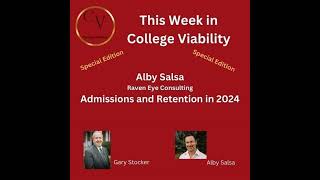
Albie Salsa of Raven Eye Consulting discusses how colleges can survive by treating programs as products, diversifying revenue through adult learners and employer partnerships, and prioritizing retention over recruitment. He emphasizes that first-year to second-year retention is far cheaper than new student acquisition and should become a key marketing differentiator.
Chapters
Welcome to yet another episode, a special episode of This Week in College Viability. Hi, my name is Gary Stocker, and today I'm talking with Albie Salsa, who is from RavenEye Consulting, and we're going to explore higher education from a kind of a focused area today. First of all, Albie, welcome. Thanks for making time to join me.
Gary, thanks for having me.
So Albie, your organization, RavenEye Consulting, and that's R-A-V-E-N, provides both enrollment and retention solutions to your higher education clients. Talk a little bit about your company and the higher market niche you think you fall in.
Sure.
Yeah.
Thanks, Gary. And, you know, first and foremost, before I jump in, I am a fan of the show. I've been listening to your episodes. I like the This Week in College Viability episodes when you go through all the data and the news. I was just listening yesterday and I like these special episodes too. So thanks for the work. Work that you're doing.
Well, thank you very much. I appreciate those kind words.
Yeah, man, for sure. So yeah, Rave and I, we are, we're a boutique higher ed enrollment management consulting group. And what we do is we partner directly with colleges and universities to help them accelerate their paths to enrollment gains. I started the company 2 and a half years ago because I saw a big need in the market. And frankly, what I observed was that the marketing and enrollment consulting space had become sort of like the OPM market, really big contracts, what I perceived as colleges not really getting the bang for their buck in most cases when they were partnering with consulting groups. And I felt like there was a need for an alternative to those options that they had. So I commit to being super flexible and adaptable to our clients' needs, creating client-friendly contracts and terms and really accelerating their path to results. You know, I've seen the templated readouts that some of these leading higher ed consulting companies provide. And when I read through them, I get frustrated because I feel like they're doing their clients a disservice by just kind of taking this templated approach. And I think that some of this work that they're doing is really solid, which is, you know, that's the only way that you can become larger companies if you're doing good work. But I also think that some of the work has kind of become canned and vanilla, frankly. So we offer a set, you know, like I said, an alternative and a set of marketing, enrollment, and student success capabilities for our clients, ranging from operational assessments to staff training to staff recruitment. We've worked with large name brand institutions to smaller regional for-profit brands, large community college networks, for your privates, for your publics. So we've worked in every— you ask what kind of what segment or what niche we're in. We've worked with institutions from all different segments of the industry. Each segment, as you know, has its unique set of needs, and each client inside of those segments has their unique sets of needs. And we, we pride ourselves on being able to provide personalized value. So As I mentioned before, we partner directly with colleges and universities, but we also have developed quite a bit of successful strategic partnerships with other service providers. We partner with marketing consulting companies. We partner with call center companies to provide package solutions to our clients. And in terms of me and my background, I've led enrollment operations for service providers. Like InsideTrack. I've led enrollment strategy and solution delivery at Blackboard. I've also worked on within a university administration. I've ran enrollment operations for Bramman University. I kind of set that whole thing up prior before, before they got acquired by UMass Global. So I've been on both sides of the house. And really simply put, what I do is I, my sweet spot is I set up and I fix enrollment operations.
So it's February 2024, and there's probably more than one elephant in the room. Let's talk about the most recent elephant in the room in higher education, and I'll be, that's the FAFSA delays. What are you hearing from your clients about the impact of those delays, and what are you sharing with those same clients about how to work your way through that?
Yeah, well, it, it's interesting that you asked because, um, I actually just made a post about this on LinkedIn this morning. Some recent news that— did you see that the DOE announced they're throwing $50 million at this problem to set up a concierge service and to put some boots on the ground to help under-resourced companies? I didn't see that. So anyhow, yeah, I mean, I'm seeing and hearing the same thing that you're probably seeing on social and in particular on LinkedIn. Clients are anxiously waiting. The FAFSA info. As we all know by now, or if you don't know and you're listening, the DOE announced that the information that will be provided to colleges and universities has been delayed to March 15th from previously the date was January 31st, which was already a delay. So what I'm seeing and observing is a scramble and some anxiety, some, you know, really kind of contemplating a couple of things around like, should we push our deposit deadline back? Some institutions are doing that already. And, but really how can we communicate with families? And I think that, you know, what I'm seeing, Gary, is like, this is just bringing to the surface. And it's really more of a microcosm of a larger issue that I see within the four-year private sector with recruitment. And you're not, and it's around communication. You're not going to change anyone's mind with an email. And so what I observe is like, hey, what emails can we send out and how can we set up an FAQ? And it's so much of it is like knowledge-based. So like what, what pieces of information can we share out? And, and obviously that's important. People need to get their questions answered, but what's missing. And I think what's missing in general with recruitment in the four-year sector is like this personalized outreach and even more detailed than that personalized outreach via the phone and actually having personalized conversations with parents and prospective students. And here's the thing, I think that there's a, there's a concern about outreaching to with your families if you don't have all the answers. And that's okay. I think the fact that you're actually taking the time to call and people hear your tone of voice and your genuine concern will reinforce their commitment to maybe a tenure institution. And even I saw R&L, somebody from speaking of a larger consulting firm posted around like the, you've seen all this data, Niche puts it out, R&L puts it out and they survey their families around like, Who is the most influential person in terms of making your decision when you choose to attend school for a traditional age college student? And it's like parent number one, admissions rep number two, right? So if you're an admissions rep, why not call and talk to the parent and to the students? It seems so logical to me, right? So, but what we hear is we hear objections all the time around phone. You know, it's like, hey, there's the list is too large. We don't have enough resources. Well, you know what? Okay. So if the list is too large, then why don't we segment that list down and figure out who you want to call. Get a smaller list. It's, it's simple to me, right? Or we don't have the technology to do it. Well, let us help you figure out from a long-term investment perspective how to set that up. And finally, you know, the other thing that we hear a lot is kids don't want to talk on the phone these days. We need to be able to talk through text. And that's— hey, look, I get it. I have a college-age, college-bound daughter who's going to college this coming fall. And I get it. I know that kids aren't using the phone the way that maybe you and I do. But the parents are. So I guess this kind of elephant in the room, sure. But it's just really bringing to the surface some, I think, some core challenges from a cultural and an operational perspective in the 4-year private sector.
Well, let me just throw a Gary Stocker thought out there, Albie. And if you have a sense on it, great.
And if you don't want to comment on it, that's fine as well. But I'm thinking about this FAFSA situation. This is beyond what I focus on, so I'm a little hesitant to do too much with it.
But FAFSA data has been around for a while, right? And all colleges have the FAFSA data from their student populations from the last some number of years. Is it reasonable to, to operate this year for the colleges that want to go back and look at that historical FAFSA data under the premise that their student population is going to be pretty similar from year to year, both demographic and financial, and use historical data to offer financial aid for 2024, if for no other reason than to get a jump on their competitors and even maybe end some of the anxiety from some of the students and their families on getting that financial aid so they can make an admissions decision.
Yeah, I don't know. And, you know, like you, I'm a little over my skis with, with those sorts of details related to awarding strategies. But I would ask, like, how would you do that for an incoming class? Would you just create personas and similar profiles with other students and then award based on that? Is that what you're thinking?
Something like that.
Yeah, I don't know. I mean, I'm sure that somebody out there is already thinking about ways to put that together, but I'm not sure.
Okay, okay.
And I've talked to some folks about that. I think I posted something similar this morning on social. Just my two cents, if that, worth the idea on the whole FAFSA mess. So let's change the topic a little bit and go back to Economics 101.
Sure, let's go.
Long time, obviously, since I've taken Econ 101. I don't know about you. And the supply and demand and the way it relates to higher education. And I make this statement often to my podcast guests and others, and it goes something like, the enrollment and finance challenges that we have in higher ed are based on the law of supply and demand. And I further contend that there are not many, if any, programmatic changes that colleges can make that would generate materially significant new revenue. Now, this is your chance, Albie, to say, Gary, you're nuts, or Gary, you're right. Take it either way.
I'm good.
Well, you might not be wrong. I'm not sure. I think that what you're highlighting is that, well, if the challenge I think with what you said is if you're a university leader and you hear that, I wouldn't want the message to be, to kind of create paralysis. Well, there's nothing we can do. But so I do think that now more than ever, colleges and universities should be undertaking a regular review of their program offerings. And I think that I think about this from the perspective of product fit. And a lot of what the way that I view And the way that I talk to my clients is I view this as running a business, right? So if you think about it from the perspective of a product fit, how do your products or your, in this case, your programs fit within the market needs? And not only from the perspective of the major, but modality, you know, and are you really leaning into microcredentials or not, for example? And are you diversifying your student base and ultimately your revenue streams are not. And if we talk about the 4-year private sector again, and I feel like, you know, that's a good sector to stay on since we're talking about FAFSA. If you are an institution that is hanging your hat on the traditional market and, you know, I know you talk about the 8-year trend a lot in your app, you show the 8-year trend and whatnot. I guess maybe it's a 9-year trend now. But if you're one of these institutions that has the 8-year trend going down on enrollments and you are not really leaning into the adult market, like now might be the time to identify if there's an opportunity to capture some of that market in your local community in the adult market and specifically with potentially microcredentials. I'll come back to that because if you look at like Western Governors, I want to say that the president shared last year that, and correct me if I'm wrong, I think it's 40% of their enrollments now come from employer partnerships.
Right.
And there's, there's a reason why the guilds of the world, the guild has done so well. And, you know, we are at Rave and I, we just, I'm really excited about this recent partnership. We just started in Q4 and we're actively working on it now. We're helping one of our clients to build out their employer B2B partnership strategy and framework to go develop tuition reimbursement partnerships and to develop corporate trainings and extended education opportunities for the adult market. In their regional market. So I think those are the sorts of things that I think are really, really important that I think maybe contradict a little bit of what you're saying, but I don't think that you're totally wrong.
Yeah.
And you make a good point on the paralysis piece. And yes, I do that with intent. And one of the main reasons I view my role is to lovingly but seriously and sometimes with tongue in cheek help college leaders think beyond that private box. And if it involves me being a little sharp, like we talked about earlier, taking an attitude, which I know I do with intent, I think that's my role. And you've got to know, I don't think you and I have talked about this, that I have my own list and it's 200-plus strong of private colleges that I don't think are going to make it. Now, I'm not ever, ever, ever, ever going to share that list with anybody. But I use it for my own purposes. And if I'm right, let's go back for a second. What if I'm wrong and there's never ever again another college closure for the next 5 or 10 years? All right, all right, I'm wrong. It's not a likely scenario, but I'm wrong. But here I think is a more important question. And again, I will never ever identify an individual college and say, "Abby Salsa University is going to close." Never going to do it. But here's the big question. Albie, what if I'm right? What if I'm right and we're looking at an increasing rate of private college closures and public college consolidations that goes even beyond what I can envision or you can envision or anybody else can envision? What happens then?
Yeah, I don't know. And I would actually say, well, let me ask you a question. Why are you not sharing that? That list.
I'm trying to argue both sides just for the sake of the discussion. Um, I think I'm right. I think there will continue to be a higher rate of closures, and it worries me. How is it going to adjust? And if I'm wrong, well, then I provided some content, some thought for folks to help make me wrong, and I'm okay with that. I don't think it's a likely scenario, but I worry that I'm right, then we've got more issues than anybody can address with any certainty at all.
I think about the parents. I think about the parents. Um, maybe it's just because my, my daughter's going away to school and I'm, I'm that persona right now. I'm living it. And I have, uh, it's interesting that, you know, my friends and cousins and whatnot, they all have kids who are about the same age as my daughter, right? So they know that I work in higher ed. So they're all hitting me up and asking me questions. For the first questions were around, you know, what's up with the FAFSA? But, uh, I did send the link to, um, one, a webinar. I think you have a, um, webinar you're hosting, you gave various time slots on your website. I signed up for one of them. I'm not sure if you saw that, but I forwarded that link to a buddy of mine because his daughter is considering a variety of private schools. And I think that, you know, the work that you're doing is so valuable for that persona, for the families and for the kids.
Yeah.
So I would say there's, there's an argument to be made that, you know, while publishing that, it wouldn't be great for the institutions. And I could see why. And I, and I, I'm totally empathetic to that because a lot of my colleagues are running a universities and colleges, but from the perspective of what's best, ultimately we should be of service to the students, right? And what is best for the students? And it might be releasing the list. I don't know.
Yeah.
Yeah.
It's, it's a fascinating time and, and I hope to contribute some to it, something to it in a positive sense, but I know most of my content is guys, be careful, be careful. It's a mess out there. And I want to go just, just to one last question, Alvin. I want to talk about graduation rates. And I'll talk about the 2024 College Viability App. It's about ready to go out the door. And I was altering back and forth between making a free version of the app for enrollment for the last 8 years available to anybody or a free year of the 4-year graduation rates, 8 years worth of data for all the private colleges and eventually all the public colleges. And I decided to go with the graduation rate one. And here's why. The enrollment one is important, but it's an indirect measure of a college's health. It all is associated with tuition fee and revenue, tuition fees and revenue. But we have, I think it's more than 50% of all public and private colleges graduate less than half of their students in 4 years. That scares the bejeebers out of me. What about you?
Yeah. I cut my teeth in higher ed working on student retention initiatives. Are you familiar with the organization called InsideTrack?
I think so.
Yeah.
Started with them. Yeah. So, and we were back then, we were primarily doing student retention work, but yeah, I mean, here's the thing. I think we all have seen the data, but yet when it's time to make decisions, I don't see us acting in a way that is informed by the data. And the data says that it costs a lot more money to go recruit a new student than it does to retain one. right? Um, yeah, right. But yet every project we get pulled into, it's, even though I have a background in retention and my colleagues do too, we get pulled into funnel management, right? And I think it's because there's more of a direct correlation and attribution between activities and performance. And, but so anyway, I, with, with student, yeah, it does concern me. And I think that If what I try to guide my clients to is like, let's get really focused on like a phase of the student journey. Because when you think about graduation, it seems pretty overwhelming. Graduation rates, it's like, okay, this is a 6-year measure. But if you can get focused around like, how can you help your students have a really strong start? Right. And having a strong start is so important because what it does is it helps you have a strong first semester and ultimately strong first year. And then you come back for your second year. And all of the data shows that now I'm talking about the traditional enrollment cycle again, fall to fall retention. If you can get somebody to year 2, the likelihood of them graduating, it's like the big cliff is between year 1 and year 2. And the big reason behind the cliff, all the qualitative information I've looked at says it has to do with those first couple months. Right? So, and when you start unpacking like, okay, from the moment that somebody is doing their orientation and sort of like the moments before they arrive on campus, or even an adult learner, right? Even an adult learner when it's virtual. What does that look like from a student experience perspective to help them build a sense of belonging and a community? Let's call it community on campus. And how are we removing unnecessary friction points in that phase of the journey? So I think if you get really, really laser-focused on this idea of how do you help people have a strong start, you're going to start seeing big gains from year 1 to year 2. And ultimately it flows down to graduation.
And then just a quick follow-up to that, and then I'll wrap this up, is do you think that graduation rates will increasingly become a selling point for colleges that do well as opposed to those who don't graduate 50% or more?
Well, it should be. I mean, I would certainly hope so. I mean, here's the thing, Gary. I think that institutions just in general need to really take a regular view and refresh of what their value propositions are. And if you have a graduation rate that is high or significantly higher than your competition or than the national average, you need to be promoting the heck out of that. Yeah, yeah, for sure.
Cool, cool. Well, I am grateful for your time this afternoon. Albie Salsa, who is the founder of Raven Eye Consulting— that's R-A-V-E-N-I-E-Y-E Consulting, and I'll provide a link on the show notes— has been my guest. Albie, thanks again for making time. I wish you continued success, continued success with Raven Eye.
Great, thanks, Gary. Appreciate that. Hey, thanks for having me. Really appreciate the time.
Anytime. Good conversation. I appreciate it.
And we'll be back soon with another edition of This Week in College Viability.
My name is Gary Stocker.
More from Gary


What does it look like when a college increases both total revenue and total expenses?



College Financial Crisis? We look at the financial health of Bay Path U. (MA) and Coe College (IA)


Private College Financial Crisis? We look at the financial health of Hobart William Smith College


Financial Compass tutorial (Private college version.) Financial statements compiled 2016-2025.

