This Week In College Viability (TWICV) for March 11, 2024
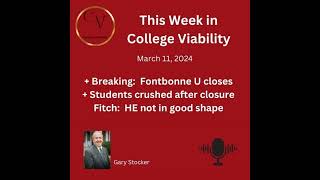
Gary Stocker reports on accelerating college closures and financial distress: Fontbonne University will close in 2025, Notre Dame College cut programs, and small private institutions face rising risk. His Private College Viability App tracks eight-year outlooks for roughly 1,300 schools, offering families data beyond standard financial aid tools.
Chapters
It's March 11th, 2024, and it's This Week in College Viability. Hi, my name is Gary Stocker. What do we have on tap this week? Again, more layoffs and cutbacks. We'll talk about those in a minute. Uh, some student impact stories on the Notre Dame closure, some good, some bad. Uh, stories from both Fitch and Bloomberg rating services on the higher education industry. The state of Mississippi joins the merger consolidation movement. And at the University of Virginia, a LinkedIn connection sent me a note that it will take 1,000 undergrads to pay the base salaries of their DEI staff. A brief story on that. And a basketball team without a college continues to play basketball. That and much more on This Week in College Viability. But I think for the first time ever, breaking news, as I was getting ready to record this morning, Fontbonne University here in the St. Louis area just announced earlier this morning they are closing in 2025. They will not accept any new students in 2024. There appears to be additional information that they may have had issues with the Higher Learning Commission they have not, that they have not shared with the public. Local reporters are looking into that as we speak. On to layoffs and cutbacks. Valparaiso University to weigh cutting 28 programs. They'll let us know by the fall of 2024. That's from Laura Spitalniak of Higher Education Divide. Higher Education Divide on March 4th, St. Norbert College announces further layoffs amid ongoing budget issues. This is from Ben Krumholz and Fox 11 News. That was last Friday. They're gonna be cutting 12 additional faculty jobs at St. Norbert College. Actually, 12 faculty jobs are being cut after 35 non-academic jobs were cut last fall. And then Michael Marsden, who was the interim VP of Academic Affairs, and it's clear he took one for the team here. He was asked by the reporter, who's responsible for these cutbacks? And Marsden responded, the blame, I think, is not to be attributed to any particular person. I think there was not as much attention to trends that were clearly there, projections that were clearly there, And I think now we're addressing them. This certainly falls into the category of day late and dollar short. And then an alum from St. Norbert says, how am I supposed to be confident that the people who didn't make the right decisions the first time around are going to finally figure it out? That is my main question, said a 2010 St. Norbert alum. It continues, and it will continue. Page 2, I want to lead off with An unneeded crushing disappointment from a teenager that was devastated by the closure announcement of Notre Dame College. And this is about a student who I'm not going to name who had a football scholarship to go to Notre Dame College. And of course, he lost that and was crushed that he wasn't going to be able to play football, number one, at Notre Dame College, and two, that he had to find another option. And the story came from Brynn Caswell on Channel 5 ABC News in Cleveland. And I posted this story. You can read the details. In the show notes, I'll give you the link, of course. I posted this story to my LinkedIn account as soon as I saw it. I think it was last Wednesday. And I've had 1,600 impressions in the last 4, 5, 6 days. And I guess this is kind of like Bon Bon in many ways, but the leadership at Notre Dame College has to have known for months, many months, that the college was in danger of closing. I knew it. I shared the concerns with others. And if you're a college leader, this story is for you. If you're a college leader or a board member who is fully and reasonably aware that your college may not survive, be honorable and make the announcement sooner rather than later. Do it for your faculty, for your staff, for your students and their families, for your communities. Don't wait till the last minute. And if you don't, if you insist on holding it close to the vest, I understand there's some logic for that because otherwise it becomes a self-fulfilling prophecy. But if you don't, I will. The 2024 Private College Viability App for students and families will tell them that your enrollment has decreased, that your graduation rates, if they're awful, are awful, that just— that your tuition and fees are down, that your tuition rates, what trend they have gone. I'll tell them if you won't. I'll tell them gladly. And I'll make a couple bucks doing that. So the next story is again from Notre Dame, and the read— the story is from IdeaStream Public Media, and it's written by Connor Morris. And the headline is Notre Dame College students mold next steps after news closure. But what I'm going to focus on is in the story, it lists the colleges that Notre Dame College is sending its students to as possibilities, as recommendations for where they can continue on with their college education. And I'm going to read you the list. It's Baldwin-Wallace University— I know they have issues— Cleveland State University, Hiram College, John Carroll University, Kent State University, Lake Erie College with lots of issues, Ursuline College, Walsh University, and Mercyhurst University in Erie, Pennsylvania. Here's what I want to share. All 7, all 7 that I just referenced had negative enrollment trends over the last 8 reported years. 5 of the 7 had endowments less than $50 million. 6 of the 7 had increased unfunded institutional grants. Of course, you and I know those as merit aid and most scholarships, although 2 of those were very small increases. And 5 of the 7 had decreased tuition and fee revenue over the last 8 reported years. So here's the point: a college that couldn't stay open is in large part sending its students toward other colleges that are financially unhealthy without exception and with viability issues. Some have viability issues. It's important to note though that none of them are as bad off as Notre Dame College when you compare them with the College Viability App. But the point is, you know, some of these may close. I don't think they'll all close, but it's, it's, it's not just closure that we want to talk about. It's a good college experience. If you had a good college experience, I think you would want that for everybody. But if colleges like these 7, many of whom have their last financial dollars circling the drain, can they really provide— can they really provide a good college experience for their students? Not a question for me to answer, but it's certainly a question for you, the listeners, and many, many others to answer as well. Page 3. And this is from Fitch, and the headline reads, distress soars at small colleges— small U.S. colleges— as enrollment declines. And the subheading is, schools have broken covenants, which are usually part of bond agreements, and struck deals with bondholders. It lists no particular details. And then it concludes, Fitch, the rating service, sees consolidation persisting in 2024 and beyond. And the story comes from Nick Corallo, uh, and Bloomberg on March 5th. And I want to read part of what Nick Corallo wrote. Consolidation is expected to persist in 2024 and beyond. And this is from Emily Wadhani, who's a senior director at Fitch Ratings. Bloomberg's analysis, developed in consultation with 6 higher education experts— they're not listed— measured schools with fewer than 5,000 students across 5 metrics. I won't read, I won't read those to you. And, and, and the data span was about 1,000, about 1,100 colleges over the last two decades. And the most recent data from the federal database includes enrollment and admission figures from the fall of '22, and there's that lag that comes with it. Now here's Bloomberg offers their data, uh, Fitch is also referenced in this story. But here's where— here's the part where I differ from Bloomberg, and really from Fitch as well. And I, I actually share the individual college data with anyone who wants to— who wants to look at it. I'm not going to identify the colleges that I think aren't going to make it. I have my own list. But the 2024 Private College Viability App, the 3 different versions of that, reviews 8 years' worth of individual data for individual colleges. And it's data the colleges themselves submitted. It's almost 1,300 colleges. And as the late Paul Harvey would've said, the rest of the story, again, from the Bloomberg and Fitch's stories, roughly 200 schools met at least 3 of the 5 metrics that used, and about 60 schools met at least 4 of them, 10 met at least 5 of them, Colleges met all 5 of the high-risk data points in the 2022-2023 collection period. Yeah, it's going to continue, it's going to continue. And it also, you know, Fitch has another story that was on March 6th, um, and it references something new, and that is public colleges. Not that public colleges are going to close because that's rarely if ever going to be the case. But in the case of Pennsylvania, this story writes, Pennsylvania is considering limiting tuition at certain public colleges to $1,000— I guess per semester, it doesn't say— for lower-income students. Now, that's fine. States are welcome to do what they need. But what impact does that have? Not on a public college's viability. I don't know that many will close. Some may merge. But what impact does it have on that college's ability to offer low enrollment majors? And I'm going to pick on journalism because that's one I do all the time. What if a college only has 5 or 10 journalism majors and this $1,000 tuition limit pushes public colleges in Pennsylvania, some of them, to say we can't afford to offer journalism? Now again, just an example, pick whatever topic that you want, but there's, there's, there's unforeseen consequences with public entities recommending tuition minimums— maximums, really— And be careful what you do with those because it can come back and bite you. And on to Mississippi. And Zach Player in the Columbus, Mississippi Dispatch on March 6th wrote about a public official in Mississippi, and I'm not going to use the name here, who was looking at merging some number of the 7 public colleges in that state. Now this is a story I'm going to follow in the coming weeks. Because it's confusing from the stories that I'm reading whether it's going to happen or not, whether this was some guy had a hare or not and decided to try and merge some colleges, or whether it's got some actual steam. But the point is, it's another state that may be looking at consolidating public colleges. And I think there were 2 or 3 that had some pretty significant decline— declines in enrollment over the last number of years. I'll provide the links to the story in the show notes. And then a LinkedIn connection, and I mentioned this in the lead to This Week in College Viability. A LinkedIn connection sent me a story that some researchers had done that at the University of Virginia, it would take 1,000 undergrads, I presume at list price, it doesn't say, 1,000 undergrads to pay the base salaries of DEI staff. Now colleges, public or private, are welcome to hire whoever they want and have them do whatever they want. But that was an interesting number. That's a lot of undergrads. The University of Virginia is kind of expensive. I don't know what their list price is off the top, but 1,000 undergrads just to pay for that function? Somebody's gonna push back. I don't do politics here. It's a no-win, but that is, it's a noteworthy data point from my perspective. Page 4, Notre Dame College— I'm sorry, page 4, Massachusetts. We're going to go to Massachusetts. Too much on Notre Dame College today. Massachusetts ramps up financial oversight for two faith-based colleges. Now, if there is a trend on these closures that we're seeing, they tend to be religious or faith-based colleges, and that's the case here. In my mind, that's a sub-story of all that's going on. Is probably not doing anything to substantially alter the supply and demand issues that I talk about all the time. But this is a story from Higher Education Dive and Natalie Schwartz on March 7th, and the two colleges referenced are Boston Baptist College and North Point Bible College. And you'll recall a couple years ago, Massachusetts, when Mount Ida closed, they created some guidelines that if colleges were in danger of closing the state of Massachusetts was going to know about it and in some form or fashion try and make sure that this wasn't a short notice closure. All right, good luck with that. Um, there are all sorts of issues that we can talk about another day, but both these colleges, Boston Baptist College and North Point Bible College, the data on them from the 2024 College Viability App, both have full-time enrollment of less than 200 students. Both the 4-year graduation rates for Boston Baptist and North Point are 13% and 24%, respectively. Disgustingly low. The tuition and fees and even the endowment weren't much more than couch money. And, and these may or may not close. They probably will. They don't have enough money to keep the lights on. But the issue again is quality. What kind of quality are you getting? Not much if you're only graduating 13% and 24% of your students after 4 years. Why are they even at college? I guess I have to keep asking that question. And guys, I think maybe we didn't do Birmingham Southern College last week. Well, we can't do that. So Natalie Schwartz from Higher Education Dive, February 6th was the story this came from with the March 5th update. There was a bill in early February that Alabama lawmakers filed that would give Birmingham Southern another shot at the $30 million loan. I teased about that in a previous episode of This Week by saying they wanted to change the referees in the middle of the game, or fire the referees in the middle of the game. And this had to do with, I think, the treasurer in the state of Alabama, Mr. Boozer. I remember his first name. So on March 5th, the story from Natalie Schwartz, uh, I'll read the quote. Birmingham Southern has fallen on some hard financial times, hard financial times, and this is a way to hopefully continue to keep them alive. And this is replacing Mr. Boozer with somebody else to make the decision on this $30 million. And it goes on to say, I'll be honest, if this does not pass— I don't see a reference to this quote— if this does not pass, they probably close their doors. Now put your extreme sarcasm alert note on because I'm going to be extremely sarcastic here. If this does not pass, they'll probably be closing their door. Now that's a college I want to send my children to. And lastly, Antelope Valley, and this is a community college, uh, is in the NAIA tournament despite school shutdown. This is from Myron Metcalf, Metcalf. MEGCLF. And this is from an ESPN Big Time sportswriter on March 8th. And the college is closing. Antelope Valley is closing. They're locking doors, not letting folks in, all sorts of like that. But the college basketball team apparently had some skills and were doing all right. I think both men's and women's, as I recall. And they'd raised $40,000. The college itself had had some financial mismanagement. There's lots more details to that. So here's the quote: The players have been through a lot. As our school has officially announced its closing, they have still not communicated to any of us or the students what their plans are for helping students find a new school or finish their degree. And the burden has fallen on the students, their families, our staff, and others in the community that care about the well-being of these young men and young women. Am I the only one documenting this continuing level of higher education fraud, fraud and its impact on these students? I did a story earlier today about Notre Dame College, and I don't know that I created the College Viability App exclusively for this purpose, but it certainly serves this purpose. It is demonstrable that there are too many of these public and private colleges that are at the end of their financial existence in some form or fashion. The data trends clearly show us this. Buy the application, buy the app, don't buy the app, but you know what, send a few bucks my way and purchase it just to ease your anxieties. The parent and student version is only $29 to the end of March. The executive analysis version is a lot more expensive than that, but provides 30+ reports across almost 1,300 colleges over 8 years. It's a couple bucks per college. Do it, don't do it. Many will, but many won't. I realize that, but the data is there. And to go back to the story from Notre Dame, if your child is looking at playing a sport at a college, especially a small private college, especially a small private college in the middle of nowhere, Look at the finances. I call it the College Viability App. I can call it a reverse FAFSA. You've given the college your financial information with the FAFSA. Use the College Viability App as a reverse FAFSA so you know about the college's finances just like they know about yours. And let's wrap this up. There's always a set of stories that I don't— that I do not include in This Week in College Viability. And as you've heard in previous podcasts, I use Google Alerts to stay informed on many different higher education topics. And some of those, quite a few of those, include enrollment increase stories. I don't really view those as newsworthy or really within what I'm focusing on and for what I'm trying to do with this podcast in particular. But it does reinforce the point that I make regularly, regularly, that there are many colleges that are surviving and some are thriving. There's no question. I do make note of those that are thriving in my Top to Bottom reports that go out each Sunday by state or by region. But remember, as I wrap this up, it's not that colleges continue to close and have layoffs and cutbacks. It is the unassailable fact that many are mere shadows of what they used to be. They cannot reasonably be expected to provide a positive college experience if their primary focus is on survival. And for public colleges, it's not really an issue of closure, maybe in rare occasions. It's making sure that the career path a student has chosen, whatever it may be, will be supported at that college. Until next Monday when we do this again, this is Gary Stocker for This Week in College Viability. We'll hear from you next week. Take care.
More from Gary


What does it look like when a college increases both total revenue and total expenses?



College Financial Crisis? We look at the financial health of Bay Path U. (MA) and Coe College (IA)


Private College Financial Crisis? We look at the financial health of Hobart William Smith College


Financial Compass tutorial (Private college version.) Financial statements compiled 2016-2025.

