This Week In College Viability (TWICV) for Feb 10, 2025
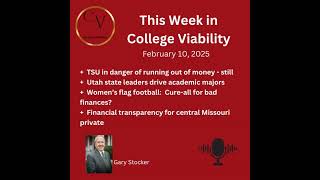
Gary Stocker examines the financial crisis hitting U.S. colleges: structural deficits forcing layoffs at Cleveland State, Lakeland Community College, and others. Utah is offering $60 million to reward colleges that shift to high-demand majors. Master's degree costs have tripled since 2000, while employers report Gen Z graduates lack workplace readiness.
Chapters
It is Monday, February 10, 2025. Time for yet another podcast episode of This Week in College Viability news and commentary. Hi everybody, Gary Stocker back again for another podcast episode. You know, the, the second Trump administration— and I'm not going to do politics here— the second Trump administration has given higher education a lot more than finances to worry about in its first few weeks of existence. But But have, have no fear. I will continue to stay focused on the financial health and viability of public and private colleges. And as I have shared regularly, the market always adjusts. This market adjustment is being driven by government decisions, and it will continue to do so as the financial challenges alongside, right beside it, continue to mount for too many. Private, and as we'll talk about in this week's podcast, some public colleges as well. Headlines this week: Tennessee State University— I gotta put them on, gotta put them on the frequent flyer list— is still in danger of running out of money to keep the lights on. I have more details on that. Utah, seeing that its colleges aren't getting the job done, is pushing its colleges to cut low-enrolling programs. There's more to the story than just that. And spin, spin, spin, spin, spin a spin story about a Missouri private college spinning data, which they all do. And as always, I will provide the needed balance. And then sarcasm alert for the headline and for the story itself. Flag football for women is the latest profound strategy to save a college. And of course, much much, much more as we go through this podcast episode. Layoffs and cutbacks. Cleveland State University cuts 3 sports as it works to reduce its budget deficit. This comes from Ideastream Public Media. Connor Morris published this on January 24th. Uh, details are common. They're cutting back to be able to deal with the structural deficit. I'm going to talk about structural deficits here in a minute. Lakeland Community College, another regular on the podcast, not yet quite at frequent flyer status. Lakeland Community College seeks to lay off 30 faculty to address their deficit. Again, idea of public media. Uh, Connor Morris has this story also on February 7th. Standard stuff we've seen before. Lakeland President Sunil Ahuja said the college needs to balance its budget. Okay. Let's write that down as profound. Enrollment has dropped 44% since 2015. Uh, the number of professors though has stayed basically the same. The president said there are now 117, 117 full-time faculty. The president Sunil Ahuja goes on to say, this is not something that anyone enjoys doing. I am carefully, thoughtfully looking at this campus-wide. That's college dribble for today. And I think this will be the last round for us. I hope so, because in 2023, they cut 25 folks and 17 administrator positions in summer 2024, but it's probable that 2025 is the magic number and no additional cutbacks will be required. Uh, the Ohio auditor, I guess state auditor Keith Faber, in an April 2023 audit said the college was in serious financial trouble and needed to correct its course quickly. I guess 2 years later is better than nothing. Page 2, more than meets the eye to this story. Utah is pushing its colleges, public colleges, to cut low-enrolling programs. All right, well, we can track that with the 2025 College Majors Completion App that's out and ready for purchase. It's putting $60 million— the state of Utah is putting $60 million at stake. The story's by Christina— Christina, excuse me, Krista Dettin in the Chronicle for Higher Education. The story leads with Utah's higher education system is facing a $60 million cut. But it might come with an asterisk. Colleges can earn a share of the money back if they spend it in areas identified by the legislature. That's got to make faculty really happy. The bill awaits the signature of Utah Governor Spencer Cox. It specifies that about $60 million of the annual higher education budget be shifted toward strategic reinvestment. All right, drivel, I'll give you that. An accompanying bill that has not yet passed lays out how colleges can appeal, ask for, get back their share of money by allocating it to high-demand, high-wage majors. Now, it looks to me, it looks to me like Utah colleges have failed to adjust to market demand, and they're not the only ones. So Utah colleges have failed to adjust and offered what the state thinks should be more high-demand, high-wage majors. So the state is going to provide some financial incentives to do so. Now I'm guessing the good folks in Utah public colleges will say, "Hey, we're already doing this stuff." And they have a lot of other, probably in the category of college drivel, to share with that. But it's interesting that the state says, "Hey, here is a little incentive that I'm going to dangle in front of you to do what you should have done on your own," they're saying to colleges. In Utah. The University of New Hampshire faces a $15 to $20 million set of budget cuts and a tuition hike is coming. This is from Ian Linehan in the Portsmouth Herald on February 6th. The University of New Hampshire projects about $20 million in budget cuts for the next fiscal year. I presume that's '25-'26. And tuition increases are also planned. UNH, University of New Hampshire officials cite a structural deficit. I'm going to talk about that in a second. Decreased state funding and rising health insurance costs as reason for the cuts. All right, we've seen that before. Dean, who's the school's president— not a true dean— Dean, the school's former president, announced last year, January of 2024, that roughly 75 employees were being laid off amid an undergraduate enrollment drop from years past. Again, how many years past, and when did somebody finally notice this was happening? Well, let's talk about structural deficit. So a structural deficit occurs when any organization— but we're going to focus on universities— a structural deficit occurs when the university's ongoing expenses consistently, not just a one-time shot, expenses consistently exceed its ongoing sources of revenue or income. Structural deficit is not a shot in the dark, not a one-year thing. It is a pattern. And the definition goes on to say, unlike a temporary budget shortfall, structural deficit is a recurring gap that requires long-term solutions. We see the structural deficit reference in almost, if not every story that I have on colleges and cutbacks and layoffs and closures. And it is to reinforce it's not just a one-time thing. This is something that's been going on for a long time. We see that here in the New Hampshire story, and colleges are just chronically and historically way too slow to say, hey, numbers are not going in the right direction. All right, get out your old-fashioned 33 record player. We've got a spin, spin, spin story going here. The headline reads, campus experiences record spring enrollment. Now, I've seen this story many times from different colleges. I'm letting most of them go. I just don't have time to go and adjust the spin for everyone. Campus experiences record spring enrollment. This is a February 25th internal story from Missouri Valley College. It's a smaller private college in the middle of Missouri. And so here's the spin alert from the story, from the internal story. 1,381 students enrolled in spring 2025. I don't think it identifies whether it's total or F or full-time equivalent. I don't know that matters. That's a 13% increase over last fall. All right, spring to fall comparisons, that's interesting. So of course I'm here to do the rest of the story, as the late great Paul Harvey often did. Missouri Valley had 3,012 full-time equivalent students in the year 2015. 2,500 times what they're reporting in the spring of 2025. They had 2,668 as recently as 2022, and that was down 344 students over those 8 reported years, 2015 to 2022. So let's do the math. I got out my iPhone slash calculator. 2,668 minus 1,381 from 2022 is down 1,287 students since just 2022. So they're spinning a short, a short data sample. They're looking at the data saying, what can we spin out of this? And they chose a spring to fall increase. And I don't doubt the numbers. I'm not going to doubt the numbers at all. It'd be dangerous for them to make those up. But what else is going on? Revenue's up 3%, just 3% from 2016 to 2023. And this is from Matt Hendricks, Advance Compass. Expenses are up 22%. That's a 19% gap. Expense growth has been hovering around the 75th percentile, which means 75% of private colleges spend— expenses have gone up less than Missouri Valley's. Their net tuition revenue has been flat. All right, I will grant them many colleges have net tuition revenue going down. Enrollment has grown. For sure in the last year. But the draw on the endowment, it's a small endowment as I recall, is, is, is increasing in the post-pandemic era. And here's the spin reality. I've shared this before. Missouri Valley College is managing by public relations. They take isolated data points and spin them. Nothing wrong with that. Sadly, it's the American way, but that's why I'm here. That's why I developed the College Viability App. That's why Matt Hendricks developed his Advanced Compass and his Strategic Compass. We are both examples of a small but maybe growing cadre of higher education data entrepreneurs working to improve the financial transparency of colleges. Is Missouri Valley College a bad college? It's not likely. Are their finances strong? I have my concerns. I'll let you draw your own conclusions based on the limited data I have. And on the 2025 College Viability app that's coming out and on the Advanced Compass from Perspective Data Science and Matt Hendricks. Critical thinking is a skill most colleges would like to offer, but most simply don't get it done. Maybe, maybe the students at Missouri Valley can take the actual data like I just shared, do some research on their own and start practicing critical thinking on their own instead of spin, spin, spin. Page 3. Sarcasm alert. I wish I had music to go with this. Lourdes University. Lourdes University announces addition of women's flag football. This is from the Wolverine Hoosier Athletic Conference. Now I'm not going to delve into the details here. It's at a sport enrollment grows. That's the operating premise. And I've, I and others have talked about how this is a false assumption. And it's again, yet another management by public relations tactic. Lourdes University's in Ohio. And of course, just like I did for Missouri Valley, I'm going, I'm going to the data. I'm going to the financial data for Lourdes University in Ohio. Full-time equivalent enrollment is down. 21%, 270-some-odd students from 2015 to 2022. 2023 data will be out with the 2025 version of the College Viability App. Tuition fees down $8 million, down 40%. And the 2022 endowment wasn't much more than college couch money at $8.5 million and change. And the 4-year graduation rate for undergrad students over that same 8-year period hovers around 40%, 4 in 10, 40 out of 100, 400 out of 1,000 is all that graduate of the students that started at La Roche University. Yet women's flag football should fix it all. Sheesh. Sheesh. Sheesh. Sheesh. Is your master's degree useless? This is a story from The Economist, and I don't often quote The Economist on, on the podcast. This is from the November 18th, 2024 edition. New data show a shockingly high proportion of courses— they're talking about master's courses— are a waste of money. Well, we've heard that before, and I'm not sure I've seen it documented like they do here at The Economist. And the story reads, since 2000, the cost of postgraduate or master's degree study in America has more than tripled. The cost has more than tripled in real terms in the last 25 years. This is according to the Center on Education and the Workforce at Georgetown University. And we have used that as a source before on the podcast as well. The median borrower for a master's degree now acquires around $50,000 in debt while completing their second degree or their master's degree. And that's up from $34,000 20 years ago. Almost— now listen to this— almost half of the money, almost half of the money America's government lends to students goes to postgraduates, even though they are only 17, 1-7%, of learners. And for those that didn't pay attention in math class, almost half is 50%. So 50% of government lending goes to only 17% of learners. This is not good news for higher education. Graduate programs have been relative cash cows for colleges. And when students start seeing stats like this and they're not seeing the income that follows, that $50,000 or so in debt, it won't be, it will not be a positive financial development for colleges. Page 4, Tennessee State. Tennessee State University could run out of cash this spring without headline, without help, reads the headline from Higher Education Dialogue in a story from February 7th. That Ben Unglesby had. Now there's, there's, there's nothing new here. This struggling college is an HBCU, is dependent on state money to survive. There's also the case I talked about in previous podcases where they, where the college is making the case, and it's not completely wrong at all, that either the feds and or the state owe them a considerable amount of money. So there's nothing new here. The story goes on to say that TSU, Tennessee State's financial troubles are steep. We know that. And immediate. Well, I don't doubt that at all. They even have an FAQ page on the university's website that acknowledges that the financial condition has reached crisis levels stemming from missed enrollment targets and operating deficits, almost certainly structural operating deficits. This fall, I've talked about this before, the university posted a projected deficit of $46 million by the end of this fiscal year. I'm guessing that will be June 30th. And it just reinforces that I believe we'll see a dramatic scenario on the campus of Tennessee State University play out in the coming weeks. I have no idea how it's going to shake out. Ben Unglesby, who writes that TSU could run out of money to pay its bills as soon as this April or this May. So stay tuned. We're going to make Tennessee State a frequent flyer on the show. They earned it. While I believe, I still believe it's highly unlikely that this or many publics at all will close, it just, there's too much politics involved. I do believe that it's realistic and the data suggests this I do believe it's realistic that Tennessee State and many other publics and privates will have to shrink considerably, shrink considerably for survival today. And maybe, maybe long, big time, maybe, maybe thrive somewhere down the road. It's simply, folks, like I've said so many times, too many colleges, too many college seats, even though this is an HBCU. Too many colleges, too many college seats, and not enough demand. Not enough demand for those seats. And until that is addressed, we're going to continue to see stories like I have recorded and shared for the last few years. I'm going to take the last story for today from a LinkedIn post, and I'm not going to cite the source because I don't, I didn't get their permission, but you can find it on LinkedIn. You can find it on search criteria. I'll give you here. There is a, a research report done by Intelligent.com, Intelligent.com, in December of 2023, and it was a survey of 800 US managers, directors, and executives who are involved in hiring recent Gen Z college graduates. And here are the key findings. I hope you're sitting down. 2023 research, intelligent.com, 800 US managers, directors, and executives who hire Gen Z. 38% of employers avoid hiring recent college graduates in favor of older employees. Grab the sides of your chair for this one. 1 in 5 employers, 1 in 5, have had a recent college graduate bring a parent to a job interview. 61% of Gen Zs are late to work. 52%, according to this research, intelligent.com, 53% struggle with eye contact. 50% are difficult to manage. 47% dress inappropriately. And 58% of these 800 US managers, directors, and executives say recent college graduates are unprepared for the workforce, and nearly half of these employers have had to fire recent college graduates. So I'm going to do the wrap. I'm going to do the wrap based on this story from intelligent.com and this research for intelligent.com, the story posted to LinkedIn. A parent to a job interview? Dressing inappropriately, unprepared for the workforce are just a few of the many indictments in that research. This reflects on higher education's lack of success, lack of success in adapting to the times. Colleges continue to focus too much on what they have always done: content, content, and more content. And of course, That is what they are paid to do. But look at those numbers. I just— go back and rewind the podcast. Listen to those numbers. Find the research on your own. Students, as we know, students and their families are spending tens of thousands of dollars in many cases to get prepared for an income-earning job. And this research dramatically suggests statistically suggest they are not getting what they paid for. Maybe, maybe the content, though that's problematic at best. And for those in higher education that argue that it's not their job to prepare students for income earning, your lack of understanding of market dynamics is telling, demonstrably so. The diplomas, your college awards, are just a ticket for a conversation about a job. There has to be some preparation. And if that, to those who think it's not your job to prepare students for income-earning careers, if that's where you want to leave your students, a diploma and limited to no job skills, shame. Shame on you. And I, I regularly see content that indicates the market is moving, and I'm sure you do too, content that indicates the market is moving away from college degrees to other income-earning education, all sorts of options. And yes, I focus on the financial health of colleges, but this, to me, this is an indirect indicator of why so many colleges are financially challenged. They take their students' tuition money, take their students' tuition money, and then don't finish the task of helping those students find a job and a career with sufficient compensation that deserves a jeesh. Hey, thanks for listening. I'll be back next Monday with another Higher Education News and Commentary podcast. For College Viability, I'm Gary Stocker. We'll be back again next Monday.
More from Gary


What does it look like when a college increases both total revenue and total expenses?



College Financial Crisis? We look at the financial health of Bay Path U. (MA) and Coe College (IA)


Private College Financial Crisis? We look at the financial health of Hobart William Smith College


Financial Compass tutorial (Private college version.) Financial statements compiled 2016-2025.

