This Week In College Viability (TWICV) for Feb 3, 2025
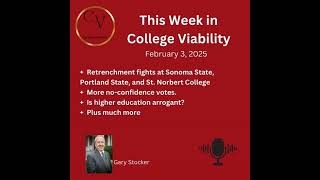
Gary Stocker surveys recent college closures, budget crises, and leadership upheaval at institutions like Portland State, Catholic University, and LSU. He argues colleges face the same market pressures as restaurants: demand, cost, reputation. Students are moving toward larger public institutions while smaller colleges struggle with deficits and endowment draws.
Chapters
It's This Week in College Viability news and commentary for February 3rd, 2025. Hi everybody, Gary Stocker back again this lovely Monday afternoon in St. Louis. I, I had my annual summit, kind of a tongue-in-cheek there, with a good higher education friend last week. He was one of my first virtual-only connections and always brings valuable perspective for me. And he talked about restaurants, not the kinds that we, you and I, might go to and eat on a regular basis. But he talked about restaurants, and over the course of time, many restaurants open and a certain percentage of them will close for a variety of reasons: bad food, bad location, bad pricing, high costs, poor financial management, and the list goes on and on. And restaurants are reviewed by any number of websites and other publications. There are some really good ones, I know here in St. Louis for sure, and those that are not really so good. He made the point, just like colleges. And I guess in the business context, in the business context, aren't colleges like restaurants in many ways? In today's podcast, here's a couple of the lead stories. Students and faculty argue that Portland State University's financial sustainability does more harm than good. You and I will call that a protest and move on. Louisiana State, listen to this, a $279 million net gain for fiscal 2024. And I'm going to make the case in this story that this, that this story supports my my operating premise that student markets— students are moving toward bigger colleges, mostly public but some private. And then we have two no-confidence votes for colleges: Lafayette College in Pennsylvania and Mount Vernon Nazarene in Ohio. And then a LinkedIn post from a gentleman by the name of Peter Corey. He's got experience as a college president and many other roles in higher education, and he talks about higher education's arrogance, and of course much, much, much more in this episode of This Week in College Viability. Layoffs and cutbacks. No closure announcements this week. Layoffs and cutbacks. St. Norbert College, Wisconsin, to develop recommendations for program eliminations and faculty layoffs. This was by Brian Kernan on Fox 11 on January 28th. St. Norbert College, Wisconsin St. Norbert has balanced its budget— this is from the story— has balanced its budget for this year but projects a deficit next year and will continue its process of laying off faculty members, according to a letter sent to the college community last week. The Catholic college has faced declining enrollments and has announced several efforts to reduce spending. The letter from college president Lori Joyner, excuse me, Lori Joyner said that efforts, the efforts have resulted in budget adjustments of nearly $12 million, no details provided. It goes on to say the college has started the process known as retrenchment as a way to reduce the size of the faculty, and that will continue. It goes on to say retrenchment is an essential step to ensure academic excellence and the long-term financial strength of St. Norbert College. Okay, Catholic University, interesting one. Catholic University in Washington, DC pledges cuts to offset a $30 million budget deficit. This is from Sean Salai in the Washington Times on January 23rd. Catholic University of America, the president Peter Kilpatrick says in a quote, for the past decade we have bridged such gaps through transfers from financial reserves. He goes on to say, a practice we must now cease in order to ensure long-term sustainability. All right, this one's, this one's tough. This one's tough to figure out. The 4-year graduation rates are really strong at Catholic University, 73% on average for the last 8 reported years. Their university's in the 2022 endowment was over $300 million. Their draw on that endowment was a little high in 2017-18, not that much, but not really. It's been right in the 3.5 to 4.5% range since then. Their draw on the endowment, they bring out of that endowment to make payroll and keep the lights on, is my euphemism. Their draw on that endowment was a little high, but their endowment growth, this is what's stunning, is above the 75th percentile. Whatever they're investing in, they're doing a good job with it. And the source of those comparisons is is Matt Hendricks' Perspective Data Science, the Advanced Compass app that he has. Revenues up 12%, expenses up 19%. Not great, not awful. Net tuition revenue though is down 24%. At the 50th percentile, which meaning half or more, half or less, at the 50th percentile, the net tuition revenue over the last 8 reported years averages a negative 1%. Catholic University is down 24%. And then it's clear to me that this university is facing tuition discounting pressures. And I looked, their unfunded institutional discounts— you and I call that merit aid and most scholarships— their unfunded institutional discounts have increased $16 million in the reporting period 2015-2022. I've seen a lot in that kind of range in relation to their size. And just a quick product reminder, the 2025 version of the College Liability App should be out later this week. It'll have data from 2016 to 2023. We've doubled the number of reports, added some graphics, and it should be a great product for higher education leaders across the spectrum. And of course, we're also going to have a version of that for students and their families. So back to Catholic University, I'm going to keep an eye on this story. It's interesting because it doesn't meet the parameters that we see with most private colleges that are in financial trouble. Got to do college drivel. Now, I don't say the name of the college, but you might recognize this from a couple minutes ago. College drivel today: retrenchment is an essential step to ensure academic excellence and the long-term financial strength of a given college. Retrenchment— cutting stuff to ensure academic excellence. All right, all right. It goes in my college dual section. You call it whatever you want. Page 2, students and faculty argue that Portland State University's financial sustainability plan does more harm than good. This is by Tiffany Cami on January 25th for opb.org. That's Oregon Public Radio, I think, or Oregon Public Broadcasting. Portland State is on track to close an $18 million budget gap this school year. But shock of shocks, that's my part. Shock of shocks, faculty and students are unhappy, unhappy with how the university is getting there. And like all these stories, I'll have links in the show notes. They say they're on track to close an $18 million budget gap, but I, and I look at this stuff all the time, you know that. I don't see enough detail to believe that number. I think somebody's making it up. But faculty and students are happy. Portland State suggested or indicated last month, I believe it was, they're laying off 17 non-tenure-track faculty. And at last week's Board of Trustees meeting, I think that was late January, faculty and students were warned that cuts could negatively— faculty and students warned that the cuts could negatively impact the university. Well, of course, they're always going to say that. Department chair said some of the faculty included in the layoffs teach classes with high enrollment, and the cuts could threaten students' chances of completing certain degree programs. Earlier this month, PSU's Faculty Senate voted on a resolution calling for greater transparency surrounding layoffs. Nothing wrong with that, it's not going to change anything. It also proposed alternatives to job losses like administrative pay cuts and voluntary furloughs. All right, sarcasm alert, sarcasm alert. Nothing like having college faculty recommend solutions to financial challenges. Of course, that's always their expertise. And students who spoke at this, at this meeting called the cuts short-sighted and questioned the board on decisions to invest in infrastructure rather than education. Apparently they're building something new at the college. Again, maybe that's the case, but like I shared before, everybody protests. That's not news. It's also not news. It's also not news that this college, like many, many others, waited too long. We're going to see that not only in this podcast later on, but we're going to continue to see this week after week, month after month. What does it take to say, hey, there's a pattern? And it's not a good one. Katie DiBenedetti on January 30th at KQED NPR Radio in Monterey, California, I believe, has a story that says, "They're scared to see our faces. Angry Sonoma State community protests wide cuts." And part of the story reads, hundreds of students and staff gathered at Sonoma State University Angry and grieving, one week after the school announced massive cuts to academic departments and the elimination of all NCAA athletics programs— we had this story last week— the gathering went virtual. The college insisted, because of all the interest in the meeting, that there wasn't a physical space available on campus, so they made the virtual meeting— the meeting virtual. They used a virtual format. And that move, as you might imagine, angered many students who were hoping, I suppose politely, hoping for an opportunity to speak with administrators face to face, and that didn't happen. And in an act of great maturity, sarcasm alert, I'm sorry, in an act of great maturity, boos erupted from the crowd as the president at Sonoma State and other administrators appeared on screen. Students yelled for the interim president, and I said this before, interim president How many times, how many times do we see that with colleges in trouble? Students yelled at the interim president to go back to Texas. I presume that's where she's from. Called her a liar as she answered questions. Oh, that's impressive. Sarcasm alert. The timing of the cuts, though they did have a point, the timing of the cuts announced just 3 days into the spring semester after students have paid their tuition was another point of frustration and contention. Why wait? Why— students logically shared, why didn't you tell us this earlier? It's not like it just popped up on the radar. And even that, even the faculty there, the hiring period for faculty is essentially over, and now they may have to wait. One, one faculty member was quoted as saying he may have to wait 18 months to find another job. Students signed leases in the area, you know, this We can talk about this more in the podcast. There's no excuse if your college is in trouble. College leaders, board members, even faculty leaders, you got to get it out there. It's not fun. It's not pretty. It's not pleasant. But I can make a case that although it may challenge your fiduciary responsibilities in those roles, it is certainly an ethical one you need to strongly consider. And I've talked about this before. And this is yet another example at Sonoma State of college leaders either being inept, it's possible, or totally inconsiderate, quite likely, of their students, faculty, and staff in terms of timing. These trends at Sonoma and other places, countless other places, have been observable for years. And I make the argument, and it's just a logical one, the timing of the cuts is a poor reflection on this college Sonoma State. And because we've seen similar things happening elsewhere, it's also a poor reflection on the higher education industry. It's going to come back to bite. It's gonna come back to bite. All right, the King's College used to be a frequent flyer on the show, on This Week in College Viability podcast. They've been off our radar for a little while, but trustees at the college, which shut down in 2023, want to gift it GIFT, to like-minded evangelical Christians in the hope a partner could resurrect the institution. Josh Moody had this on Inside Higher Education on January 28th. When— this is from the story— when the King's College in New York shut down in the summer of 2023, its leadership said the cancellation of fall classes and termination of faculty and staff did not mean permanent closure. They actually said that. I should have had that in the dribble section. Now it's Board of Trustees is seeking to revive the evangelical institution. This is according to a report from Religion Unplugged. The news outlet obtained a document that detailed a plan to gift the college, and I assume all of its Title IV excess, including its charter and intellectual property, to like-minded evangelical Christians who propose the most compelling vision to resume the operations of the college. Now here's, here's my thoughts on this. To these folks at the now closed King's College, do they really think that the world cannot possibly survive without them? The world cannot possibly survive with another college that lacks the financial resources, demonstrably so, and operational expertise these evangelical Christians from wherever they are coming from or may come from, do they really think the world still needs them jumping back into the higher education industry? Sheesh. Sheesh. And a new term, and I've got it again later in this podcast, we're gonna call this higher education narcissism. Guys, 3 heartbeats later and the students who are at the King's College will find another home just as good, if not better, academically. Page 3, Penn State. Let's go to Pennsylvania, a college overpopulated— state overpopulated with more colleges than they can ever use and operate profitably. This is from Wyatt Massey of Spotlight PA, State College, on January 27th. And Penn State faculty fear the school will close campuses across the state, and officials won't give them a straight answer. Okay, what's new with that? And this is, you know, the details of yet another, another higher education system engaging in a lack of transparency with its students and faculty and staff and communities. And folks, this, this pattern is going to continue to expose continue to expose the lack of skilled leadership, skilled vision in too many of our private and public colleges and universities. It's not good. I'm not going to go yet with an official jeesh, but they may be able to pull one out of me down the road. Louisiana State, Nolan McKendry in the center square on January 27th, $279 million net gain for fiscal 2024. Amid rising revenues and enrollment. And the details are in the story link, and I'll include that in the show notes. Now, some of the revenue reported in this story is not from student tuition fees. It comes from a variety of other sources, including athletics. And LSU is in this Southeastern Conference, the SEC, and have strong athletic programs in many sports. And I, I've touched on this before, and I'm going to continue to watch for these stories. I still believe, still believe we are in the early, maybe to middle stages of a rapid market movement by students toward larger public and in some cases larger private universities. It is reasonable in my mind to speculate, and maybe informed speculation, that many students and their families will feel are already starting to feel and maybe will increasingly feel a little queasy, a little uncertain, a little uneasy about smaller colleges as the damaging news stories continue to describe the financial and other challenges for those smaller colleges. St. Augustine University, North Carolina, faces ticking clock to fix Finances. Josh Moody in Inside Higher Education. Here's the essence of the story. And back in November, the folks at St. Augustine struck a $70 million deal with a company called 50+1 Sports, a fledgling— and that's important— new Florida company, to lease its campus and develop university property for 99 years. So last week The North Carolina Attorney General's Office, which looks at the deal, says no, yet, nah, we're not going to do this. And they wouldn't approve the arrangement with 50+1 Sports due to a lack of sufficient documentation. This is a quote from the story: due to lack of sufficient documentation to support the proposal and concerns that the payout is too low to justify transfer of these rights. Not enough money to pay for what they're asking for. The campus is appraised at $198 million. It was a $70 million deal. Do the math. The Attorney General's Office also expressed concerns about St. Augustine University's ability to continue to operate. So apparently this is not a good deal, so saith the folks in the North Carolina Attorney General's Office. And again, just like I mentioned a few minutes ago, I asked the question about this higher education narcissism. Trust me, trust me, the higher education industry will survive and thrive quite nicely without all of these colleges who ignored bad enrollment trends, bad financial tracks, bad financial trends, decreasing revenue, increasing expenses, and most of whom, most of which don't even graduate half, don't even graduate half of their students in 4 years. All fluff, no substance. Page 4. I think last week I had another story on regurgitation reporting. This is one from Brian Pimprassi in Forbes on January 29th, a poorly written story in my mind. It's another example, like I just mentioned, of regurgitation reporting. A reporter takes a press release from a college— in this case it was 3 colleges— and sends it out as a news story. And the 3 colleges involved here are Mills College, Hampshire College, and Sweet Briar— I think it's college also— all in the Northeast. And from the story, in all 3 of the cases, academic leaders were able— this reporter says, this is Brian Pimbraschi— in all 3 of the cases above, academic leaders were able to save their institutions despite steep odds, and always in the face of painful but necessary restructuring and with heated disagreement, they have not. They have— there's no reason to think any of the three will survive long term. Each of the three now currently exists in some form or fashion. Mills, I believe, merged last year with a college out in California. Hampshire has recovered, but if you're like, sorry, Triborough has recovered from their trauma about 7 or 8 years ago. But I look at their finances on occasion, it's not— they're not good. And remember last week's podcast, Hampshire College reporter again regurgitated a news story from Hampshire College saying we have survived, we are great. This was in conjunction with the story about the president leaving. And I'll remind you, I went and did the research the employer— that the reporter should have done And in the 2023 audited financial statements for Hampshire College, the independent auditors issued a going concern. They had concerns about that college being able to continue as a viable entity. No reporter yet has shared this. I even tagged the reporter in last week's story, tagged the reporter, I think even the publication. So hey, I'll give you free access to the College Viability App. I'll give you free access to what I know and the information I have. Crickets. Crickets. Reporters, do your homework. If you have a story, drop me a note. Courtesy access to the 2025 College Viability App comes your way on me. 50+ reports. I'll even give you 30 minutes of time to talk about the college reporting on to give you a feel for how to use the app and how to do the comparisons. And then you find yourself in a better position to counter this college drivel and get away from this regurgitation reporting. That's embarrassing. It's embarrassing to see this stuff come out without critical analysis. John Bakkenstedt, who is the vice president of enrollment, retiring vice president of enrollment at Oregon State University, has something on enrollment VP blog on January 30th that talks about football. And the headline on the, on the blog reads, "Does football count?" I'm going to kind of paraphrase and read some of John's blog post. He's talking about a colleague of his who predicted tough times ahead for Oregon State University as last year the Pac-12, which Oregon State was a member, disintegrated. This colleague said to John, you'll lose all that TV exposure in your key markets, just like Kansas and Kansas State did. So John said— I, John Bacca said— I indicated I had no idea what he was talking about. So he mentioned to me that KU, Kansas University, and Kansas State were pummeled— his word, not mine— in the enrollment area in Missouri when Missouri left the Big 12 back in— that would have been 8 years ago, 7 years ago, something like that. Back in the day. They weren't on those colleges— KU and Kansas State weren't on TV in Missouri anymore, and it was disastrous for them, so alleged the colleague. Now, John Bockenstedt does some of the best work out there. He, he cranks out more analytical data than most internal institutional research folks do, I think. And so he goes on to say in his blog, I didn't remember that happening. He goes on to say, I don't know how many teenagers who watch any TV anymore And he suggested football watchers would be a subset of folks who watch TV. But he says, I've, in my years, I've learned that sometimes the most unbelievable things are true. So fortunately, John Buckenstedt says, I like to let the data do the talking these days. And he's really, really good at it. And so he went to iPads and he's got a file on his desk that he used. And here's what he found out. And he's got images on the blog and the link. Yeah, I've got the link on the show notes. So you'll be able to go to that blog and take a look. Take a look at the actual graphics that he has. Not only after Kansas— University of Kansas and Kansas State left the Big— after Mizzou left the Big 12, not only did enrollment not implode, not shrink, it grew for both KU and KSU, both in numbers and as a percentage of the class at both institutions, doubling at KU and almost doubling at Kansas State. So, you know, his colleague may have been incorrect on this. So John concludes football or big-time athletics is demonstrably not the driver that some people might think it is. So interesting. And of course, I'm fascinated by the data piece of this, but this looks like another higher education myth bites the dust. Mike Nietzel, senior contributor, and this is from Forbes on February 1st. Here's the headline: Presidential no-confidence votes at two more colleges. Votes of confidence— votes of no confidence, excuse me— votes of no confidence were cast at Lafayette College in Pennsylvania and Mount Vernon Nazarene University, a private Christian university in Ohio. The faculty at Lafayette voted in favor of a no-confidence resolution against President Nicole Heard on January 28th. The vote passed 102 to 86, and it was the first such vote in nearly 200-year— in the 200-year history of the college. Among the concerns cited in this no-confidence vote, no-confidence motion, are or were the steadily declining conditions at the college, I presume physical, the ongoing crisis in leadership, okay, and threats to the role of faculty. Here's the deal. Here's why they're concerned. And they say threats to the role of the faculty and to shared government. The Board of Trustees at Lafayette responded quickly to the vote with— to the vote of no confidence with a resolution expressing complete confidence, of course, in President Nicole Heard. At Mount Vernon University, the no confidence vote was in their president, Dr. Carson Kasserman. Also on January 28th, 43 faculty voted for the motion, 13 against, and 13 abstained. Interesting. The faculty pointed out to a hostile work environment, issues with communication, a minimalization of the voices of academics, infringement on academic freedom, and unprofessional, unethical behaviors as complaints. As I read the board response, it was muddled. I couldn't figure out what they were saying. And as, as you will see in the next story, traditional higher education doesn't have a leadership problem. Yeah, it does in some cases. That's not right. In some cases they do. That's clear. When college leaders have been around for a long time, they look at the data and they don't act, that's a leadership problem. But as I'm going to talk about in the next story, it's a reality problem or so. And here's that story, The Presidential Graveyard: How Higher Ed's Arrogance Makes leadership almost impossible. This is from Dr. Peter Corey on February 2nd with a LinkedIn post. We don't have the link to the story in, in the show notes, and it was a long article. I'm not gonna read the whole thing, but there was an entertaining summary for each part, and, and Peter Corey called it the 'there I said it.' So it's kind of a brief summary of the section above it, and there are 4 of those. There were 6 or 7 in the article. There are 4 that I want to share, and the first one was There I said it. This is Peter Corey saying this. Instead of systemic change, we cling to the fantasy that every school can be saved with the right leader, the philanthropist whale guy gives a lot of money, gal who gives a lot of money, the perfect ad campaign, and the perfect director of admissions, ignoring that we are setting, keep setting them up to fail. Well, yeah, for sure. And, and it's the supply and demand thing that I've talked about before. You can't tweak operations, you can't tweak leadership in the face of a massive supply versus demand issue. I've talked about that many times. The second one, the second 'there I said it,' is the industry's arrogance prevents it from seeing the truth. The problem isn't as simple as a rash of bad leaders. It's a broken system that no leader can fix under the current conditions. At the board level, college leadership, college leadership level, faculty and staff level, and in many ways at the student level, culture eats change for lunch. It is what it is, and it's not going to change until the market faces it to change. Number 3, there I said it. In the end, Peter Korey says, the question is not whether the current model is sustainable. It isn't. The real question is how many more presidents will have to fail before higher education admits that the problem isn't them, it's the presidents, it's the system that keeps setting them up to fail. I couldn't, I couldn't have said it better. There's a tipping point out there. The challenge to the tipping point question is when Are we getting close to that tipping point where the market says it's all over? Are we, are we already on the downside and just don't know yet? Are we already on the downside of that tipping point and it will result in some set of catastrophic number of closures this year or next year or when? And finally, there I said it, traditional higher education doesn't have a leadership problem. It has a reality problem that I shared earlier. Amen. Amen. The market is changing, and I'm not the only one talking about that. And higher education, in its— in the, in the four walls that house it, higher education only pays lip service to those changes. The industry is so embedded overall— there are exceptions— the industry is so embedded in its past as a whole It can't internally generate the change that is needed. So be it. So be it. Markets, markets always, always, always, always adjust. That's already happening in higher education. And there will be a day, I sincerely believe there will be a day when we look back and say, oh, that's what that was. That's what was going on. And so let's do the wrap for this podcast. I did a special This Week in College Viability podcast with Bill Quayn and Joe Carabi last week, and I mentioned it on the show. The podcast, the video podcast version, will be released later this week on February 5th. And remember, these two are college professors, and they wrote the newly released book called Bankrupt You. And I bring this up again as a follow-up to the last story. Peter Khoury's article in LinkedIn charges that higher ed's arrogance makes leadership almost impossible. And the book "Bankrupt U" that Bill Quayle and Joe Carabi wrote provides many examples of that arrogance at the student and family level. And during the "Bankrupt U" podcast that you'll hear, you'll hear one of the authors talk about the response he received from his college leadership when he shared copies of the book with them. And I'm going to quote him: crickets, nothing. So either they don't care— possible— or they don't want to engage in a transparent discussion, a real discussion about the failing business model. And I think more importantly, maybe even the systems and processes in place for students and their families. I've read the book. I've read the book, both the electronic version and the hard copy they graciously sent me. This is an easy-to-understand indictment of the college business model, the college business processes. Just a section on the 10 college money traps, 10 college money traps and how to manage them, will be valuable to all students and families during their college life. So, so what does this all mean? To those listeners and to those readers of the media that I do, push back. Push back the leadership level. More pushback against colleges on the business model and how colleges deal with students and their families. There's not one untouchable component of our American life. Eventually, all organizations, all ways of life, assumptions, and much, much more are challenged. And we're living that challenge for higher education. I believe the current and coming business and process changes in higher education, in the higher education industry, will be much, much more traumatic than they will be pleasant. And yes, each year tens of thousands, tens of thousands of college students will graduate and move on to productive and rewarding lives. Absolutely. Congratulations and best wishes to each and every one of them. But you know where I'm going next. Too many will fall victim to a bad higher education market and colleges unwilling, unable to adapt. These students will gain in many cases nothing more than a little knowledge, maybe, and many if not most will exit with debt that is beyond their means to pay. And if you're a college leader— and I don't know how many listen to this podcast, send this to them if you want to— if you're a college leader, feel free to roll your eyes, feel free to stay on the course you're on. The market's changing. It's a risky journey. It's a risky journey. And if you're a college student, potential college student, future college student, parent, family member, don't just research the college. Look at content that challenges the status quo of the entire industry. My stuff and lots of others have content out there. Students, family members, you're in a position of strength. You are in a position of strength. Colleges need you a lot more than you need them. So go to college, negotiate the best tuition and fees deal possible. There are people who try to do that. Take 15 credits every semester Don't fall behind and challenge your advisor to give you an unassailable path to graduate in 4 years. And if they don't, take that college to task for failing you. Get that degree. Make sure it's one that will pay you a substantive return on your college financial investment. Go out and, as many commencement speakers have suggested, go out and change. The world. Thanks to all for making time to listen. Send your questions and comments, challenges, concerns to me at gary@collegeviability— college viability is one word— gary@collegeviability.com. Until, until next Monday, this is Gary Stalker for College Viability. We'll be back in a week.
More from Gary


What does it look like when a college increases both total revenue and total expenses?



College Financial Crisis? We look at the financial health of Bay Path U. (MA) and Coe College (IA)


Private College Financial Crisis? We look at the financial health of Hobart William Smith College


Financial Compass tutorial (Private college version.) Financial statements compiled 2016-2025.

