This Week In College Viability (TWICV) for February 5, 2024
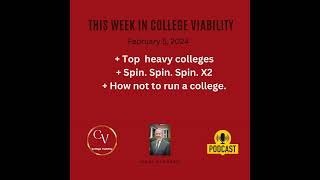
Gary Stocker reviews recent higher-education news using IPEDS data and the College Viability app. Baldwin-Wallace cut $17 million, University of Arizona faces a $177 million deficit, and vocational program enrollment is growing faster than traditional degrees. He debunks enrollment claims from Southern Illinois University Carbondale and SUNY Empire State College using longitudinal data.
Chapters
It's February 5th. The sun is shining outside my home office window. I continue to have zero commutes to an office, and I get to play in a pickleball tournament this coming weekend. Hello, Gary Stocker with another episode of This Week in College Viability. What do I want to talk about today? Well, we continue to get reports of top-heavy administration. This time it's Cornell University. We're going to talk about the FAFSA delay. Who isn't? We have a couple spin stories. SIU Carbondale putting on some laughable spin about increased enrollment in 2024. And spin, spin, spin, take 2 is Sarasota Springs College in the state of New York. We're going to talk about UConn. It has really good basketball programs. I had a chance to see their women play in Milwaukee a couple of weeks ago, but they have some serious budget issues. We'll talk about that. Webster University. I think somebody's going to write a book about how not to run a college in the 21st century. Webster University will be a highlight in that book in my mind. And what would an episode of This Week in College Viability be without a story about Birmingham Southern College? This time we drill down on their president's ChatGPT-generated responses to questions from the Birmingham Business Journal. And as always, we start off our episode with layoffs and cutbacks. And this week, Baldwin-Wallace University announced cutbacks. This is from a January 31st story from Hannah Wetmore at bwexponent.com. I must assume that's the college's newspaper. And they're going to be dropping, dropping $17 million from the budget. Now it's going to include cuts to programs and staff. That's Baldwin-Wallace University. I don't remember the state right off the top. University of Arizona getting more and more negative press about their $177 million deficit, uh, budget cuts, layoffs coming. That's been promised for a few months now. And it's a story about, uh, from Mike Nitzel, Mike Nitzel at Forbes. And I'm going to quote from his story. And the story says they, the University of Arizona, cited a decentralized budgeting model leading to insufficient oversight of unit spending, stagnant tuition revenue coupled with increased student financial aid, overspending on its strategic plan, cost inflation, the COVID-19 pandemic, and large deficits in the intercollegiate athletic program as their excuse. Well, yes, I don't doubt that most, if not all, of those things are true in some form or fashion, but But aren't college leaders paid to manage those situations and ideally before they become a crisis? It's kind of like the cute dog videos you see on YouTube. The dog has torn up some valuable item and the shredded pieces are laying all around, just like we talked about the University of Arizona. And the dog is looking up with those love, longing eyes, hoping for salvation from his humans. These messages are almost everywhere throughout higher education. Challenges are everywhere. Clean them up, Arizona. Spare us the verbal and written doggy eyes. You're not unique. You have problems just like everybody else. Page 2, Cornell, and this is from Micaiah Bilzerd, and she's the assistant editor at The College Fix. This is from January 30th, and we had a story from The College Fix about another administrator overload a couple weeks ago. Cornell has one administrator for every two undergrads, analysis finds. And this is from, again, The College Fix. Micaiah Belzer. Uh, interesting. Maybe the Fix has some data that I don't have that they can track administrators per FTE or per undergrad or per grad, whatever the case may be. It's an interesting story. It's probably not a big story. Cornell— I haven't seen any excuse or any rationalization from them. But if folks are using data to make these kind of reports, it's just another indication that we're in the Moneyball era of higher education. And, and we here at College Viability use data to make these kind of analysis and stories and comparisons and trends. And clearly the good folks at The College Fix are doing likewise. The FAFSA delay— I guess this maybe is the first comedy of errors story, although it's serious because it's a topic that many college, almost all college students need. And like almost everyone else, Rick Seltzer in his Daily newsletter summary one day last week. He asked an important question. Now, the FAFSA delays are causing all sorts of issues. I'm not gonna spend any time on that, but here's what Seltzer says is the bigger question. How many students who are on the fence about going to college walk away because of delays and confusion? How many admissions employees throw in the towel and say, screw this, I can't get the financial aid packages out, I'm losing students. And finally, what financial fallout, what financial fallout might await colleges, particularly the small institutions, the small private in the middle of nowhere colleges that enroll a larger number of price-sensitive students, Rick Seltzer asks. Fair question. It'll be interesting to see what some colleges do in regards to these FAFSA delays. I've even wondered— I wonder out loud now— I'm guessing the data that eventually comes from FAFSA from the government will be similar to what they've seen in previous years. I wonder which colleges might look at their previous year's FAFSA revenue projections, apply that to the class that was starting in the fall of 2024, and jump ahead of their competitors and make financial aid offers, offers based on what they can reasonably predict the FAFSA numbers might look like. I'm not even close to being completely knowledgeable about how that would work, but I wondered about that, obviously. Page 3, Dr. Ricardo Aziz for the Higher Education Dive on January 30th asked the question, how many people actually need a 4-year diploma? And we've seen discussions like this before, but here's the one piece of research that Dr. Aziz did that caught my attention. And for those of you that follow, I know Dr. Aziz is working on a book about mergers and acquisitions, consolidations in higher education. I think it's out later this year. But anyway, here's the research that caught my attention, and I'm going to quote from his, from his article in Higher Ed Dive. He says, he writes, enrollment has also notably increased in vocational programs according to a report by the National Student Clearinghouse from the fall of 2022. To the fall of 2023, enrollment increased. This is for mechanic and repair trade programs at 2-year colleges. Enrollment increased 11.3% in mechanic and repair trade programs, 3.6% in construction, 6.9% in precision and production— I assume that's manufacturing— and 7.6%, 7.6% in culinary programs. Meanwhile, overall enrollment increased only 2.6%. That's lower than any of those other trades. Enrollment only increased 2.6% at public 2-year colleges and only, not even 1%, 0.6% at public 4-year institutions. And this is the first time I've seen research that supports what has been anecdotally reported as a move away from traditional college education. I'm always trying to get a handle on where that trend is. And I know the market will fluctuate. The market will fluctuate from time to time. But in my mind, this is just another indicator that there are way, way, way too many college seats and not enough students interested in buying those seats at whatever discounted or giveaway rates that are out there from colleges desperate to have students to say, to pick them, to choose them. And here's our first spin story. So here's the headlines. SIU Carbondale, Southern Illinois University in Carbondale, spring 2024 enrollment rises. The story is by Kim Renfeld from WSIU Public Radio. I assume that's attached to the college. And sure it does. I don't doubt for a second that the enrollment over a dedicated Specific period of time went up at Southern Illinois University. And I believe in the summer it's hot and in the winter it's cold. Very similar, unnewsworthy kind of stories. And here's why it's a spin. It was up. Um, the article reports the enrollment is at 10,525 for, I think, the spring of 2024. Well, let's actually do some work here and let's use the IPEDS data and the College Viability App and look back to 2014, 8 years ago. Actually 9 years ago, and the FTE, the enrollment, was almost 16,000. The article notes that 10,525— do the math on your own, but it's not quite 6,000 less in 2024 spring than there was sometime in 2014, 9 years ago. And even then, they don't indicate what, what kind of enrollment. This is kind of an inside baseball fact. Is it total student enrollment? That would count, you know, one student taking 3 credits the same as a student taking 15 credits? Or is it the FTE, which is what I use, which is a way to standardize the reporting? And so if you're mixing and matching the numbers, you can make yourself look a lot better. And the chancellor at SIU Carbondale, Austin A. Lane, had this to say: we have a lot to offer students. He's justifying the 1-year increase, or whatever it was, in enrollment. Chancellor Austin Lane says, "We have a lot to offer to students of all ages and walks of life, including people with limited options." I have no idea what that means, Lane said. And in bold, I add, "We will continue to reach out to students to let them know of the rare, of the rare opportunities available to them at SIU." Southern Illinois University Carbondale. Folks, they're not rare opportunities. SIU Carbondale is not unique. They're not the best-kept secret. They don't have the tallest trees and the greenest grass. Geez, they offer bachelor's degrees, they offer master's degrees, they might offer doctoral degrees. They're a commodity. Yeah, the buildings are different, the location's different, the tuition pricing is different, the sports are different. There's not rare opportunities. I'm going to leave it as a single G's for right now, but let's go to the IPEDS data. Let's really look at the data and not engage in lazy reporting like Kim Renfrow did at WSIU Public Radio. Southern Illinois University graduate enrollment is down 1,400 students from 2014 to 2021. I did not see reference to that in her story. Their 4-year graduation rate hovers around 30%. That's 3 out of every 10 students who started at Southern Illinois University Carbondale graduated 4 years later. And the 6-year rate is only at about 45%. Not even half of the students who start at SIU Carbondale Not even half graduate after 6 years. The percent admitted is up 13 points to 95% in 2021. The admissions yield, which is that market indicator, the popularity indicator, is down 10 points from 31% in 2014 to 21% in 2021. And I'm guessing, like I have shared before, that the Admissions and enrollment motto at SIU Carbondale is "Have Heartbeat." We'll admit 95 out of every 100 who apply. And the institutional support expenses for administrative tasks and much more are up almost 50% per student from $3,600 per student to $5,400 and change. And the total operating revenues, because of discounts and scholarships and merit aid, I'm assuming, is down $31 million. And this week it's not good enough to have one spin story, we're going to go with two spin stories. The Empire State University enrollment increases. This is by Saratoga Today, and Empire State is in New York State. And this is just an example of lazy press release reporting. The reporting from Saratoga Springs in New York states that Empire State University saw a 25% increase in new student enrollment for its 2024 Spring 1 term, an increase of 12% and an additional 500 applicants, which means nothing for the spring compared to last year. The quote from Andrea Hennessy, who's the Vice President for Enrollment Management and Marketing, says SUNY Empire— that's part of this, this New York State system— has always been at the forefront of providing innovative education that meets students where they She adds, the increases we are seeing are testament to the university's commitment to online learning and the desire among all demographics for affordable, flexible, high-quality education options. Well, gosh, maybe, maybe we should go to the data. And from the 2023 Public College Viability Summary screen, over the last 8 reported years, 2014 to 2021, the FTE fall enrollment was down 1500 students. The 4-year graduation rate was up a little bit. The 6-year graduation rate was up a little bit. But hey, here's what the actual numbers were. In 2014, the 4-year graduation rate was 8%, 8 out of 10, 80 out of 100. I'm sorry, 8 out of 100 graduated. In 2020, in 2018, 4 years later, The values were 14 out of 100 graduated. The 6-year numbers aren't much better. The retention rates at SUNY Empire State College are marginal at best, 57% in 2014, 62% in 2018. And even the total entering students are down almost, or over 500 students. They're not painting the whole picture, and then that's their job, I understand, and it's my job to say, hey, Let's look at the whole picture here, boys and girls, ladies and gentlemen. And that's what we've just done. And to Colorado— I'm sorry, to Connecticut— there we go. There are different parts of the country. Fernanda Zamudio Suarez had this in a February 3rd Chronicle article. And the University of Connecticut is facing something along the lines of a $70 million budget deficit in 2025. And it's in large part because the state is reducing funding allocation And in something that will surprise absolutely no one, faculty members' frustration has reached a fever pitch. The Chronicle reports last month the faculty union held a protest and signed an open letter to express their opposition to the proposal. They told the Chronicle that they feel the 15% plan was generated without adequate Transparency or consultation. Where have we heard that before? We've heard that everywhere before. Is it true? Eh, tomato, tomato, I'm not sure. And at a town hall meeting at last week somewhere, Connecticut's provost, Anna D'Oliva, noted that other campuses were also facing budget woes in Pennsylvania and New York. And the story goes on. Now, this is a newsletter story, so I won't have the actual link on that, but it was from, again, Fernando. I'll put Fernando's name on there so you can actually track it if you'd like to see the content. But here's what's going on, and I see this many other places. So it's a kind of, it's a happening everywhere else story. Don't blame us from colleges. And the first part is true. It is happening everywhere else. But the don't blame us, so who, who do we blame? It's just that don't blame us message is the continuing message that we hear from too many in higher education. They are working, they're trying to work their public relations magic to the point that the blame goes everywhere except the market And as we have discussed before, there are too many college seats and too few students willing to pay anything for those college seats. Page 4, Webster University. I hope somebody takes me up on this. How Not to Run a College in the 21st Century would be the title I envision for the book, and Webster University would be a key character. A key case study, a key example on how not to run a university. And folks, this is a comedy. This is a comedy of leadership errors. In just the past week, the St. Louis Post-Dispatch, Blythe Bernhard and Steph Kekuljan, reported that Webster had first asked endowment donors, restricted endowment donors, those who had given their money for a specific cause for the university, Webster University had asked them if they could use their restricted dedicated donations to cover a loan that Webster had made, my words, not theirs, to keep the lights on. And the story that Bernhard and Kukuljan wrote focused on a gentleman who had created a scholarship for his young wife who had died many years ago. And that scholarship had funded a couple thousand dollars in scholarships for many years. And the man was clearly upset. In the words, my interpretation from the words in the story, that Webster was in effect, again, my words, not theirs, dishonoring his wife by taking away the endowed scholarship. Now Webster did say, we'll replace the funds. All right, the right thing to say. If they're in financial trouble, and that appears to be the case, I'm not sure I would count on that as a done deal. And then the next day, The Post, brand new story, reported that Webster found that $2 million, not quite, $2 million had been misappropriated at the university. And the story suggested that Webster officials suspected a former employee, now no longer an employee. Interestingly, the Post also noted that Webster had a similar misappropriation event back in 2017, just not even 7 years ago, I guess. Now remember, Webster University is in my backyard. So I have both a local fascination and an industry impact fascination with this story. And frequent readers and listeners may recall that the Post-Dispatch took Webster and its leadership and its board leadership in particular to task last fall for the executive compensation they were giving to its chancellor and president. Now, the details are in previous stories. You can Google, you can use your favorite search engine to search on Webster University. In the St. Louis Post-Dispatch. And I, I, I think I said this before, I still believe Webster is unlikely to close. I may be wrong. They're just, just not figuring it out at all. And, and if anybody wants to write a book about how not to run a 21st century college, here's, here's your lead story right there. And side note, reporters Steph Kokoyan and Blythe Bernhardt from the Post Dispatch, I think, are doing award-winning work in researching and breaking and writing these Webster stories. And then our good friends, last story, our good friends at Birmingham Southern College. And this is why they won't survive, one of the many reasons. And this was, there was a story in the Birmingham Business Journal last week, looks like February 2nd, and it was sponsored by sponsored content. So Samford, S-A-M-F-O-R-D University sponsored this. And they asked a series of questions to local college leaders. And one of those leaders was Birmingham Southern College President Daniel Coleman. And I'm just going to focus on two of his responses. And this is from the reporter, and I don't see reporter's name. The first question was, what makes your school unique? I'm going to read verbatim what Daniel B. Coleman, the president at Birmingham Southern College, said to the question, what makes your school unique? And quote, Birmingham Southern College fills a unique and important role in the educational landscape of Alabama and the city of Birmingham. As a liberal arts college, we provide small class sizes where our students receive personal attention from their professors. End quote. That's not unique. Everybody, almost everybody says, hey, personal attention from professors. And the second question: What role can education play in helping a company not only build its talent pipeline but also develop future leaders and managers? And again, Dr. Coleman, I believe Daniel Coleman says Birmingham Southern College cultivates well-rounded students who can adapt to diverse challenges, making them valuable assets for companies aiming to build a sustainable leadership pipeline, end quote. Both responses, both responses sound like ChatGPT-generated responses. To me, count me as not impressed, and few, if any, I know will care about my opinion. But these trite responses to questions from what I think is an important local news source don't bode well for an already tenuous future at Birmingham Southern College. And then finally, in January, there was a story from the National Student Clearinghouse, and I referenced this earlier, that college enrollment was up. It was a really small percentage, like 0.6%, something like that. And there were in-the-bag reporters like Derek Newton at Forbes who quickly proclaimed that the higher education crisis was over. And by the way, Mr. Newton took some notable heat in certain social media circles for his Pollyanna analysis. I'm not quite ready to do that, but the day draws near. And the point is that almost all nonpolitical reporting. And note that I rarely, if ever, take This Week in College Viability into politics. But almost all reporting in higher education is revolving around cutbacks and layoffs and delays and closures and other negative stuff. The 2024 College Viability app will be out any day now. I'm looking at final versions as we speak, and I'm going to make custom versions available at affordable price points for higher ed leaders a special version for faculty and staff, a special version for students and families, and a new version this year for community stakeholders. And folks, the, the objective— the moneyball era of higher education is upon us. We saw that with some of the stories we talked about today. And as more and more stakeholders compare the financial, the enrollment, and the outcome trends of both public and private colleges in our country, The stronger are going to move forward, and you can see that in the app comparisons. And you can also see that the weak will not. And that, my friends, in my mind, is a good thing. Until next Monday and another episode of This Week in College Viability, my name is Gary Stocker. We'll talk then.
More from Gary


What does it look like when a college increases both total revenue and total expenses?



College Financial Crisis? We look at the financial health of Bay Path U. (MA) and Coe College (IA)


Private College Financial Crisis? We look at the financial health of Hobart William Smith College


Financial Compass tutorial (Private college version.) Financial statements compiled 2016-2025.

