This Week In College Viability (TWICV) for Apr 28, 2025
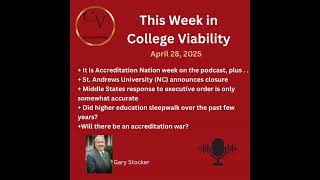
Gary Stocker argues that accreditors fail to warn students about financially failing colleges. He cites recent closures at Limestone, St. Andrews, and Toledo, and calls for transparent financial metrics and a 50% graduation-rate threshold to protect students from sudden institutional collapse.
Chapters
It is Monday, April 28th, 2025. Must be time for another episode of This Week in College Viability News and Commentary. Hi everybody, Gary Stocker back again for the regular podcast show. Kind of have a different podcast intro, and from week to week I do it differently. And today I'm going to open with an accreditation editorial, and the editorial is from me. As a matter of fact, a lot of the stories in this week's podcast are about accreditation. And so just be prepared for an accreditation ride, for better or for worse, in today's podcast. And it was on April 23rd, a story that Eric Kelderman for the Chronicle of Higher Education had. And the headline reads, Trump's executive order bashes accreditors, blames DEI for low standards and poor outcomes. All right, we'll give him the first part. We'll withhold judgment on the second part. So here is a line from the announcement. This is from the federal government. The accreditor's job— and I'm quoting here from the story— the accreditor's job is to determine which institutions provide a quality education and which therefore merit accreditation, the order states. Unfortunately, it goes on, accreditors have not only failed in this responsibility to students, families, and American taxpayers, and it goes on from there. So let's focus on the two areas that I have focused on before, and that is on graduation rates as the first one. Accreditors may say they don't have financial authority to warn the public, but they, they relatedly act like they do. And there are countless instances in the past and even today when colleges don't have the financial resources to provide a quality education, yet they remain accredited. And let's talk about the business model conflict. And we know what it is. The accreditors are paid by the colleges they accredit. And so I wanted to make sure I had this right. So I looked up, I went to my good friends at Google Gemini AI, said, hey, how do accreditation agencies make their money? And for the most part, it had different ways they charge fees for their services. Nothing wrong with that. It's a nonprofit. But here's the quote that I didn't even ask for from Google Gemini AI, and I'll read it to you. The federal government does not directly pay accrediting agencies. Does not directly pay for their services in overseeing institutions that receive federal student aid, typically Title IV funds. The reliance on fees from the institutions they accredit has at times, has at times raised questions about potential conflicts of interest. And it concludes by saying, though accrediting agencies have standards and processes in place to ensure impartiality in their reviews— boy, I'd sure like to see those— And if I'm wrong on that and you're part of an accrediting agency and you have standards and processes in place to ensure that graduation rates are considered, to ensure that financial standards, values, current ones are used, let me know. I'll gladly say I'm wrong. Well, I don't think that's going to be the case. And really what we need, I think I talked about this last week, is as I ponder this, and again, for those of you who follow the podcast regularly, I poke the accreditation bear regularly. They've earned it. And I try and be fair, but they're weak on these two areas, graduation rates and finances. I think what we need is a financial health only accreditor using the data that I've created on the College Viability App and that Matt Hendricks has in both his Advanced Compass and his Strategic Compass.
Have somebody provide objective data have them set the standards, and then the accrediting agencies can do whatever they want to with it. But now they appear lost and appear unable to be able to identify financial parameters of colleges at risk, even though I can look at the data and tell you which ones are not going to make it. So remember what I've said before about the enrollment piece. Colleges make a big deal out of any enrollment increase each fall, but when it's tied to graduation, I have yet to hear one college say at their May commencement ceremony. By the way, by the way, we graduated 42% of the students who started with us 4 years ago. And of course, I should have provided a sarcasm alert because that indeed is what I have going on. They talk about enrollment, but they don't talk about those students that either do graduate or those students that don't graduate. If you can't graduate at least 50% of your students, You're not much more than a coin toss college in my mind.
And then others have pushed back and said, Gary, you know, when you get on your graduation rate soapbox, they say, Gary, some colleges accept lower performing students and so they should be allowed to graduate a lower percentage of those lower performing students. Hogwash.
I don't think I've ever used that before in this podcast.
Hogwash with a capital H.
If these colleges choose to serve less academically prepared students, that's fine. Have them say so. Don't mislead the public into thinking they're accepting only top-of-the-line students. And if they're okay with something like a 42% graduation rate, that's fine, but say so, so the students know what they're getting. So then students know upfront what their odds are of being able to be successful in 4 years or even 6 years at this college. And then let's you and I look at the data. Let's go to the data and look back at the last 5 to 10 years.
I have 8 years on the College Viability App. And let's see, has that graduation rate increased from whatever they say it is or decreased? And it can go both ways. I've seen it go both ways. And accreditors have earned, they deserve the increased visibility, the increased critique from me and from others and the accountability demands that go with that on those two fronts, graduation rates and finances.
And withholding financial information on financially weak colleges, I still don't understand.
I understand that it is, indeed a self-fulfilling prophecy.
I understand that, but it's not for the colleges, it's for the students.
They need to know.
And so accreditors, if you're looking the other way when colleges don't graduate students or when colleges have bad finances, you're not doing the public, you're not doing the industry any kind of positive service. Thus endeth the editorial opening up today's show. Layoffs and cutbacks, St. Andrews University. Let me give you the timeframe on this.
April 21st, the Limestone University announces the college may close, or it also says they may go to exclusively online. 2 days later, on April 23rd, there's a story out that Limestone University pulls back from the brink of closure, pulls back from the brink of closure. And I posted a social media comment on this. It was trying to say that they had some kind of financial relief. Now, to be fair, they did qualify pretty heavily, so they weren't They didn't say it was a done deal. And then on the 25th, this is from 11 Channel 11 ABC News in South Carolina, I think. In South Carolina, St. Andrews University to close for good after the spring 2025 semester. I believe it's May 5th, something like that is the date of closure. There will be more. There have been more. There will be more. And it's just sad, you know, after 2 days they dangled this faint hope. For their students, families, faculty, and staff. And then 2 days later they said, hey, we're closing. And again, yet again, another short notice closure. I got word this morning of another one may come later this week. Another short notice closure. Too many, way too many short notice closures are happening. Not good. In Ohio, the University of Toledo announces plans to cut multiple undergrad programs. They plan to phase out several low enrollment degrees. Good for them. Starting with the 2025-2026 academic years. And to their credit, while admissions to these programs will be suspended. The University of Toledo says students already enrolled in these programs will be able to finish their degrees without interruption. Good for them. That's the best way to do it, even though I doubt the finances look pretty good on that— look very good at all on that. And here's— there's a long list of majors they're going to cut or suspend, and I'm not going to read them all, but just some examples, because there's a point that I want to make here. And they're going to be suspending the Bachelor of Arts in Asian Studies, Bachelor of Arts in Data Analytics, and some others. Bachelor of Arts in Women's and Gender Studies. We've seen that before. And several other programs that are part of the Provost Review include the Bachelor of Science in Health Information Administration, Master of Education in Educational Technology. Interesting. Master of Science in Geology and a doctoral degree in Curriculum Instruction Educational Technology. And here's, as I look at this list, the University of Toledo, it reflects how many colleges and clearly Toledo is part of this, how many colleges were trying to be everything to everybody. You can look at the whole list. We'll go to the announcement. I'll have the link in the show notes. You can go and see the whole list of cutbacks projected. And then they just tried to be everything to everybody, as do many other colleges. And it's just not possible in this day and age when there are too many colleges, too many college seats, and not enough students willing to pay whatever discounted tuition to go to those places. And we'll continue to see this. We'll continue to see this until the market becomes more balanced between degree offerings at each individual college and across regions across the country and student interest in those degrees. Page 2. So the Trump administration had their executive orders, and Middle States and a couple of the other accrediting agencies had some stories, had some releases on this as well. I'm going to read the one from Middle States Commission on Higher Education. This came out on April 25th. It's from their website, and it's mostly a rebuttal.
It's a fair rebuttal.
Note they disagree. They're entitled to do that. They note that they're looking forward to working with the Department of Education and the Secretary to make things better. That's what you would expect. And they say, this is from a quote from the Middle States Commission on Higher Education response to the Trump administration order regarding accreditation. Many statements, many statements, they say, in the executive order portray accreditation inaccurately.
Our statement, they go on to say, intends to correct those inaccuracies and provide information to the public in the areas noted in the executive order. Now, I will cede that there may be a shoot first, aim later approach to federal policy changes.
That's just the way they're doing it.
And Middle States certainly is correct to try and defend itself, but they're not always being upfront.
And I've got some issues. And the first one is the executive order, again, from Middle States.
The executive order also implies that accreditors do not appropriately utilize data to improve student outcomes. Our commission, Middle States, has data at the forefront of its work, including monitoring student success measures on a regular basis. Okay, where in that documentation is there a reference to accreditation? Excuse me, is there a reference to graduation rates?
How many times am I gonna have to bring this up?
If you can't graduate students, why are you even a college? Or if you're gonna have lower graduation rates, say that up front. And I had a couple comments. They say, we've never abused our authority. Well, I don't care. I'm not interested in this. Each party can fight that battle on their own. The second bullet point from the story is we do not approve this is from Middle States. We do not approve institutions that are low quality. What do you think I'm going to say here? There continue to be accredited colleges across the country with pathetic, with miserable, with embarrassingly low 4- and 6-year graduation rates. Matter of fact, I've talked about it previously on the podcast. Colleges are so generally embarrassed about their 4-year graduation rates, they're trying to pitch 6-year graduation rates as a better number. And I'm not gonna get into detail on that, but even the 6-year numbers are miserable. They're not good. And they say, "We have not failed our students and the communities we serve." Well, again, beg to differ. You have failed creditors, not just Middle States. You have failed to give warning, to make the public, to make the students, to make their families, to make their faculty and staff at these colleges, to make the communities aware in anything close to a timely manner when a college is in financial trouble? How many times have I said on this podcast and other media that I do that accreditors are not providing any semblance of easily accessible heads-ups, head-ups, heads-up when colleges have markedly weak finances? I can see them. They're there in public data. Now I create apps, as do others that I work with, that makes it easy to compare the financial health of colleges. And how many times have colleges announced cutbacks, layoffs, even closures, and we see nothing from the accreditors? That's what they want their mission to be. Fine, be upfront. Tell us, we don't want to provide financial updates. We're not capable of financially providing timely financial awareness to the consumers.
I'm okay with that.
I'll do it. I've got tools. I've got products that will do that. And on the infrequent occasion that these accreditors cite a college, cite a college that doesn't meet the accreditor standard for financial health, usually all that's required is the college cited for whatever malfeasance needs to show only a policy or procedure to address the unfulfilled accreditation standard. Here's a policy we just wrote. Here's a procedure we just wrote. There is no documented need to show actual improvement over a period of time in its financial health and viability that meets anything close to providing the kind of accountability that, that consumers deserve. And I told this story, I did an interview with a major news media last week and I gave the story, how many students and their families in the past month have sat around the proverbial kitchen table or the actual kitchen table to make their college decision for their child or for themselves? And how many of those colleges being selected at those kitchen tables are actually watching their last dollars circle the financial drain and the families don't know? And in almost every case, maybe every case, these accrediting agencies offer no heads up to these education consumers. Kyle Beltramini wrote a story in Inside Higher Education entitled "Where Is Congress? Broad Structural Reform." The subheading reads, "Broad structural reform directed by Congress is what's needed to fix America's colleges." Right, it's called Beltramini in Inside Higher Education back on April 2nd.
I've had to push this story out a few weeks because I've had so much content.
Good stuff. And here's some— I'm gonna pick parts of it as I usually do, and here's some quotes from the story.
And Mr. Beltramini writes, left to its own devices, the higher education industry sleepwalked through the Great Recession and the COVID-19 pandemic, learning little and frittering away the public's trust. High debt loads combined with educational priorities horribly misaligned— his words, not mine— horribly misaligned with the needs of the country's workforce have led to a 52% underemployment rate among recent graduates, as well as a shrinking return on investment for many college graduates. He goes on to say it should be a national scandal. A national scandal, Kyle Beltrame writes, that taxpayers spend $20 billion a year to institutions, or send $20 billion a year to institutions that graduate fewer than half. $20 billion to institutions that graduate fewer than half of their students in 6 years is his data. Oh, and a recent Third Way analysis found that. That was the source of that study. There should, Mr. Beltrame goes on, there should be protests over that statistic that more than 1/3 of students leave college with minimal cognitive gains. That's from other research. And the boards of private nonprofit— he put that in quotes— nonprofit colleges should be called to account for how they can justify holding endowments valued at over $580 billion and overpaying their executives. He uses an average salary of $850,000. I don't know where that comes from. And while their average student graduates with nearly $34,000 in debt, And he concludes this comment, how can this industry continue to expect deference from politicians and the public in the face of such obvious systemic abuses? Again, this is from Kyle Beltrame and Inside Higher Education on April 2nd. Mr. Beltrame also offers yet another serious indictment of the current accreditation system. And I'm not going to pile onto his comments on top of what I've already said about accreditors, but he had more concerns about accreditors similar to what I've shared before. About graduation rates and unrecognized financial chaos in too many colleges. Kara Halford in the Eagle at American University has a headline. This is from April 24th. Kara Halford, H-A-L-F-O-R-D. Increase in administrative positions prompts report from faculty. Now, report— I cite this because again, this is coming from inside a college. The study group on administrative growth report to the faculty senate. Again, this is American University in the District of Columbia. Found that there was a 64% increase in vice president and director titles in comparison to only a 10% increase in faculty positions. I don't see a date range cited on this. What this sort of expansion does, given finite tuition revenue— again, this is from Carla Halford and the American Eagle at American University— is risk crowding out resources that otherwise would have gone to the academic mission of the university. American University is facing a $68 million budget shortfall in 2023, '24, and projected to be $80 million. Those are big numbers. $80 million shortfall in 2026. Okay. These, those are really, really big deficit numbers. And I gotta think that American University is gonna continue to stay on my radar to see what comes of those cutbacks. Those, those are really, really big numbers. Page 3, accreditation. I told you at the top is, is a continuing theme today. And what we're looking at is how an accreditation war could start. Here's what to expect from Linda McMahon in the next 90 days. This was dated March 24th. So again, it's been pushed back a few weeks because I've had so many stories. This is from Robert Shireman in the Chronicle of Higher Education. He's a senior fellow at the Century Foundation. Of course, all these links will be in the show notes. And there's a lot of speculation in this article, and that's fine.
He's entitled.
He wrote the piece. Is there some political bias? Maybe, you know, I don't do politics in these stories to the best of my ability. Even if all of the scenarios that Mr. Sherman talks about were to be implemented, scenarios from the federal government were to be implemented in the next 2 years or so, they would almost certainly, almost certainly be modified by subsequent political leaders in 2026, 2030, whatever the case may be. What— 2028, excuse me, 2028. What cannot be modified is what Mr. Sherman did not address in the story. He did not even have one single character of his article addressed accreditors not providing alerts about financially weak colleges. Again, that's the theme for this podcast week. I know that, and I'm being redundant in part with intent. And those that follow this week in college viability on a regular basis at least have probably heard me talk about the I-dotters and T-crossers.
It of course references my perspective on accreditors.
They're almost about inputs and policies Inputs and procedures, what we plan to do, what we're thinking about doing, and outputs are almost, almost, huh, in my mind, totally ignored. And the biggest one is the graduation rates.
So bad, so sad.
And the most distressing output is not graduation rates, even though that is, it's the dance that creditors do around financially weak colleges. The next story is from a post that Ariel Sokol posted on, I believe it was Inside Higher Education a few weeks ago. And he was talking about financial transparency, and he made some really good points. And I want to follow up on that. For too long, for too long, financial assessments of colleges have been written in a language only bond markets, bondholders, and financial analysts understood. When Fitch or Moody's or Standard Poor's assign a B+ or BB- to institution, they're not talking to the people investing in their future— students and their families, faculty and staff. and often spending tens of thousands, and in many cases hundreds of thousands of dollars. These folks are speaking to investors. In higher education, I make the argument that the true investors are students and their families. They're the ones paying the tuition. Now, I understand bondholders are lending money. I understand that part. But who are these ratings for? Colleges and universities often measure institutional viability in terms of their ability to stay afloat for just another year, not their ability to deliver high-quality, long-term educational experiences. And as Mr. Sokol rightly points out, many institutions, many institutions are more concerned about meeting their bond covenants, 'cause they have to, than supporting their students. Now again, this is Ariel Sokol with that comment. And when history looks back, this is me talking, when history looks back on this period of rapid college closures, I believe the data will likely show, and I've said this before, The data will likely show that debt and the inability of colleges to meet the terms attached to that debt will be at the heart of many, many closures. The covenants attached to those debts, the rules attached to those debts, and the current Department of Education's fiscal— excuse me, financial responsibility composite score, FRCS, for those of you that like acronyms— has perhaps, Mr. Sokol writes, has perhaps unintentionally created an environment where taking on more debt can be beneficial to get a good financial score rather than the financial stability that we hope for. And that's a, that's a dangerous process. That's a dangerous precedent, especially when students are the ones who pay the price, when students are the ones who pay the price in one way or another when things go south. And so the tools already exist. Fortunately, we don't need to start from scratch. Tools like the Private College Advanced Financial Compass from Perspective Data Science and my own college viability apps already offer financial health assessments, financial health comparisons tailored to different audiences. College leaders can use these tools to access in-depth analytics comparisons while students and families can explore simpler, easier-to-understand reports to get a real sense of the financial health and viability of the colleges they are considering. The tools are out there, you know, Yes, the folks at Fitch's and those places, S&P, can issue their own bond covenant ratings. That's fine. Their own ratings, that's fine. But we really need tools that everybody can understand. And the tools we have don't speak in cryptic acronyms. They don't use vague ratings. They focus on clear indicators. And some examples, you know, look at the enrollment. It's not a 1-year number that colleges throw out there. We look at enrollment trends. And when I bring up the College Viability App, state after state, college by college, sector by sector, there are more declining full-time enrollment rates than there are increasing. We look at endowments that are under $50 million, $50 million. That's my own standard. If your endowment is below $50 million for the entire life of your organization, don't tell me that when you're in a pinch you can raise $10 million or $20 million in a period of weeks or months. Just not gonna happen. And graduation rates, we've talked about 50%. I won't beat that one to death. Won't beat that one to death. We've talked about coin toss colleges and even, even something I talk about on occasion, capital expenditures. How much colleges are spending to keep their facilities safe and up to date. It's kind of a little inside baseball number, and it's a potential indicator, I believe, of a college falling behind in maintaining and improving its infrastructure. And this includes buildings and preventive maintenance and capital items like computers and chairs and desks and those kind of things. And again, the apps that I talk about do it individual college, college by college. You can compare and see who's investing in infrastructure, who's investing in safety, who's investing in making sure they have the updated computers, and software that goes with those computers and who's not. And even endowment draw rates, even though it's still a little bit inside baseball. Time and time again on the College Financial Health Show with Matt Hendricks and Gary Stocker, we show colleges taking way, way, way too much from their endowment. They're breaking the piggy bank to get into those funds to keep the lights on and meet payroll. And time and time again, we see that's going to be a leading indicator and a final indicator of colleges that just cannot continue to do that and have an unsustainable future whether that's with a long runway in some cases or relatively short runway in too many cases. And then finally, page 4, George Leif at the James G. Martin Center for Academic Renewal has a story that says, yes, the college bubble will deflate. A new book on higher ed's future should give university presidents pause is the subheading. George Leif again on April 16th. He writes, for the entire existence of the James G. Martin Center, We have been arguing that due to governmental policies, higher education has been badly oversold. Badly oversold. This is from George Leaf at the James Martin Center. That is, many students have been lured into college even though they have little interest in or aptitude for advanced academic studies. The notion that a college degree was a surefire investment that would pay off handsomely after graduation was erroneous. Not for everybody, but for too many. That was my comment. But great numbers of students and families were taken in by that siren song. Again, this is George Leaf at the James G. Martin Center for Academic Renewal. He goes on to write, Charles Murray in his book, "Real Education," again, the link to this story will be in the show notes. George Leaf writes, since Murray's book was published, a lot of evidence has come to light that supports his point of view, especially the large number of college graduates who have ended up working in low-paying jobs that call for no advanced study. We've seen those stories before. We've heard about those stories before. Nevertheless, Mr. Murillo continues, the education lobby has continued to declare that the college degree is the best way for almost everyone. Mr. Leaf goes on, it will be impossible to keep up the cheerleading, he contends, that college is the key to the American dream now that Kathleen Delasky's book Who Needs College Anymore is out. She has written a deeply—
Mr.
Leaf goes on— she has written a deeply thought-out and extensively researched book arguing that new methods for preparing young people for the working world and for helping employers identify those who best suit their needs, they're all rapidly developing. And the days, Ms. Dolaski writes, the days when a college degree was essential for these types of jobs, not for all jobs, will be gone. And Ms. Dolaski concludes, the huge artificial expansion of demand for college degrees that began with the government's ill-considered intervention in higher education 70 years ago is going to decrease greatly As students avail themselves of better ways, of better ways of getting into the world of work, most colleges will have a hard time finding ways to fit into the new reality. Only a rather small percentage of those students who really need a college degree, such as those who go into medicine, law, or professional colleges, those are the only ones who will be open to those kind of college degrees. So wow, wow.
And remember my operating premise: there will be massive consolidation in higher education, first with closures sometime soon, sooner rather than later, followed with large-scale mergers, along with a smattering of acquisitions as companies, what I believe will be, create their own vertical learning systems for their own uses.
And how many times have I said the market always speaks?
It doesn't matter what the industry is, doesn't matter what the business is, the market always speaks. Sometimes it speaks and acts too slowly, but it always, always reacts to make the process, the products, the services better. And that's what we're seeing in higher education today. And this story just reaffirms what I've been saying, what I've been saying for many, many, many years and will continue to say. And let's do a wrap. Accreditation was the theme today and accreditors are under increasing fire for many fronts. And I've talked about that today and many times before. The market for traditional college students consistently is consistently eroding and there's data supporting both of those trends. And there are families I talked about earlier making their decisions right now about the fall 2025 college choice. And sadly, most of those won't have evaluated the financial health of the colleges they are considering. And for all the work that I do and others do to get that information out there, the entirety of the market just isn't there. You're not even close. But it will happen at some point, and there will be a tipping point that I have mentioned regularly over the past few years. And just like the move toward, for example, smartphones and cameras, the cameras attached to them, the move, the market move to considering the financial health of colleges will happen pretty quickly. I don't know when that will be, but again, sooner rather than later. Sooner rather than later. And for listeners of this podcast, I make the case you're part, you are part of the tipping point journey. Share this podcast, share the College Viability website, share the apps available through College Viability and Perspective Data Science. Do your part with friends and families and neighbors to make sure they have the information they need to choose financially healthier and financially viable colleges. Hey, that's a wrap. Until next Monday, as always, thanks for listening. Let's do it again next Monday. It's going to be in May already, May of 2025. I'm Gary Stocker for College Viability. We'll talk then.
More from Gary


What does it look like when a college increases both total revenue and total expenses?



College Financial Crisis? We look at the financial health of Bay Path U. (MA) and Coe College (IA)


Private College Financial Crisis? We look at the financial health of Hobart William Smith College


Financial Compass tutorial (Private college version.) Financial statements compiled 2016-2025.

