This Week In College Viability (TWICV) for December 16, 2024
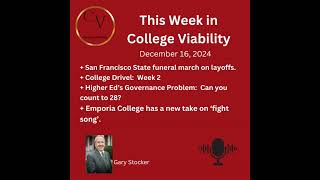
Gary Stocker reviews layoffs and closures at Drexel, Portland State, and San Francisco State, then examines why colleges fail to adapt. Private college boards average 28 members when 7 is optimal, hampering decisions. A predictive model flagged 100 at-risk institutions; 52% have closed.
Chapters
It is This Week in College Viability news and commentary for December 16, 2024. Hi everybody, Gary Stocker back behind the cute blue Yeti microphone, and I have a big announcement to start off today's show. After reading and listening and watching traditional higher education media, I have I realized somewhat belatedly that that is not me. I don't really do cookbook stories on how to fix higher education on the margins. I don't engage in trite college stories about awesome or exciting events or personalities. It's time. Here's the announcement. It's time for me to step forward and share that I am your self-appointed— yes, that's right— your self-appointed higher education education alternative media source. Giggle if you will, roll your eyes if you must. My operating premise, right or wrong, has been that higher education is in the midst of an economic model adjustment that will inevitably result in consolidation in the form of continuing college closures and increased merger activity. I try to be polite. I hope that comes across. Some have called me somewhat bombastic. I can live with that. I do, though, offer sarcasm alerts. And I do— I, I have an interest in engaging in collegial discussions with those who have other thoughts, and already plans are in the making to engage, to bring more folks onto the show, both this podcast and the College Financial Health Show with Matt Hendrix that we do every Tuesday in 2025. And I've also had many say, Gary, keep doing what you're doing. Many have said that, and to those, I thank you. And this podcast and the other media that I do will continue to lovingly poke the current higher education bear in a never-ending attempt to do my small part to move the industry past its historical model and toward one that recognizes the higher education industry. It needs fewer colleges. I've said it before and I will continue to say it again in the future. And to layoffs and cutbacks, we start the show as we always do. Drexel University lays off 60 staffers due to enrollment drop, and flawed FAFSA rollout is their excuse. And I certainly The faster rollout had an impact on Drexel and many other colleges. This story came from James Samuel on December 11th from The College Fix. At Drexel, interim president Dennis O'Brien attributed— get this— increased investments in both financial aid to promote access and affordability and in student supports to ensure their success and well-being and rising costs associated with doing business as the main drivers of the university's budget imbalance. You'll hear that quote again in the college dribble section of today's podcast. Enrollment has consistently fallen at Drexel University since 2015. At what point did someone at Drexel or elsewhere even besides us, besides me, stand up and say, hey, Houston, or Drexel, we have a problem. And a recent message to the campus from President O'Brien said Drexel has created an academic transformation plan. Stop the presses. That involves cutting $150 million in expenses. That's a lot of money. By 2027 to achieve sustainable positive operating margins. Nothing wrong with that at all.
But again, why?
Why, why the wait? At Drexel, like many places, this financial challenge is not an overnight development. And it's a similar story across countless colleges in this country. There was a Mark Perry, I presume a Dr. Mark Perry, who's Professor Emeritus of Economics at the University of Michigan Flint, said in an email to The Fix, and that's who's reporting this story, that he does not believe, at Drexel apparently, he does not believe overspending is the main issue. Dr. Perry goes on to say the decline in enrollment at Drexel is consistent with the national decline in enrollment since 2010. Welcome to the show, Dr. Perry, via text, via content. Dr. Perry, due respect, If you would actually look at the data, you would see the total— the Drexel total expenses as their enrollment plummeted. Total Drexel expenses increased about $37 million from 2015 to 2022. There was an expense issue. It's not just enrollment issues. They're connected for sure. And just as a sidebar, Matt Hendricks and I reviewed Drexel's financial health and viability on the August 13th episode of the College Financial Health Show. I'll put a link in the show notes so those of you that want to listen to that can go right to the YouTube video on that. Moving on, Portland State to lay off 17 faculty members. The union says more layoffs could be coming. Just trying to keep everybody up to speed on layoffs. This is a public college, of course, in Oregon. And in San Francisco, entertainment value San Francisco State faculty mourn upcoming layoffs in a New Orleans-style funeral march. The stories from Alison Alexie, the San Francisco Examiner, on December 11th. Yes, they had fake caskets and many of the New Orleans accoutrements associated with a funeral at San Francisco State University. Positive points: Positive points for creativity, negative endpoints for actually doing anything, negative points for impact. And on to something that a lot of you liked after I introduced this just last week on the podcast. It's time for the college drivel section where we take information from colleges that just seems so goofy, so silly, so fluffy as to be worth giggling about. I'll start with one that says, "Our commitment—" and again, for these Dribbble, college Dribbble quotes, now I don't attribute them. I may change that, but for now I'm not going to. "Our commitment to providing high-quality learning experiences to the most diverse student body in the region at an affordable cost continues to be what sets this university apart," said a senior leader. And like I shared before from the good folks at Drexel, increased investments both in financial aid to promote access. These are discounts, no extra dollars transferred. Increased investments both in financial aid to promote access and affordability and in student support to ensure 50% graduation rates. I have to check what Drexel is. And to ensure their success and well-being and rising costs associated with doing business as the main drivers. Of the university's budget and balance. I don't even know what that means. That's a line, that's 3 lines going in all sorts of directions. And then finally, from an English department person in a private Midwest college, goes on to say that many of the programs affected in their cutbacks at this college are in the humanities and languages. Making those disciplines less available to rural students than they are to urban and suburban ones. This is the part that gets me. These subjects, I guess humanities, languages, these subjects do much of the work helping students dream beyond their realities, said this English department chair at a private Midwestern college. Great. Now, I don't want to have all the fun here, so listeners, send me your college dribble quotes. Send them to me, gary@collegeviability— that's one word— gary@collegeviability.com. Let me know if you want attribution. Happy to offer it. If not, I will certainly keep that confidential as well. And remember, I won't use a person's name or college or business name in the college dribble quote quote, although like I said at the top, I'm pondering whether to change my mind on that. Page 2, Intel. You might remember them as a company who made chips in the early days of computers, especially home computers, personal computers. And they have fallen behind the times. And the story, I'll include the link, was from CNN, Claire Duffy at CNN, earlier this month on December 4th. And the essence of the story was Intel was dominant but failed to keep up with technology and business trends. Where have we heard that before? If a name like Intel, a prominent dominant name like Intel, struggles to survive in this era, what does that mean for colleges that refuse to aggressively or even just adapt to new technologies and business processes? That's a rhetorical question for you to ask and answer. Higher Ed's Governance Problem is the headline. This is from a guest essay that Dr. Brian Rosenberg did in The Chronicle on December 12th. And if you don't recall, Dr. Rosenberg wrote the book about this time last year entitled Whatever It Is, I'm Against It. He was a long-term president at Macalester College, I think, Macalester College in Minnesota. Again, higher ed's governance problem—boards are bloated and ineffectual, so says Dr. Rosenberg.
Here's some content I'm going to paraphrase from Dr.
Rosenberg's guest essay. According to the Association of Governing Boards of Universities and Colleges, the average size of a private nonprofit college or university board is 28. He makes note that that is larger than a Major League Baseball roster. Nice analogy, I like that. By way of comparison, Brian Rosenberg continues to write, the average size of the board of directors of a publicly traded company— the IBMs, the Apples, those kind of places— is 9. And if that—
he goes on to write—
if that seems too corporate, consider the average size of the board of a nonprofit healthcare institution is 13.
13 in healthcare, nonprofit healthcare, private nonprofit healthcare institutions. And the average size for nonprofit institutions more broadly is 17.
And Dr. Rosenberg suggests that's probably elevated by the inclusion of so many large nonprofit private university boards.
And most, again from Dr.
Brian Rosenberg, most governance experts view these numbers to be on the high end of the optimal range, really high end.
A study done by Bain Capital a while back— I don't see a date— puts the ideal size of a board for the purposes of decision-making, ideal size, at 7. And again, college boards are about 4 times that size on average. And Bain estimates that each member beyond that number results in a 10% decline in effectiveness. That's got to be a real tough number to calculate, so probably a soft number. And again, To wrap this up, getting 12 people, Brian Rosenberg writes, getting 12 people to spend significant time studying serious challenges and then reaching consensus about how to tackle those challenges is a heavy lift. Doing this with 25 or 35, he writes, or 45 people is close to impossible. And this is, this is me, this is yet another indicator that higher education is not even close, not even close to being able to adjust their business or management models. In too many cases, there are of course exceptions. I've been in a room with 25 or so board members. It is nothing more than a form of quasi-organized chaos and in many cases indifference. Uninformed participation, and it continues to be a function of formality and collegiality over substance and action. And does this large board size contribute to the, to the poor financial performance and concerns about short and long-term viability? Absolutely. And I, I, I could make a good case that until college boards make themselves smaller and more involved in the college's finances and future, there is reason to believe that boards will continue to be a major factor in the financial ruin, in the financial ruin of many, many more colleges. Private ones will close. Public and some private colleges will merge or otherwise consolidate in that market, as I've said before, with too many college seats and not enough students willing to pay for those seats. How many colleges may close after 2029? This story originated, it was last week, week before last, and I've got a story from Alcino Donadel at University Business on December 4th.
And researchers in this study, and again, it was all over the media last week, week before last. Researchers studied everything from an institution's enrollment, endowment, total staff, debt, and other metrics to inform its predictive tool. All right, fair enough. 52, 5-2, of the 100 institutions that the study identified as the riskiest, riskiest institutions in higher education closed within 3 years. Now, I don't see the dates here. However, and this is important qualification, I'll come back to this in a second though. However, it had— the study missed the mark on colleges that have already closed that include Birmingham Southern, Iowa Wesleyan, and the University of the Arts in Philadelphia. Now, 52% out of 100, 52 out of 100 for those that didn't pay attention in math class, 52% is statistically noteworthy. But it's a risky prediction model for college closures, along with, along with all of the human and community elements involved in saying, hey, this college is going to close or is likely to close. For example, would you send your child to a college for whom a valid statistical projection, a legitimate statistical projection for closure was proven to be correct a little over half the time. And the challenge— and I've said this many times, and that's the focus of my business model— the challenge is to report on risky colleges while at the same time looking for ways for these colleges, for these at-risk colleges, to survive. And as the article correctly notes, these at-risk colleges are a big deal in their communities. And Matt Hendricks, when we do the College Financial Health Show, regularly mentions his interest in helping these colleges survive using the data he can provide them. And his College Financial Health Strategic Compass does just that. If you haven't seen our show, you want to take a look at that. We're going to be diving more and more into the Strategic Compass in the weeks and months ahead. And nobody in my mind— and I could be wrong on this, feel free to correct me— nobody identifies individual colleges at risk and their unsustainable practices like METAs. Nobody identifies those colleges like I do with the College Viability App, and that's a big deal. Our focus for students and faculty and community continues to be on the financial health comparisons of individual colleges. The consumers can decide, the faculty can decide, the The community can decide, students can decide. We'll provide the data, we'll provide the analysis. Never will we say that any single college will close. Page 3, a reimagined Jewell College. This is just north of Kansas City. This is an internal webpage notice on December 5th, and effectively it provides a lot of words in the first 3 or 4 or 5 paragraphs, a lot of words to announce that the board has declared a financial exigency at Jewell College. And here's what I noted when I did a quick look. Net income, operating margins, net tuition revenue are all trending very close to the College Financial Health Advanced Compass patterns of recently closed colleges. Jewel College is tracking at least those parameters I mentioned, along with recently closed colleges. Draw your own conclusion. And you've, you've heard me say this before, I said earlier in the show, Jewel, why now? These, these financial challenges are not an overnight development. Time for some entertainment. So let's go to Emporia State University in Kansas, the middle of Kansas. Emporia State University president faults tech college for competition and visions hostile takeover. This is in the Kansas Reflector on December 10th, in an article written by Sherman Smith. And this is kind of a fight, fight, fight, fight brewing in the middle of Kansas somewhere. Here's, here's the lead from the story. I'm gonna read it. Emporia State University president Ken Hush— I believe is how you pronounce it— President Ken Hush, in a letter to a local economic development agency, accused Flint Hills Technical College of competing for students. How un-American.
Of competing for students. That was my part.
Of competing for students and warned that lawmakers, lawmakers could force a hostile takeover of the tech college. By the university. As always, I'm going to include the link in the show notes. Read the entire story. It is both sad and entertaining in the same breath. And Emporia State, like Webster University and others, are working hard to show us all how not to run a public or private college. And as does— you gotta wonder, does this suggest that if other public or even private colleges face competition, as apparently Emporia State University President Ken Push does not like, do other colleges engage in hostile takeover actions to remove competitors? I would say state too, but I'm not sure I'm going to stick with this story.
It's too off the rails.
And then I did a post on this on social media, on LinkedIn last week, and the headline from, from a LinkedIn story that I wrote, the headline from the, from a story, news story in Iowa, read that Iowa private officials were confident in popularity, sustainability of increased financial aid. All right, fair enough.
But the article, as I wrote online, I'm going to talk about now, the article, the article is yet another example of colleges spinning incomplete and vague data in hopes of creating nothing more than positive public perception.
Now, of course, colleges are welcome to do that. Nothing wrong with that.
But as we always do here, and you know it, as we always do here at College Viability, to the data we must go. And I'm just going to focus on Simpson College. The other college referenced in the story was Drake University. And I'm gonna cede that Drake University has a much healthier financial position than Simpson College. And if you want, you can watch our mixed review that Matt and I had of Drake University on October, on the October 15th, the College Financial Health Show.
I'll put the, the link in the show notes.
The Drake review starts right at the 16-minute mark. So from 2015 to 2022, Simpson College had a 27% decrease in FTE enrollment, down 400+ students. The tuition and fee revenue decreased almost $7 million. And while their 2022 endowment was a modest $95 million, their endowment— get this, this is a nuance, this is an inside baseball kind of reflection— their endowment at Simpson College in Iowa, their endowment only grew 2.6%, 2.6% from 2016 to 2023, the Simpson College peer group, as determined by Perspective Data Science and the College Financial Health Strategic Compass, the endowment of the peer group for Simpson College increased 45%. That's 45% in the same time period. So this college, Simpson College, fell significantly behind many of its competitors in endowment growth. And there are all sorts of consequences from that. I'm not going to go into that today. To continue, graduate student enrollment at Simpson dropped 64%, down 43 students. Simpson's net tuition revenue mirrored that of recently closed colleges. It was down, down 34% from 2016 to 2023. And again, the source for this is Simpson College's own audited financial statements. Matt Hendricks just compiles the data into a database and does the visualization work from there. The college expenses in the face of declining enrollment were up 16%. Expenses up 16% to colleges. Simpson College's total operating revenues were down almost 14%. So let's look at the spin from the story. The first one is Simpson College is applying university dollars to fill the gap in tuition costs. Again, this is a tuition, a full tuition program is what this is called. And the college, university is applying dollars to fill the tuition, to fill the gap in tuition costs. Well, again, I'm gonna go inside higher education, inside baseball here. Well, there's no real dollars being used. They are foregone dollars, universities discounting dollars to get students in the door, but it's not real dollars. And I know that's a nuance, but it's an important nuance. There are no real dollars in that kind of statement, and the only university dollars applied are these, just these non-cash dollars. They're simply discounts that colleges, like I've said many times, simply discounts that colleges like students and families to believe are real dollars In a form they are, but not in the way they're presented. Gary Steinke, I believe I had that correct, who's the president of the Iowa Association of Independent Colleges and Universities, offered the main reason behind these new full tuition programs plays into many of the decisions colleges are making ahead of the enrollment cliff, which is to attract more students and boost enrollment, end quote. So I've shared Many times that enrollment does not— enrollment alone does not pay the bills. It does not meet payroll, does not keep the lights on. It is the tuition revenue that these colleges are forgoing. It's the tuition revenue that comes from those enrollments, and these colleges are saying, you know, we don't need it. Now, that again, that's probably not fair, but these colleges are passing on that revenue and trying to make us think that that's not going to financially impact them.
And then again, you know me, I focus on words. Lee Mlodzic— I'm going to do that again— Lee Mlodzic, my apologies, sir. Lee Mlodzic, Vice President of Enrollment at Simpson, said the college has seen hikes— H-I-K-E-S— college has seen hikes in both revenue and enrollment as a result of the programs, these tuition, full-tuition programs launched just last year. Now, I always note vague words like hikes. A good reporter on this story would have asked for that to be quantified. They didn't. And I'll tell you what, I'll cede they saw a hike, even though it's undocumented and we're taking their word for it. That does not alter the 8-year trends described above, I can make an easy argument that the financial trends are not positive and Simpson is trying to PR spin its way out of their real financial health issues. And again, final quote: college officials— and this from the story— college officials agree that they aren't expecting, aren't expecting to see any dips in revenue or other negative financial impacts from implementing more full-tuition financial aid programs, with Mlodzik saying the college took a strategic approach to growing both enrollment and revenue streams. Maybe that goes on College Dribble for next week. They took a strategic approach. Now, I, I find this hard to believe because first of all, it's not really full tuition, even though that's how they're describing the program. The college will accept, as I understand it, the college will accept Pell Grants as some revenue for these full tuition students. And there appears to be some sort of Iowa state government fund to subsidize enrollment. But to do the math, the 2022 average net price at Simpson College was $23,000 and change. List price is $45,000, so they're discounting about 50%, which is normal. Pell Grants are about $8,000. So again, y'all get your calculators out, your fingers and toes. $23,000 minus $8,000— is the state going to provide $15,000 per student to get to just the average net price? And for, you know, for how many years is the state subsidy going to be available? And what number— maybe that number is available, I didn't see it. And I understand this is a Walmart approach to higher education. Get folks in the door with discounted stuff and drive revenue from volume, assuming enrollment increases. And that's very problematic given the intense competition for students in the Midwest, Iowa included, of course. At what point does Simpson— if they get all these students in because of this full tuition program— at what point do the college's expenses increase to accommodate that increased enrollment? Faculty, dorms, food, whatever the case may be.
This is the Moneyball error.
I've said it many times, data is always going to be available to support or refute the chronic spin provided by public and private colleges alike. If their attempt is simply to try and create a positive public perception, and they're more than welcome to give it a shot, If their attempt is to simply try and create a positive public perception, there is appreciable risk, appreciable risk in being caught spinning or ignoring data beyond reason. Let's do a wrap on this episode. When Gown Leaves Town, an excellent story written by Karen Fisher in the Chronicle on December 13th. When Gown Leaves Town, For communities surrounding small colleges, the losses are more than economic. Now you can guess what the story is about. It's a thorough story. It is an accurate story in my mind, and it at times can be an emotional story. But what Ms. Fisher describes in this article is also necessary. These closures, be they rural, urban, non-urban areas, are necessary for the economic well-being of this nation so that the colleges that survive have the financial resources to provide a quality college education and not worried about tuition payment, tuition payment, tuition payment to keep the doors open. There are simply too many colleges, too many colleges, and not enough students willing to pay for and attend those colleges. That must change. That balance, that equilibrium must change for higher education to move forward. And industries have left small towns for decades, if not centuries. Higher education is simply another industry that can no longer be supported by these communities. And I know, I know there is trickle-down impact. It is negative trickle-down impact, and that it is not pleasant. There is trauma of all sorts when this happens, and it must and will continue for higher education in this country to be the best it can be. Ladies and gentlemen, I look at financial college financial data all the time, all the time.
Colleges are closing and will continue to do so.
It is a needed economic adjustment for our nation. I'll be back on Two Days Before Christmas. I'll be back with more higher education news and commentary next Monday on December 23rd. For those who continue to subscribe to this podcast, I'm grateful. I appreciate it. Make sure to drop me a note at gary@collegeviability.com with suggestions for stories. Comments, concerns, and of course criticisms. I welcome those. I encourage those. I always welcome folks who have a different perspective. You can even join me on the podcast if you'd like, and maybe we can even get more of you to join me on this podcast and even on the College Financial Health Show with Matt Hendricks in 2025. At College Viability, I'm Gary Stocker. Good day to all.
More from Gary


What does it look like when a college increases both total revenue and total expenses?



College Financial Crisis? We look at the financial health of Bay Path U. (MA) and Coe College (IA)


Private College Financial Crisis? We look at the financial health of Hobart William Smith College


Financial Compass tutorial (Private college version.) Financial statements compiled 2016-2025.

