This Week In College Viability (TWICV) for Sep 22, 2025
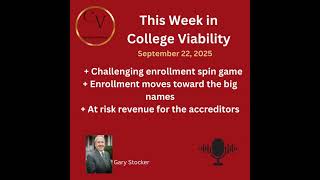
Gary Stocker exposes how colleges use enrollment spin to hide financial trouble, citing layoffs at major universities and case studies like Missouri Southern (sub-20% graduation rate) and Bethel University (negative net income for a decade). He calls for transparent quarterly reporting and warns that accreditors have a conflict of interest since they're paid by the institutions they oversee.
Chapters
It is Monday, September 22nd. Welcome to the second or first day of fall, depending on your interpretation. September 22nd, 2025, yet another episode of This Week in College Viability News and Commentary. Hi everybody, Gary Stocker. As always, so grateful, so thankful that you make time to listen to the podcast. Of course, this is the podcast that talks about the financial health and viability of public and private colleges with data and with details and with perspectives offered, I believe, nowhere else. And as always, when you get a chance, forward this podcast link to your higher education friends, your neighbors, or friends or family. No sense in just you getting the latest news and commentary and a different perspective on the whole higher education industry. This week's theme— I don't always have themes— this week's theme though is challenging the enrollment spin. If you've been around the last few weeks, I've had lots of stories on colleges releasing their enrollment numbers, some legit, but many are spun so much. And today I thought I'd pull some of those from last week's postings. And again, remember, I get all of my information from Google Alerts. That jumps just dozens and dozens of these in my email. And I have a set of colleges on today's show that would like us to believe that they are winning the higher education enrollment game. Yet in, in every case, their enrollment data is selective, and in almost all cases, it is short-term. They ignore mostly pathetic graduation rates and don't even begin to share their troublesome financial picture, all the while, all the while trying to paint a rosy picture that their college, their college is not like all of the other colleges in dire financial straits. You see that lead, that qualification in almost every story. And then the truth, because financial truths are more valuable than spin and other narratives. The truth, each of these colleges have substantive, substantive financial challenges that they are hiding from their students, their faculty, their communities, and probably more. Here are the spinners for this week, and there are a lot more. Lyon College in Arkansas, Missouri Southern State University Bethel, University of Duane in Minnesota, Youngstown State University in Ohio, University of New Orleans, um, apparently their calculators don't work. I'll have more on that. And McNeese State University. And let's start with layoffs and cutbacks. And I pulled this, this story from Alcino Donadel, who wrote on September 19th a bunch of layoffs and cutbacks for University Business. And as always, I'll have the, the links the podcast show notes. And the first is the University of Chicago is taking a host of steps to cut its annual budget by $100 million.
President Paul Alivisatos announced plans to lay off 400— that's 4 with 2 zeros— staff members and administrators. Faculty wasn't referenced in that. East Carolina will try to reduce its total budget by 2%. Or about $25 million. The University of Wisconsin-Madison is targeting libraries— libraries, yes, libraries at a college— in an effort to reduce department budgets by 5%. The University of Nebraska-Lincoln aims to save $27.5 million eliminating 6 academic programs. And here's the moral, here's the lesson of this story: don't Don't become desensitized to these 2025 layoff and cutback announcements. I had them deleted off every show, and here's why.
Don't be desensitized because this time last year, this time last year, they weren't—
they were not happening at this level. Just one short year ago, yes, there were layoffs and cutbacks, but not at this level. This is yet another indicator Yet another indicator that higher education is in its consolidation era. I have said that many times before, and we can certainly anticipate me sharing that many times in the future. Layoffs and cutbacks and college closures, and eventually, as I've shared so often, large-scale mergers.
College Drivel Today is not—
College Drivel is not from higher education, it's from Cracker Barrel.
If you follow that story, they had all sorts of issues with logos and remodeling here recently.
Their CEO, Julie Massino, had this to say about after all the backlash, and I'll read to you. We're moving ahead with a strong plan to regain traffic and the momentum we had a month ago. There was a lot to be optimistic about, and our teams are focused on getting back to a positive trajectory, Massino said. Now, who does this sound like? I put it in college drivel because substitute some of the words in there and you've got college leaders with vague, self-serving, not documentable proclamations of imminent success that are no way, no way, no way likely to happen, at least anytime soon.
Page 2.
Well, let's start with Missouri Southern State University Public College. Overall enrollment is up, the story reads. This is from KZGR Radio, Steve Smith, on September 18th. All right, to the data. And this is, this is again more regurgitation reporting. Take colleges, taking a college's press release and treating it as the gospel and not doing any kind of critical analysis. Reporter not doing any critical analysis on his own. The 4-year graduation rate at Missouri Southern averages less than 20%, less than 20%. For those of you that went to Missouri Southern and didn't graduate, that is only 2 out of every 10, 20 out of every 100, 200 out of every 1,000 who graduated in 4 years. Enrollment is down almost 2,000 students despite the headline since 2016, or from 2016 to 2023. The graduation enrollment is up 46 students. All right, give them credit for that. Interestingly, the number of students receiving a bachelor's degree, and this is from my College Majors Completion app, is down 128 students from 2016. So in 2023, the last available reported data, Fewer students are getting bachelor's degrees from Missouri Southern than they were 8 reported years ago. And the state of Missouri has given Missouri Southern $5 million more in 2016. And this is what they get— bad graduation rates and decreasing enrollment. Reporters, contact me. I'll give you the stuff. I'll give you what I use. Professional courtesy. I'll train you how to use it. We need more people sharing critical analysis and saying, hey, your enrollment may be up since last semester, but it's down lots from 5 or 8 or 10 years ago. Why is that? Why is your graduation rate so bad? Why is your retention so bad? Why are you trying to— why are you giving away the store with tuition discounts just to get students in the door? And before we continue our spin stories, the University of Illinois-Champaign-Urbana, I used to usher the football games there a long, long time ago. Got in free, had to point folks to their seats and watched a lot of football. The University of Illinois announces plans for a new 400-bed residence hall, and this is from WAND-TV.
I think that's Channel 17 on September 19th. And I share this— I'm not going to go into any detail— I share this because it is one of what I believe are many stories helping to confirm what I've been saying for quite a while. There is a move underway by students, move underway toward the big, toward the brand-name colleges, and that most almost certainly means away from smaller, maybe away from privates, although I'm not quite sure that's the case. And that the University of Illinois is adding a 400— a new, brand-new building from the ground up, a new 400-bed facility, is an indication that they are thinking and seeing the same thing. Back to the spin. McNeese State University, Louisiana sees largest enrollment increase in two decades. This is from Courtney Peterson, staff writer, on September 19th for theadvocate.com. McNeese State University President Wade Rouse— my apologies if I butchered that— Wade Rouse says enrollment growth means greater financial stability. Okay, which is critical for McNeese's long-term success, grant him that, Ralph said, but it is also energizing. It is also energizing to walk across the campus and see so many students, to hear their stories and to witness their dreams, their dreams taking shape. This is for a college with a 4-year graduation rate hovering below 30%, enrollment is down more than 900 in the last 8 reported years. And he says to witness dreams taking shape, 30 out of every 100 students, they're completing their dreams. What about the other 70 out of every 100 students? And for those of you who did not graduate from McNeese State, 70 out of 100 is 70%. 30 out of 100 is 30%. Spin, spin, spin, spin, spin. We've got to look at the data. We've got to continue to look at the data. The University of New Orleans enrollment is down again. What does that mean for the university? Marie Fazio had that story on September 19th at NOLA.com. The University of New Orleans is down about 800 students. All right, get out your calculators or your cell phones, whatever you use for calculators. University of New Orleans President Kathy Johnson said in an email to faculty and staff this week that the university's revenue will be $1.1 million less than anticipated due to the enrollment decline, 800 students. All right, so this, this is what gets me. Nobody's doing the math on this, reporters. So to my calculator slash cell phone I go: $1.1 million, how much less earning, divided by 800 students, the decrease enrollment. $1.1 million divided by 800 is $1,375 per student. Of course, that begs the question, is that what—
is that all that the University of New Orleans was charging students? I doubt it. This is yet another example of both regurgitation reporting, and I guess colleges thinking we're not paying attention to the numbers, and they're probably right in too many cases. Reporters, again, I've said this once already in the podcast, and many, many times previously contact me, I'll give you free courtesy access. I'll teach you how to use the tools I use so that when colleges give you this number, give you the spin, you have easy access to data that you can challenge them with, ask informed questions with, and actually get a better handle on what's going on with and for the colleges in your reporting region.
Page 3, we continue.
Bethel University, the Minnesota version, had a LinkedIn post.
Tim Hammer, Vice President of Marketing and Communications. They had a tuition reset at Bethel University. Of course, they don't call it that. They spin that and they call that tuition— tuition repositioning. Oh, I'm so sorry. Tuition reset is tuition repositioning. Okay, we'll grant them that. All right.
I'm a good guy.
I'm a fair guy. So what Mr. Hammer said was every year students visited their campus in Minnesota, applied, and were even accepted. When it came time to decide the numbers for the families and the students, just didn't work. Okay. And he goes on to say, we had successfully communicated. So he says, we had successfully communicated the value and the return on investment of a Bethel education. But for many families, the numbers just didn't work. All right, so a year ago, September 16, 2024, Bethel University, the Minnesota version, we announced a clear price, they said, as part of our tuition repositioning. It was going to be $20— now listen closely, this is $26,700. Write that down, $26,700 before Financial aid. No inflated sticker price, they said, just clarity. Now, $26,700 before financial aid, just clarity— those don't mesh. And he goes on to add, and nearly every incoming student receives financial aid. Okay, so did it work? There's some bullet points in here I'm going to skip over. A couple I want to talk about. They suggested— Mr. Hammer suggested Bethel's market share grew 19%. No citation on this from a college.
You'd like to see some source on that.
What was the source of that market share growth? Their numbers compared to what group? What market?
What area?
What region? And again, reporters, it's gary@collegeviability.com. I'm also on LinkedIn. Both College Viability and Gary Stocker, S-T-O-C-K-E-R, these guys are spinning out of existence. Maybe not out of existence, but they're spinning so much that your credibility cannot continue to be strong when you're taking this stuff and not looking at it critically. They go on to say families moved Bethel up in their list. They say 1 in 4 parents said Bethel's clear price 1 in 4 parents said Bethel's clear price was an important factor in their student's decision.
What?
Again, any chance you could cite a source on this? Are you making the numbers up? And then they, they go on to say they want to optimize revenue. Okay, certainly they want to grow overall revenue and strengthen net tuition. Which is tuition actually received by the university. And they— the sustainable model they want is tuition repositioning. They say created a revenue model built for long-term sustainability. So I don't know how that works. The good folks at Bethany University, the Minnesota version, drop me a note. I'll invite you on the podcast. I've done that for other colleges before. You can tell me how it works. To the data, to the data we go. For Bethel University, this is from audited financial statements, 19—
19—
2016 through 2024. The IRS 990s also from that time period, and IPEDS from 2016 to 2024. 4-year graduation rate's good, really good at Bethel University, and you don't hear me say that very often. Their net income margin profitability—
and again, they don't call it profit in non-for-profit education, but that's what it is— is Their net income margin was below zero, below zero for 7 of the past 9 years.
Their unfunded institutional grants— you and I know that as merit aid and most scholarships— were up almost $20 million over the last 8 reported years, so $2 million and change per year.
Then it came down a lot. This is a lot of variation in this, and I've got some more for you in a second. Then it went down, went up, then went down, which means they probably decided, and justifiably, They couldn't afford to keep giving away this door to get students in the door. Their tuition and fee revenue was down $11 million over that time period. Their endowment, not bad per student and per $1 million in total operating revenue, about normal for all private colleges. Their draw was trending upward but not nearly as bad as I've seen. And then I was ready to say they're doing okay. Then I looked at one more factor.
And it's called unrestricted net assets per student.
And I looked at unrestricted net assets per $1 million in total operating revenue in this college, Bethel University, Minnesota. Unrestricted net assets, the value of the college, if you will, per student— nice standardized comparison— per $1 million in total operating revenue, hovering around and below the 25th percentile. Spin, spin, spin. Let's look at the data. Let's just look at the data. Colleges, you're gonna keep spinning, I know that, because there are not enough folks like me out there challenging your assumptions, challenging your data, challenging you to report what's actually going on. But when you do, me, and there will almost certainly be others, are going to be out there to say, hey, be upfront. And maybe what we need is what we have in the private sector. Businesses have— report quarterly earnings. Maybe we need to have colleges report quarterly earnings so we get a more frequent look at their financial status as opposed to once a year.
And then I talked about the institutional grants at Bethel University. They were $65 million. Again, these are unfunded grants, so they are merit aid and most scholarships, not all. In 2016, the institutional grants unfunded—
that means there's no money behind them, they're discounts, they're giveaways, they're freebies. Nothing wrong with that, it's good for the students, not so good for the colleges many times.
That institutional grant unfunded in 2016 was $65 million. In 2020, it went up to almost $85 million.
And then by 2023 had plummeted to just below $70 million. So that's all over the place.
Now, I see a lot of these unfunded institutional grant numbers all the time, and I've seen a few with this kind of variance, but not very many. These folks, my mind, the good folks at Bethel University in Minnesota, were kind of, and still are, kind of throwing mud against the wall.
The proverbial example of throwing mud against the wall and see what sticks. And now it is a tuition—
what are they calling it?
A tuition repositioning.
You and I know that as a tuition reset.
Let's go to Youngstown State in Ohio. Youngstown State digs into fall enrollment numbers, and that's always an indication it's not good news to follow. And this is from the Tribune Chronicle online on September 20th. I don't see a reporter on this.
I'll have the URL in the show notes.
Again, this is another spin story. The focus is on short-term enrollment numbers and ignores the fact that the enrollment, the full-time equivalent enrollment, nice standardized measure, decreased from 2018 to 2023.
It's down more than 2,000 students since 2016.
The graduate enrollment was up 1,200, and of course that's good. And remember how I say so many times How many times have I shared that colleges focus on enrollment and not on graduation rate outcomes?
If you follow the show, follow the show regularly, you've heard me say I've yet to hear a college say in their May commencement ceremonies, we proudly graduated 37% of the students who started with us 4 years ago.
They just don't do it. They're so focused on enrollment and the revenue piece that I can make a sustainable and documentable argument that they're not focusing on graduation rates. If they are, they're not being successful. And at 6 years at Youngstown State, while trending up, at the 4-year rate at Youngstown State, while trending up, 4 years started at 9% in 2016, still not even close to 30%. The 6-year graduation rates, undergraduates, again trending up, still below 50% after 6 whole years, 6 whole academic years, less than half the students that go to Youngstown State University in Ohio graduate from Youngstown State. So I know, went to other places, they transferred and graduated, but it's comparisons that matter, one college to the other. It's apples to apples. And it begs the question, I guess, is enrollment good and graduation bad? That's kind of what these kind of stories tell us. Our enrollment is up, but our graduation rates, not so much. And then the wrap I have today is going to change the tone, the tenor of our conversation a little bit. What happens to the revenue stream of creditors— there are 5 or 6 major ones— if a large number of colleges close? There was a story posted this past week, and I didn't get the source, my bad, and it was discussing the inherent conflict of interest regarding higher education accreditation agencies. And of course, that conflict is the revenue source— most of the revenue comes from the colleges they, they accredit, they review. And so there's, there's a natural incentive, although these accreditors deny it all the time and say there's systems and processes in place that doesn't impact their ratings or evaluation, their accreditation. You got to be really careful to accept that at face value. So there's a conflict of interest, and, and the article of the Post got me thinking. There will certainly be many more college closures. I'm not the only one suggesting that. The financial numbers are just too obvious to believe any other scenario. And as these colleges close, the fees paid to accrediting agencies will also decrease. And at what point Will that decrease be materially significant to those agencies? Can they make it up by increasing the fees for other colleges? Maybe. But it's also important to note that new accreditation competitors are out there. They're not in bloom yet, but they might be. It's a tough call. And if they get out there, they'll probably keep fees lower than they would have been Otherwise, and if there are cost pressures on these accreditors because so many colleges are closing, they lose that tuition revenue, or they lose colleges to other competitors, will that negatively impact their ability to monitor the education quality of those colleges they are supposed to monitor? We already know that these current agencies lack any consistent ability to monitor the financial health and viability of colleges. I've talked about that so many times. They just don't get it. They're there. That's what really makes me think there's that conflict of interest because they're looking at the fees and they're not massive for any individual college, but they're still fees. And we know, of course, that higher education is headed for more, more than just enrollment cliff. Some call it enrollment slope. It's starting right now, starting next year. And there will be so many unintended consequences. So many unintended consequences. It is hard to imagine.
It's hard to imagine what this industry, for all of its historical intransigence, will look like in the next few years. As always, thank you for listening. Thank you. Thank you for making time, whether you're walking, driving, sitting at your desk. Thanks for listening. Send me your feedback. Send me, send me feedback, good or bad. I take insults well. I take feedback well, I take guidance well. Send them to me at gary@collegeviability.com. I'm also on LinkedIn, feel free to reach out to me there. And I'll be back next week, the last Monday of September, and we'll have more of This Week in College Viability.
More from Gary


What does it look like when a college increases both total revenue and total expenses?



College Financial Crisis? We look at the financial health of Bay Path U. (MA) and Coe College (IA)


Private College Financial Crisis? We look at the financial health of Hobart William Smith College


Financial Compass tutorial (Private college version.) Financial statements compiled 2016-2025.

