This Week In College Viability (TWICV) for May 19, 2025
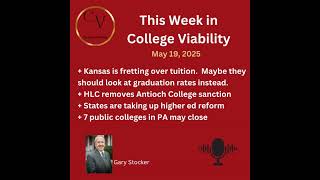
In this solo podcast episode, host Gary Stocker surveys a range of recent higher‑education financial‑viability stories, offering data‑driven commentary and critique. He begins with a proposed "transformative partnership" between Christian Brothers University and Lewis University, framing it as a financially stronger institution rescuing a weaker one. He then details Penn State’s recommendation to close seven of its branch campuses, emphasizing the inevitability of consolidations for financially unhealthy public colleges. Next, he examines Union College’s enrollment shortfall, heavy endowment draws, and Moody’s negative outlook, arguing that reliance on tuition discounts is unsustainable. He briefly mentions an unnamed small private college that laid off 129 staff while maintaining a high staff‑to‑student ratio, and a separate college (Salem College) that entered bankruptcy but saw a post‑recruitment enrollment surge, noting its low tuition and modest four‑year graduation rate. The episode moves to Kansas public universities, highlighting widespread tuition hikes, low four‑year graduation rates (ranging from 25% to 50%), and the tension between affordability and "graduateability." Stocker then sharply critiques the Higher Learning Commission’s removal of Antioch College’s financial‑distress designation, presenting enrollment, graduation, endowment, and net‑income data to argue the decision is unjustified. He reviews state‑level higher‑education reform proposals in Arkansas (drastic general‑education core reduction), Texas (Senate Bill 37 shifting governance power to boards), and Florida, summarizing their oversight models. Finally, he recounts a 2019 Inside Higher Ed story about a planned private‑college‑closure prediction tool that was suppressed, using it to illustrate the growing, yet still limited, awareness of college financial fragility and the need for transparency. Throughout, Stocker intersperses sarcasm, personal observations, and a call for greater openness in college finances.
Chapters
It is Monday, May 19th, 2025. Time for another episode of This Week in College Viability News and Commentary. Hi everybody, Gary Stocker back behind the blue Yeti microphone yet once again. In an era of DEI cutbacks that we read about all the time, today we have a diverse set of stories for this week's episode. Among the stories, 7 Public colleges in Pennsylvania proposed to close. Kansas is fretting over public tuition increases, but the real issue is they can't graduate students in 4 years. A college closure prediction story from 2019. And regulators, HLC, the Higher Learning Commission, remove Antioch College's financial distress designation beyond all reasonable explanation in my mind. And states are taking up higher education reform. Let's start off with layoffs and cutbacks and partnerships, maybe mergers. Christian Brothers University and Lewis University signed a letter of intent to explore transformative partnership. Gotta use big words. This is an internal document from Lewis University, it's up by Chicago, on May 13th. Now they can call this whatever transformative partnership that they want, they're certainly entitled. But this is a story of a financially stronger college coming to the rescue of one not so financially strong college. And I don't know why it is that colleges cannot commit to the obvious business reality that one has more dollars, one has more resources than the other, and they're trying to hide it behind exploring transformative partnerships. One cannot look at the data for these two colleges and miss the obvious fact, miss the obvious fact that one is troubled and the other much less so. To Pennsylvania we go. State University leadership recommends closing 7 branch campuses. This story comes from Lauren Linder. It was from CBS Pittsburgh on May 14th of this year. I'm gonna read from her story. Penn State's board has recommended closing 7 of the Penn State University's branch campuses. And it was down from 12, that was the original proposal. Those colleges being closed, the branch colleges, I guess, are Dubois, Fayette, Mont Alto, New Kensington, Shenango, Wilkes-Barre, and York campuses. They'll close following the 2026-2027 spring season. The 5 colleges that were considered but survived this round at least are Beaver, Greater Allegheny, Hazleton, Shickel, and Scranton campuses. They had all been previously considered for closure but are now no longer on the chopping block. That's according to Lauren Linder at CBS Pittsburgh last weekend. And despite much protest, and there's a lot of protest in Pennsylvania, as you might imagine, it's clear to me, and I've talked about this before, it's clear to me that the public colleges are doing What's needed when colleges are financially unviable, when they're financially unhealthy? They're consolidating, they're closing when they need to. And we're still in an era— private college closures happen, we all know that. But most, in my mind and in my experience, most private colleges are closing their financial eyes and hoping, closing and hoping to survive, not Good. To Union College we go. This is kind of a mixed bag story. Union College falls short on enrollment with big loss of international students. We've seen that story before. This is from thetimesunion.com and Kathleen Moore, M-O-O-R-E, on May 16th. And this is an upfront college. Union College is an upfront college, kind of. The story I'm about to share with you came from an employee who leaked the data, so this didn't come directly from the Union College leadership. Connect— excuse me, New York Union College has fallen short in filling its freshman class for 2 years and is now pulling millions of dollars from its endowment to balance its budget, College President David Harris said in an email to staff. After getting the preliminary enrollment figures for this fall, college leaders at Union College made the immediate financial decisions. Some positions will be left vacant, uh, Harris wrote, and there will be no raises this year. And the college is cutting back on its retirement contributions and its contributions to new employees' children's college tuition bills. This is from President David Harris at Union College. The college— the story goes on— the college has been drawing $27 million a year from its endowment. Normally that would catch my attention. It's a big number, but their endowment is $525 million, half a billion unchanged, even though they're drawing down from that. For the next, for the next school year, the story writes, the college will draw down an additional $5.5 million. Okay, so that's the scenario predicted that Moody's Investors, the rating service, gave a credit rating agency that said the college— the outlook for its college was negative. All right, they're drawing down the endowment. That's, that's never a good thing, but it's a, it's a half a billion dollar endowment. Moody's goes on to say that Union must do less discounting, less discounting of tuition to avoid an operating budget deficit, and predicted ongoing multi-year operating deficits requiring the use of reserves, resulting in a weakening financial reserve levels relative to its peers. And it's exactly right, Moody's is correct, but Union is like Every, almost every other college out there, tuition discounting is a fact of life. Students are looking for and getting better deals by looking for what colleges call scholarships or merit aid. They're just discounts. But, but Union, as do all colleges, have to compete. And since colleges are viewed by many, if not all, as a commodity product, one diploma fits all, they're really selling a commodity product. It's very difficult to differentiate, even though these colleges say they all have unique experiences life-changing experiences. It's a commodity. And as Matt Hendricks and I have shared regularly on the College Financial Health Show, drawing down the endowment beyond about 5% a year, 4 to 5% per year, is risky. But sometimes, I will grant, it's a needed business decision. Union, like I said, has a strong endowment, but there are many other colleges with excessive endowment draws who do not have a similarly strong endowment. Their risks are much higher— Moody's— their risks are much higher than those at Union College. I've got some college drivel this week. All right, so this is from a college that just laid off 129 employees and already had about 1 employee for every student. All right, here's the college. Of course, I'm not going to name the college. They laid off 129 employees even though they still have about 1 employee per student enrolled. We stand firmly committed to providing an exceptional educational experience. There will be, there will be no changes to our course offerings or services as we remain confident in our ability to meet the needs of our students and our graduates, apparently with a lot fewer staff and faculty than beforehand. And then this is from a college that was just sent into bankruptcy court. Try not to fall out of your chair giggling. The Board of Trustees are committed to the future of this historic college and believe that it will continue to provide a quality education for our students for decades to come. This is from a college that was just put into bankruptcy court. Page 2, Salem College, North Carolina. Sees surge in enrollment after national recruitment push. All right, I will, I will cede the point. You, you make a push and you may see an enrollment increase. What the tuition will be for that, what the tuition discount will be for that remains to be seen. This is on May 16th, Paul Garber at WFDD Radio. So the surge is fine. The tuition rate, what students pay for going to Salem College is really low, really low. I think about $10,000 per year in 2023. I need to check that. Enrollment is down to about 500 students since 2016, and I'll remind everyone of the Matt Hendricks rule. Matt Hendricks from Perspective Data Science. It takes about 4 to 5 years to financially recover from one bad enrollment year. 4 to 5 years to recover from one bad enrollment year. Enrollment at St. Salem College has decreased, has decreased in 6 6 of the past 8 years. I, I believe Salem is a good college, and here's why. They graduate about 60% of their students in 4 years. That's better than much, most, as those of you who follow me regularly know. If you're considering Salem, fine, get as much information as you can about their financial future. If you want, drop me a note. Drop me a note at gary to gary@collegeviability.com. That's one word, collegeviability.com. I'll be happy to schedule a quick Q&A for you about Salem and maybe other colleges that you're looking at. To Kansas we go, flyover country. 5 of 6 state universities in Kansas seek tuition hikes to grapple with financial obstacles. And this is from Tim Carpenter on May 15th at the Kansas Reflector. So there's one holdout, and that's Emporia State University, and they're proposing no increase in tuition. And again, if you follow these podcasts or the news at all, Emporia State has more challenges, financial otherwise, than you can shake the proverbial stick at. So for whatever reason— I know why— they're not going to increase their tuition. However, let's go to Fort Hays State University and their president, Tisa Mason. They propose a 4% increase in tuition. Whatever, they can do that. In 2023, President Mason at Fort Hays State University, in 2023, you graduated 29% of your students that started 4 years earlier. 29%. Every 100 students that started 4 years ago, 29 walked out the door with a diploma. And she goes on to say, and I'll quote, we believe that the proposed tuition increase is essential That's fine. For maintaining our high-quality education, let me offer a slogan. President Mason, come to Fort Hays State University. If you're one of the lucky 29 out of 100, you'll graduate. That's a long slogan. You might want to cut that down a little bit. Ken Hush, who's the president at Emporia State University, no increase, said Emporia State was proud to offer a high-quality quality education with a tuition rate that moderated financial barriers faced by students. That should have been in the dribble section. Uh, Emporia State University, your 4-year graduation rate in 2023, 32%. 3-2%. It's up 10 points since 2016. Draw, draw your own conclusions. And as I've said so many times, The focus continues by colleges across the country to be on enrollment. Get students in the door, collect their tuition and fees, and the focus is not on graduation. Obviously, just from this story, they're not graduating anybody. So is, is, is it student affordability, which is the focus of this article for the public colleges in Kansas, where Or is it student graduateability? I'm making that word up. Graduateability. That is more important. Are we trying to graduate students or just get them in the door? And then, as the late great Doris Day said, que sera sera, whatever will be will be. And then finally on this story, let me read 2023 4-year graduation rates for all 7 Kansas publics, but without a name. The 4-year graduation rates in 2023: 32%, 29%, 41%, 31%, 50%. Yeah, somebody graduates at least half. 27% and 25%. Don't tell me it's a tuition issue. This is a graduateability issue. I'm going to coin that phrase. You're not graduating anybody, Kansas Public Is it the diploma that matters? It is the diploma that matters. And the Kansas public colleges, among many others, not just them, are still focused on affordability, undefinable though that may be, and annual enrollment numbers, certainly definable, but to get them in the door and they don't graduate them. Just, I think that's a tragedy. I've said that many, many times before. Paige, 3. Antioch College has been on the podcast many times. Matter of fact, I'm considering making them one of my frequent flyers for the podcast. Regulators remove Antioch College— Antioch College's financial distress designation. This is from WYSO, Catherine Mobley, on May 7th. Here's from the story: The Higher Learning Commission has removed the financial distress designation from Antioch College in Ohio, I believe. The status change went into effect last week, so it'd been late April. Members of a special advisory team— I wonder how special that was— members of a special advisory team sent a report acknowledging the school has a viable plan and demonstrating progress in key financial areas. You know where I'm going with this. To the data. The enrollment at Antioch College in 2024, 123 students. There are football teams with more students. Their 4-year graduation rate has plummeted from around 50%, tolerable, to 18%, 1-8% in 2023. Retention rate, about 6 in 10 stick around from year 1 to year 2. Antioch College admits 82% in 2023, I believe. That doesn't get to the heartbeat admission policy that some colleges have, but that's a high number. And their endowment, their end-of-year endowment in 2023 was $20 million. And if you've heard me before, $50 million is my bare minimum, and that's just my own thoughts. And their endowment contributions, this is interesting, their endowment contributions, and this comes from Matt Hendricks' Advanced Private College Financial Compass, their endowment contributions have effectively been zero $0 since 2020. The net income margin is below that, below that of 9 recently closed colleges in 2023 and 2024. It's been below zero since at least 2016, down 76%, 76% since then. So who is the Higher Learning Commission protecting? You know, I've asked this before. Is Antioch the college Clearly. Or is it students? Clearly not. With such bad numbers, come on, come on, come on, guys. Move on. Move Antioch College and others in similar situations, move on from this I-dotting and T-crossing model and let these students and faculty and staff and community get on with their lives. Find somebody to turn off the lights. And the last thing I want to do on this, on this story, is talk about 3 Higher Learning Commission standards from HLC Criterion 5. Has to do with finances. I'm only going to have a couple of them because I want to talk about them. The first one reads, the institution's administration— talking about Antioch here— the institution's administration uses data to reach informed decisions in the best interest of the institution and its constituents. I could pick this apart for hours, and if that's really a standard, they would have long ago reached out to turn off the lights at Antioch College. Look at graduation rates, look at finances. What data are they using? Do they have their data that I don't have access to? Maybe some parts, but I get to see the audited financials. I get to see what they submit to IPEDS. I can see most of what they would have submitted to the Higher Learning Commission. Somebody's looking at it wrong and it's not me. The second one is the institution, the institution, again Antioch College, has a well-developed process in place for budgeting and for monitoring its finances. Really, HLC? You wanna talk about I-dotting and T-crossing? That's gotta be the only thing that Antioch has done. They've got a process. It's not a good process because look at their finances that I just shared. And the third and final one, the institution plans on the basis of a sound understanding of its current capacity, including fluctuations in the institution's sources of revenue and enrollment, period. Clearly not. These are so vague, these three. The others are are just as vague. I didn't know what to take the time to go over those. So vague, you can make them dance any way you want. Clearly that's what HLC is doing. So sarcasm alert, here is what Antioch College probably had to do. Pure speculation on my part. Here's what Antioch College probably had to do to be removed from sanctions. They wrote a letter and the letter said, again, this is me writing the letter, dear Higher Learning Commission, We are sorry for not dotting our i's and crossing our t's to your satisfaction. We promise to do better, period. Love, your fees-paying colleagues at Antioch College in Ohio. What else could it be? What else could it be? This organization's, this college's finances are miserable. It is highly unlikely that their students are getting anything close to a quality college education because the college is counting pennies daily to stay alive. I'll say it again, please find someone. Please find someone soon to turn the lights off at Antioch College. Page 4, states are taking up higher ed reform. The subheading on this is Florida, Arkansas, and Texas provide 3 models for public oversight at the state level of universities. This is on May 14th from Scott Yenor. And this is, Scott Yenor is the senior director of state coalitions for the Claremont Institute Center for the American Way of Life and a professor of political science at Boise State University. Go Broncos. That's quite the business card. Quite the description to get on the business card. And this is from the James G. Martin Center. And here, here are some, some highlights, my highlights from the story. Arkansas has a bill that shrinks the general education core, the gen ed core, from 35 credits to 15, and does so to focus on achieving specific state goals. The goal of the legislation is to produce informed, self-reliant, and civic-minded citizens across the whole system. And then most importantly, in Arkansas, the bill says courses will be fully transferable within the entire system. I hope that's not just for Gen Ed, but that's probably the case. And Texas has Senate Bill 37— excuse me— which bespeaks a suspicion— this is from the story— bespeaks a suspicion that Texas public universities are closed shops unwilling to consider outside input and unwilling to accept accountability. It goes on to say they decide, talking about colleges, they decide what is and what is not general education, as well who teaches, who gets promoted, and what future jobs are going to look like. The bill, Texas Senate Bill 37, the bill would further transfer power from faculty, from faculty senates to governing boards to enhance their oversight power over the decisions of university administrators. Probably not a bad idea, but you got to know that faculty senates across the state of Texas, and if it ever goes beyond that, across the country, will fight that tooth and nail, for better or for worse. And lastly, in Texas, the proposal enhances— the proposal enhances board-level training and transparency. New duties come with new training. I'm working on a project for that. A concession to the reality that current governing boards may not be up to implementing this Texas law. Board nominees will be told what their jobs entail and be equipped to do the jobs with front-end training. And let's do a wrap and let's go back to November 18th, 2019. November 18th, 2019, a story on Inside Higher Education. Private conversations about Private college closures. Inside Higher Education. In 2019, a college advising company, Admit, edmit.me, planned to release a list projecting when specific private colleges could run out of money and close. Admit was going to publish the list with a story at Inside Higher Education, but pushbacks from the higher education industry convinced the company and Inside Higher Ed to scuttle its plans. All right, historical story. It happened. I was there when it happened. I was watching it. I was thinking about a similar tool. Didn't end up doing it, but I was thinking like that. And I'll make the case the conversation has changed a lot since— just since 2019. As recently as that time frame, there was only a vague awareness the financial plight of many colleges, mostly private mostly rural, mostly small. And today the media is generally aware of the plight, but it really hasn't reached students and their families yet. I still believe there's a tipping point out there, and I think we're close to it. And I conclude with— I had a LinkedIn connection, it's been a month or two now, asking me for some financial data for a college that they were looking at a significant leadership role in. That connection reported back to me that when they started asking about this college's finances, they cut him off, him or her off, and said they had better candidates. All right, now I know this is a one-off, it's an anecdotal event, I know that, but it raises my radar warning, raises my radar warning about colleges and their financial transparency. They're not willing to talk about it with potential leaders. They're hiding it from potential leaders. Not good. And there's, there's a shift taking place. It's a slow shift, and colleges are fighting change with protests and silence when it benefits them. But in the end, transparency always wins. Transparency always wins. It takes time, but it is inevitable. Hey everybody, thanks for making time to listen to this week's podcast. I'm always grateful. Until next week, this is Gary Stocker with College Viability. Thanks again. We'll talk next week.
More from Gary


What does it look like when a college increases both total revenue and total expenses?



College Financial Crisis? We look at the financial health of Bay Path U. (MA) and Coe College (IA)


Private College Financial Crisis? We look at the financial health of Hobart William Smith College


Financial Compass tutorial (Private college version.) Financial statements compiled 2016-2025.

