This Week In College Viability (TWICV) for Dec 7, 2023 - Chuck Ambrose 'Colleges on the Brink'
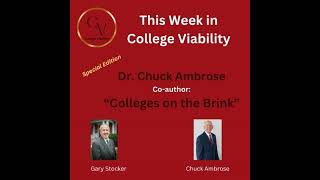
Dr. Chuck Ambrose discusses his book Colleges on the Brink, arguing that financial exigency can be a tool for strategic change rather than failure. He introduces the Freedom Protection Coefficient, a governance model that lets presidents make rapid decisions, and walks through case studies from Central Missouri, Henderson State, and Arkansas State showing how data-driven leadership steers colleges through crisis.
Chapters
Welcome to a special podcast episode of This Week in College Viability. My name is Gary Stocker. My guest today is a longtime higher education leader serving as president of many colleges, including Central Missouri State here in my great state of Missouri, and most recently Henderson State University just down the street in Arkansas. Dr. Ambrose is currently serving as a senior higher education strategist with the law firm Husch Blackwell. Our topic today is his new book, Colleges on the Brink. Dr. Ambrose, welcome.
Gary, it's good to be with you, and I have looked forward to this conversation and appreciate what you're doing to kind of focus people's attention on the overall value proposition of college.
And I want to set the stage. The book title, Colleges on the Brink, is ominous. It's an ominous title, but you make the case regularly in your book that it's not necessarily a fatal business condition for colleges. And I want to talk about that in a minute. But let's just start, if you would please, with your characterization of the state of higher education in 2023. Yeah.
And, you know, Gary, I'm going to revisit what you just said in terms of ominous. I think the subheader of the book, The Case for Financial Exigency, may even be more ominous. Right. So we can visit about why that becomes a tool for change, a tool for transformation rather than certain demise, right? And more of the sky is falling. But, you know, higher ed has been, and of course I'm grateful because not only am I a product that had committed kind of career and personal journey to the enterprise, has had both systemic and structural challenges, deficits that have built up over time, and they're pretty well known. And I think, again, I appreciate your work and kind of calling attention to the fact that college just costs too much. It takes too long to get a degree, especially with the accelerated pace of learning that technology and other tools bring to the table. Without question, kind of the clarion call from the outside world is that there's a skills gap that exists between degrees and the outcomes of that degree, and then the skills and competencies, the talent required to drive not just this current workforce, but kind of a 22nd century workforce forward. And then a lot of attention accumulated over time about the actual dollars that students have to borrow to afford college. Well, you know, as these kind of structural deficits play out in so many different ways on almost every campus, you know, in 2008, kind of driven by a recession, I really believe that kind of that value proposition, the cost-price question would be drawn into both public policy and public perception in ways that would affect change. Unfortunately, that just didn't happen, right? And then, you know, we experienced something of perhaps even more significant nature in a global pandemic. And I think like most social systems, those Band-Aids have been ripped off, those structural deficits exposed in ways where most of us were trained to grow out of our problems, to generate more than we're spending. And those historic models and somewhat of that historic culture is just not going to work anymore. And so, Here we find ourselves with not just individual institutions, but in many ways the overall sector being challenged with things that we're not necessarily totally equipped to meet.
And so the book itself, you've characterized the industry, the book itself, is it upbeat? Is it scary? Is it a cookbook for healthy colleges, for weak colleges? Talk about the book itself.
So, you know, Colleges on the Brink really kind of recognizes again at the enterprise level that these systemic challenges left unaddressed literally puts us all at risk. And when I say all, I mean public and private, 2-year and 4-year, geographically, that we're all somewhat, Gary, on this sliding scale. Some would say perhaps you might characterize as a a downward spiral. And it really just depends on your size and your assets about how long, right, you have to address these at kind of an elevated level from crisis management all the way to restructuring, to re-engineering, to innovation. And obviously, the more means you have, the longer you have and perhaps the less dramatic the timeframe in which you have to affect change. And, you know, as you ask questions about upbeat versus kind of sky is falling, is it positive, is it negative, is it meant to be kind of a burning platform, or is it hopeful, is it creative, is it responsive to new models, perhaps inverted paradigms in terms of both? How we deliver and what the outcomes are, it's really both. But there is some key learnings, not only within the book, but within the journey, that's more of a call to action. And if there's an underlying theme to where we find ourselves on campuses, it's just don't wait too long to affect change. And the more proactive and more offensive you are in addressing some of both the systemic disparities, but more importantly, the structural challenges and deficits, the more likely you are that you can emerge in what's next. And I think for higher education, there's definitely a what next, and I think it's going to be new models that will emerge, and I think it'll be quite exciting when you combine learning with the advances that we're making across systems to do college differently. And hopefully, "College Is on the Brink" is how to weather the storm, but then how to consider all of the ingredients available to us to create a sustainable model into the future.
And let's talk terms. And I'm kind of going through, there's 8 chapters in the book, I believe, and I'm kind of going to talk about something from each of the chapters. And Chapter 2 talks about financial exigency. And of course, in higher education, we have to have fancy schmancy words to define what's going on. And financial exigency is kind of like fiduciary. Nobody in our world really understands that. But if you would please, you know, leave fiduciary alone, that we can do that another day. But you make the case in the book that a declaration of financial exigency is not necessarily an endgame event. What did you mean by that?
Well, you know, actually the American Association of University Professors states it probably in terms that when you're going through it, help me not only understand it but operationalize it. It's, you know, simply when a college either waits too long or fails to act, it puts the long-term survivability of the institution at risk. Most of it determined by financial health and viability, using a term that you focus on, but it's overall kind of net productivity. And I was asked this question last week and I thought it was a great way to frame it. Is there other correlation, something that you would compare it to And it's a lot like what healthcare has gone through over the last decade to move more towards an outcome-based model. When I say outcome-based, it's both funding and kind of, you know, certainly positive outcomes for both the patient and the recovery. But financial exigency is just a tool to put an institution on elevated response to really re-engineering. And the term I use probably more frequently than any other is just an allocation of resources. It's a reallocation month that has to take what is narrowing margins and increasingly scarce resources and applying them to the things that matter the most. You know, it's a term that's been within higher education over 100 years, but you're right, probably one of the least understood terms. It's different from bankruptcy in the for-profit sector because you actually cannot fend off your creditors. You still have to pay your bills. But it's a means by which, similar to bankruptcy, that you think differently about your resources and you much more aggressively make decisions based on presenting fiscal integrity first and then a sustainable business model into the future.
And we jump to the next chapter, which is the numbers that every college should know. And I want to kind of refine that to every college leader Should Know. And you and I have discussed the College Viability App that I have and its capacity to compare public and private colleges over 30 different fields, reports, whatever it is. And it covers finances and outcomes and enrollment and stuff like that. And on pages 63 and 64 in the book, you list what every president knows or should know about, about numbers, about these numbers. My perception is too many college leaders are caught up in the academic issues and not really the numbers detailing a college's financial position. Do you agree or not?
You know, I think it's easy to say that every leader and every institutional set of circumstances are different. They are. But at the same time, I maybe come at that premise just a little differently. You know, as you emerge towards senior leadership and you think about the things that you have to really focus on every day, I actually believe most leaders, and I would say most college presidents, know. They know where the potholes are. They can work directly with other senior-level resources like CFOs and Chief Academic Officers and others. And granted, we may not all be cost accountants or economists, but the learning curve for leadership is really pretty quick in regards— you mentioned fiduciary, but You know, that really primary role the president plays along with the board to understand where you are financially, how you're performing in terms of overall revenues, but more particularly net revenues and discount rates and the things that have really narrowed our ability to present the resources required to operate. The problem is, right, that most of our spend is in people. And if the left side of your brain knows where the potholes are as a president, the right side really knows all the tools that you have available. And most of us worked every day trying not to use them to actually align those resources to present operating statements, you know, again, in the corporate sector, we just say simple P&L statements that are within the kind of operating tolerances we would say have integrity, right? So you, you know what the challenges are on one side of the brain, but all of the tools that you have available to basically right-size your overall net revenue with your expenses involve making decisions that impact people. And that's why leading colleges and universities is so difficult because all of your assets, all of your product, all of your customers have a direct impact on people's lives, their livelihood. And there's again energy and potential and creativity with what's possible on one side of the equation, but the accumulation of cost and our overcapacity, the declining demographics, debt burdens that were used to advance agendas, all of these have kind of caught up to us. And makes that equation today even more difficult. And that's why there's a fundamental question, Gary, within the book. And I think certainly some fundamental questions that you seek to answer with your tool and your efforts, but every institution really ought to know what it costs to produce a degree. And if you take that down to the program level or the instructor level, you can quickly see that, you know, there's misalignment between how we generate our resources and how much they cost. And it's not to, it is not to just cost cut, reduce spend, eliminate programs. It's just to improve performance. The more students we have, the longer they stay, the more value they feel in their degree. And doing that as efficiently as possible is a very positive construct and one really that the book lifts up this up more as a playbook to a sustainable future.
Yeah. And you mentioned programs. And one of the projects I'm working on is the completions project. And I use IPEDS data to compare completions. And an example I have is there's a university, private university in Illinois that graduates 6 students per year in communications programs and one that graduates 122 students per year. And I make the case, or I'm trying to make the case with that kind of analogy, that what's the college with 6 graduates doing? You know, it's kind of like the guy who does the open heart surgery. You just as soon go to the guy who does 122 a year as opposed to the guy who does 6 a year. Is that a logical extension of the application of program completion?
Oh, it absolutely is. And I think, you know, for many years between mission drift and just trying to drive enrollments and adding programs to, you know, extend levers for students to attend. You know, we've often been criticized for, you know, everybody doing basically the same thing, not having distinction within the marketplace. And that's one reason, Gary, you know, the book lifts up the power of systems, certainly mergers and acquisitions, shared services. But the real gains, right, for finding new ways to be more efficient is not every college, public or private in Illinois, needs a communications program. Right, right. There you've got twice the number of programs for half the number of students. And let's take public policy in Arkansas as an example where you have 30,000 high school graduates a year. Only half of them go to college. You have 10 public universities. And if you share, you know, those college-going students equally across offerings, The last calculation, and this is just off of my memory, Gary, was something like every institution would get 353 new students a year, right? I mean, it's just a capacity issue that we've overbuilt opportunity. And, you know, you throw the price-cost equation on top of that and students now actively making decisions on the basis of is college worth it? And it really puts strain on your market. And I tell you, one of my best friends and one of the best thought leaders in this space who taught me this well over a decade ago simply puts it: mission, market, margin. And of course, we hear in the private and public sector, no margin, no mission. But it's the alignment of those three. And so that equation that you offered in terms of communications and the number of graduates, as the book points out, students basically hire us to do three jobs, and that's open the door of access and opportunity, get them across the finish line with a degree, and make sure that degree is meaningful to be competitive in both life and work. Well, you know, that isn't, you know, that's a public policy kind of objective. It's a system objective. It's an institutional objective. But it comes down to really today, it comes down to the program level of analysis that again, every college needs to know what the net cost of a program and a degree is. And then again, it's not to make decisions of whether you keep degrees or eliminate them. It's simply just to improve performance, right? To know that we all have shared stake in how many students we have and how long they are retained. And so I actually, you know, with your questions, feel that the book is much more of a positive. There is light at the end of the tunnel. If you use data-informed decision-making and not afraid to make decisions with the data you're willing to generate.
And you kind of touched on this earlier in chapter 4, the title is The Journey Through Financial Exigency. And if there's a news report that says Chuck Ambrose University announced financial exigency today, that's not a good thing. But yet my perception is the book focuses on saying, well, It's not a good thing, but it's a recoverable thing. Can you kind of expand on that just a little bit more?
Well, and I'll put it in real value terms. When you're sitting with rating agencies like Moody's and Fitch, and they're very specific within their outreach to institutions to say financial exigency can be a credit positive. I would suggest today that those institutions that are having immediate financial challenges of presenting operating integrity, that a declaration of financial exigency is much better than not having one. Because again, the longer you wait, the more difficult the decisions. And literally the more impact you're going to assert on members of your community.
And when we, I guess we'll jump ahead to the fifth chapter, and the title of this is the Freedom Protection Coefficient. Nice naming, by the way. I have noticed, and just in my own observations, I've noticed an increased frequency on criticism of how boards hire presidents. You suggest in this chapter, the Freedom Protection Coefficient, that presidents and other college leaders must be given freedom to take bold steps. And with that proposed freedom to act, you suggest, what guidance would you give to these boards looking to hire new presidents? Just focus on the private colleges for right now.
Yeah, you know, I'm going to lift up and I need to mention I had an incredible co-author partner longtime colleague friend that we, in thinking about the fifth chapter in the Freedom and Protection Coefficient, I'll be transparent, Gary, I wanted to name the book that. And Mike Knitzel, who served as governor's advisor for education in Missouri, was president of Missouri State and provost at Kentucky. He kind of argued against that. I feel that, but at the same time, as I told Eric Kelderman in the Chronicle, when I literally volunteered to go to Henderson, knowing it was an institution under distress, knowing that we needed to lead differently, really to bring the arsenal of tools and experiences that accumulated over 23 years, at that time, 20 years of being a college president, and demonstrate, right, what it was going to take to be sustainable into the future. I was very explicit with him to say, like a job that I've never experienced, even though I had been president of a private institution, president of a public institution, and a nonprofit foundation. It was as if it was almost like a new job, certainly a different set of qualifications, which means both candidates for the position as well as boards who are doing the hiring need to consider that these aren't the same jobs. And the characteristics that are typically within those prospectus for candidates, the expected deliverables for leadership have to be refocused on the realities that are today, like holding two ends of a polarized world together on a college campus, which is called directly into the news and very difficult for leaders to do. So, if they aren't empowered with the delegated authority of governance behind them and supported in ways that can get quite personal in the effect of the kinds of decisions they have to make, it's not just kind of a lonely job. It's one that that at least current research would say is shortening the lifespan considerably. I was very, very privileged to lead a Methodist private college for over a decade, 12 years, and 8 years within the public sector. And I couldn't have done that if I weren't in full partnership of one mind and one heart not just with my board chair, but with the entire board, knowing that we were going to stay focused on a North Star that transcended the problems that we would have to deal with every day. So, I would put governance, strategic governance, and effective governance at the top of the list in regards to what is required for a sustainable future.
And, you know, I would, you know, if I got a chance to vote, I would vote for Mike Nitzel's choice of titles for the book, College is on the Brink.
He's even kind enough to a friend to say, well, that's Ambrose's term, so I'll claim it. But, you know, There is a, you know, there's a significant amount of Colleges on the Brink that focuses on the Henderson story, and unfortunately the deficits for both the private sector, because as the state's public liberal arts institution, which demanded small class sizes and, you know, a lot of programs within arts and humanities, many of the again, challenges that small private colleges are facing, along with some of the more pronounced public institution challenges, kind of all found themselves at one place at one time. And so to literally take a public university through a financial exigency and cost containment within the last 5 and a half months of a fiscal year If governance between the Arkansas State University board and the leadership of the Arkansas State University System weren't solidly behind the change management agenda, it never would have worked. And rarely does a college president— and I'm grateful for Asa Hutchinson being included within the book and his perspective about leadership— But when you go to the governor and say, well, our choices are to declare exigency and reduce our overall spend, or I'm going to give you the keys to the university, 80 acres in Arkadelphia, Arkansas, and $78 million of debt back to the state, you kind of understand what the stakes are.
And, you know, as we get toward the end of the book here, chapter 6 is The Resistance. And when you talk about good titles, Brian Rosenberg, and he's going to be on the podcast next week. Brian Rosenberg's new book is entitled Whatever It Is, I Don't Like It. And while College Is on the Brink is a great title, Rosenberg's title, I think, is even better. And it really ties into what you're doing there. And it's a reference to his experience, of course, as a college president at Macalester College up in Minnesota. And I guess what I would call the prototypical responses he received from his faculty on effectively any proposal that had any substantive change on his college's business model. And in the book, Colleges on the Brink, great title, by the way, you offer that this resistance has three components. And just briefly review those three components because college presidents, college boards listening to this are going to say, yeah, but the faculty aren't going to go for this for a minute.
Well, you know, I have to think about my answer, Gary, because even in the immediacy of Henderson being so relatively current, I've always had the firm belief that campuses and faculty and staff they want to change. They— I don't think that— I think given the majority of individuals on campus, especially when you turn attention to the deficits of student success and the really the gaps that are created for student achievement in terms of being able to stay in college and complete degrees, If I said that we had more students in collections than we had enrolled, I believe that members of a campus community want to change that. Right. But colleges, we're not the best learning communities for our own internal constituencies. We don't, we don't really We don't teach people how colleges work. We don't utilize modified cash budgets to demonstrate that we only bring in this much money a month for the end of the fiscal year. This is how much we spend. And oh, by the way, we're going to have a real challenge paying you in June. Well, the more knowledge, you know, you have, the more intentionality and more motivation you have to change. But at the same time, when it comes down to impacting me, and I think that is space that probably more work needs to be asserted than any of engaging early, having an expectation of moving, as several commentators have said, from shared governance to shared responsibility. For those institutions, Gary, with resources, I think there's ways to incentivize people's ability to buy into affecting change because we really don't incentivize performance down to the program and certainly the instructional level. One quick example at the University of Central Missouri, We had 11 programs of well over 100 that educated 40% of our students. They were signature programs. It was what we were known for. But our budget processes and our allocation of resources and the reward structure for those who were literally building national, if not international reputation, don't receive much reward. They have subsidies that they carry to to really make a difference for those communication programs like you mentioned in Illinois. But so our overall, again, with the right data and the tools that we lift up, there's a way to build models that could actually, you know, you want to invert college, you're going to have to invert resistance to advocacy. Because you've got to have the full campus buy-in. But there is a playbook that exists for decision makers, and it's been played out very publicly with everything from no-confidence votes to social media elevated resistance to informal opportunities for censure. And, you know, that has to be balanced, right, against some of the other more public recognition you can have if you don't fix it, like accreditation, you know, state approval. So all that said, is that the resistance is to be expected, but structures, processes, and tools used properly has to begin to recognize that kind of moving that resistance to more active engagement and ultimately advocacy for new models is going to be required for this next generation of leaders.
And then the last chapter is entitled Beyond Exigency. And you have in the previous chapters stepped the readers through the overview, the process about all the things we've talked about. And the first sentence in that last chapter, and I'm going to quote this, you write that financial exigency need not be the death blow to a college. All right. And you've done it. The book is well worth it just for the process to get there. But there's an internal perception and a public perception. And if the headline reads, Gary Stocker University declares financial exigency, how do you overcome the public perception that Stocker University is not going to make it?
Yeah. And you know, that's a great way to frame the question, Gary. And you know, We've heard this. I'm not going to say it's a myth because people who will challenge you and say you can't cut your way to sustainability are partly right, you know, but if the expense side, the fixed cost side, the overhead, the debt service, if you build an institution that expenses will far exceed any student's willingness and ability not only to pay tuition but provide other sources of support, you have to, as we've suggested in the book, you kind of have to floor yourself financially to a base where you can look at people in the eye and say, we are operating with fiscal integrity. We are operating within our means. And that's kind of a fundamental starting point, again, requisite to say that fiscal integrity is our first goal. But then from there, I firmly believe that there are transcendent values. The data is still clear that college degrees and the skills that accompany them is one of the greatest differentiators for social, economic, and educational equality. And equity, that if we are willing to invert our model and, you know, one of my favorite images is the transformation from a school that requires college-ready students to an institution that's built to be student-ready. If we actively commit ourselves to reimagining college that actually works for students and invert our performance from more students actually do graduate than leave without a degree, or more students can present degrees that have lifetime earning potential greater than what they've had to borrow to pay for it. I believe that many of the new models for education are going to still emerge out of our existing system. But there's also going to be a whole next generation of new learning tools and new learning opportunities that are going to have to be blended. And one of my favorite examples, and we lifted up two students who were absolutely pioneers and kind of affected as much change as any administrator or trustee. But the blending of school to work, the blending of high school to college to work, when you take the potential for learning that young people have today and remove some of the artificial barriers like high school and 2-year and 4-year colleges and make it seamless, and you partner with those businesses and industries that have such a high demand for these skills, you can create efficiencies of resources, but you can really present a multiplier of outcomes. And, but, right, you've got to be able to say that we are going to steward our resources in ways that best use your investment of not just your tuition dollars, but that sacrifice of time and effort you make to accomplish great things when you go to college.
So Chuck, the book is available when and how do I get it?
So the book is available on Friday, December 15th. It's available for pre-order like all books are on Amazon under Colleges on the Brink and on the publisher's website of Roman Littlefield, and you can have the option of just a simple Google Colleges on the Brink: The Case for Financial Exigency, and it will be in your hands in time for Christmas. It can be of great dinner conversation because I recognize that financial exigency is just the topic that everybody's probably to talk about, but in all seriousness, we have been very heartened by the response. We've had some great friends give us feedback and input along the way. And it would be true, especially for Mike and I, to say it's the accumulation of decades of friendships and work together with the belief that the hope for college can still be fulfilled.
So my guest today has been Dr. Chuck Ambrose, co-author along with Mike Nitzel of College Is on the Brink, coming out in about, what, 9 days, something like that? To put it mildly, it is a very challenging market in higher education today. College on the Brink does a good job and takes a realistic look at the traumas and challenges of higher education and offers a reasonable business prescription for colleges really throughout our country. Dr. Ambrose, thanks for joining us. I wish you every success with the book.
And thanks for having me. And I do want to say I just appreciate your advocacy on behalf of those that depend on college, and keep on keeping on with your focus.
I appreciate that. Until next time, this is Gary Stocker with a special edition of This Week in College Viability.
More from Gary


What does it look like when a college increases both total revenue and total expenses?



College Financial Crisis? We look at the financial health of Bay Path U. (MA) and Coe College (IA)


Private College Financial Crisis? We look at the financial health of Hobart William Smith College


Financial Compass tutorial (Private college version.) Financial statements compiled 2016-2025.

