This Week In College Viability (TWICV) for Feb 02, 2026
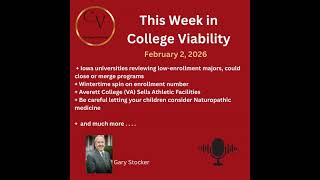
Gary Stocker reviews financial trouble at U.S. colleges: Iowa may close African American Studies programs, Oregon State is cutting budgets, and Everett University sold athletic facilities at a loss. Total higher-education enrollment will grow only 2.9% over 32 years, triggering an enrollment cliff and college closures.
Chapters
It is This Week in College Viability News and Commentary for February 2nd, 2026. Hi everybody, Gary Stocker sitting again in front of that blue Yeti microphone and running the ever-smooth Riverside.fm podcast software. And of course, this is the podcast. This is the show that talks about the financial health and viability of public and private colleges with data and with details and perspectives offered nowhere else. This week, Iowa universities, Iowa public universities reviewing low enrollment majors. They could close or merge programs. Again, Iowa is one of an increasing number of, of states doing this to public colleges. I'll have some comments on that in a minute. Wintertime spin on enrollment numbers. All summer long I track summertime spin. I got a wintertime story for you in Illinois. And Everett College, A-V-E-R-E-T-T, in Virginia sells its athletic facilities in a leaseback arrangement. I have some thoughts on their finances and future. And be careful, be careful about letting your sons and daughters consider naturopathic medicine. I'll tell you the reasons why in a few. And of course, much, much more. And let's head to Iowa to start things off. Iowa universities reviewing low enrollment majors could close or merge programs. Vanessa Miller had this story on February 1st. In the Cedar Rapids Gazette. Let me read from her story. The University of Iowa is reviewing undergraduate majors with low enrollment like African American Studies and Gender, Women's, and Sexuality Studies after the Board of Regents last year mandated a comprehensive study of how well campus programs are meeting workforce needs and student demands. All right, I've had this kind of story from other states— Oklahoma, Texas, Ohio, Pennsylvania, I believe, and I'm missing a couple. It's happening, it's happening to public colleges across the country. So let's take out time, let's take time for a Gary Stocker college viability plug. The 2026 version of the College Majors Completion app— how many majors students complete across 150+ majors— is out this week. It will have data on more than 2,000 public 2- and 4-year colleges And of course, for your nonprofit colleges, I think I've added for-profit colleges as well if anybody's interested. And this would be across associate and bachelor and master degrees from 2020 through 2024, the last reported data. That's 5 years worth of data. The data comes from IPEDS, and here's where the value is. First of all, I've already done it, so colleges don't need to go and do the work I did, which was a lot, to get this set up. So the IPEDS data includes two tabs on the app: one for external market share— what percentage of, say, journalism majors a college has in a state, or with a given set of public and private colleges. You can spec out the set of colleges, external market share, just like for-profits do in every industry out there. And, and I've also added another tab in the app for internal market share. Now, every college knows how many majors are completed I don't know if they all calculate it as a percentage like I do, but nobody that I know of has access to 2,000+ colleges and how many majors have been completed across those associate, bachelor, and master programs over the last 5 years. It's an opportunity for these colleges, public or private, to look at their competitors, local or not local, and see where those competitors have low numbers and maybe an opportunity to pick off students, or look at revenue sharing, sharing revenue sharing arrangements, or where colleges are strong and maybe could be approached to help your college out with low major completion enrollments as well. Introductory pricing, $499. This was hours and hours of work. To replicate that would take a lot more than $499. And the student and parent version comes out shortly thereafter. You won't have as much data over as many years, but students and their families will know which colleges have strong majors and which colleges have weak majors before they commit to that college. Ladies and gentlemen, boys and girls, Moneyball era. The data's out there. Oregon State, way out on the West Coast. Oregon State University faces uncertain financial future Amid enrollment decline, budget cuts. Fox Perez and Samson Niloé had this story on January 31st for the Daily Barrel in the Orange Media Network. I assume that's associated with Oregon State University. And all right, cutbacks. I've had so many of these stories, I'm not going to go into the details, but here's one, here's one quote that caught my attention on this story. So the vice president for research and innovation A gentleman, I presume, gentleman named Ira Turner said, we're going— this falls in the category of panic proclamations. Dr. Turner, I presume, said, we're going to lose a whole generation of graduate students, scientists, researchers, engineers, and humanists. I have no idea what he was thinking. Of course, a whole generation, please, sir. Ma'am, yeah, the numbers may go down, they'll adjust to what the market needs, but that just shows how out of touch higher education can be when they get panic-stricken because change is happening. It ain't going to be a whole generation. Certainly the numbers will be lower, that's just the market adjustments. And for those of you that follow the podcast all year long, you know each summer I take great joy and an element of sarcasm in looking at college enrollment announcements for the upcoming fall and how those announcements are spun in most cases. But now I've got a winter spin that doesn't happen very much. Southern Illinois University Edwardsville spring 2026 continues trend of enrollment success. And even reading that headline, I know it's going to be spun. Nicole Franklin had this story at riverbender.com. On February 1st. So this is why I am here, and I don't doubt the numbers for a second that are reported in Ms. Franklin's story. The college is picking the time period to compare to, and that best serves their interests. That's fine. Everybody does it. I'm not going to pick on that. But here, here, here is their mistake. So the chancellor, James T. Minor, the chancellor at Southern Illinois University Edwardsville, had this to say about the story: Our current enrollment trends demonstrate that students and families still recognize the value of a high-quality, accessible college degree. Dr. Minor goes on to say, these numbers are also a reflection of our collective focus on retention, our intentional institutional effort to keep a greater number of students on track— there's Ben— keep a greater number of students on track toward graduation, something that is at the core of our mission. Why don't they look at the numbers? You know, SIU is the target today, but there are so many others because it's so easy to pull up the numbers. So let me do it since the reporter didn't. You know, the reporter continues— reporters continue to engage in college regurgitation reporting. Whatever the college says, they take and spit it out there as unedited, unqualified, unresearched news. So I'd like to ask the good folks at Southern Illinois University Edwardsville to define high-quality accessible college degree. That's what the term they used, because I'm going to note that they didn't. Their 2016 4-year undergraduate graduation rate was 29% in 2016. The last reported year of 2023, it was 30%. So over 8 years, the last 8 reported years, it went up 1 point. In 2023, for every 100 students that started SIU Edwardsville 4 years earlier, 30 graduated. 30 out of 100. You, you decide if that's good. The 6-year rate wasn't much better— 50% in 2016, 49% in 2023. So not, not even a coin toss college, you know. Half their students aren't even graduating in 6 years. In my mind, it is difficult to quantify that as high quality It's just, I don't know what they're thinking. I know what they're thinking. They're thinking, I can get away with this. Nobody's going to look at the numbers. But yeah, folks, yeah, I'm looking at the numbers. So yet again, clearly at SIU Edwardsville, the focus is on access, getting them in the door, getting those tuition dollars, getting those room and board dollars. Clearly the focus is not on graduation, despite words trying to paint it as a high-quality High-quality organization. Page 3. I don't think I've had this kind of story before. Men are opting out of college. New England's campuses are missing them. This is by Hillary Burns in the Boston Globe on January 30th. The subheading reads, the gender gap is widening year by year to the point where colleges are worrying about the shortage of male students. Now, As usual, Hillary Burns at the Boston Globe has a well-researched, well-reported story. She doesn't engage in regurgitation reporting like so many reporters do. Much of the story though reports on what colleges are trying to do to get more males to enroll. Nothing wrong with that. They need to do that. They're welcome to do that. But let's go back to something I've talked about before. Let's go back to Economics 101. And that reality that we all make decisions on almost everything we decide on— our car, our house, the length of our hair, the computers we buy, the phones we buy— we make those decisions on the margins, on marginal issues, side issues that aren't particularly central to the whole decision. And I say that because men, young men and otherwise, are looking at the margins, looking on the margins of what a college degree offers in their minds. And obviously, in increasing numbers across the country, although this story is just for us, the Massachusetts area, they're making a negative decision on that college degree based on marginal analysis, marginal decisions, and maybe some marketing changes that— but let's remember There are millions of men already pursuing a college degree, millions, along with millions of women, and next to nothing will stop them. They know what they want. They see value. It is those on the margins, men and women, but the story's about men. It is those men on the margins who just don't as readily see the value and who are leading the marginal move away from higher education. I say marginal move because there are millions who are going to go no matter what, millions of young men, and have many, if not most, success associated with that college experience. But we're marketing to those on the margins, in my mind, just to get their enrollment dollars, just to get their room and board fees. And they are not nearly as likely to complete as those who know exactly what they want. I'll talk about that more in the coming weeks and months. To Virginia we go. Everett University, A-V-E-R-E-T-T, sells its athletic facilities. Well, I guess that's right. Josh Moody had the story on Inside Higher Education on January 30th, and Josh writes that seeking financial stability, Everett University has sold its North Campus athletic facilities in an $18 million deal that will allow it to lease back the nearby 70-acre site. So for those of you that don't follow finance, um, they get $18 million in cash and will lease that facility back, at least those facilities and ground back from another entity. And I don't see that in my notes here. This story was reported by the Cardinal News. At Inside Higher Education. So let's go to the financial data. At Everett University, the net income margin profit was negative in 4 of the last 5 reported years. And I know colleges are nonprofit, but they still seek to generate positive cash. Their cash and investments at Everett University decreased. The endowment is flat, up a little bit, but the, the median endowment for private colleges is up something like 55%. In the last 9 reported years. Average was not even close to that. There's something called the UNAEP, which is essentially their value that includes property, plant, and equipment, has plummeted to what may be the lowest value in the country. And their enrollment is— interestingly, their enrollment is up 55%, but student revenue is down 15— 1-5%— 4-year graduation rate around 35%. Pathetic. Unfunded institutional grants, you and I know that as merit aid and most scholarships, of about $20 million, up to about $20 million in 2023, about $1 million per year on average for the past 8 reported years. And certainly they bought time with this leaseback. They've got cash now. But again, I look at this kind of data all the time. Market conditions and Averitt's historical performance don't instill much confidence. One more part to add to the story. Josh Moody reports, and I'll read the quote, Officials at Everett have blamed the shortfall on a former employee who made unauthorized withdrawals from the endowment. While administrators have said there was no evidence of embezzlement or theft, they filed a lawsuit last April— that would have been in 2025— alleging the former chief financial officer and an investment firm colluded to hide budget deficits and drained the endowment of almost $20 $18 million. Let's do the math. Averitt has averaged about $3 million in deficit each of the 5 years, past 5 years. That's a trend. Take the $18 million divided by the $3 million deficit, that's 6 years at best of runway. At best, 6-year runway. Page 4, I think I started— I had my first story about Ryan Hofer and his Substack post last week, and this is a similar story but more focused. Ryan posted this on his Substack on January 31st, and he talks about the Department of Education and its proposed rule on student caps. And I won't go into the details on that. It impacts, it impacts what's called naturopathic medicine degrees, all right? And Ryan notes that because these naturopathic degrees, naturopathic medicine degrees, don't qualify for federal student loans, they won't be able to for the changes in federal student loans. They won't be able to generate as much tuition revenue as they have historically or need to. The bigger story is what's new this week. The bigger story from Ryan is that the Department of Education specifically explained why the naturopathic degree will not receive the upper $200,000 graduate cap. Here's what Ryan writes: the department determined that a naturopathic medicine degree did not satisfy the professional degree definition because the regulatory landscape surrounding naturopathic medicine is unsettled. Currently, only 23 states license naturopathic physicians. Furthermore, and this is important, furthermore, the practice of naturopathy is explicitly banned in 3 states. So while universal licensure is not required, the fact that less than half of the states license naturopathic physicians and some states just downright ban it. The department determined that a naturopathic medicine cannot clearly be said to be required for entrance into a specific profession or lead to licensure at this moment in time. Ryan writes, this is absolutely the worst-case scenario for these ND programs, these naturopathic programs, and the colleges that offer them. There's going to be a lot of activity in the next couple of months, couple years, as these, these, these colleges in particular look at these degrees. And again, in the top of the show, parents, if your children are looking at these, be very, very, very cautious. Follow Ryan's Substack post called Debt to EBT by Natural Causes to find out much more detail on individual naturopathic college finances. And I guess I'm going to wrap this up with— here's a scenario that Ryan doesn't mention, a scenario where these naturopathic, naturopathic medicine colleges close in some noteworthy numbers and become the leading edge of the tipping point for higher education, for higher education consumers, that makes them more thoroughly look at the financial health and viability of colleges they are considering. There's going to be a tipping point. I've talked about it many times. Nailing the timing is difficult. It is inevitable. The timing is just tough to call. And with that, how about a wrap? There was a LinkedIn post this past week from Ken Anselment. Ken's a good guy, has some good data, good post, was well presented. What caught my attention though was a handful or so of comments associated with Mr. Anselman's post, and I think most, if not all, were looking to make Mr. Anselman's post as justification for business in higher education as usual. Here's my comment on the post. He showed— he was making the point that total higher education enrollment from 2008 to 2040, about 32 years, that the enrollment only went from 3.3 million in 2008 to 3.4 million in 2040 projected, 3.4 million. Do the math with lots of fingers and toes, that's a difference of 100,000 students. All right, so I put my toes and fingers away, got out my fancy phone calculator, and I wrote this. I would like to add a financial calculation. This is for me in a comment for the post. A financial calculation for consideration also: 100,000 more total students in a population of 3.4 million students over 32 years is just a 2.9% increase over that 32 years, 2008 to something like 2040. And you do the math on that, it's a really, really, really small percentage increase overall on average in each of those 32 years, something like 0.0009% per year. And so I offered some additional questions to consider. And for those of you that follow the podcast regularly, I go from enrollment numbers to finances, and I ask what— to these folks who think that the, that the enrollment cliff, the enrollment slope, whatever you want to call it, is no reason to change the way things are being— things are done in higher education. First question I ask is, what will the net tuition and fee revenue need to be for public and private colleges in the next 14 years, 2026 to 2040, to cover that slowly declining enrollment that started last year, this year, or something like that? How many students? How many students on the margins, like we talked about with men earlier, will choose to pay the increasing tuition and fees amount needed to keep those colleges financially solvent and viable? How many colleges? How many colleges will be able to financially, to financially be capable to survive the impact of declining enrollment and the intense, intense pressure they face on tuition discounting now, historically, and in the coming years? And what happens, and what happens if there is a financial tipping point associated with declining enrollment that moves both traditional and non-traditional students away from college education at whatever level. Mr. Anselman's data is solid. The additional perspective to consider is that— was what I've said so, so many times— the additional perspective is there are too many colleges, too many colleges and not enough students. At the end of his post, Mr. Anselman offered some strategic guidance some things to think about, and I make the case, all right, try them, but there is no amount of strategic adjustments, no amount that will change the basic economics of higher education. Too many colleges, not enough students. And I continue, I keep seeing articles and news stories about higher education offering marginal solutions, specific details, enhance enrollment, to enhance retention, lots of different topics, and absolutely nothing wrong with that. I'm sure many of them have strong evidence to support them, but it still doesn't change the basic economics of higher education. There will be much more consolidation, closures now, mergers in the future. I don't see any reasonable alternative that that does not include that component of mergers, closures in the coming years. And on that alarming note, let's call it a wrap for this episode. And please share the link, share the link with friends, family, college colleagues. Um, let them get my perspective, let them think this through from their perspective. If you have questions, if you have comments, questions, concerns, insults, drop me a note, gary@collegeviability.com. And I will be back next Monday with the February 9th podcast episode of This Week in College Viability. As always, thanks again. We'll be back next Monday.
More from Gary


What does it look like when a college increases both total revenue and total expenses?



College Financial Crisis? We look at the financial health of Bay Path U. (MA) and Coe College (IA)


Private College Financial Crisis? We look at the financial health of Hobart William Smith College


Financial Compass tutorial (Private college version.) Financial statements compiled 2016-2025.

