This Week In College Viability (TWICV) Special Eric Kelderman from The Chronicle of Higher Educat...
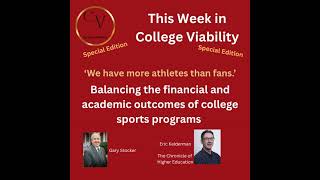
Eric Kelderman from The Chronicle of Higher Education explains why small colleges added sports to boost enrollment, then describes the financial disaster at Lourdes University: scholarship stacking created 74-89% tuition discounts for athletes, while hidden costs like extended dining hours and transportation drained budgets. Research shows D-III schools that didn't increase athletic spending actually gained enrollment.
Chapters
Welcome back to yet another special episode of This Week in College Viability. Hi everybody, Gary Stocker back again. Eric Kelderman is a senior writer at the Chronicle for Higher Education, and he writes about nearly every aspect of college administration with the goal of bringing clarity to complex topics like accreditation, athletics, finance, legal affairs, leadership, and even state policy. He Wrote an article about a month ago, and the title of that article was, "We Have More Athletes Than We Have Fans." And the subheading on that was, "Many small colleges have invested in sports to boost enrollment. What happens when it doesn't work?" Eric, welcome to This Week in College Viability.
Thanks. It's great to be with you, Gary. I appreciate the opportunity to talk about this.
Always a pleasure. I'm a big college sports fan, and not to the extent that I really care who wins or loses. It's about the competition. It's about watching young people succeed. And all the growth that goes with that. But I worry and I have concerns that the actions of the Power 4 conferences will ultimately change not just the college athletic landscape, but ultimately something you talk about in your story, youth and high school sports. But that's not really our topic today. Our focus is on really a couple of colleges, Loyola University and Juniata College. And Loyola University, Eric, The story is really about adding athletics to boost enrollment. And in my mind, that's problematic at best.
Well, it's become a sort of standard strategy, I think, for small tuition-dependent colleges. It's sort of a sure way at least to get a few more students on campus, right? If you start a If you start a tennis team or a golf team or a women's wrestling team, there's enough interest out there from high school athletes in our athletics-crazed society that they want to come and continue their athletic experience. And who can blame them, right? They get to say, I'm playing college sports. In some cases, there's athletic scholarships for them. And so, you know, like you, everybody loves college sports, right? Or a vast majority of our— and that's how we get to this place, right? Which is, that's what creates the interest in continuing beyond high school, even if it's at a place like Lourdes, which is an NAIA school. It's very small. But I think that, you know, the sort of the perceived value of continuing to play sports in colleges is very high for these young people and also for their parents.
And I've got a big windup for the second question, so bear with me as I get through this. And you write in your story, and this is more— we have more athletes than we have fans. It was a mid-March publication date. You write in the story, the athletics bet for colleges has seemed like a reasonable one, especially as youth sports has flourished and young athletes and their parents have clamored for opportunities to keep playing. So just 2 minutes from where I sit here in suburban St. Louis, there are 2 massive soccer complexes. And the little road that runs behind our house is traffic heavy all the time with moms and dads taking junior to play soccer. And we see that throughout the country. And my perception is that, again, having gone through that many years ago, is that many parents see this as their child's athletic abilities, whether real or imagined, are a ticket to a college scholarship. With a sports-heavy culture, in youth sports, middle schools, and high schools? Will that continue if more colleges find the sports model financially unfeasible?
That's a really good question. I'm not sure. I mean, sports is so ingrained into the American educational experience. You know, when you think about when there are cuts at your local elementary or secondary school, You know, it's rarely the PE program or the football team that gets cut. It's the art class or the music program or the band or something like that, right? So I think it's here to stay. The question is, for colleges and universities, is it a reliable way? Will it continue to be a reliable way to build enrollment? And that's where Lourdes really ran into to problems. Right. Right. Part of their issue was timing and part of it was what the way they managed the finances of how they did it. So they ran into some real challenges in that.
Yeah, 'cause you and I know, both know that most sports scholarships are just the same kind of discounts, tuition discounts that everybody else gets, right? So it doesn't have to be throw a good fastball or hit a 3-pointer. It can be, your skill can be in arts or music or dance or any computer programming, any of those kind of things. And it'd be fascinating to see if those kind of skill sets become more prominent as this athletic thing plays out. Lourdes University made some business decisions related to athletics that appear to have contributed to their, what I would call, significant financial challenges. What are those?
Yeah, so in a way, Lourdes is a little bit of an outlier because they only started adding— they only started having athletics programs in 2010. Before that, they had been primarily commuter campus serving non-traditional working adults, things like that. But, you know, a couple years into the Great Recession, undergraduate enrollment was really booming. And so the board of the institution saw, well, this is a great time for us to transition into a sort of a more traditional residential liberal arts college. And to do that, to help facilitate that move, we're going to add some sports. Now, what they didn't know, what they couldn't have known, was that by 2011, right, the enrollment boom from the Great Recession was over. We started to see sort of steady declines. The other thing that really hampered Lourdes in this was the fact that they joined the— this decision wasn't by and of itself a problem, but they joined the NAIA. Right. So in the NCAA at the D3 level, which is probably where Lourdes would have competed had they joined the NCAA, you're not allowed to offer athletic scholarships. Right. You get, as you mentioned, the athletic scholarship is a form of merit aid typically. And the NAIA Schools can actually use scholarship for specific sports to attract students, but they were also offering sort of, you know, traditional discount, tuition discounts that small private colleges often— What happened was, though, that the coaches who serve as enrollment officers were offering students athletic scholarships, and then they were stacking that on top of the merit aid. And so, you know, on average, small private schools offer about a 50% discount off their sticker price for students. But the discount for athletes actually rose much higher because they weren't really watching the bottom line. So the average athlete at Lourdes was getting a 74% discount on their tuition. And it went as high as— the president there told me that one team, the average discount rate was 89%. Now, in theory, I suppose you could, you could do that, but you'd have to have a whole lot of full-pay students on the other end, right? And that's what they don't have, right? They're serving, you know, your, your average. They don't have an international draw. They're not, they're not pulling in a bunch of full-pay students from China or India or anything like that, or, or even across the United States, right? So, That's what really cost them. And I think too that maybe they didn't see the, you know, the other marginal costs of adding athletics. They weren't contemplating those. For instance, what they found was they had to extend the hours of their dining hall to facilitate athletes who were in practices or competitions because they wouldn't get to the dining hall on time, right? So you have to add hours. That's a cost. There's transportation costs, there's scheduling costs of courses and things like that, right? That sometimes those are just inconveniences, but it all adds up. And I don't know that they contemplate sort of the full range of impact that it would happen if you add a couple of dozen sports teams.
Yeah, and I often commented on the podcast that I do each Monday and other shows and other media that I do that colleges, and as you talked about this in the article, they look at athletics as a source of supplemental revenue for sure. And there's nothing wrong with that. It's true. Although 11% supplemental revenue at 89% seems hefty, but they don't really account for, you know, if you and I ran a business, the Eric and Gary business, we'd have a cost center for everything that we had. And maybe the football team needs to be a cost center and not just cost for the football coach's salary and all the travel and entertainment and referees and all that kind of stuff. But the allocated cost, you know, the cost associated with running a college, president's salary, all those kind of things. And I don't see that. Do you think if colleges actually accounted for all of those costs, they would be as aggressive at adding new sports programs?
I mean, I don't want to say that every college is operating on the same premise that Lourdes is. I think many do, right, understand sort of the overall cost. And they're being savvy a little bit about it by adding teams that have a sort of a low cost basis. So for instance, bowling has become very popular, right? So you rent some space in the local bowling alley. You're not providing your own facility. Athletes don't need a lot of equipment right now. I, I don't want to downplay the cost of what a really good bowling ball might be, but it's not football. Now, Lords didn't offer Lords didn't add football, which would have been, right, a huge mistake for them because that's a really big cost, 120 or so players and all the equipment that goes with that. And then the transportation is quite high. But women's wrestling is another very popular sport, right? You've got a singlet and some shoes and you need a practice space. But so many universities are trying to do this in a very cost-effective way. I think the other issue for Lourdes really is though that once you add a bunch of athletes, what does that do to the culture of the campus? So once you get above, and I know I've heard this figure sort of 44% of athletes, does that start to change the culture of the campus? Does it become so sports heavy that that students who aren't interested in playing athletics, the prospective students come and visit and they say, well, what's my place here? What am I going to do, right? And I think there was a sense that that's what had happened at Lourdes to a certain extent, right? Teams come and they bond with each other. That's a great thing for the athletes. It's an engagement tool and it works very well and it helps retention and things. What does it mean for the students who are not playing athletics? Do they have that same kind of interaction? Do they feel left out?
And you write about that. And there were a couple things from your story. And one, you cited an article that found that adding a football team at the DIII level, and similar to ANIA in many aspects, it doesn't lead to a statistically significant increase in enrollment revenue or endowment. Yet Lourdes appears to have bet the farm on athletics. That's risky.
Yeah, I think that's what was the most interesting part of the story to me, which is, and I think that, you know, there is some research that's emerging that would indicate that adding a significant number of athletes does change the kinds of students you're going to attract in the long run. And doesn't necessarily help your bottom line. That said, you know, Lourdes, now that Lourdes has whatever, 20-some teams, it also makes it difficult to cut, right? So, right, Lourdes can't afford to lose any more students. They can't have fewer athletes. What they need is more what we'll call non-athletes, right? Students who are not playing collegiate sports. And then do you have the revenues to build the programs or add academic programs that will attract students who are not interested in playing sports.
And one of the facts you cited from Lourdes in your story was, I think it was the baseball team went from 35, which was already a big number, to 50. To me, that says somebody's not thinking this through at all. That's silly, 'cause you can't have 50 players on a baseball team. That's a small football team.
Right, exactly. Yeah, yeah, adding, that's become another way that schools have tried to sort of capitalize on this athletics thing, which is to invite players to the campus to join a team, but then you're on a roster that's so large, you don't get enough playing time. And, you know, now that it's easier for many athletes to transfer between institutions, I think that's a trend that we'll see will be short-lived.
Okay.
Yeah.
Interesting. And I'm going to go back to something you just mentioned a moment ago. And you said in the story that, I'm paraphrasing a little bit here, Eric, that athletes chase away non-athlete students. And there was a report from the Urban Institute that actually suggests that DIII colleges that didn't increase their investment in athletics were more likely to see enrollment increases. That's a fascinating observation.
Oh yeah, it really is. I mean, I think it cuts at the heart of this strategy that so many small colleges have tried to use to, you know, to bring more students to campus. So it will be interesting to see, you know, how does the sports trend play out over the next few years? There's some interesting pressure points happening here right at the you talked about the D1 level, right? The sort of the top tier of the NCAA. Right, right. And, you know, the financial pressures on those institutions and the ability of athletes to transfer easily. I do wonder if the changing landscape at the upper echelons of sports will push more students to play, say, D2, D3, Well, there may be, there may be some corollary impact of the, you know, the money that's flowing into D1 about those schools being, say, pickier or, or able to, you know, we're going to have roster limits in theory in a few years if the House settlement is approved. Will that then cause a flow of students to go sort of down the food chain to some of these smaller schools?
One of the things that I commented on, because I posted on your article, I think it was on LinkedIn, and I noted that the 4-year graduation rate, the differences for the 2 colleges in your story that were highlighted, Lourdes and Juniata, there was substantial differences. Juniata had something like a 70-plus percent over the last 8 reported years, 70-plus percent 4-year graduation rate. I'm being nice, but Lourdes was well below 50%.
Yeah.
How fair, Eric, how fair is it to judge colleges by the percentage of students who graduate, either in the context of athletics or not?
That's a tricky, it's a great question. It's a tricky question. I think what you need to do is you need to look at, if you're going to judge two colleges based on a graduation rate, you need to compare the student body, right? And the kinds of, so, is Juniata probably more selective than Lourdes? They might be a wealthier institution able to provide more financial aid. They have maybe a longer history of providing a wider variety of academic programming and cultural programming on campus. But I do think you need to look at— so if we it wouldn't be fair to say compare, right, a very selective private college to Lourdes. I think if you're going to compare two colleges' graduation rate, you'd have to look at sort of what's the percentage of Pell students that are each at each institution, excuse me, and what's the amount of aid that they're providing to those students? Are they using, say, standardized tests as a measure of enrollment or admission selectivity, things like that. And then I think you can get to places where you can compare apples to apples. And I haven't done that comparison between Juniata and Lourdes, but it would be, that would be interesting.
Yeah, that's a good point. Yeah, that's a good point. And you mentioned a couple minutes ago, essentially Lourdes and many, many other private colleges find themselves in this situation. That they have invested in sports in whatever combination of sports that they have, and they find themselves where that sports has become their— I'm going to make up a word here, a phrase— their survival revenue source. And you kind of talked about this a minute ago. So if they cut sports, they essentially cut enrollment and they essentially cut revenue. It's kind of a catch-22.
Oh, absolutely. And I would argue that sports isn't even a survival revenue stream for them at this point, because as the article points out, right, they, they tripled between 2012 and 2022. They tripled the number of athletes on their campus, and yet their overall enrollment fell by half.
Yeah, I saw that.
So it wasn't even that they were providing too much financial— it wasn't just that they were providing too much financially to athletes. It was the fact that they were, they were bleeding, you know, students. That's a poor analogy. They were losing students at a rate that was really, that makes it unsustainable for them in the long run.
You know, I have to wonder, was it the factor that Lourdes had sports or was it just a factor like every other college that's struggling? Fewer students were saying college is for me and Lourdes was just a part of that whole scenario as well.
I think there is a bigger picture story here, which is that Lourdes isn't a part of the country where certainly the birth rate has been falling steadily for decades. So there's fewer high school students in Ohio, right? Same thing in Wisconsin, Michigan, and in the Northeast, right? Where we've seen a lot of college closers. So they're also battling demographics. And that's a tough thing. That's almost an insurmountable challenge for them because Amen. It's tough for them to draw outside of their sort of geographic, traditional geographic marketplace. In one sense, that was a way that athletics helped them. They had attracted a few international students, some Brazilians and others.
I saw that, yeah.
Coming to play volleyball and soccer. So in that sense, it had helped them. It just hadn't helped them overall enough.
And then I guess the last question, Erica, and thanks for making time to join me today. When I look at this sports and colleges kind of considering sports as loss leaders, and we've heard that term of course in retail, they'll have something to get you in the store. Costco and Sam's, those kind of places will do that. You build a successful sports program and more paying students will follow. Well, that's not what we're seeing in, When you did your research for this story, were there any other equivalent kind of lost leaders that colleges were even looking at besides sports?
You know, that's a great question. I was trying to ponder what that might be. I would think of, I remember talking to the president at Wartburg University in Iowa. I'm from Iowa. I went to a similar institution, Luther College up in northeast Iowa. Fort Burg's another Lutheran college. It's maybe an hour and a half from Decorah. And the president was talking about both schools have big music programs, right?
There you go.
And when you bring music programs on, so there's, right, a choir or a band might have 100, even 100, and a band might have 100 players, choir might have, say, 50 to 70 participants, right? That's a pretty good ratio in terms of you're looking at like You're paying for a credit hour and you got an instructor and then you have 70 students. That's a good, that's a really good return, right? That's like a big classroom where the cost is relatively low. But on the other end of that, you have a lot of students who are taking individual lessons. So private music lessons, right? And they might be paying half a credit or even a credit for a lesson, but it's one-on-one. Right? So, so there the ratio is, is, is not good. They're probably losing money on, on something like that. Um, maybe it's, maybe it's paid for in the ensemble, the money they make up in ensembles. I don't— I haven't looked at the revenues specifically, but, um, that would be something like that. So, uh, you know, having, having a small class size, uh, in any program is going to be more expensive than a larger class size, or, you know, a program that attracts a big cohort of students to a classroom.
Well, Eric Kelderman, writer for The Chronicle, I could talk college sports all day long, but I don't want to do that because you're taking the rest of the day off, I understand.
No, no, I wish. I mean, I want to say, you know, this article is not anti-sports. There's a lot of advantages for colleges to add sports. It's an important part of our culture. It does build engagement on campus. It's exciting and fun. I'm a huge sports fan myself. I grew up loving, you know, the Iowa Hawkeye basketball team in particular and continue to watch and play sports. But as an enrollment strategy, I think it maybe has reached the end of its useful life for many institutions.
That's a fascinating observation because I sense that you're probably right on that. Eric, thanks for making time today. For those listening to the podcast, we're grateful for you making the time to listen to it. I'm Gary Stocker with College Viability. This has been a special episode of This Week in College Viability.
More from Gary


What does it look like when a college increases both total revenue and total expenses?



College Financial Crisis? We look at the financial health of Bay Path U. (MA) and Coe College (IA)


Private College Financial Crisis? We look at the financial health of Hobart William Smith College


Financial Compass tutorial (Private college version.) Financial statements compiled 2016-2025.

