This Week In College Viability (TWICV) for December 9, 2024
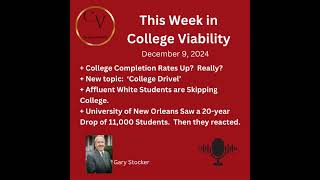
Gary Stocker surveys financial crises across U.S. colleges: University of New Orleans dropped from 17,000 students to 6,000 with a $15 million shortfall, Fitch Ratings predicts deteriorating conditions in 2025, and Barnard faces $252 million in projected debt. He argues that 61% six-year graduation rates still leave 40% of students without credentials and criticizes colleges for inflating enrollment through dual-enrollment programs.
Chapters
It is Monday, December 9th, 2024. Hey everybody, it's time for another This Week in College Viability news and commentary. Hi, it's Gary Stocker back again on yet another Monday. This week we have some action in layoffs and cutbacks. I thought we had an imminent closure, but Keystone College in Pennsylvania is still trying to ride out a nearly impossible financial situation. With appeals of their accreditation removal for middle states, poor, poor students, poor faculty, poor staff, poor community. I've never used fake news in this podcast before, but I have a story about college completion rates trending up that fits that categorization. I'll have some stories, have some news on that as well. And I've added a section and I'm going to call College Dribble, D-R-I-B-B-L. By definition, it is to talk stupidly or carelessly. We should have some fun with that one. Another headline reads, affluent white students are skipping college and no one is sure why. I am, and I'll be glad to tell you. And there's more bad higher education industry news from Fitch Ratings. These and much, much more on the December 9th, 2024 This Week in College Viability podcast. And of course, we always start with layoffs and cutbacks. The University of New Orleans is going to consolidate colleges, lay off administrators to address a $15 million shortfall. Typical kind of headline. These changes are expected to take place next month in January and save the university $2.1 million, which seems a little bit short of $15 million, but maybe math isn't my thing. And the story was released by Nigel Moses on 4WWL-TV CBS. I believe that was in New Orleans. And this comes after University of New Orleans President Kathy Johnson ordered administrators to cut the school budget by 15% and interestingly reduce the athletic department by 25% this past July. 5 colleges will be temporarily, okay, consolidated into 2. The enrollment at the University of New Orleans was 17,000 students, give or take, back in 2003. This fall, somewhere around 6,000. Um, isn't the market telling the good folks at the University of New Orleans that they don't like what they are selling? And 17,000 to 6,000, that's 11,000 over 21 years. At what point did they realize there was a pattern? At what point did they realize there was a trend in declining enrollment and they're just now responding? And it's typical. I have this kind of story on regularly.
Colleges are so slow, so slow to react, and it's not going to be good for students. It's not going to be good for faculty, staff, and it's not going to be good for communities. How about another headline? Faculty push back. Stunning. Faculty push back against staffing cuts recommended for state colleges. And this is in the Connecticut Examiner on December 5th. Emilia Atte, I believe, is the last name. And it's standard stuff.
The cute part is the picture for this story. And again, the link will be in the show notes.
The picture is of faculty sitting in a circle in a room with signs that read, "Come to the table," and one that reads, "Listen to faculty and students—not consultants." Now, these are fine signs. They were professionally done. They just want somebody handwriting with a marker, with a magic marker. But it continues to reflect that in almost every case, faculty aren't or not doing their financial homework. Apps like My College Viability App and Matt Hendricks' free— I'll say that again— free College Financial Health Compass are tools faculty can use to bolster and improve their cases or not with their leadership. And carrying signs is an age-old and largely ineffective tool. And you would think, you would think that college faculty, many trained in some form of data research, would use data to their advantage. Clearly, most do not, especially in the case of finances for their own college and their own livelihoods. That's their problem. The tools are there, faculty, faculty leaders. The tools are there. At least I provide a tool to use, and I don't typically ever hold up signs saying, talk to me.
Page 2, Fitch again comes out. I think I had a story about this a couple of weeks ago. Fitch again comes out indicating no letup in financial pressure on colleges in 2025. And this has come from the eternally hardworking Ben Unglesby at Higher Education Dive on December 4th. I don't know what Ben's quota for stories is, but the man just generates story after story and does a good job with every one of them. It's a gloomy outlook. It's nothing new. They expect— Fitch expects deteriorating, deteriorating— say that fast— deteriorating financial conditions for many institutions next year. The credit rating agency said uneven enrollment dynamics, rising competitive pressures, and continuing margin pressures on tuition will challenge credit factors across the sector. Added to those challenges, Fitch adds, and Engelsby reports, added to those challenges are flat public spending, elevated wage costs, constraints on revenue, and rising capital spending needs. I need to talk about capital spending needs on another podcast. Those challenges, which concludes, will continue to chip away at more vulnerable higher education institutions in 2025. And that's even if inflation eases, even if inflation eases and interest rates come down. With $252 million— that's a quarter billion, quarter billion with a B— $252 million in projected debt, Barnard Bernard, excuse me, Bernard College, I believe, makes cuts to faculty and staff benefits. And the college's chapter of the American Association of University Professors wrote that employees were blindsided by news of the budget crisis. Again and yet again, and I'm sure in the future again, I will share with faculty, why are you just now finding out there are tools available that you don't have to rely on your college leadership. The College Viability App, Matt Hendricks and Perspective Data Science has a whole new series of apps, some of which are free, some which are moderately priced, some which are not moderately priced to help you out. Why, with so much for so long about colleges being in financial trouble, were the folks at Barnard shocked, blindsided by news of the budget crisis. This story comes from Shea Vance and Maya Stahl and Anna Puketsch on December 3rd in the Columbia Spectator.
A quote from the story: Faculty and staff are now being asked—
at Barnard— faculty and staff are now being asked to make a series of sacrifices in order to dig the campus out of an economic hole We had no part in making the chapter. Well, do you teach the classes? Do you create the classes?
Do you teach the students? They're not coming to Barnard and paying whatever tuition you're charging for, for some reason.
You have a role, faculty at Barnard, in the market, in students choosing or not choosing your organization.
Don't be so naive as to say we had no part in making. And I can't spoon-feed you the information about the financial trends at your college.
It's readily available. Let's do this.
If by some miracle the podcast, this podcast is listened to by a faculty member or a staff member, a community member, and you wanna take initiative and get across and get access You know, take the initiative and get access to the financial information that your leadership allegedly hasn't provided. I'll put you in touch with someone. I'll put you in touch with someone who went through a similar sequence at their private college a few years ago. And I'm not hopeful that will happen. Too many, in my experience, too many faculty live in an artificial world they think makes them immune. To market and financial realities. Oops, my mistake. I should have issued a sarcasm, sarcasm alert. Let's do it again. Too many faculty live in an artificial world they think makes them immune to market and financial realities. That was sarcasm. Page 3. All right, fake news. I don't like political stuff because there's no way to win, and we've heard the fake news for Lord knows how many years now, but I'm going to use it this time and I'll be hesitant to use it again. December 4th, Katherine Palmer on Inside Higher Education had a headline that read, "College Completion Rates Trending Up." Let me read to you as I am wont to do. Ms. Palmer writes, prior dual enrollment experience made students more likely to finish their credential, their degree, within 6 years of starting college, according to a new report from the National Center for the National Student Clearinghouse Research Center. Did you hear 6 years in there? In 6 years?
This is the epitome of trying to spin a new standard. 6 years to finish. What happened? What happened? What happened to 4 years? To graduate. The story goes on to say the report found that students who started college for the first time in 2018—my bold here—had a 6-year credential degree completion rate of 61% and change, a 0.5 percentage point increase over those who started a year earlier in 2017. So after 6 years Barely more than 6 in 10. After 6 years, barely more than 6 in 10 graduated according to the National Student Clearinghouse Research Center. And 8-year rates, same story. 8-year completion rates for those starting in the fall of 2016, not quite, not quite 65%. So after 8 years, 35 out of every 100 students who started college did not complete after 8 years. And then here's the kicker on the story. Here's the kicker on the story. The article did not at any point, did not at any point reference a 4-year graduation rate anywhere. And regular listeners to the podcast know that I am on that all the time. 4-year graduation rates are pathetic. I can make the case my threshold is—
let's see, Gary Stocker version—
for 6 years is 70%.
7 out of 10 after 6 years.
If you can't graduate 7 out of 10 students in 6 years, not good. Not good for a lot of reasons.
Onward. 2 Seattle colleges announced merger.
This is broken by Liam Knox on December 6th and Inside Higher Education as well. Seattle University and Cornish College of the Arts to merge. Interestingly, one part of this that caught my attention was Seattle University— the merger, not the mergee—
Seattle University President Eduardo Peñalver said in a press release that the merger would not benefit Cornish, Cornish College of Arts, but would complement the larger university's mission of incorporating the arts into its students' education.
And the background in this story is Seattle University recently received 200 works of art worth a reported $300 million from a recent alum. Page 4. College drivel.
I think I picked up the term many, many, many years ago from a guy I used to sell stuff with. Drivel. D-R-I-V-E-L. To talk stupidly and carelessly. And so it's, it's always in my mind, it's always silly season with college PR announcements. And part of my mission has regularly been to challenge college statements. You heard me doing this podcast and the social media that I use. So in recognition of those silly statements, I'm adding a section, adding a regular section. May not be every week, but regularly. And it will be anonymized because I want any college leader or a public relations person who follows the podcast, and there are many, to be able to reuse these lines. So I'm going to use the quotes, but I'm going to make a vague reference to the college that shared them. And here's the ones I want to start off with. And if you would please consider this my contribution— College of Viability's contribution to higher education communication efficiency. Again, I screwed up. I should have had a sarcasm alert prior. To sharing that one. Here's the first one. Like all higher education institutions, the impact of the pandemic on us was dramatic. This is from a chancellor. This chancellor goes on to say, our commitment to providing high-quality learning experiences to the most diverse student body in the region at an affordable cost, as we did during COVID continues to be what sets this university apart. All right, the next one, Drivel University. I made that up. Drivel University, not the real university, of course, says, similar to many institutions of higher education operating in the current economic and political environment, we're in the process of making strategic decisions that support our commitment to long-term academic excellence. Wonder what their graduation rate is. Long-term academic excellence and financial sustainability, this college leader wrote. Over the past 10 years, they continued, our faculty and staff have accelerated the progress and the pursuit of excellence at our university. I will share with you without naming the college that they have financial issues that are significant. And then finally, a reimagined— name of university— a reimagined university aligns costs to revenues while improving our agility and ability to meet student demand We are focused on ensuring relevance and maintaining excellence for students, employers, and our greater community long into the future. And I just got back from my annual trip to the eye doctor and my eyes are watering.
I'm not sure it's from the eye doctor or from those touching moments of higher education college drivel.
I hope we can have some more fun with those. Just to point out, it's not idiocy, that's not fair. Just to point out the silliness of some of these statements and their grandiose nature.
Many times, not always, many times from colleges who I know are watching their last dollars, watching their last dollars circle their financial drain. Affluent white students are skipping college and no one is sure why. I think I do. The attendance rate for these students, white affluent white students, has seen the steepest drop among any demographic in recent years. This is from the Chronicle of Higher Education on December 3rd, and Lee Gardner wrote this story. Let me read. White students, this is from Lee Gardner in the Chronicle, white students are falling out of higher education more quickly than any other racial group. And recent data suggests that middle and upper income white students are skipping College, middle and upper income white students are skipping college at a higher rate than their lower income peers. Mr. Gardner goes on to write that flies in the face of entrenched narratives about more affluent white students following a well-marked path to college. Experts can only speculate about why it might be happening. Well, I can speculate. I can tell you why. It's the market speaking. Higher education market is speaking. And this demographic, if this research is legitimate— we have to consider that, we have to consider that it is— the higher education market is saying, hey, you're not giving us what we want. Consumers buy stuff. Consumers buy stuff that they think benefits them. This article suggests that affluent white students are not willing to invest time or resources in a service, in a college education, because they don't think it benefits them. And remember, I've talked before, remember that old economic concept of marginal analysis. It's probably not a profound observation saying, you know what, college, I'm not going to do it. Or, you know what, college, I am going to do it. It's marginal analysis. It's those things on the side. It's those things on the periphery that you and I use when we buy phones and coffee and computers and cars and houses and spouses, for that matter. We make those decisions on the margins. And clearly, if this research is legit, and it probably is, that's what's happening with these students. It's not that tough. Dual enrollment. This is from Minding the Campus Reforming Our Universities website, a gentleman by the name of Peter Wood on December 4th. Dual enrollment is a deceptive fix for declining admissions.
Again, this is from Minding the Campus Reforming Our Universities.
Mr. Wood reports that colleges and universities are searching for ways to continue business as usual. Yeah, That means filling classrooms with any students they can get. He adds a qualifier: within limits. And the limits, he goes on to write, are admitting students whose presence would undermine the credibility of the curriculum. But he continues, some colleges skate, some colleges skate very close to those limits. And colleges have been doing this for a long time, since, you know, at least, at least the 19th century. But it was for exceptional students, those with really, really significant skills far and above those of their peers in math and languages and sciences and other areas, um, far beyond other college students. But the new game, Mr. Wood writes, the new game is admitting ordinary high school students Define ordinary any way you want. Admitting ordinary high school students to get them settled on the college's curriculum and student culture. Now, in practice, probably nothing wrong with that unless, and this is what's happening, those students aren't prepared for college. Their middle school, grade school, and high school courses, programs didn't prepare them for a college curriculum. And the transition is easy, and this makes sense. Many colleges have lowered their standards to a level— get this— lowered their standards to a level barely above high school standards. And Mr. Woods says, I say deception because the students who take the bait— it's a strong word, I guess— who take the bait and after taking some courses as high school students go on to enroll as full-time students, they are probably failing in their responsibility to look at other options. Even though they've taken some courses from another college, some dual enrollment courses from another college. Okay, all right, so the market is what it is, but the author reinforces a point that, that many are making, including myself. Colleges— and I've said this before— colleges are so focused on getting students enrolled that they don't— in my mind, they don't concern themselves with how many graduate. Get them in the door. What happens after that, the data shows doesn't matter because of such pathetic low graduation rates. And I've told the story before, how many times at a May or even June graduation event, college graduation event, have you heard a college proudly announce, "We had 41% of this year's class graduate." Of course, they're not going to say that. It doesn't happen. But that proves my point. They'll say we had 2% more students enroll in fall, but they won't say we only graduated— we didn't even graduate half of the students that started in our college. And let's wrap this up with something from Keystone College. And this was an opinion by the editorial board at a place called the Standard Speaker on December 7th. And the story reads, Keystone College deserving of time to prove viability. And I mentioned this at the top. It's highly unlikely that Keystone survives for lots of reasons. I've shared the data before. I'm not going to do that again today. But reading this editorial, and you can get what the gist of it is by the title, They're saying that the college deserves more time. Well, they've had decades— I don't know if it's been centuries or not— but decades to prove viability. And slowly and surely, the market has said, for whatever reasons or set of reasons, no to Keystone College. And then you may not believe this, but I spend a lot of time pondering, pondering the impact of a college closure. The impact of a college closure, mostly at a small private non-urban community. And of course, organizations like Stand to Speak are talking about Keystone. They're welcome to make their point, but so am I. And my point continues to be that there are too many colleges. There are just simply too many colleges, too many college seats, and not enough students willing to pay at whatever discounted tuition willing to pay for those seats. It's basic economics. Again, it comes up. Until the supply of college seats more closely matches the demand for those seats, there will continue to be downward pressure on tuition, upward pressure on tuition discounts. And it is in that scenario, in that scenario, that more colleges will continue to consolidate. Be that in the form of closures or mergers with other organizations. And it's a legitimate concern that communities will be traumatically and negatively impacted by a college closure, especially small ones. However, I make the argument, and I think it's a solid argument, I believe it's a solid argument, for the greater good, these closures are a necessity. While some or many may argue that the colleges are different, that colleges are different from other industries, that's not correct.
They have different cultures.
Every industry has a different culture. The college degree in almost every case is simply a commodity product, a commodity service.
It has value for sure in almost all cases, but it's still a a commodity product or service is still that piece of paper that says I have my bachelor's, I have my master's in whatever discipline. That's a commodity. That's what employers look for, not the college name printed on the top of that diploma. And, and you're welcome, please feel free to try and make the case that your Bachelor of Science in chemistry or biology or Bachelor of Arts in fine arts or music or dance or whatever the discipline is different make the case that it's different or better or unique than other degrees. But that, that is a dangerous assumption. Employers may prefer some of the top 30 to 50 colleges, but in almost all cases, it's a piece of paper that says I graduated.
I graduated with a diploma, with a degree.
That's the ticket to a conversation for a job and even for a career, not the college. They are commodities. And I remind you as I wrap this up of the College Viability Manifesto and the first 4 points. College is good.
Go if you can.
College Viability Manifesto: graduation is better than just going and taking courses. Number 3, some colleges will not survive. We've seen in the past, we'll see in the future, but most will. The challenge, of course, is to pick out the ones that will not survive before going there.
And number 4, only consider colleges in comparatively good financial health. And my work there, my app is there, others have done the same or similar kind of work, not college by college, but similar kind of work. Only consider colleges in comparatively good financial health. And as always, thanks for making time. My name is Gary Stocker with College Viability. Every Monday I'm right here with another podcast episode of This Week in College Viability, and next Monday, December 16th, will be no exception. We'll talk then.
Take care.
More from Gary


What does it look like when a college increases both total revenue and total expenses?



College Financial Crisis? We look at the financial health of Bay Path U. (MA) and Coe College (IA)


Private College Financial Crisis? We look at the financial health of Hobart William Smith College


Financial Compass tutorial (Private college version.) Financial statements compiled 2016-2025.

