This Week In College Viability (TWICV) for August 4, 2025
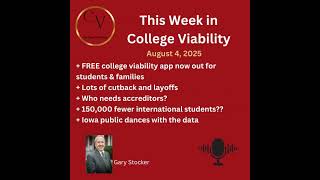
Gary Stocker surveys college financial crises: Northwestern, Barnard, and Moody Bible Institute are cutting staff; Southern Oregon plans $10.5M in cuts. International enrollment is projected to drop 150,000 students, costing colleges $7B. A Texas court ruling challenges law school accreditation, potentially weakening other accreditors.
Chapters
It is This Week in College Viability news and commentary for August 3rd. Boy, summer is racing by. August 3rd, 2025. Hi everybody, Gary Stocker back behind the blue— I guess it is— Yeti microphone yet again for another Monday of news and commentary. Hey, a big weekend here at College Viability. We released our first fully automated College Viability Report for students and families. You'll of course hear more and see more about that in the coming weeks and months. And really, it's kind of got two analogies. It's kind of the Kelley Blue Book, if you will. Where Kelley Blue Book kicks the tires on cars, our app kicks the tires, kicks the financial statements, kicks the financial health of public and private colleges across the country. And we also think it's kind of a reverse FAFSA. We all know what the FAFSA does— students and their families give colleges information Well, we've turned around. Now we give students and families financial information about colleges that they probably can't get anywhere else. And shortly we'll have a custom PDF for students that they can use to ask specific questions based on the financial health of colleges they are considering. We're going to have similar products out soon for high school counselors and then college faculty and staff, and maybe somewhere down the road a version of this for college leaders, board members, those kind of folks. News stories and commentary this week: too, too, too many closure and cutback announcements. I've never seen this many in the 3+ years I've been doing this podcast. And how about the American Bar Association? There's a story we'll talk about that they don't— they aren't needed to accredit law schools, and I'll share how this will apply to regular college creditors that you and I talk about all the time. Forbes, in a story written by Mike Nistel, I believe, uh, international college students could drop by 150,000— 1-5-0 followed by 3 more zeros—
this fall.
And Iowa students in neighboring states from Iowa— it doesn't say if it's adjacent states or just neighboring states— get the Iowa tuition rate. Some serious spin going on with that. And finally, the enemy within: former college presidents offer warnings. Not new, but something I want to share with you anyway. Layoffs and cutbacks, Northwestern and Bernard Colleges. Northwestern University, Bernard College announced staff layoffs linked to federal funding cuts. What else is new? And debt. This is from Michaela Bilzer, the assistant editor at The College Fix. At Northwestern Illinois, Northwestern University in Illinois, President Michael Scheele said approximately 225 employees employees will be laid off and 200 vacant positions will be eliminated. It's from WGN Channel 9 in Chicago area, and that's about 5% of the staff. It's a result of— is the result of mounting financial pressures despite cuts the university has already made. Bernard College in New York stated last week that it plans to lay off 80 full-time employees The layoffs come about 3 weeks after Barnard leaders agreed to settle a lawsuit brought by Jewish students claiming that the university they're affiliated with, Columbia, failed to properly address campus antisemitism. And they go on to say, as part of a one-time college-wide restructuring, we've made the hard but necessary decision— don't they all say that— to eliminate multiple staff positions. Barnard President Laura Rosenberry wrote to the college. Staff on their website. Moody Bible Institute lays off 9% of their staff, and it also has a sidebar that says small religious schools nationwide struggle. You know, yes, there's issues here, and they're going to let between 8-9% of their staff go at Moody. Um, just part of the trend. And, and I looked at this, and first of all, I guess I've talked about this all summer long— nothing like sending out layoff announcements in the dead of summer. Which is what Bernard and Northwestern are doing here. And the data Bernard suggested, you know, they're probably getting ahead of the game. If you want to see a more thorough analysis on Bernard, drop me a note and we'll make sure to add it to the long, long list of colleges being requested for the College Financial Health Show that I do with Matt Hendricks every Tuesday. You know, the net income margin at Bernard is up 16 It was up 16%, now it's down to a negative 5%. The net tuition revenue is down about $10 million. The 4-year graduation rates— this caught my attention, you know me and graduation rates— down from 64% to 42% in the last 8 years. The 6-year rate down from 73% to 53%. That ain't good. The endowment is up, however, so that's, that's looking all right. And, and the revenue is a little bit below the expenses, about 7— about 6 to 7 million— $6 to $7 million per year. So probably just getting ahead of the game. A more thorough analysis would be needed on that. Let's go to ABC 11, uh, on Tuesday, July 22nd. Sean Coffey has a story. Meredith College— I believe that's in North Carolina— is laying off 6% of the workforce. Of course, it's called a gut punch, which we see regularly. The story reads, Meredith College All right, they say at Meredith College that we're in a strong, a financially strong position. We are a financially strong institution. And they go on to blame the economic realities, which is fine, they do. Meredith is facing financial pressures as a result of economic and demographic shifts, blah blah blah blah blah. Meredith values and cares about our colleagues affected. I'm sure they do, but they're not financially strong. Their net tuition revenue is down $8 million over the last 8 years. Enrollment is down about 400 students from 1,900 to about $1,500. The net income margin— profit, don't tell them to call it that— the net income margin was zero in 6 of the last 7 years, was below zero in 6 of the last 7 years. And the total operating revenue was down 6%. What do you think the expenses were? Total operating expenses up 5%. Not a good match over the last 8 or 9 reported years. The endowment is okay at about $100 million, but they've been robbing the piggy bank a little bit. Um, the draw has been above 5%, which is a little high in and of itself, in 5 of the last 6 years. So they're not— you know, I beg to differ to the good folks at Meredith College. I don't see them as a financially strong institution. The 4-year graduation rate is fine at 60%, and their unfunded institutional grants— you and I call that merit aid and most scholarships— is up about $3 million over the last 8 years.
Not a big, big number.
Elon, let's do another one. Elon University, North Carolina, announces a pause on hiring, hiring faculty, hiring vacant faculty, staff positions for 2025-26. And the president at Elon says it's because they're not meeting incoming enrollment goal. Elon's fine, but it's important to note— financially fine— but it's important to note that they're citing the Issue with incoming enrollment. Stories from Nia Bedard on the Elon News Network. So an internal news story: Elon University President Connie Book announced in an email that Elon University will be pausing the hiring— that's clever— pausing the hiring of vacant faculty and staff positions. Uh, there are 28 open positions currently. The decision was made, President Book said, after not meeting the university's enrollment goal for the incoming class Again, this is probably another getting ahead of the game situation, but it just fits that pattern that we are seeing.
Fits that pattern.
The layoffs, cutbacks and programs endemic to the industry, endemic to the industry. And all the way out to Southern Oregon University we go, and the Southern Oregon University president President Rick Bailey says today, the headline reads, today we are declaring exigency.
Now, he didn't say financial exigency, that's really the proper term.
They're building, they're declaring a financial exigency, and they're building to a $60 million university, 15% off current budget.
No idea what that means.
Holly Dillamouth at the Ashland News had that story on August 2nd.
Southern Oregon University President Rick Bailey unveiled a provisional plan of action to respond to a structural deficit at the institution, declaring exigency, okay, with draft plans to cut $10.5 million over the next 3 years. So $3 million and change over the next 3 to 3.5 years, reducing staff by 64 positions. Approximately half of those 64 are going to be considered layoffs, okay.
Detail.
They're also going to cut back the majors from— they're going to have cut 38 academic majors down to 23, and they're going to cut $1 million from the athletic department and something called American Studies minor. So financial exigency— look out, faculty. The exigency is the calling card for tenure— tenured faculty layoffs. Now They're probably needed here.
Well, no, I'll talk more about that towards the end of the podcast when we talk about how slow higher education has chronically historically been to react.
So, tenured faculty, you're in the firing line almost certainly. We'll look forward to hearing your protests when that comes because that's always a follow-up page to finally done. We're finally done with cutbacks and layoffs, kind of. Page 2, the University of Houston language programs shrink as students choose other fields. This is from Samantha Ketterer. She's a staff writer at the Houston Chronicle. Now, there's a lot in the story, and here's, here's what caught my attention. Let me read from the story, one small paragraph. Universities typically gauge the success of a major, success of a major, by the number of students who complete degrees. and this is in Texas, in Houston—
partially because of a state requirement that undergraduate programs produce— now get the number here— a requirement that undergraduate programs produce 25 degrees, 25 major completions in 5 years in order to remain on the books. Now, why is this important? I think it was last week I had a story about the state of Indiana made the number 15 in a given year. For publics to be able to keep a major. And now we have Texas in effect saying that number is 5 per year— 25 over 5 years, or on average 5 per year. Folks, I can bring up the 2025 College Majors Completion App and there are hundreds, if not thousands, of colleges that don't meet either of those numbers. It begs the question Now that we have two numbers to look at, how many publics, probably to be followed by how many private colleges will say, hey, you can't get me 10, 15, 20, whatever it is, majors graduating from this program in every 2 years, 10 years, 5 years, whatever, we're gonna cut it back. Now there will be those listening say, well, that's a loss of revenue. Yeah, absolutely. Loss of tuition revenue for those programs. In some cases, and maybe in many cases, those majors offer early-level freshman and sophomore required courses. I understand that part. But this is a trend. This is the early part of a trend. Trust me, like Jeff Selingo said in one of his recent newsletters, 2025 is probably the year that colleges will finally decide, finally realize that colleges can no longer afford to be everything can no longer afford to be everything to everybody. And these last two stories this week and last suggest that Jeff's lingo is correct. Page 3: International college students could drop by 150,000 this fall. This is from Mike Niesel, who's a senior contributor at Forbes. The story came out on August 3rd. So the projection, and it's by an association of internal educators, international educators And essentially says, according to this NAFSA analysis, a potential, a potential 30 to 40% decline in new foreign students would yield a 15% drop in overall international enrollment in the United States. I don't know where those numbers come from. I have to think about that. That decrease would equate Here's some extrapolation. That decrease would equate— decrease in enrollment would mean some losses of some nearly $7 billion, with a B, in lost revenue and more than 60,000 fewer jobs. Now, I assume that means jobs in colleges and not jobs after college. I'm not quite sure what that means. If it's 60,000 fewer jobs in colleges, anything I'm Anything comes close to that, the catastrophic set of closures I have suggested are coming. This might very well be the precipice where we see that. And those are big numbers. We'll grant them the soil, we'll grant them the research methodology that they use, but let's assume that's just, just some percentage of that number becomes a reality. Because I continue to believe that the big college brands will get whatever and how many students they need. They've got the brand name recognition, they've got the resources, they've got the campus, they've got the majors. They're going to get what they need. It's those losses. If it's, if it's 15% drop in overall international students, there's going to be a trickle-down impact. Those losses, in my mind and others as well, not just me, ultimately impact— will ultimately impact the smallest least, smallest colleges, less able to afford those losses. Let's call it the trickle-down enrollment impact. And there's some details behind that that suggest that the data might be correct: suspension of visa interviews, limited appointment availability, downward visa trends, and visa bans in 19 countries, with as many, they suggest, as 36 more countries to be added. And they note in this story threatening billions in higher education revenue. It's, it's, it's, it's the market. Markets always adjust, boys and girls, ladies and gentlemen. We're in the middle of that market adjustment. We're just seeing the beginning, maybe the, the middle beginning of this economic, this market adjustment. Am I wrong? Maybe, but the news and numbers suggest I'm probably not wrong. And to Iowa we go, and they probably need to use some kind of AI tool at the University of Northern Iowa to help them write things. So Dar Danielson has a story on July 31st from Radio Iowa. And the story headline reads, students in neighboring states can get the Iowa tuition rate at the University of Northern Iowa this fall. Let me read from Dar Danielson's story. UNI President Mark Nook, okay, says the plan will help the Cedar Falls school and the state. All right, the data from neighboring states that have tuition reciprocity indicate that the University of Northern Iowa will see a sevenfold increase in enrollment and graduates from the 6 neighboring states. I'm going to pause for a second because I got that in my notes, was in red. I, I'm missing the logic of how you can go from what other states have done to say that your university will see a 7-fold increase from some set of neighboring states. You got to be making that up, Dr. Nook. If I'm missing something, let me know. gary@collegeviability.com. And he goes on to suggest that once this initiative is fully implemented, the University of Northern Iowa should increase the number of workers placed in the Iowa workforce annually by a little over 300. I gotta see the math behind that. Is this a dartboard number? This whole section should have been college dribble.
My bad.
This is— that's just silly.
Now, Nook says there are some startup costs.
And even this is not, is not accurate. He says the first few years of this initiative will cost the university significantly.
Well, I guess if you play the words, it's a revenue loss.
Instead of getting out-of-state revenue from these students, they'll be getting in-state revenue. I think that's fine, they can make that decision. He's trying to say that the decrease in revenue is a cost.
Am I missing something? He goes on to say there will be approximately, I guess this year, there will be approximately 160, 160 new entering students from 6 states who would have paid non-tuition, non-resident tuition, President Nook said. So man, give me some Advil. So President Mark Nook is saying that these 160 students where it comes up with that number, I have no idea— are from neighboring states. That's not even defined. And he's saying they will pay less. All right, I can, I can believe that.
They're going to charge them in-state rates.
And he's trying to call that a cost. In my mind, this is just revenue foregone, trying to make it look like there's a cost to make it look better. I, I should have had this in college. Drivel page for the enemy within. This is in October. This is from some, some warnings from former college presidents.
And this is from David Rosowsky, who's also a Forbes contributor.
And this is from way back in October, almost 2 years ago, October 2023. And here's my LinkedIn post. I'm going to summarize that for you.
In Mr. Rosowsky's article, he cites Brian Rosenberg, who wrote the book Whatever It Is, I Don't Like It, and was the president at Macalester College up in Minnesota for many, many, many, many years. I think it was 17 And there's a lot in the article, and of course I'll have the link in the show notes. Here is my biggest takeaway. All right, I'm going to read from the article from Mark— from David Oskowski. What is making former presidents like Brian Rosenberg and others come forward at this time? Again, back in 2023, perhaps it's the rising sense of urgency or the observations from their post-presidential purchases that nothing nothing has changed. Or number 2, the institutions themselves, their culture and processes, pace and arrogance— he uses that word, pace and arrogance— are to blame. And Mr. Rosowski, I think he's right, suggests that college presidents are in a tough spot to move their organizations toward needed change.
He's correct.
Brian Rosenberg talks about that. Countless others talk about that.
It's the faculty.
And maybe even I'm off base and college leaders recognize that I'm right, that we're headed toward a significant set of college closures, probably in the middle of it, early phases of it, and their faculty still will not adjust, will not adapt in any meaningful or materially significant way. And he's— colleges— Mr. Rosowski is correct, college presidents are in a tough spot.
I, however, I'm not in a tough spot.
I have no such challenges and will continue to kind of my self-described role to poke the higher education bear.
I do that each week.
You've heard me do that today already.
I'm thinking about in the coming months, I might shift my focus a little bit from college leaders. They have their own silly ways to faculty because faculty are almost always almost always the roadblocks to change and to real-time, real change, real progress.
I'm not going to let the chronic inability of college boards, boards of trust, easily to get away though. I'm still, even though this is an audio recording, I'm shaking my head as I record this.
Boards in way, way, way too many cases are just not worthy of the important fiduciary responsibilities they have.
John Nichols' book Requiem for a College, second edition, reinforces that not only across St.
Joseph's College in Rensselaer, Indiana back in 2017 when the board was asleep at the wheel, but John in his second excellent edition of Requiem for a College cites more college boards just not with it. Matter of fact, while I think about that, working with working with, um, I'll be releasing a product on September 1st that is a financial aid financial tools financial comparisons tool for college boards, and I'll have more information on that in the coming weeks. And then finally, the American Bar Association Needn't Accredit Law Schools. All right, this is from a Texas Supreme Court decision, July 29th, George Leif at the James Martin Center for Academic Renewal. And Mr. Leif starts off with his story. A number of sacred cows, sacred cow beliefs regarding higher education are finally, he puts in parentheses, coming under scrutiny. One of them is that it is important for the American Bar Association, ABA, to oversee law schools via its power of accreditation. They shouldn't, is what he's saying. In all but a few states, any individual who wants to enter the legal profession must graduate from an ABA-accredited law school before being allowed to sit for a bar exam.
And the restriction, he goes on to say, is to protect consumers.
But he goes on to say that's not good, not a good ruse. So the ABA is really, he says, this is Mr. Leaf, is looking out for its own interests. With government doing its dirty work by imposing regulations that needlessly interfere with competition in the market's search for efficiency. The good news, Mr. Leaf adds, is that the ABA's position starts to crumble. Now, there's been some back and forth on this, but essentially this is a big step, a big story in the context of accreditation agencies in general. We're talking about the American Bar Association and law schools now. Matter of fact, I spoke with a guy who did the Law School Transparency Project a few years ago and was one of the leading factors in making sure that law schools were telling the truth in terms of the numbers behind their marketing. And I'm going to make the case, I'm going to make the logical case that this same logic applies to all college creditors. You've heard me constantly harp on them. They focus on inputs and outcomes. They dot I's and cross T's. And they, these accreditors, ignore pathetic, pathetic graduation rates and financially unhealthy colleges, low enrollment majors, and much, much, much, much more. And finally, with the wrap, and again, Ryan Craig, I've had him on the podcast, had his stories in the podcast regularly. And his regular newsletter last week started off like he always does with a link to what the point he wants to make. He talked about a story about how CVS, the pharmaceutical retail outlet, has so many products in plastic cases, behind locked plastic cases. And he offers some cute examples from a friend. You know, he wants some special toothpaste. He wants some medicines of some sort, some over-the-counter medicines. And he has to ask somebody to unlock the plastic cases to let him in. And he's making the case that this kind of locks out consumers from that world of getting the products that we need. And certainly that's the case in higher education. Mr. Craig notes colleges have locked themselves, he says, behind the equivalent of a plastic case in the two most important ways imaginable. First, programs of study haven't, have not been responsive economic needs. Nearly all schools continue to offer the same degree programs they've run for generations: business, nursing, psychology, biology, engineering. He knows only computer science would have been out of place when our grandparents— our grandparents, who are almost all deceased— were of college age. And then he makes the case that the people teaching at colleges aren't responsive to economic needs. We've heard that many times before. He argues that tenured faculty are required to have terminal degrees, and they have typically gone from college to terminal degree to teaching colleges. And this means, Ryan Craig argues, that the people educating and preparing students to work in the real economy, the real world, have never worked or almost never worked in that real world, in that real economy. Just as CVS employees can't help us choose what toothpaste to acquire through that plastic wall, that plastic case, that plastic cover, faculty without real-world experience can't, cannot provide helpful career guidance if they haven't lived it, if they're not living it. And he finally makes the point with the undergraduate majors rarely have a straight line to a good first job. He makes note of research from Lightcast. The unemployment rate for the last 5 classes of college graduations is up 40%. It's not 40%, it's up 40% from what it was. And 12% of the grads in their 20s are currently unemployed. But he talks about when you look at the underemployment, which is around 52%, you bring those two together and the class of 2025 just graduated are struggling to launch.
And I'm gonna have more on this next week, but I'm out of time today, so I'll bring this back next week. Hey, I'm grateful. I'm grateful for every one of you that make time to listen to the podcast. I would love your feedback, good or bad. Holler at me, praise me, give me some ideas. Send your feedback to gary@collegeviability— that's one word— collegeviability.com. I will be back next Monday with what I predict will be some very interesting news stories and commentary on this week in college viability. For College Viability, I'm Gary Stocker. Thanks again for listening.
More from Gary


What does it look like when a college increases both total revenue and total expenses?



College Financial Crisis? We look at the financial health of Bay Path U. (MA) and Coe College (IA)


Private College Financial Crisis? We look at the financial health of Hobart William Smith College


Financial Compass tutorial (Private college version.) Financial statements compiled 2016-2025.

