This Week In College Viability (TWICV) for May 5, 2025
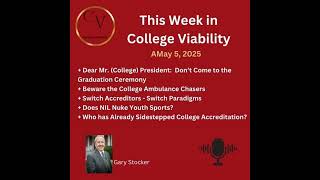
In this episode Gary Stocker reviews recent turmoil in higher education, focusing on the imminent closure of Limestone University and the broader pattern of college failures. He presents detailed financial and enrollment data for Limestone and comparable institutions, critiques faculty and administration for ignoring publicly available metrics, and argues that market oversupply is the primary driver of closures. Stocker warns about "college ambulance chasers"—institutions offering rapid transfer deals to displaced students—highlighting both generous scholarships and potential predatory offers. He discusses the Department of Education’s proposal to simplify switching accreditors, weighing concerns about accreditation shopping against the potential for private, data‑driven accreditation tools. The episode then shifts to the ripple effects of NIL and the transfer portal, especially how reduced revenue from Power‑Five schools could cripple non‑Power‑Five programs and youth sports. Stocker examines the House’s higher‑education bill, outlining caps on financial aid, elimination of Grad PLUS loans, stricter loan‑repayment rules, institutional risk‑sharing, and performance‑based funding, and predicts these changes will intensify enrollment declines, spur mergers, and force colleges to prioritize high‑earning majors. Throughout, he emphasizes the need for transparent, data‑based assessments of college viability and offers his consulting services to analyze institutional finances for stakeholders.
Chapters
Hello everybody, welcome back to yet another podcast episode of This Week in College Viability News and Commentary for May 5th, 2025. Spring is upon us. Hi everybody, thanks for making time to listen. It's Gary Stocker with our weekly podcast on what in the world is going on in higher education and some commentary on those stories. I've got 4 leads today. Limestone University holds graduation after the faculty votes to ban the president, the vice president, and board of trustees. As you might guess, I have some thoughts on that. Closed college students, Limestone University, St. Andrews University, and others in the past, in the future, be wary of the college ambulance chasers. I've got a good one and a bad one this week. The Education Department moves to make it easier for colleges to switch accreditors. I've got some follow-up on that, just taking a different perspective and suggesting that that's probably a good move. And then the president's accreditation guidance sidesteps core higher education safeguards. This is the story that I'm going to say no, no, they've already been sidestepped, and I will tell you how. Let's look at layoffs, cutbacks, closures, and mergers. And I've got, of course, More on Limestone University. It announced about 2, maybe 3 weeks ago that closure was likely. Then a couple days later they said, oh wait, we might have a benefactor. And then a couple days later they said, no, we can't make it work, we're gonna close. I believe May 9th is a date that faculty, that's this week, that faculty have to close. There's a couple stories on this. There's similar stories and I'll cite both of them in the show notes. The first one is from Mary Louise, Mary Ruiz, R-U-I-Z, on Fox Carolina. And the second one is from Baker Maltzby from the Spartanburg Herald-Journal on May 1st. So here's a quote from the story. This is the one from Mr. Maltzby, I believe. I'll read the quote. A statement from the college faculty alleges mismanagement of the university's finances in recent years and criticizes the leader's decision-making processes and communications. Surrounding the school's closures— school's closure. Given the circumstances of the last 2 years— goes longer than that— of the last 2 years and the deplorable behaviors— okay, let's introduce some emotion here— the deplorable behaviors of the last 2 weeks, it has become apparent that the administration of Limestone University and its board have not acted in the university's best interest The statement reads in this story, this is from the faculty. Here is another perspective. Here is my perspective, and I've shared this before, nothing new. The faculty at Limestone University and other places past and other places current and almost certainly other places in the future, the faculty ignored publicly available financial enrollment Graduation rate and other outcome data available on audited financial statements, IRS Form 990s, IPEDS data, and more. And I make the argument this is a case again of the proverbial shooting of the messenger. To the data. I've done this before, I think, on the podcast and on my social media posts. To the data we go. Faculty, administration, stakeholders, students, families at Limestone and other places, St. Andrews. From 20— 2016 to 2023, total operating revenue decreased 16%. Total operating expenses increased 14%. Do the math, that's a 30% gap. Enrollment decreased from about 2,600 in 2016 to 1,400 in 2023. Do the math, that's a 1,200-student decrease, give or take. The endowment draw— and this is the one area where the faculty might have a point— the endowment draw skyrocketed from 8% in 2021 to 42% in 2023. Somebody was breaking open the piggy bank to keep the lights on. But I'll offer some more data for the faculty at Limestone University. The IPEDS data for 4-year undergraduate graduation rates 2016 to 2023. I'm going to read the individual data points again. 2016 to 2023, 4-year undergraduate graduation rates at Limestone University: 13%, 22%, 20%, 12%, 22%, 32%, 21%, 27%, and 14%. Average out those last 8 reported years, not quite 20%. 3% of the students who started at Limestone University 4 years ago graduated in 4 years or less. Not, not good. It's in the data. This is the Moneyball era. I'm just sharing the data. I'm not making judgments. A reasonable case can be made here that culpability extends far and wide Culpability extends far and wide for this university's closure. However, the biggest factor is not the faculty, it's not the administration, it's not the students. The biggest factor for this and every other college closure, past, future, and present, continues to be the market, declining market, the disintegrating market for higher education. Too many colleges. I've said this so many times. Too many colleges, not enough students willing to pay even substantially discounted tuition to go to those colleges. Are the faculty at Limestone University poor losers? I don't know. I don't, I don't think so. It's emotional. It's tough. Is it an overreaction? Probably. But the data was available. Faculty are just as culpable for not knowing the data, not knowing the trend, as is the leadership at Limestone University for not sharing that data earlier. The data's out there. It's out there. It's a common lesson. It's a tough lesson for sure. And I know I have involuntarily lost two jobs in my career. It's not fun. I know that part. But the data is out there. If you're at a college, if you're faculty, staff, students, family, stakeholders, community leaders, reach out. I'm willing to take a look at the data together. And as a tidbit, I've talked about this before, same story, and it's a harsh term and it's true to some degree, but I want to make a point using a harsh term, college ambulance chasers. Are now out there for both Limestone University and St. Andrews, and they were in the past and they will be in the future. Erskine College in South Carolina is offering a $25,000 scholarship for each year a student has been at Limestone. There are other details at Erskine. So let's look at the data at Erskine. While the enrollment has gone up since 2019, the finances are not particularly solid. There is a 13% mismatch in revenue to expense growth. That means expenses are up 13% more than revenue. And there— and the 4-year graduation rate is down 8 points from 44% to 36% in the last 8 reported years. So students of Limestone, University of St. Andrews, and others ask questions to the folks, to colleges, to the representative colleges you're looking at, because you lost your college at Limestone or St. Andrews or others in the past and in the future. Ask questions. Another story about that, Gardner-Webb. Gardner-Webb, this is from a LinkedIn post on May 2nd. They have an offer to Limestone and St. Andrews students. It's out of North Carolina, I believe. Officials, I'll read to you, over the past few weeks, officials from Gardner-Webb University have been in touch with leadership and administrative staff at both Limestone and St. Andrews We have offered our sympathy, okay, and prayers, okay, of course. We have also offered our help, fair enough. If you're a student at Limestone or St. Andrews, it goes on with some details about what they're gonna offer. Now, nothing wrong with that, nothing wrong with that, that the college ambulance chaser designation notwithstanding applies. Enter the data at Gardner-Webb. Total revenue flat, total expenses flat. They're managing their numbers. Their net income, not bad. Their operating cash flow, not bad. Their full-time enrollment down 22%. This is from 2016 to 2024. Net tuition revenue down about 20%. So the match is pretty consistent there. The endowment growth is at about the 25th percentile and it's a $70 million endowment. This was 2023. It's not great, but it's not bad. It concerns me that their endowment growth is only at the 25th percentile. I don't know why. I'd have to look into it more in more detail. So at least they're not breaking the endowment piggy bank yet to keep the lights on. So this, this is the college. This is the college, um, Gardner-Webb University, with decent but not a great financial health profile. And I'll be honest, most of the time it's not great. This is not— it's not the case for Gardner-Webb. They're okay. So students at any university in financial trouble, closing, already closed, if you're looking somewhere else, remember, only about half the students from a closed college look somewhere else. Ask about the financial health of any colleges you are looking to transfer to. And if you have questions about a college's finances, drop me a note. Do it through LinkedIn. I'll get you a brief financial. Look, it happens all the time. I've got the data to do that pretty quickly. Now, if I get 10,000 requests, that's not going to happen. If I get a few dozen requests, not a problem at all. And, and even as I prepared this podcast over the weekend, the number of college ambulance chasers rushing to the rescue for St. Andrews and and limestone students has expanded considerably. Be careful, students, if the offer from another college is too good to be true. Well, you know what the rest of that is. Page 2, this is the story from Eric Kelderman on May 1st at the Chronicle of Higher Education, and his headline reads, Education Department Moves to Make It Easier for Colleges to Switch Accreditors. Now this story that Mr. Kelderman wrote is a good one. It's a good description of the proposed changes, and I want, I want to address the concerns I have seen elsewhere, not necessarily from just this story, suggesting that this easier-to-switch will enable colleges with evil intentions to shop for friendly accreditors. Well, all right, that's certainly possible. By lowering the barriers to changing accreditors, it will encourage some of these bad actors facing scrutiny to seek more lenient oversight. I think they use the term accreditation shopping. All right, it hasn't happened much, but you got to wonder if it might increase, especially if it's easier for colleges to switch. So, so it begs the question, it begs the question, how do we catch these likely bad actor colleges. So let me answer the question with a question. How many times have you heard me or read content I provided that questioned— with data— questioned the financial health, the viability, the graduation rates of colleges and more? And as I write this, even, I am working with some folks to develop a set of products, a set of products to replace, to replace the function of government-endorsed accreditors. Replace— I'll say that again— replace the function of government-endorsed accreditors with private tools and private resources. We will move to shift the paradigm from public accreditation to private with data and results-driven tools offered without prejudice and without the potential for conflict of interest that the current set of accreditors clearly have. Although they will say they don't have those, I'll take them at their word, but the conflict still exists whether they exercise it or not overtly is a tougher call to make. And if bad actors now or in the future, if bad actors have bad finances, have bad graduation rates or more, I'm going to point them out. I'm going to point them out consistently on this show and other work that I do, just like I have done over the past 5 years or so. We'll find you. We'll talk about you. The market will learn in due course. Page 3. Let's change the tone here, change the subject. And this is a story from Hush Blackwell. It's a consulting firm, has some higher education business, and written by Chuck Ambrose. And Chuck has been on the podcast with a couple special editions over the past year or so. And he's got a book on exigency that was out, I think, not quite 2 years ago, and it's got one out on no confidence votes and the history of no confidence votes and their impact with Mike Nitzel coming out, I think early next year sometime. I'm going to read from Chuck Ambrose's comments in this. It's on the Hush Blackwell site. And again, the link will be in the show notes. Here's what Chuck Ambrose says. With this new model, we're talking about the NIL, we're talking about the portal. With this new model, there's a risk of Power 4 conferences, the big boys, splintering off and siphoning the overall revenue distribution from the rest of the NCAA. All right, I've talked about this. He continues, not only would this affect the revenue distribution for Division I schools, but it will have an adverse effect on Division II and III, as the big boys, Division I, funds the lower divisions' championships. Okay, fair enough, that's pretty common knowledge. He goes on to add, there is a need to create a future that aligns the college athlete's welfare and experience with the educational mission of the institution, providing a more sustainable model for the future. So I mentioned Eric Kelderman a couple minutes ago, and I had him on a podcast just, I think, 2 weeks ago. And one of the discussions we had, and his story that we focused on was about colleges that use sports to essentially fund the college in large part. But one of the discussions we had around the— was around the trickle-down effect, the trickle-down effect of name, image, and likeness, NIL, and transfer portal, not just on college athletics, that's my focus, not just on college athletics, but on how that might trickle down to impact youth sports. Throughout this country. Here's my logic. This is a big deal, all right? First of all, many non-Power Four colleges— the FCS, for those of you familiar with the terminology— for those of you familiar with the terminology, many non-Power Four colleges rely on what are called pay-to-lose revenue games. Essentially pay a lot of money to go to a place to lose a basketball game, lose a football game, and it helps fund their budgets. It helps fund the budgets of these FCS or lower-level non-Power Four colleges. If the power colleges—Power Four, Power Five—either eliminate or cut back those games, or even if these Power Four colleges move to a new league, a new division, a new conference, a new system, whatever, the impact almost certainly will be catastrophic for for those colleges not included, which will be most of them. Their financial ability to support any sport, let alone minor sports, will be severely and negatively impacted. I love college sports. I love college sports a lot. I'm really unconcerned with who wins or loses. I enjoy watching that part, but more importantly, I enjoy watching the athletes and the competition. And in particular, like many, I love close late games. So here's, here's the big question: will these non-big boy FCS and smaller— will these non-big boy colleges end up cutting athletic programs, or will they look at lower cost alternatives like clubs, regional leagues where they can keep the travel costs lower, whatever else develops? What will happen? And what will happen to these colleges where sports is a big deal but the funding is problematic in many regards? And as I mentioned before, there's also a second, a second question. It's not necessarily related to colleges. The second big question: if parents, if parents don't see an opportunity for their children to earn athletic scholarships, unlikely though they may be. What will be the impact on youth sports? What will be the impact on youth sports both in terms of competition, in terms of training, and the organizations that provide training, regional facilities being built a lot across the country for youth sports? What happens to all those? Now, I don't have anything close to an answer. It's a complex, complex set of circumstances and reactions. But I did want to throw that out there for others to ponder. Feedback, of course, is welcome. Drop me a note either through LinkedIn or through my website at collegeviability.com with your comments. Be glad to include those in future shows, future podcasts. Page 4, this is from a blog post written from New America, and it was written by Mr. Wesley Whistle and Jeremy Bauer-Wolf on May 2nd. And the headline reads Trump's accreditation guidance sidesteps core higher education safeguards. Let me read that again from Wesley Whistle and Jeremy Bauerwolf, New America, May 2nd. Trump's accreditation guidance sidesteps core higher ed safeguards. Well, no, they don't because it's already happening. Core education safeguards are already being sidestepped by the current accreditors. You've heard me say this so many times. These current accreditors regularly ignore financial issues and, in my mind, have outright abandoned graduation rates as an indicator of quality. Others disagree with me, and they're entitled, but accreditors don't— Lyamson University have an average 8-year, 4-year graduation rate for undergrads. Under 25%. Do the math. Who's losing out on this? The colleges are collecting their tuition revenue, although not enough for some of these colleges. And so in what world, in what world can we say that the current accreditation process accurately and in a timely manner informs the public about financially risky colleges? In what world do Mr. Whistle and Mr. Bauerwolf think colleges with sub-50% 4-year graduation rates provide a quality education to most of their students? They don't. They're not graduating. And I know the arguments, I've talked about them before, that some colleges choose lower academically performing students. That's fine, but at least be upfront and say our target graduation rate is going to be 30%, it's going to be 40%, whatever it is. Don't pretend like your college is going to graduate 70, 80, 90% of your students and you have no reasonable means or, or path to doing that. And in what world— to continue that thought— in what world is it a good system when those tasked with providing access to billions of dollars in federal funding get most of their compensation from the businesses, in this case colleges, They get most of their compensation from the businesses, colleges they review. And I don't know how this shakes out. The market, the market is clearly demanding better information and more transparency from colleges and from those who review them. I, and I don't care how the i's are dotted. I don't care. I don't care how the t's are crossed. I want a process in place that consumers know clearly or can compare clearly when a college is financially and/or academically weak. And then finally, and headline reads, an ugly fight brews. This is Rick Seltzer in the Chronicle of Higher Education on April 30th in his daily briefing. And Rick Seltzer writes, President Trump hopes Congress can overcome razor-thin Republican majorities by slashing spending, cutting taxes, and rewriting policies in one big beautiful bill. I think he's quoting the president on that. But when the House's plan for higher education arrived, I guess it was last Monday, it looked pretty ugly to many in higher education. Okay, so again, good summary article by Rick Seltzer and his daily briefing post on the Chronicle of Higher Education, April 30th. And he says House Republicans' sweeping proposals would drastically reshape higher education. All right, granted, if they go through as written, an unlikely scenario, but possible in some form or fashion. So I want to look at some of the impacts that, that Rick wrote about here in his article. And just, you know, I'm going to mention all of them, but I'm only going to comment on some of them. Financial aid caps. Okay, fine, they would— the, the bill would cap financial aid All right, that's fine. I'm not going to talk about that. Paired-down loan programs— I am going to talk about that. And in particular, this program, this proposal, would have Grad PLUS loans be eliminated, and so too would be unsubsidized loans for undergraduates. Parent PLUS loans would survive but would have an aggregate limit of $50,000. Okay, fair enough. That number is probably going to be adjusted in, in committee and compromise in some form or fashion. Here's the impact on higher education. Fewer students will have access to the resources needed to pay for their graduate degrees and undergraduate degrees, which will lead, which will lead to decreased enrollment, which will lead to even more colleges facing financial distress. And of course, inevitably, a larger number of colleges will close. And in the context of the market, too many colleges, not enough students, that's a reasonable scenario with or without federal policy changes. Limited loan repayment plans, apparently they're going to simplify that. That's great. I'm not going to talk about that. Pell Grants. So students would have to be enrolled for at least 15 semester hours per year to qualify for need-based grants. So effectively they're saying, hey, if you want the Pell, You need to be enrolled full-time. All right, how this shakes out, I have no idea. And they're going to add billions for programs to cover other things. All right, that's a detail for another day. But the impact on higher education, I, I'm going to speculate that fewer students can make that 15 semester hours per year work for them with their work schedule, their family obligations, and whatever else they have going on. That's going to lead to decreased enrollment. That's going to lead to even more colleges facing financial distress. And just like the limits on graduation loans, almost certainly more colleges will succumb to the financial distress. And then here's an interesting one. This has been on before, and I think I've talked about that on previous podcasts, posted about it on social media. Skin in the game for colleges. Again, this is from Rick Seltzer in the Chronicle. He writes, institutions would be required— this is from the Republican bill— institutions would be required to reimburse the government for a percentage of new student loans disbursed after 2027 that aren't repaid. That percentage would be based on an institution's total price, graduate earnings, and completion rates. Talk about moneyball. So the impact on higher education— colleges will fight with everything they have everything they have to never ever give back money to the government. And if this proposal makes it through with any materially significant payback guidelines for colleges, these colleges will, I believe, develop stricter admissions and stricter financial specifications for admitting students. They want to make sure they'll be able to pay, or they'll want to make sure or ensure a little more stronger likelihood that what they're going to graduate with will give them enough compensation, enough income to repay those loans, so the colleges themselves don't have to. Now here's my impact. There's a lot more that goes into this. So colleges, in due course, there will be impact on enrollment and things I talked about for the first two. If this one comes into play, I think that will be a more significant factor that leads to colleges having to merge. And I think merge to scale— 5, 10, 15 colleges, whatever— colleges will have to merge to gain opportunities to scale the cost and revenue associated with both academic and non-academic operations. It has happened in every other industry. It is now higher education's turn. You and I are sitting in the middle of this pathway, this market adjustment for higher education. And I've said before, colleges will fight to keep from ever giving money back to any government entity and expect that here. But if there is even some small reimbursement percentage gets through, that will be the dollar bill straw that will break the financial back of many colleges. And then finally in this story, performance-based funding and a grant called a Promise Grant awarding colleges up to $5,000 per student based on a formula intended to reward high earnings outcomes. All right, great idea. Whether it becomes a fruition or not is not the point of the discussion today. Here's the impact, and I bet not many have thought about this. Here's the impact on higher education. Too many colleges, most colleges, will focus on high earnings outcomes for obvious reasons, because more more supply will be there of these high-demand programs because too many colleges are focusing on them. Students will be able to negotiate lower tuition. Hey, I can take this STEM program here for $10,000 less. They'll negotiate lower tuition rates even more than they do now because that high supply of those high-earnings majors. Colleges will study the pay plan. That's what this is, the the promised grant pay plan to drive revenue. Nothing wrong with that. Nothing wrong with that. Sales reps all the time study pay plans to decide what they're going to sell. Colleges will do the same thing. But what if almost all of them are reacting to the same pay plan with the same solutions? That ain't a fix. And some commentary again inside of Seltzer's story, but I've done this summary already. So it's again from Rick Seltzer's story in the Chronicle. It's no secret that colleges have exploited the availability of uncapped federal lending. This is from Representative Tim Walberg, who's the House Committee Chair, and I don't see what he's a chair of, in his opening remarks at the bill markup session last week sometime. Seltzer also adds, poison pills abound for higher education. And this is directly from his story. The death of Grad PLUS alone The death of Grad Plus alone might threaten to close some colleges. All right, we've talked about that. It will take time to map out all of the potential perverse— okay, perverse incentives that stem from basing funding on metrics like earning outcomes and low payment rates. Some reactions outside of this story. This is from Ted Mitchell, who's the president of the American Council on Education. The proposal to create an institutional risk-sharing process is significantly problematic, Mr. Mitchell says. And this is in a letter signed by many other higher ed association leaders. And he goes on to have some stats that will unduly penalize the very institutions serving the largest number of those students who struggle most in the labor market— low-income, first-generation, and underrepresented populations. All right. Maybe, maybe. And sure, it's problematic. Sure, it's problematic. All this is problematic at this point. But if we look at both sides of the equation, there will be some balance. Think back to Algebra 101. Yeah, it's problematic, but so, so was landing men on the moon was problematic. Sending a rover to the surface of Mars was problematic. Look at the success it has had. And so was the successful landing on Omaha Beach on June 6th, 1944, problematic in so many ways and while tragic, successful in so many ways as well. And will these proposals in whatever form they are adopted and signed into law, if at all, change the higher education business model? Absolutely. Absolutely. For the better? In some cases, yes. For the worst? Almost certainly. In some cases, yes. But markets, markets always adjust. You may think that's too simplistic, you may think that's naive, but it's a fact of business life. Markets always adjust. Again, like I said a minute ago, we're sitting in the middle of the higher education market adjustment. So Mr. Mitchell and yourself, get over yourselves. Mr. Mitchell and your colleagues, your decades, your decades, sir, of systems and processes that you put in place have led to an overbuilt higher education market, an overbuilt higher education market. We're seeing that now, and financial trauma to millions of students in the past, in the present, and sadly, probably in the future. So one other item as I wrap up this podcast: there are millions of traditional— of non-traditional— excuse me, there are millions of traditional— I'll say that one more time— there are millions of non-traditional college-age students who have and will continue to successfully complete and pay for their college education. It's those students on the margins. I understand that it's those students on the margins who have been relentlessly marketed to so that colleges can pay their bills that are at risk. I got to think there's two sides to that equation as well. Is it for the better or for the worse that the opportunity to pay for tuition for problematic degrees or not even to complete those degrees based on graduation rates Is it better or worse for these students, these kind of changes being proposed? Is it for those, for those, you know, for those who don't, for those colleges who don't even graduate half their students, those students are going to be beneficiaries if they find something else to do. It's reasonable to assume that many of these students, based on whatever decisions, whatever marginal decisions they make, will find other ways intellectual satisfaction and financial security. Mr. Mitchell's false flag efforts to protect the status quo is much more damaging, much, much more damaging than the efforts to modernize the higher education model, business model, and its historically miserable outcome for millions, in spite of the fact of historically fabulous outcomes for millions more. I suggest we get together next Monday and do another This Week in College Viability podcast episode. Until then, thanks as always for listening. At College Viability, this is Gary Stocker. Good day for now.
More from Gary


What does it look like when a college increases both total revenue and total expenses?



College Financial Crisis? We look at the financial health of Bay Path U. (MA) and Coe College (IA)


Private College Financial Crisis? We look at the financial health of Hobart William Smith College


Financial Compass tutorial (Private college version.) Financial statements compiled 2016-2025.

