This Week In College Viability (TWICV) for July 29, 2024
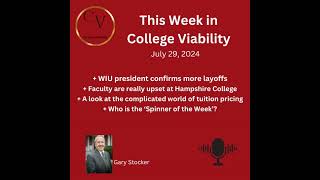
Gary Stocker surveys financial crises across U.S. colleges: Western Illinois faces a $10 million shortfall and 4,100-student enrollment drop, while the University of New Orleans has shrunk from 17,000 students in 2003 to 6,600 today. Most merit scholarships are price discounts, not real aid, and colleges betting on prestige signaling over affordability are struggling to fill seats.
Chapters
It is July 29th, 2024. Obviously, the end of July is upon us. The Olympics are all over the TV and the news. I understand there is a presidential election sometime in the next 100 days or so. And I just saw 5 bucks and 3 does wandering through my typical American suburb street. And none of this changes the fact that higher education in general and smaller privates and colleges in particular are headed toward the consequences of a diminishing demand and the FAFSA debacle of 2024. Hi, everybody. It's Gary Stocker with College Viability, back with yet another episode, another podcast episode of This Week in College Viability. And the headlines read, our frequent flyer, Uh, for this week in college viability, Western Illinois, their interim president, because they go through them faster than you and I go through a dozen eggs, confirms more layoffs. They have under $10 million, they say, left to balance the budget. Good luck with that. Faculty are really upset at Hampshire College. I'm inclined to put them on my frequent flyer list as well, but not quite yet. And sticker shock— we're going to talk just a little bit about the complicated world of tuition pricing and really the market that's driving that. And the Spinner of the Week, the college gets my award for spinning news the most, is Monroe Community College in New York, and they continue to right-size their budget. Okay, we'll talk about that and of course much, much more. A lot of layoffs and cutbacks this week. And again, our frequent This Week in College Viability flyer: Western Illinois president confirms more layoffs, under $10 million left to balance the budget. This is from Dylan Smith at WGEM on July 25th. Interim President Kristi Mindrup said 80% of the budget is represented by personnel. All right, we will grant them that. So you know what I do, I go to the data, and from the 2024 College Viability App, the 4-year graduation rate at Western Illinois University is about 30% over the last 4 years. Their FTE enrollment, their enrollment is down about 4,000 students. And so really, to make it— to put this in perspective, I went out and I grabbed all of the 4-year Illinois public colleges and I compared Western Illinois to the— to the— looks like it was 12 or 14 of those colleges. Um, and here's what it shows, right? The enrollment for Western Illinois University is down 4,100 students. 4,100 students. The average for the other 11 Illinois public colleges is almost 1,400. So about 3 times as much decrease in admission. The graduate enrollment at Western Illinois is 380, and the average graduate enrollment across the other 11, or really across all 12 public colleges, is about 650. The 4-year graduation rate, already a dismal 30%, is down 4%. The 4-year graduation rate across all 12 Illinois public colleges is up about 4.5%. It's still going to be a bad number, but nonetheless Western is worse than the worst. And finally, the percent admitted at Western Illinois is up 15%, which indicates less selectivity, more along the lines of have heartbeat, will admit. And the average for the other— for all 12 public 4-year colleges in Illinois is a smidge under 10%. As I have shared before, I don't know that Western closes, but man, they're working hard to try and prove me wrong. We'll keep an eye on that frequent flyer in the coming weeks and months ahead. Of course, let's go to North Carolina. The UNC Board of Governors unanimously approves program cuts at the Asheville and Greensboro campuses, and this comes from WUNC Public Radio, Brianna Atkinson, on July 4th. And cuts at Asheville include drama, philosophy, religious studies, ancient Mediterranean studies, as well as French and German language concentrations. And at the Greenboro campus, it includes anthropology, physics, interestingly, religious studies majors, as well as minors in Chinese, Russian, and Korean language courses. The kind of cuts we have seen in programs across country. These are almost always typically low-enrollment programs. When we continue to see cuts, we'll see more of those as well. Kimberly Van Nort, who is the 9th chancellor— I don't know why that's important— at the Asheville campus, proposed several academic department eliminations to help ease the university's $6 million deficit. I'm sure that will go over well with the faculty. And over the past 5 years, Asheville also has had a student body enrollment drop 25%, and so the president is dealing— the chancellor, excuse me— is dealing with a $6 million budget shortfall this year. Page 2, we're continuing with layoffs, cutbacks, and closures. Monroe Community College, there's the one that's up for the Spin of the Week award. Monroe Community College continues to work to right-size their budget. This is from Narm Nathan at the Rochester Beacon on July 24th. And the president at MCC, Monroe Community College, President Deanna Burt-Nana says MCC is not in a crisis. President Burt-Nana says, we are at a course correction point. I don't know if she thinks she's on a boat or something. We are at a course correction point to build capacity for our long-term sustainability so that we can continue delivering high-value programs and services that place Monroe County and New York residents into good-paying jobs. And of course, any change in a business model brings protests, and there was pushback from MCC's faculty. The parties then got together, to their credit, and the Board of Trustees to get the process started. The MCC Board of Trustees announce a voluntary retirement and separation opportunities, as I've seen in most of the other colleges that don't make it. This is a first step in a long process. Usually it's just more and more cutbacks, and of course sometimes it results in a college's closure. And even a community college is at some risk, not as much as— much more than a 4-year college would be. And how about the University of New Orleans? Let's go down to NOLA, and, and the University of New Orleans is facing a $15 million deficit, and they will cut positions, they will lay off staff and close buildings. And the story is from nola.com. Marie Falzo is reporting. And faced with that $15 million deficit, New Orleans President Kathy Johnson issued a tall order, okay, to administrators this spring: cut each school's budget by 15% and slashed the athletic department's budget by 25%. Enrollment at the University of New Orleans is down from 17,000 students in 2003 to about 6,600 students in the fall of 2023. Too many colleges, not enough students willing to go for— go to and pay for those colleges. University of New Orleans is just one of Scores and scores, if not hundreds, of colleges exhibiting the symptoms of this nationwide disease. Wittenberg, Ohio, is our next stop, and Wittenberg weighs $7 million in cuts. And I keep telling you these stories because it builds a pattern. We'll talk about it a little bit later in the podcast.
And of course, the proposal includes faculty and staff reductions, and this is in the Springfield, Ohio, I think, campus. And Eileen McClory, on July 28th, in The Springfield News-Sun paper is reporting this. Tax documents for the 2022-2023 school year show the university spent about $17 million more than it brought in. That's never good. It does report in 2021 they had a surplus of $3.5 million. Of course, that is from the federal government's COVID pandemic bailout funds, and the proposed plan is supposed to cut projected deficits They're going to cut staff positions at a minimum of $3 million in the current fiscal year coming up now, and another $4 million in something called faculty lines. I don't know what that is in fiscal year 2026 and beyond. And of course, they add the tag while retaining those academy programs necessary for the university to maintain and grow its current enrollment It's not going to happen. I can't, I can't believe to see the continuing delusions from these colleges and college leaders. And the story was also reported in Forbes, and it was quoted in there, the leadership, uh, President Michael Franzen and William D. Edwards, chairman of the board, says they, they believe these changes and others will make Wittenberg into a more affordable outcomes-oriented institution while providing us with a strong financial foundation for the decades ahead. And so, why didn't the good folks at Wittenberg, why didn't they do this before they got into a budgetary crisis? Why wait until now? For all these profound statements and unrealistic expectations. Yet again, another example of management by PR. Page 3, Liam Knox, an Inside Higher Education, Desperate Times, Unorthodox Measures. Interestingly, this is a focus on the tuition discounting.
We've talked about it before, and I'm going to bring it up again because at this point I hope almost all the listeners are familiar with the fact that most of the scholarships, most of the merit aid, almost all of the merit aid, almost all scholarships are just simple discounts, just like you and I get on food and clothes and computers and cars. There is no cash transferring from one account to another. If your child is given a $20,000 merit aid scholarship, certainly the university is foregoing $20,000 in revenue. But there is not any $20,000 exchange going from one account into another to pay for your child's education. It's just a discount. No funds actually change hands. So Farragut College is the focal point of the story. Farragut College is offering a $10,000 tuition discount this enrollment cycle, fall of 2024, for both incoming and continuing students. A drastic reduction that is, they admit, a financial risk, but they were willing to do it. Now, the story says they, they believe it's working because it shows an additional 23 students. Well, all right, you know me. Is it an additional new 23 students? Is it 23 students who are going to apply anyway that have made these deposits? You just got to be careful when these folks try and spin this information. And maybe it is, maybe it is 23 incremental new students, but that's— I can't tell that from the story. And then John Naughton, who is a vice president for enrollment at Ohio Dominican University, said that despite a 35% uptick in applications— and of course applications these days are as easy to do as adding an ingredient to a pizza— is up 35%, his institution, Mr. Naughton reports, is nearly 15— that's 1-5%— behind last year's prior year-to-date in student deposits. And because of that, here's the scary part, because of that, officials remain— officials at Ohio Dominican and across the country really remain largely in the dark about their enrollments for this fall. So let me turn to my right, look at my calendar, and I see that we have 1, 2, 3 days, 2 and a half days left in the month of July. College start month is 3 short days away, and colleges across the country, unlike previous years, don't know how many students are coming to their college. Double geesh, triple geesh on that. And that's essentially what Mr. Naughton at Ohio Dominican University is saying. And, and this is one of the reasons why I'm here. All of these isolated stories about the FAFSA debacle are rolling towards a series of cutbacks and layoffs and closures this fall and in the spring of 2025 that higher education has never ever experienced. And how that shakes out a year from now, a year from now and beyond, will shape colleges and the higher education industry for decades. Beyond sticker shock. A look at the complicated world of tuition pricing and our good friend Ben Unglesby at Higher Education Dive. This was on July 2nd, uh, July 22nd, last Monday. And I'm going to start with this. I've said this different ways, but this is from Philip Levine, who's a professor at Wellesley College.
And I don't see what kind of professor he is.
Uh, Philip Levine, a professor at Wellesley College, says ignore the sticker price, It is a meaningless number. It tells you nothing, Mr. or Dr. Levine says. And the story is long. It does a good job, as Ben always does, in explaining the story. There's a growing gap between net tuition and sticker price. Sticker price is, you know, analogous to what you see on a sticker price on a car and the discount that comes before you actually buy the car. So what's the point of a sticker price? And, and I've heard this reference in this story. I've heard it from college presidents and other sources. It's simple. It's marketing. It has everything to do with the perception of value. And this quote is from Emily Wadhani at Fitch's. It's because the market would love to say, and parents love to say, we love our children, right?
We love to say, hey, my child got a $40,000 scholarship. To an $80,000 school. That sounds much better than our tuition is $40,000. And that's what's driving this high sticker price, high discount model. And, and Ms. Wadhwani goes on to say there's a philosophical and psychological strategy that's at play— the parents loving to boast to friends, family, and relatives. And it's really hard to unwind this. So I don't know in my mind how this high price, high discount model ever goes away. I, I'm engaged in informed speculation on this. And here's what I've said for a long time. As for simply increasing the tuition discount, it doesn't always— it doesn't always lead to increase in enrollment. Colleges can on paper control their prices and discounts. And this is from Lucy Lepofsky. She's a principal at Lepofsky Consulting. Colleges on paper, she says, can control their prices and their discounts, but they can't control demand for what they're offering. And that raises issues, Miss Lepofsky says, way Beyond prices, and again, boys and girls, ladies and gentlemen, this is simply basic economics. There are no programmatic, no marketing changes that will alter the fact that there are too many college seats, too many, way too many, some estimate 2 million or more. I've seen it as high as 3 million. And demand, there are not enough students willing to pay even these highly discounted rates to go to college. And the reasons behind that are way beyond the scope of today's discussion. And discounting will continue. This is me. Discounting will continue under the guise of merit aid and the fancy naming of scholarships, presidential scholarships, and the whatnot. Downward pressures on tuition and fees because of this discounting will be, if not the main, one of the main driving factors on the continuing trend and pattern we see of college cutbacks and layoffs and closures. And page 4, our final news story for today. This is a guest columnist, Jennifer Bjorek. She's a Hampshire College faculty member. I presume she's a PhD. Guest columnist Jennifer Bjorek says Hampshire College pay cuts, layoffs are not so transparent. And this is from the Daily Hampshire Gazette. She was a guest columnist on July 25th.
And Dr. Bjorek, I presume, is chair of the executive committee of the faculty, Hampshire College. And she's writing on behalf of the executive committee of the faculty, that very item, that very entity. Dr. Bjorek says that the June 19th article that Hampshire College leadership put out says that fall enrollment numbers are lower than anticipated, and she says that evidence suggests that other factors played a more important role in administration's decision to cut employee compensation. I think it's mostly in the form of benefits. The executive faculty and Dr. Bajora can conclude that there was overspending of— and she says overspending on the order of $1.4 million last year. I presume she means 2023. And she goes on to add that both the June 19 and July 3 articles, again from senior administrative folks at Hampshire, says administrative salaries will be cut. All right, it's a given, they agree with that. But she adds, this statement requires further context. Senior administrative salaries were increased, she says. In the fiscal 2022-2023 year while the college was running a deficit. So I think she's making the point they increased the executive compensation, the management compensation last year, only to cut it back maybe to the same levels for this year. But at the same time, this is probably really what ticks off the faculty at Hampshire College. They did this while increasing the teaching load without increasing the salary. And without a compensating decrease in other teaching and advising responsibilities. That's never going to go over well with faculty at any colleges. So prototypical, this again is management by PR at Hampshire College. This time the faculty developed what appears to be a data-driven response. We'll assume the data they used is accurate and reasonably applied, no reason to think otherwise. So bottom line, Hampshire College is not the shining beacon of private college recovery that is being pitched by its management team and some in the media. Here's the lesson: if your college has a severe financial crisis, hope and cheering and eternal patience will unlikely— will be an unlikely solution. The dollar is always tell the truth. So here's my bet, and I'm going to qualify it a little bit. Hampshire College eventually turns the lights out. Here's my qualification: Hampshire does appear to have a unique model that might make it a worthy merger partner. My concern is that the current leadership doesn't appear capable of pulling that off. They're so parochially focused, so focused in their college that they can't see beyond its borders. So maybe a change in leadership is in order for the good folks at Hampshire College. And finally, let's do a wrap on this July 29th episode. And I've shared this before, college is a really, really good thing. Get that degree if at all possible, students and your families. Taking courses though is good. Taking courses is good, but it's just a cost when you're taking courses. Graduating and getting that piece of paper that says, "I have earned a degree in whatever," is much better than just taking courses. So students, family members, if you're making the college commitment, do the best you can to make it a 4-year commitment. Get it done. Life gets in the way, I understand, but taking courses is only a good way to increase lifelong, potentially lifelong debt.
Graduating at least provides an opportunity for higher income, although that's not even always guaranteed.
And both of these items are from the College Viability Manifesto. And if you want to read it, go search for College Viability Manifesto and it will have the entire manifesto listed. So for students, I, I would add that some majors will provide you— and you know this— will provide you with a higher earning potential than others. If you are looking at a major and career with, with lower earning potential, it might, it might be best to go for lower-cost colleges. The diploma is going to be the same. The name means next to nothing to employers, and you'll probably appreciate the smaller loan and repayment numbers later on in your life. But again, the decision on the colleges you are considering needs to start, needs to start with a financial health and viability decision. Students and families purchase the 2024 College Viability App for Students and Families. There's a public college version and a public and a private college version. Buy one, buy them both. It's a $30 investment that will almost assuredly bring increased peace of mind that the colleges you are considering, or maybe have even chosen, are financially healthy.
Or sadly, some will not be.
And college leaders, I, I already know, I already know which colleges are unlikely to survive.
I'm not going to share that with anybody. It's not my business. I provide a resource that lets consumers and many, many others compare the financial health of colleges. And I'm guessing, college leaders, that many of you are really worried about your college's financial health and viability. If you know you can't make it, college leaders, do us all a favor.
If you're not going to make it, let the world know today.
There are too many stories of short notice closures that are impacting many, many, too many lives. Don't do that to your students or your faculty, your staff, and your community.
Tell them now that you're not gonna make it.
I know it's not fun. I know it's a stain on your career, but tell them now.
Let those many, many individuals get on with their careers, and with their education, they will be grateful you turned off the lights when you did. This is Gary Stocker for This Week in College Viability. Hey, always we're going to do it on Mondays, and I look forward to sharing more news and commentary with you next Monday on the first Monday in August. Until then, thanks for listening. I'm always grateful. We'll talk soon.
More from Gary


What does it look like when a college increases both total revenue and total expenses?



College Financial Crisis? We look at the financial health of Bay Path U. (MA) and Coe College (IA)


Private College Financial Crisis? We look at the financial health of Hobart William Smith College


Financial Compass tutorial (Private college version.) Financial statements compiled 2016-2025.

