This Week In College Viability (TWICV) for June 30, 2025
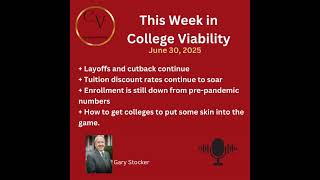
Gary Stocker surveys financial collapse across U.S. colleges: Stanford, USC, and Sonoma State cutting athletics; Cornell College raising tuition discounts to unsustainable levels; Birmingham Southern shutting down entirely. Regional accreditors fail to monitor outcomes, letting low-graduation schools keep federal aid eligibility.
Chapters
Welcome back. It's June 30, 2025. Time for yet another podcast episode of This Week in College Viability news and commentary. Hi everybody, Gary Stocker back as always on a Monday recording the podcast. Thanks as always for listening. Lots of layoff and cutback announcements this past week, probably time for a period when not many faculty and students are paying attention to college news. Cornell College in Iowa steering away from financial focus to one maybe marketing Hail Mary. We'll talk about the details of that. I'll show you the numbers. And my alma mater, Eastern Illinois University, got a story that shows the typical plight of both public and private colleges. The tuition discount rate continues to grow higher and larger. Good for the students, for sure. Not so good for many colleges. And Seth Odell, a guy who does a lot of good stuff that I read on LinkedIn and other social media, talks about it's the trend that matters in terms of enrollment. And he notes that enrollment is still down from pre-pandemic numbers, even though many colleges try and say a jump from one term to the next is a big deal. It's not. And then a newsletter story from a gentleman named Anand Sanwa, that suggests colleges get some skin in the game, just like every other industry has had to do over time. This and much, much, much more layoffs and cutbacks. San Francisco State took out 3 athletic programs. This is from the NBC Bay Area staff on— this is published on March 6th, so it's been a little while ago. And I post this because it's— we're going to see this story and other stories like it more and more as the combination of poor college finances and the need for more college dollars to field competitive major sports teams, especially the Power 4 level. And, and we've seen this in other stories I've had on other media sources. If, for example, the Power 4 teams— the Big East, I'm sorry, the Big Ten, the SEC, the ACC, the Big 12. If those conference teams are laying off employees, and they are, there's stories about that regularly, what's going to happen for the less prosperous level of colleges, those is called FCS schools, if how they can stay competitive? They're not. They're not going to be able to afford that. But what's going to be fascinating to watch is what happens to those, what they call Olympic sports, your tennis, your golf, your wrestling, those kind of things. Are they going to survive? I, I don't know. Stanford— that's not a small school. Stanford University to lay off staff, cut $140 million from its budget. This is from Mike Nitzel. The details are in the story. As always, I'll have the links there. And then just here's the summary. This is yet another big player, big brand, big name reacting to probably, possibly losing federal money. And like I've shared before and others as well, they're not gonna suffer. They're gonna reach down and get whatever number of students they need to make up whatever losses they're gonna suffer, or at least most of the losses they're gonna suffer from the federal government.
But the stories go on and on.
Sonoma State slashed programs, cut all their athletics, and now it's getting $45 million from the California state budget. This is from Katie Nielsen, CBS San Francisco, on June 25th. And here's part of Ms. Nielsen's story. Sonoma State University faced major pushback from students when it decided to slash its entire athletic program. That was about 250 to 300-some-odd students, and cut several degree programs to address a $24 million budget deficit. But now it will be getting $45 million as a one-time— so they say, as a one-time infusion from the state budget. Here's an interesting caveat, but last week the university sent out an email to staff, an email to staff saying NCAA athletics will not be reinstated, will not be reinstated for the 2025-2026 school year. Huge blow to coaches and players. And I have to wonder, that'll be a full year without coaches. I wonder how they can recover from that. It's not going to be pretty. Enrollment at Sonoma State down 40% over the past 10 years. And they're going to try and boost programs. They reference $16 million for a nursing program, $5 million for a data science center, $5 million for a career center, and on and on it goes. And, and, and, and maybe Maybe they get a return on that investment. But again, let's not ever lose sight of the fact— let's never lose sight of the fact that they're facing competition for nursing and IT and data science and career centers. How they survive and compete will be fascinating to watch. And it's, it's— from my perspective, it's important to project Even though this is a single event at a single college, Sonoma State in California, it's really part of my wider operating beliefs, my wider operating theory. This will continue to happen. And on to the next story. USC Southern Cal plans to order significant budget cuts. Another one of the big boys. Some units will see reductions as high as 10%. And the story front comes from Tom Wu Chin, on June 8th from the MorningTroyan.com. Academic cuts will be about 5%, Mr. Chan wrote, admin cuts up to 10%. And so it continues.
Page 2, when a college closes, something either happens or doesn't happen.
Birmingham Southern College, after a year being closed, remains closed as neighbors hope For new life on campus, this is from WBRC in Birmingham on June 23rd. College closed, it had an offer to purchase, maybe a couple offers to purchase, and for whatever reason, Birmingham Southern's existing leadership, whatever that looks like, said no. And the current owners, including what's left of the college's administration, have remained tight-lipped, the story reports, only assuring the public that the campus is secure, maintained, and being marketed internationally through a private firm.
And to their credit, the neighborhood reports that the college is being maintained, the grass mowed, there is security available.
But for those community leaders around the country, and there are many with financially strapped, financially unhealthy colleges, many of them cannot possibly survive in their current business form. Is probably starting time or past starting time to start thinking, if I'm one of those community leaders, what I'm gonna do if that small college in my community cannot survive the current higher education consolidation. Innovation.
Mike Nitzel has a story at Forbes on June 24th.
Cornell College in Iowa, they have an early financial aid promise and Nitzel calls this a trendsetter. All right, we'll give him the editorial on that. And I will provide, whatever, what it's worth, points for creativity to Cornell College. But as usual, and you know where I'm headed, regular listeners know, but as usual, let's look at the real reason for this shot-in-the-dark marketing blitz. And essentially, Cornell College is going to give a large number of students guaranteed admission and guaranteed pricing, right?
There are a lot of details behind that, but that's the gist of what's going on. And and they're trying to do it for next year. So, and then Cornell College, their college is in much worse shape for sure.
Their full-time enrollment is up about a point over the last 6 years.
Their 4-year graduation rate around 60%, not bad. Many, many, many are worse than that.
Retention is 74%, a little bit below the 2023 mean of 86%. Interestingly, the percent admitted is up 10 points.
The endowment is at $92 million. The average draw has been around 6% the last 8 years, a little high, nothing to fall out of a chair over. This one is concerning, the endowment growth, because there has been a slightly higher draw.
The endowment growth is up 23%. All right, maybe you pat yourself on the back for that. Enrollment—
excuse me, endowment growth up 23%, but the median for some 1,300 private colleges, the median endowment growth is 40%.
So the good folks at Cornell College are a little bit more than half of that 40%.
They're going to fall behind.
That's one of the things that's going to lead them to have competitive issues. If their endowment gets lower than their competitors, either the draws have to be bigger or they have to find other ways to get to come up with cash.
And they've still had to do discounts.
The tuition discounts are up more than $12 million in the last 8 years to $33 million.
Again, good for the students, not so good for the colleges to be able to meet payroll and to keep the lights on. The net income margin—
here's this concern—
down 13 points. And this is a fall-out-of-your-chair number. And again, on, on the podcast and on the College Financial Health Show with Matt Hendricks and Gary Stocker, we see this way too much. At Cornell College in Iowa.
The total operating revenue is up 10% over the last 8 reported years. Revenue is up 10%, total operating expenses up 31%. 10% on revenue, up 31% on expenses. Whoops, somebody at Columbia College needs to hide the checkbook. They're spending way more than they're taking in. They're going to try and grow out of it. I suppose there's nothing wrong with that philosophically, but it's a tight market. Too many colleges, too many college seats, not enough students. Good luck to Cornell College. And of course, that data comes from my own 2025 College Viability App and Matt Hendricks and the Advanced Compass App from Perspective Data Science. It was a social media friend that commented to me on this story that for the 16,000 inquiries that they I think they have at Cornell College. They better have nonstop campus visitations this summer from July 4th until Labor Day to get them all in the door. And he or she suggests that test driving the car, in this case the college car, is important before you buy or decide to attend that college. The alma mater, my alma mater, Eastern Illinois University, Charleston, Illinois, Cameron Hardy, a senior reporter for the Daily Eastern News, on June 27th, amid a gap in state funding, the University of Illinois enrollment surges while directional schools, Northern, Southern, Eastern, Western Illinois decline. And there have been stories like this before. And, and one of the ways in the story that Mr. Hardy reports, one of the ways that Eastern is attempting to improve enrollment is by offering grants to students. Well, I'm guessing they've already been doing that, and, and here's the concern I have for that. In, in most cases, grants, especially college-offered grants, are nothing more than discounts. They're unfunded institutional grants, no money behind them. So a grant is in almost all cases, no revenue. So how does admitting students without getting any revenue solve financial problems? And they cite a couple of different, different grants in the story. Again, the same thing. And maybe, maybe I'm wrong.
I don't think I am. Maybe I'm wrong.
Is maybe there is some revenue transferred to Eastern Illinois Books, to the EIU Books for these grants?
It's usually not the case.
And if you're at Eastern Illinois and you want to reach out to me, I'm gary@collegeviability. That's one word.
Let me know that there are actual dollars coming behind that.
I'll certainly add that fact to a future story.
Page 3, Greg Pilar really writes some good stuff, and he has got a newsletter called Field Notes with Greg Pilar. And he posted the story that was big last week about the states, about the 6 states launching their own accreditation agency. And there was public colleges in 6 states saying they were going to form their own accreditation agency. Well, first of all, I'll bet a buck fifty of my own money— whole dollar and fifty cents— it goes nowhere. I will bet you that buck fifty, double down. This is more of a political public relations play by these southern states, and they were all southern states. But I did, there was another, the story was all over last week, and I did post a response to an analysis from a Mr. Wesley Whistle, who writes for New America, and he makes a good case for protecting the current accreditation model. All right, overall good case. I have a concern I want to share. Any key, there's an education triad, and it's the federal government, state government, and accrediting agencies, I believe. And, and my response essentially says, you know, good idea, I'm on board with maintaining the accreditors conditionally, because state by state, as Mr. Whistle correctly shares, state by state accreditation would indeed be a wild, wild, wild west of inconsistency and even danger. And, and the weakness, I think, I believe, in his overall solid discussion of the accreditation model is the continuing assumption that Mr. Whistle shares that the current model and set of accreditors—HLC, SACSCOC, Middle States, and the other 5 or 6—the current model and set of accreditors provide the needed monitoring of a college's academic and financial competence. All right, you've heard me say many times that the current set of accreditors have devolved—
current accreditors have devolved into becoming I-dotters and T-crossers. They monitor only inputs and effectively not outputs. Example: a generally accepted national average for 4-year graduation rates, undergraduate graduation rates, for public and private not-for-profit colleges is somewhere south of 50%. Not even half of students at all public and private 4-year colleges graduate in 4 years. Yet these colleges with 4-year graduation rates considerably below 50%, considerably in the 30s, some in the 20s, some lower than that, these colleges not graduating students are still accredited. They still pay their accreditation dues to their accreditor. And those colleges that can't graduate anywhere close to 50% of their students are still receiving their, their Title IV funds. So, so if these accreditors say they're providing quality assurance, where is the quality assurance in that scenario? As you've heard me say, colleges are paid to graduate students, not just to enroll them for their tuition revenue. And on the issue of college financial health, new reviews and comparisons of audited financial statements indicate a large, large number of private colleges, mostly, and some publics, in the depths, in the depths of financial chaos. These colleges are chronically, chronically, long-term lacking the financial resources to provide anything close to a quality college education for their students. And I think we see this when we see the increasing number of short-notice college closures. They, they say, we're fine, we're fine, we're fine, we're fine, we're closed. But a step in the right direction, a big step in the right direction of maintaining the i-dotting and t-crossing, would be to remove the financial monitoring of colleges from these creditors. They're not doing a good job in so many ways. They're not doing a good job. They don't have the skills, the resources, the tools to do it. They're already higher education debt entrepreneurs. Who can provide objective, data-driven assessment of a college's financial health and even their viability.
I'm one of them. Matt Hendricks is one of them. Rebecca Mazzone is one of them, and there are others. If the current triad that Mr. Whistler describes is to survive, the set of existing creditors needs to be removed as the sole gatekeepers to those Title IV funds for colleges. The inherent, their inherent conflict of interest, and that is associated with their main revenue source coming from the colleges they review, has to be a non-starter.
And yet that's the way it's been for decades and decades. Talk about a conflict of interest.
So let's move, let's move to more of a Consumer Reports model that provides comparisons, comparisons and trends of objective college financial and even output data, graduation rates. College consumers, students and their families, can determine who gets access to Title IV funds by making more informed decisions about which colleges deserve their business based on graduation rates and financial health. In the coming weeks— kind of a little advertisement here— in the coming weeks, I will be releasing a set of products for students and families that has the potential has the potential to become the equivalent, kind of a reverse FAFSA. FAFSA, of course, is a tool that parents and families submit their financial information. College Viability is developing a tool that will easily and clearly show families and students which colleges are financially stronger and which are weaker. And something else to ponder the current accreditor in that southern region is SACSCOC, Southern Accreditation, I don't know what it stands for. If SACSCOC takes a serious revenue hit from these public colleges leaving in these handful of states, what impact will that have on the remaining major accreditation players? Will we kind of have a situation where we have a cart pulling the horse where the colleges were supposed to be reviewed, where those colleges in our position, because they're paying their accreditors, those colleges in a position to tell our creditors what they will and won't do. Think about that again. Okay, if the colleges are— had the purse strings for these accreditors, well, it could become a scenario where the colleges will say, hey, if you don't accept what we're doing, we'll find another accreditor. And, and the scenario could include those accreditors yielding maybe legitimate quality and financial concerns because of potential revenue losses to their business. And that's no way to run a ship. I will add Robert Kelton, Bob Kelton, out of the University of Tennessee did note that the University of Tennessee would look at this, whatever creditor came out, if it does as a supplemental accreditor, not a replacement. So that's an interesting nuance to the whole story. Tuition discounting.
Tuition discounting hits another high, and again, Nacubo's latest study shows that the rate keeps going higher and higher and higher. It's mid-50s plus. Josh Moody had the story on Inside Higher Education, and this just reinforces, just reinforces that enrollment does not keep the college ship of state float. Colleges, as we've seen with closures and cutbacks and layoffs, colleges cannot continue to give away the store just to get students in the door. Hey, I've got a new number I can use: 86%. The National Student Clearinghouse reported last week on June 26th, and Ben Inglesby at Higher Ed Dive had the story. 86% is the average first year, I believe, retention for new students. So I'm going to use that. If your, your first year retention rate is below 86%, I'm going to add that to my regular go-to data section comparison, page 4. Seth O'Dell, again, good guy, writes some good stuff on social media. He makes the point that colleges— and I've done this before, I think, but he reinforces Colleges are saying, hey, our enrollment is up, and they're doing a comparison from one semester to the next or one year to the next or maybe two years. And so it's, you know, they're trying to create the perception that we've finally recovered from the COVID dip, but the trend they're looking at is too short. And Seth Odell notes this, he says zoom out and it's a different story. We're still Seth Odell notes, we're still well below pre-COVID levels and we're still way below the 2010 peak on enrollment. So college spin, they're welcome to do it, but we're going to spin right back and show the actual data. And he notes, when you consider mounting price pressures, shifting population dynamics, declining employer demand, and declining consumer confidence, the reality of our mature— interesting choice of words— The reality of our mature consolidating market can't be ignored. Yes, enrollment is up, but let's not confuse— Mr. Odell says let's not confuse a short bump with a long-term recovery. And finally, the wrap. Anand Sanwal, he is a founder of CB Insights, and his newsletter article that I think was posted on social media— it is, and I'll post the link on show notes. He says, Skin in the Game: Fixing Higher Education Student Debt Problem. This is from November of last year, but I just saw this. He notes that many young people are graduating into limited job prospects and lifelong debt. We've seen this before, we've heard this before. All while, all while, Mr. Anwalt notes, all while the institutions that sold them that dream face Zero accountability. He notes that today sellers, colleges, face zero consequences for failures.
Buyers, students, can't discharge debt through bankruptcy, and taxpayers foot the bill for defaults when students cannot repay their loans. He suggests two simple market reforms: make student loans dischargeable in bankruptcy dischargeable in bankruptcy. And it's not fun because there's a significant negative credit consequence when you declare bankruptcy. And require universities to underwrite 80% of student loans and eat losses.
This is part of the big beautiful bill, I believe. I don't remember the percentage. He notes, Mr. Onwal notes, this would force colleges to care about graduate outcomes, kill predatory programs that create no value, protect low-income students from exploitation. I've got a podcast coming up on that. And create real accountability for colleges. And he finally concludes with, when cars are defective and we drive them off the lot, manufacturers pay for repairs or recall them. But when degrees don't deliver promised or suggested or implied compensation results, universities simply walk away. And why do we let— Mr. Unwall argues, why do we let universities keep selling $200,000 lemons? That's the car term. $200,000 lemons that don't work. And that's right, you know. And he's— Mr. Unwall notes that it's time to bring market discipline to higher education. He's right. And it's already happening. It's too slow for many, but it's happening. And let's go back to that FAFSA as another example. Colleges get financial information for students, but students and their families are hard-pressed to get reliable information about the financial health of colleges, even the viability of colleges. Colleges let students declare what, what they know will be lemon degrees. Many of them are the liberal arts degrees And then those colleges, those same colleges, watch those students spend tens of thousands of dollars to get a degree with no reasonable chance to earn enough of a living to both pay it back, pay that loan back, and live. When those students walk across the graduation stage today, today that college walks away from any responsibility for the lemon of a degree that they consciously offered. And Mr.
Ron Wall is just one of many pressuring higher education as an industry to assume some lemon law risk for students.
Mr. Ron Wall, for what it's worth, you can count me as a supporter.
Hey, as always, thanks so much for making time to listen to the podcast. You got some comments, some ideas, some thoughts, send them to me at gary@collegeviability.com. That's College Viability, one word, sometimes tough to spell on the keyboard. gary@collegeviability.com. Happy to respond, happy to listen, happy to add show, add content to the show. And next Monday will be in July. It'll be July 7th, 2025. I'll be back then.
As always, thanks for listening.
More from Gary


What does it look like when a college increases both total revenue and total expenses?



College Financial Crisis? We look at the financial health of Bay Path U. (MA) and Coe College (IA)


Private College Financial Crisis? We look at the financial health of Hobart William Smith College


Financial Compass tutorial (Private college version.) Financial statements compiled 2016-2025.

