This Week In College Viability (TWICV) for Apr 21, 2025
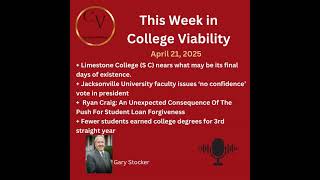
Gary Stocker and Matt Hendricks survey financial crises across U.S. colleges: Limestone University closing after a $6 million cash shortfall, Penn State weighing the fate of 12 campuses, Jacksonville University cutting programs amid a no-confidence vote in its president. They argue that even Harvard's $50 billion endowment doesn't guarantee stability.
Chapters
Welcome back to another podcast episode of This Week in College Viability News and Commentary for Monday, April 1st, 2025. So, so, so much to cover. I've already taken lots out for this week's show. As this year's traditional college year comes to an end, the news is pouring out day by day, sometimes hour by hour. Here are the headlines, and I've taken a lot of stuff out already. Here are the headlines this week. Limestone College, South Carolina, nears what may be its final days of existence. We'll talk about that in some detail. Jacksonville University in Florida, the faculty issues a no-confidence vote in President Cost, that's the name, after a decision on cuts. I've got a lot on that. Ryan Craig talks about an unexpected consequence of the push for student loan forgiveness. Interesting perspective. Fewer students earned college degrees for the third straight year. And then much, much, much, much, much more in this week's episode. Let's start with Penn State. And this is from Maggie Zeleski at ABC News Channel 16 in Moosic, Pennsylvania. M-O-O-S-I-C, Pennsylvania. A final decision on which of the 12 Penn State branch campuses would close is now expected by mid-May, so a few weeks, according to University President Nelly Banerjee. Here's the essence of this, and here's from the— here's the story from Miss Zeleski. The fate of a dozen Penn State Commonwealth campuses remains uncertain. Back in February, Benapudi said 12 campuses across northeastern Pennsylvania would face possible closures due to financial issues and declining enrollment. Now, I've got more on this story later on in the podcast. Publics are just as engaged in layoffs, cutbacks, and closures, maybe even a little bit more so than privates, and that's a fascinating observation. Ithaca College to lay off sign language professors. This is Matt Acito on April 17th from 607 News Now radio station. Ithaca wants to lay off 3 sign language professors. The Ithacan, which is the student newspaper, I think, reports over 50 students are currently taking deaf studies courses. Now, I tried to confirm that in the IPEDS data and I couldn't find that. It's probably just a function of the way they categorize it. The sign language professor Lisa Witschie, W-I-T-C-H-E-Y, told the Ithacan She was quite shocked when she learned the program was being paused. Seems like a small number, but anyway, I'll follow that story as appropriate in the coming weeks and months. Alyssa Gray and David Jesse in the Chronicle, April 17th. This is the limestone story. And the headline reads, we will have no choice. Buried in debt, this small college says it may be headed for closure, may be headed for closure. And again, in the Chronicle on April 17th, Board members at Lindenwood— excuse me, board members at Limestone University— board members at Limestone University announced the college needs a cash infusion of $6 million immediately or it will be forced to go online only or completely close. This is similar to Northland College up in, I believe, Wisconsin about this time last year. They needed $6 million, I think $12 million maybe, over the course of a few weeks. Didn't happen, and they just announced their closure here a few weeks ago. So this is the kicker. And this is, this is limestone students now find themselves in a bind. The window to submit transfer applications has already closed for most colleges, leaving students to decide whether to leave or wait and risk the university closing for good. How would you like your 18 or 19 or 20-year-old, 21-year-old to be put in that position along with yourself? Just last week, just last week, limestone South Carolina hosted its Admitted Students Day where prospective students visit campus and learn more about the university. And there's a quote, "Can't wait to see these future Saints back on campus soon." And that was a social media post from Limestone University. Too many colleges, I've said this before, too many colleges waiting too long.
I can look at the data. I can tell you which colleges are unlikely to survive. It's not my job to tell you exactly, That's why I created the apps, the College Viability apps for both leadership, executive analysis version, and for students and families.
And it also works for faculty and staff.
Look at the data, look at enrollment trends. If they're going down, not good. If the endowment is below $50 million, not good. If the graduation rate is below 50%, not good.
And those three and those three alone tell you a lot about a college.
And yes, I know, I know, before you start throwing things at your speakers, There are nuances, I understand that, but the essence is such, it's easy to tell when a college will not make it. Matt Hendricks and I do it all the time on the College Financial Health Show every Tuesday at live 10:30 AM Central Time. Join us to see how we do that. So Limestone made their announcement. Here's the student reaction. You know what it's gonna say. This is from WYFF on April 18th. Here's from students, and this is from a master's or graduate level student. I'm not gonna give you the name. There's been no talk of this the entire year, so I feel like we're all like—
I know I'm quoting this—
I feel like we're all like pretty blindsided, right? For right now, for sure. Probably didn't pay attention in English class. The move would leave close to 1,000 students without a physical campus and result in the loss of something close to 300 faculty members. University President Nathan Copeland says we still intend to— there's a qualification— intend to have an online presence. It'll certainly be a lot different than it is now.
Again, Copeland said they need $6 million to stay afloat for the fall semester.
That seems like an awfully small number for 1,000 students.
So to the data.
It's been out there for 8 years at least. The operating cash flow down more than 20 points in the past 2 years. Net income profit, although we don't call that nonprofits, the profit is down 32%. The endowment draw, the, you know, the endowment funds used to keep the lights on, to meet payroll, has exploded from 8% in 2021 to 42%, almost half of the endowment in 2024. And as we'll see later on in the show, the normal draw is around 4%, 5%, something like that. The 2023 endowment value is down to $12 million. The enrollment is down from 2,600 to 1,600. Again, this is from 2016 to 2023, the last reported data. And the 4-year undergraduate graduation rate has hovered 4 years undergraduate graduation rate has hovered only around 20. So for every 10 students that started at Limestone 4 years ago, 2 graduated. For every 120, for every 1,200, that's just abysmal. Operating revenues are down 16%, expenses are up 14%. Said I want a mismatch. We talked about the enrollment and the employee count is down from a little, from about $1,100 to a little over $300, and that's over the last 8 years plus, and I'm piling on, I know it. There was a going concern note in the 2023 audited financial statements. If anybody read those, a going concern note is as red of a flag as you can get. It says the auditors, independent auditors, the college hires, has said, we have concerns this college may not survive for the next fiscal year. That was in the 2023 audited financial statement. I didn't see the 2024 one had been released. Let me go back to Latin. Caveat emptor. If you haven't heard that, of course, caveat emptor means buyer beware. Surprise from students and faculty is almost always present when a college announces it is in dire financial straits and may close. However, the evidence of financial downfall is in the financial data, and such is the case at Limestone and many, many, too many other private colleges and some public colleges. And then there's not always going to be an announcement that the financial end is near. That's one of the things that bothers me. And we'll talk about that later in the podcast. If the end is near, say so. Don't do like Limestone and weeks before the term ends, announce you may close at the end of the term. And I know why they don't do it. It lends to a self-fulfilling prophecy. But in the balance, who are you looking out for, the college or its students? I can't answer that question, but I think that's a question these college leaders, these college boards need to answer. Use the data in my College Viability App to do your own assessment. If you're at a college, private or public, 2-year or 4-year, and you have concerns, spend the $39 on the 2025 College Viability App for Students and Families. It's written and developed for students and families but can also be used by students, by faculty and staff. I have a full version for college leaders, costs a lot more money but has a lot more data in there. Let's move on to Utah. We've been out east, let's go all the way west to Utah. With a tight deadline, Utah universities scramble to cut 10% of budget courses. Some are considering layoffs and mergers to comply with the new Utah law seeking to optimize resources. And this is an April 16th Utah News Dispatch from Alixel Cabrera.
Here's the story. With Utah public universities preparing to make cuts on what may be considered low-performing programs, all right, I call them low volume. If you want to call them low performing, that's fine. To comply with the new state law, different colleges are quickly making plans to merge and lay off some of the staff. Now, merge colleges, that might mean departments inside of colleges, I'm not sure. So there's a Utah bill approved, it's called HB 265, that essentially says, hey, colleges, public colleges in Utah, get rid of these underperforming programs and find ones that more likely meet the needs current needs of future, current and future Utah college students. And there's an initial deadline of now, but these colleges have 3 years to prepare and implement in order to receive an ongoing total of $60 million, 6-0 million, retained by the state in a strategic reinvestment account meant to be spent on high-demand programs. So first of all, this is the public market speaking, not the private market. Publics are doing the same thing. It's across the country, it's across publics and privates. But I wanna point out a nuance that I'm also gonna talk about later on the program. We see high-demand programs— define that any way you want— STEM, nursing, healthcare, whatever. But I'm watching more and more colleges make similar announcements. So if everybody is moving to high demand— again, define that any way you want— we're headed toward just another scenario where there are too many high-demand programs, too many high-demand seats offered by too many colleges, and not enough students willing to pay probably even heavily discounted tuition rates for those programs. I don't think that cures anything. Let's go to Florida. From Utah to Florida, we fly quickly. Carter Mudgett, reporter for the Jacksonville Business Journal on Tax Day, April 15th. His headline reads, Jacksonville University cuts nearly half of undergraduate degrees, focuses on— here we go again— focuses on high-demand fields. Jacksonville University, the story reads, is slashing nearly half its undergraduate— half of its undergraduate degree programs and laying off 40 faculty members. And as I looked at the data, and I've even chatted with Carter Mudgett, why now? You've heard me say this before. Why now? The data has been there for a long, long time. And of course, what happened 2 days later after this announcement by Jacksonville University? Jacksonville Action News, jax.com, on April 17th had this story: Jacksonville University faculty issues— wait for it— no confidence vote after decision on cuts. Now, this is the no confidence vote on President Coste. His name is President Tim Coste, is his last name. At a majority— they don't give a number— but a majority of Jacksonville University's faculty who attended last week's faculty meeting issued a vote of no confidence. This comes after cutbacks and layoffs and the undergraduate program cutting offerings are going from 30 to 37— excuse me, from 60 to 37— the undergraduate degree offerings from 60 to 37, and a decrease of graduate programs from 23 to 15. There's a whole list of reasons listed. I'm only going to cover I only want to cover a couple. And this is from the faculty. They note years of financial mismanagement under his leadership. And they're right, years. You know, our data goes back to 2016. Last year's was back to 2015. Who's not looking at this data? I am. A few others are. And if you're not, again, I'll say buy the $39 version of the College Viability app. Look at graduation rates, look at enrollment, look at endowment and other factors I have in there. Don't wait until a college decides they're going to tell you. Look now and ask now. The next one's interesting: a breach of a debt covenant. Now, this is the faculty bringing this up. My question is, why, why did the bondholders not note this debt covenant? And if they did, were there consequences for the university that have not been released or discovered yet on breaking those bond covenants? Because that's typically what happens. And the last one is interesting: lack of oversight for the chief financial officer, whom the president supposedly met regularly. Well, first, I hope so. I hope that the president and CFO meet regularly, if not more so. And I don't know what lack of oversight means. That's not the point. The point is nobody else is looking at the data, and it's available. I've made it available. Others have made it available. So to all, to all the college faculty in the world, you don't need to have your college leadership team hand-feed you information on the financial health of your college. In this Moneyball era, financially, financial data is readily available. What wasn't readily available until the last 3 years was a tool that compiled the data and made it relatively easy to compare the financial health and even viability of these colleges. Of course, my C— my College Viability apps and the 2025 College Majors Completion app, along with Matt Hendricks and his Private College Advanced Financial Compass— this is for private colleges— makes these comparisons easy. Yes, you have to pay for them. Yes, yes, there's some work involved in understanding them, but there's tutorials out there. We do the show each week. We look at 3 colleges every week on the College Financial Health Show, every Tuesday, 10:30 AM Central, live. Reach out to me through LinkedIn. I'll set up a Zoom to show you how these tools work. And finally, votes of no confidence have little practical impact faculty members. You may feel somewhat better about it. Get the financial data, become more informed, add some sense of business understanding to your academic expertise, and then maybe you don't have to have these effectively worthless votes of no confidence. Page 2, long way into the show. Harvard has an endowment of over $50 billion. So why do federal cuts A Few Billion Matter. This is from Kara Schenell and Eric Levinson on CNN on April 18th. This is kind of a lesson from Gary. Endowments, for those that don't know, you know, $50 billion is not like yours and my bank account that we paid the mortgage on and the car payments and food and those kind of things. Endowments can't be accessed at any time like those bank accounts.
They have to be maintained, and this is important, into perpetuity, for forever.
And they are largely restricted. For example, the restrictions can be scholarships. You know, the Gary Stocker College Viability Scholarship for $1 million. That's restricted to provide scholarship support to somebody who wants to study college finances. And for buildings and labs and equipment, all are restricted. A donor gives something for a specific purpose. About 80% of Harvard's $53 billion and change is earmarked for financial aid, for scholarships, college chairs, and you've seen that before, academic programs or other projects like I just talked about. The remaining 20% is intended to sustain the institution for forever, for years to come. But tapping into the endowment may also be impractical for several reasons, including that some is restricted, which we talked about. And endowment gifts are intended to benefit both the current— benefit both current and future generations at this university and all universities, meaning Harvard and again all universities, whether their endowment be large or small. These, these endowments these colleges only spend a small fraction each year. Now, $50 billion, a small fraction for Harvard is a lot of number, is a large number.
$5 million, like too many small private colleges, $10 million, $20 million, anything less than $50 million, you know, 5% of that's not that big of a number. And that's why these colleges are struggling in part because their endowment is not large enough to provide operational support. And the operational support comes from the earnings.
So again, the earnings on $5 billion is a lot more than the earnings on $50 million. Page 3, Ryan Craig always has good stuff. His Gap letter, his title reads, "An Unexpected Consequence of the Push for Student Loan Forgiveness." There was a Third Way High School poll that revealed the next generation has heard the yelling, their words, not mine, about detrimental student loan debt and become more risk-averse. It looks like this was written by Ben Cecil, C-E-C-I-L. So he says, it's easy to see how witnessing the loud push over the past few years for loan cancellation as a policy that only a slim majority of voters actually like. Many do not like it. It's made teens— there's some— this is their assumption— has made teens loan-averse and not fully convinced about the financial benefits of college. It goes on to say— this is Mr. Craig's article and Mr. Cecil's article— goes on to say only faster and cheaper programs are growing. And this is from the National Student Clearinghouse, that essentially shows an increase in certificate programs, quick and cheap, But in contrast, both bachelor's degrees and associate degree earners declined for the third consecutive year. And to follow up on that, I was in a story that Washington Times reporter Sean Saleh did on the 10th of April, trade programs on the upswing. Here's my quote from Sean Saleh in the Washington Times: Gary Stocker, a former university administrator who founded College Viability to evaluate campuses' financial sustainability, said the latest Clearinghouse numbers confirm a trend of fewer students starting and fewer students finishing 2 and 4-year degrees. And this ties in quite nicely with the article from Alan Craig and his Compass and his GAP newsletter from above. Page 4, going back to Penn State, which was our lead story today. Here is the headline: Abandoning our soul should not be an option. Closing campuses isn't the only answer to meeting Penn State's challenges. Now, this is written by 5 different authors, 3 of whom are actively involved. Two are actively involved and one is recently involved in the Board of Trustees at Penn State University. Well, first of all, like I always ask, you know, they're cutting campuses, maybe closing campuses, cutting programs and staff. Why do they wait? The debt has been there for a long, long, long time. Why now? But the article itself is, is delusional. And again, its authors include three trustees. One of the quotes is, there are those who will say if we were running a business, we would have closed these campuses years ago. They go on to I say, that may be true, but we aren't running a business. And they're so impressed with that, they say again, let's say that again, we aren't running a business. I should say it a third time, we are an educational institution charged with fulfilling a mission and a promise made in the mid-19th century. Well, you're not a business, I'll agree, if the faculty are willing to work for no money, if the staff is willing to work for no money, or if you're willing to accept donations to run the college. Maybe the state of Pennsylvania supports all the colleges without tuition fees, but if you need to drive revenue, net revenue, significant net revenue, if you have expenses to balance against that revenue, you're a business. That's just silly. This article is full of unsupported, mushy, hope-for-a-miracle content. It attempts to draw in readers with emotion, not logic. And if they had that, why not 2 years ago, 4 years ago, 8 years ago? The market has changed and will continue to change. I'll say it again, consolidation in the form of closures and mergers is continuing. We see it almost weekly now and will continue into the foreseeable future. And I'm going to close with a story that knocked me off my chair, and that's pretty tough to do. Chicago State— Chicago State University names Bobby Roehm II its first football coach. Now, Mr. Roehm is a former college and professional fullback He also helped start a football program at Far Eastern Federal University in Russia. Chicago State is launching a football program after a $4 million fundraising effort. I don't know if that's ongoing or will start now. And this is from the Block Club Chicago, April 5th. Maxwell Evans is the reporter, of course, for like all these stories. I'll have links in the show notes. Okay, where to start with this idiocy? Nothing against Bobby Rome. I'm sure he was a good football player. I'm confident he can coach a team. He wants to advance his career, so would any of us given a similar opportunity. But guys, have I gone to the data? Yeah, I've gone to the data once today. Let's go there again. I'm going to start by reading off the last 8 years of 4-year graduation rate percentages for Chicago State from 2016 to 2023. 4-year graduation rates. I'm going to read off the percentages: 2%, 2%, 3%, 2%, 4%, 7%, 9%, and 5%. Not once in the last 8 reported years did Chicago State even graduate double digits of its percentages. Their enrollment's down from 1,400+ to almost 1,000, down 480-some-odd students, some 30-odd percent. Tuition fees have decreased about $11 million. Retention rate averages 50%. So if 100 show up, 50 keep going. And so sarcasm alert. Again, if I had sound buzzers and horns, I would blow them. Sarcasm smell alert, and football is going to save this college. One final data note: the 2023 endowment at Chicago State was $7 million and change. Over its entire history, they had $7 million. They want to raise $4 million for a Division I FCS football team. This is the ugly, ugly epitome of management by PR. In a future podcast, I'm, I'm confident I will announce that Chicago State has eliminated its football program for a variety of reasons. So let's wrap this up. I have college alumni— I have college alumni reach out to me for some perspective and sometimes some guidance on how they, on how they could address the challenges at their alma mater. And I spoke with one last week whose college is like many, too many others, watching their last dollars circle the financial drain and unwilling to admit so. And I was blunt. I suggested it would be best for all concerned that this college and maybe even its alumni be encouraged to close, be encouraged to close with dignity and with grace and not with conflict and chaos. As we continue in a period where the college closure rate will increase, that is my hope for those many, many colleges who know, who know intellectually, in their hearts, in their minds that the end is near. And for those whose heads are stuck in the financial sands, Let your students and faculty and staff and communities know today that the end has arrived. Close with institutional dignity and grace. Fontbonne University here in St. Louis, a great example, announced almost 18 months ago they were closing. In a few weeks they will close. Dignity and grace, compliments to them. And yes, there will be the usual when those announcements are made, there will be the usual, I had no idea it was this bad, as we saw today with the Limestone University story and most others. Over the past many years, or even replicate Mount Ida, which is the poster child for short notice closures. UARTS in Philadelphia last year about this time, short notice closure, and too many others waiting too long and let the closure process be one of conflict and chaos. So college leaders, I look at your financial data all the time. I know, I know when the inevitable should be announced. Don't be like Limestone. Don't be like UARTS, Mount Ida, and too many others. Higher education is in the consolidation phase. And you're in the closure phase. When you realize your current path is unsustainable, do the right thing for your college, its faculty and staff, its students, its community, and your legacy. Close with dignity and grace, dignity and grace, and not with conflict and not with chaos. Hey, to all, thanks so much for listening week after week after week. The numbers continue to rise on those downloading and listening to This Week in College Viability. I'm grateful. I'll be back next week. It'll be the last Monday of April 2025. At College Viability, this is Gary Stocker. We'll be back next week.
More from Gary


What does it look like when a college increases both total revenue and total expenses?



College Financial Crisis? We look at the financial health of Bay Path U. (MA) and Coe College (IA)


Private College Financial Crisis? We look at the financial health of Hobart William Smith College


Financial Compass tutorial (Private college version.) Financial statements compiled 2016-2025.

