This Week In College Viability (TWICV) for June 23 2025
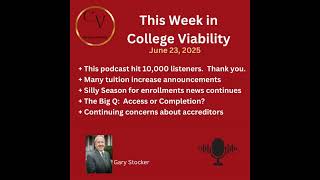
Gary Stocker reviews higher-education news: Columbia College Chicago and Vanderbilt cut budgets heavily, Minnesota and Michigan State raise tuition sharply, and Westminster College spent $2.5 million on marketing with no enrollment gain. Colleges manipulate graduation rates and spin enrollment numbers while the wage premium for degrees falls.
Chapters
It is Monday, June 23rd, 2025. Time for yet another podcast episode of This Week in College Viability News and Commentary. Hi everybody, thanks for coming back. Gary Stocker at College Viability. I want to start off with thanks, many thanks to the many, many, many listeners to this podcast. This past week we hit 10,000 downloads 10,000 downloads. Thank you so much. If you would, make sure to share the podcast link with your friends, colleagues in the industry. We don't want them to miss out on the perspectives we offer here at College Viability. And of course, this week we have layoffs, we have cutbacks, we have lots, lots of tuition increases. It also continues to be silly season for college enrollment announcements. I have one of those. And more indicators that the public colleges continue to be ahead of privates in recognizing the need for mergers. How they get there may be a challenge, but they're certainly recognizing the need. And yet more evidence that I've talked about many times before, more evidence that colleges focus more on enrollment. Yes, they focus more on enrollment than they do on graduation rates, no matter what they say. The data supports that statement. This and much, much more on this June 23rd, 2025, This Week in College Viability podcast. Layoffs and cutbacks. Columbia College in Chicago, frequent flyer to the show, laying off 20 faculty members and additional 20 faculty members amid budget cuts. It's the latest in a series of cuts the school has made, uh, in both programming and staffing to plug a $38 million— that's big— a $38 million budget deficit This is from Cindy Hernandez at WNBC in Chicago. That's 20 faculty members, 18, interestingly, 18 of which are tenured, were from the schools of audio and music, music and business and entrepreneurship, communication, culture, design, and visual arts. Vanderbilt University, big numbers here. Vanderbilt University Medical Center plan on laying off hundreds before end of the fiscal year. I presume that's June 30th. I don't see that in the story here. This is posted by Mike Lachance on June 21st, and the school is quoted as saying, "We will have to reduce operating costs by more than $300 million." Now, this has got to be tied in with the proposed federal policy cuts. We'll continue to watch to see if this actually happens, but Vanderbilt, to their credit, is preparing to make those cuts, ugly though they may be, in the face of federal Federal Revenue cuts that were going on to them, and it's something like 650 students. And it does say the end of the fiscal year is next Monday, on June 30th. It does go on to say that Vanderbilt University Medical Center will continue to hire clinical staff like doctors and nurses, care partners, surgical techs, and others in the fall of 2025. Page 2, Minnesota states tuition increase Minnesota's tuition increase will be the most in nearly 2 years. Now this starts a series of stories that I have on tuition increases, and I'll talk about those as we go forward. They're also expected at 33 colleges throughout— public colleges throughout Minnesota. That's a lot. The story comes from Aaron Adler and JP Lawrence in the Minnesota Star Tribune last week on June 18th. The increase will be somewhere between 4% and 8%. It was an 8-to-5 vote for those tuition increases. Others had one larger increase. Apparently it's a $52 million budget gap for all Minnesota public high schools— excuse me, Minnesota public colleges. And Trustee Jay Cowles, C-O-W-L-E-S, says none of us are happy to be in this position. Well, of course not. He goes on to say there's no amount of tuition increase that's going to prevent a significant loss of headcount. They're talking layoffs in the coming year. We'll follow, watch that story, of course. And there's a student who said, I've definitely been nervous. The student, Sarah Oberstar, she's at Minnesota State. I've definitely been nervous about the tuition increases. Get the rest of her quote. I've actually considered picking up, picking up a third job third job just to keep up with the cost. God bless you, Sarah Oberstar, for trying to get this thing done. Now, now, nothing wrong, nothing wrong with tuition increases. It's a business decision. Everybody increases prices. Sometimes they decrease prices. But let's go back to Econ 101, for those of you took that back in college. What happens when the price of a product or service increases? When the price increases, the demand— in this case for colleges— the demand goes down. Too many colleges. That's T-O-O. Too many colleges, not enough qualified and prepared students willing to pay even significantly discounted tuition to attend those way too many colleges. Kentucky colleges and universities increase enrollment and graduation rates. All right, here's a spin story for you. This is from Diane Byer at Beechtree News on, on June 20th. She goes on to say— Miss Byer— Miss Dyer, excuse me. Miss Dyer goes on to say the report shows that more students entering 2 or 4-year institutions are completing a degree. Now get this part— completing the degree or credential within 3, for associate's degrees, or 6 years for bachelor's degree. The 3-year graduation rate of the community college rate jumped up 3 points. The 6-year rate graduation rate bachelor's graduation rate for public universities rose 1.3%. Um, whatever happened to the 2-year time frame to graduate with the associate's degree and the 4-year time frame for bachelor's? There's no reference to the 4-year bachelor graduation rate. And no reference in this story to the 2-year associate's degree graduation rate. So folks, there is no reason to believe colleges when they offer you a 4-year financial package. That's just to get you in the door. It's increasingly clear that for their own benefit, they focus— these colleges, both the community colleges and the bachelor's degree colleges— focus on 3- and 6-year graduation rates respectively. They're trying to change the narrative to make it look better for themselves. And then I get— I'll ask the rhetorical question: how much more lost income, how much more lost income and increased college costs are not being calculated for the students who have to go 3 or 6 or more years to get the degree they had planned on 2 years or 4 years for. So even at 6 years, barely more than 6 in 10 students graduate from Kentucky— all of Kentucky's 4-year colleges in 6 years. Is that good? Now, I have my own minimum threshold. It's just a college viability— my minimum 6-year threshold for undergraduate graduation rate is 7 in 10. That's 70% for those who didn't pay attention in math class. This is, this is, in the case of Kentucky, I'll be specific here, in the case of these Kentucky colleges, this is despicable manipulation, even though I've seen this elsewhere. So colleges, feel free, tout your 6-year rate graduation rates, tout your 7-year or 8-year graduation rates, do what you need to do. But since I have earned this audience, I have earned this audience, I am going to point out your feeble attempt, your miserable attempt to redirect the expected college graduation time frame from 4 to 6 years and from 2 to 3 years at community colleges. Michigan State, next on the list, hikes tuition 4.5%. As part of a $3.7 billion budget. This was in the Detroit Free News on June 16th. Connor Irgood was the story. Just another one, another story. Tuition hikes are coming. And again, you know, business decision, I have no issue with that, but it reflects the challenges that college faces— colleges face in, in being able to balance revenue with expenses. And even though these tuition hikes are announced We all know that tuition discounts are part of the ultimate package that students get, so they probably don't even achieve the full 4.5% in the case of Michigan State, um, University. Westminster College— this is the one in Missouri— earns a full 10-year reaccreditation from the Higher Learning Commission. Now, for those regular listeners, and there are 10,000 of you, you know where I'm going. And this is an internal document from Westminster College. Sarah Rommel—Rummel—Backer wrote it. I presume an employee of the college. First, sarcasm alert: Congratulations on getting all of those required i's dotted and t's crossed at Westminster College in Missouri. Regulatory agencies like HLC and the 5 others require many, many, many faculty and staff hours to get these I's dotted and T's crossed that could alternatively be devoted to producing a better service, a better education, higher quality organization, not just producing a bunch of statements that say something to the effect of, I'm going to do this, or I plan on doing this and this and this and this and this. Just inputs, no outcomes. I'll give you outcomes next. And this comes from Matt Hendricks and the Private College Advanced Financial Compass. Matt has something on there called the College Vendor Pricing Table. I'm going to pick on a vendor here, not by name, but Westminster College invested $2.5 million rounded from 2021 to 2023 for enrollment and marketing consultants. I posted on the on LinkedIn, a story with the references, the vendor. I'm not going to do that here. And their enrollment, after spending $2.5 million with a vendor, was actually down 12 students. Actually, their $2.5 million got their enrollment down 12 students in that time period. Now, you know, the total operating revenue and the total operating expenses really are balanced nicely. This college has historically, over the time period that I looked at, 2016 to 2023, has done a good job of balancing revenues and expenses. They're almost identical from year to year. The net tuition revenue, those down 20%. Full-time equivalent enrollment is down 32% from 878, almost 900, down to 600 exactly in 2024, I believe that was. The net income margin has plummeted since 2020. We call that profit, even though colleges don't like to call it that. The endowment is only up not even 5% from 2016 to 2023. The median for some 1,300 private colleges was almost 40%. At Westminster College in Missouri, it was not even 5%. They're falling behind. They're falling behind their competitors and being able to generate additional revenue sources. The endowment draw, kind of breaking the piggy bank to keep the lights on, was above 8% since 2019 and skyrocketed to almost 15— that's 1-5%— in 2024. Not good. Now, does HLC or any other accrediting agency track this data, this financial data, this enrollment trends? Do they look at the trends? Do they compare one college to a peer set, to multiple peer sets? Like Matt Hendricks does in his apps. This is a college that appears to have managed its expenses and revenues pretty well, like I just said, yet the trends are not good. The accreditation period is for 10 years. What happens if this college loses its ability to manage cost and revenue from whatever consequence? What happens if the FTE, if the enrollment trend heads towards 500? It's at $600,000 now. What happens if the profit margin, the net income margin, stays below zero? If endowment draws continue to whittle down the principal on the endowment, I can tell you HLC is not even going to follow up. Not even going to follow up because that's not what they do. I've talked many times about the many weaknesses in accrediting agencies, and this is a college that's in decent shape today But the pattern's not good. And maybe there's a story a year or two or three down the road where their finances have deteriorated. Do you think an accrediting agency is going to come in and say, hey, to its students, to potential students and families and faculty and staff and community, this college is in trouble? No. That's, that's why I'm here. That's why other higher ed data entrepreneurs are out there. Doing what I do, mimicking what I do, to provide a consumer service that says, hey, be careful, there are colleges not financially capable of supporting the type of college education that you want. All right, how about silly season? It's that time of year. Each summer is silly season as colleges take enrollment announcements and spin them till you and I are both dizzy. This is Washington and Jefferson College. Seeing large spike in enrollment. This is from CBS News in Pittsburgh. Ross Ghadotti is the reporter on June 19th. Quote from the story: freshman enrollment up 600. Why? This is paraphrased: the tuition was cut in half. Okay, I'll talk about that in a second. To the data we go. Enrollment from 2016 to 2024 was down from 1,300 students to 1,200, down almost 11%. The endowment draw is way too high, above 6%. The endowment percent change, like we saw a minute ago at Westminster College, was only up— was less than Westminster's, up 2%. And the median for, again, almost 1,300 private colleges was up almost 40%. These folks, again, are falling behind. Net tuition revenue down from $29 million to $15 million, and yet they cut their tuition in half. They're welcome to do that, but I've got a moral of the story here. Tuition fees are down from $20— the fees they charge are down from $20,000 on average to about $12,000 in 2023, 2024. And the net income margin, again, profit margin, below zero for 5 of the past 6 years. An inside baseball stat that I use with some regularity: the CapEx to depreciation ratio, how much this college spends on its infrastructure, has been below 1, which is generally accepted as the minimum threshold, has been below 1 the past 4 years. I make the case there are safety concerns, there are updates of hardware and software concerns if that CapEx to depreciation ratio is below 1. And this is a media softball story with only a focus on enrollment. I've teased this before. Banks are still, banks are still not accepting students as cash for meeting payroll and other expenses. They need to see cash. It's cash generated from enrollment that pays the bills. Here in this story, you have a CFO, and I'm not going to reference the name, You have a CFO trying to make us believe that increased enrollment means financial success. This is yet another example, reporters, of regurgitation reporting. They took what a college shared with them and made it news. No critical questions, no data requests, no analysis. And to the reporter that wrote this story, Mr. Gadotti, Here's a story that you probably aren't aware of. Iowa Wesleyan University in Iowa, 3 years ago, increased their enrollment 300 students over the last 8 years of their existence and closed their doors, I think it was 3 years ago, because they gave away the store. They gave away the store just to get students in the door. The same thing I see happening at Washington and Jefferson College. Page 3, New Jersey we go. Lawmakers want a bigger say in New Jersey college mergers. Okay, and the subheading reads, mergers are more likely with colleges under increasing financial pressure, blah, blah, blah. Hannah Gross is the reporter. Interesting, this story comes from an education and child welfare writer on June 18th at the New Jersey Spotlight news. And this is another example of public colleges getting ahead of the merger bandwagon. Remember, I've talked about that before. We're in the closure period now, and sometime in the next year or two or three or four, we'll be in the merger period. And public colleges appear to be getting way ahead of privates and preparing for this. Now, improving awareness is one thing. Improving awareness is one thing, and a good thing, but parochial political intrusion in the process is another. We'll have to watch this. The concept is good, the implementation is going to be the kicker on this. And I watch this trend, of course, across the nation. Now it's kind of changed direction a little bit. Skip Myers is a recognized expert in higher education. He posts some really good stuff. On the leadership role. His headline reads, The Great Reset: Why Your College or University Survival Depends on Planning for Complete Reinvention by 2030. All right, big picture story. All right, we get those all the time, and, and there's much guidance, good guidance and perspective— excuse me— there's much guidance and perspective from a recognized higher education leader And in the end, this is yet another shot over the higher education bow. Dr. Myers offers both perspective and guidance, and they're both good. What continues to worry me is there are many colleges, and I'm going to use an analogy here, many colleges swimming in financial alligators up to their necks. And in my observation, they have neither the time nor the skills to remember. Their initial objective was to open the floodgates and let some new water in. So read this Skipmeyer story, this Dr. Skipmeyer, Robert Skipmeyer story. In too many cases, it's going to fall maybe not on deaf ears, but on ears that don't have the capacity to implement some of the things, even the perspective that he's talking about. And, and guys, we've already done one spin story. Should we do another? Of course. Washington State University Tri-Cities bucks national trend with strong enrollment growth despite college struggles. William Appert, Apple Valley News, on June 17th. All right, here's a couple quotes from the story. WSU, Washington State Tri-Cities, has seen— since it has seen— spit that out— has seen steady enrollment growth over the past two— that's right, two fall semesters— with undergraduate enrollment increasing over 5% over the last year. Okay, I'm not going to question the stats. I didn't check. I'm not going to question them though. First-year student enrollment jumped 20% in fall 2023 and 16% in fall 2024. Driving the campus growth. All right, I will see the data points there. I'm not going to check on the spin, spin, spin, spin, spin. Let's— this is again regurgitation reporting. To the data we go. Why is it me? Why aren't reporters doing this? To the data we go. Despite short samples, they're spinning this, and that's fine. You've heard me say before, colleges spin anything you want, but that's why I'm here. One of the many reasons I'm here is to point out the spin. The actual enrollment from 2016 to 2023 was down. The full-time equivalent enrollment down 2,300 from 21,600 to 19,300. Graduate enrollment down 670 students, although the college still has the graduate students still strong at 4,500 plus. Total enrollment is down 3,600 students, and that just includes part-time students. And all right, you're sitting Eagerly listening to your, your, your speaker. What comes next? You know what comes next. Graduation rates. 4-year graduation rates at Washington University— Washington State University Tri-State's 4-year graduation rate averaging below 40%. That's 4-0%. 6-year graduation rate is around 6%. So if you go to Washington State University Tri-State For every 10 of you that start there, only 6 graduate after 6 years. Only 6 graduate at this college. State appropriations are up $100 million, and tuition and fees over the course of those 8 reported years are down $1.5 million. Now, reporters, I'm going to do this again because I'm a heck of a guy. I give away the College Viability app to reporters all the time. No cost, no obligation. Drop me a note through LinkedIn, drop me a note at gary@collegeviability.com, gary@collegeviability, one word,.com, to request free access to the app. I'll send it to you. I can even step you through the data analysis. You're working on a story and you want some more perspective, I'll step you through the data. I'll step you through the analysis. I've already got 2 reporters lined up just this week for that type of briefing. And I have had this really since colleges let out back in mid-May. I've had reporters every week reaching out for guidance on stories they're writing. Don't, reporters, don't let these colleges pull the editorial wool over your eyes. Get an independent perspective with more data, more comparisons, more trends. Page 4, Jeff Selingo. If I could only follow one person in all higher education, it would be Jeff Selingo. And he had his newsletter come out this week and talked about the Big Beautiful Bill, and I presume we're all familiar with that. And what this talks about is, again, reinforces something I've said. That colleges focus on enrollment to survive. They don't focus on graduation rates to thrive. Now, that's my, that's my content there. That's not Jeff's. But he is quoted in this newsletter story. This is a subscriber-only base. You can subscribe easily. There's no cost. He talks about a president of a college in Pittsburgh who's worried about survival, also admitted— and again, this is from Jeff Selingo— also admitted that higher ed needs to improve. And he touches on something I talk about all the time. Going on with the quote, when more than 40% of students, when more than 40% of students at 4-year colleges don't earn a degree after 6 years, after even 6 years, this college president says something is clearly broken. Welcome to the club. The reasons students don't finish are complicated. And are often overlapping. I understand that part, yet I make the case, and that's why I say the college enrollment— the college focuses on enrollment. Get them in the door, get a couple bucks out of them. If they can survive, great. If not, move on to the next enrollment year. Caleb Williams is a senior economics writer, I believe it's at The Economist. Yeah, and he talks about a story. I'm going to wrap up with this. He talks about a story, what happened 'To the university wage premium.' College graduates get more money, essentially. June 19th, Caleb Williams from The Economist, and he uses the term 'reference in Europe.' 'Going to university,' Mr. Williams said, 'used to set you up for a solidly upper-middle-class life.' Okay, all right, well, it applies to the United States as well. And he goes on to say, 'As we report this week, career paths such as most folks are seeking are now harder to come by. In fact, he adds, all kinds of university graduates are suffering. Young American grads are more likely to be unemployed than the average worker. And, you know, similar trends in Canada, Europe, and Japan. He writes, America's university wage premium, which measures the difference between graduate earnings and those of everyone else, is falling. Right, we've seen those stories before. And relative job satisfaction is down as well. The trend is so new, he cites, all right, I will yield that, I'll stipulate that even though I don't agree. The trend is so new that few economists have written about it. I've talked about it, others have talked about it. We have therefore speculated about why graduates are losing their privilege. This is the important part. One possibility, one possibility that Mr. Williams writes about, one possibility is that universities do a worse job than before letting people in, letting people in who should not really be there, and hardly teaching them. If so, employers, he continues, will reasonably place less emphasis on the degree or certificate. In the end, Mr. Williams worries about the political consequences, and he— I'll kind of paraphrase what he's talking about here. He worries about the political consequences of young grads losing these university privileges, and history, he suggests, shows that when educated people do badly, instability results. Mr. Williams adds, more— moreover, in a world of artificial intelligence, we may be at only the start, only the start of the trend. And many believe that once AI is super intelligent— I've not heard that in context before, but all right— many jobs that involve using your brain will be automated. It will be the hands-on work, the hands-on work, construction personal care, plumbing, and the such that does best. And you don't, and you don't need a university degree to do those kind of things. So let's watch the rap. What's more important? What is more important? Is it access to college with high discounts or free college— there are quotes on that— or completion? Is it access or is it completion? And I just talked about that article in The Economist. I'm going to read it again from Callum Williams, The Economist. One possibility is that universities do a worse job than before letting in people who should not really be there and hardly teaching them. If so, employers will reasonably place less emphasis on the degree. The core of the argument is that if universities are letting in people who should not really be there and hardly teaching them, the value of the degree diminishes. Not for those that complete it, but for those who contribute to its not being completed, or those who complete the degree and they shouldn't have. Maybe they don't have the academic intellectual skills to do that. So in total, the value diminishes. This directly links to completion. If that degree, due to its dilution, if that degree no longer signifies a certain level of acquired knowledge or skill due to either poor teaching or inadequate preparation of the students— and that's the big boat that we're missing, that inadequate preparation of students— then simply having access to college or completing the coursework without genuine learning becomes meaningless. And thus we have higher education too much in 2025. Enroll them, but no demonstrable worries about whether they graduate. Not good. Not good at all. Hey, let's call that a wrap. 10,000 downloads. Thank you so much for listening. I'll I'll come back next week on the last day of June, June 30th, with another episode of This Week in College Viability. At College Viability, this is Gary Stocker. Good day and take care.
More from Gary


What does it look like when a college increases both total revenue and total expenses?



College Financial Crisis? We look at the financial health of Bay Path U. (MA) and Coe College (IA)


Private College Financial Crisis? We look at the financial health of Hobart William Smith College


Financial Compass tutorial (Private college version.) Financial statements compiled 2016-2025.

