This Week In College Viability (TWICV) for March 3, 2025
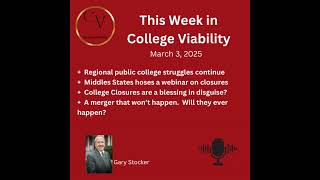
Gary Stocker surveys college closures and cuts across the U.S.: Tennessee State cutting $18-20 million in scholarships, Southern Illinois University Edwardsville proposing $10 million in deficit cuts, and California State University facing a $375 million budget cut. Accreditors are quietly preparing for waves of closures while the sector grapples with oversupply and financial strain.
Chapters
It is This Week in College Viability news and commentary for March 3rd, 2025. Hi everybody, I am back behind the blue Yeti microphone after a week of viral disease battles here at College Viability World Headquarters, also known as the spare bedroom. Springtime is close. We all know spring training is underway in Florida and Arizona, so let's do our own spring training And look at these stories. Two public colleges, Tennessee State University, who has been a frequent flyer, and Penn State, are in the college cutback news. Tennessee State with staffing cuts, and Penn State across their entire system will soon be looking at closing some of their regional public colleges. We'll be talking about that. And the Middle States Commission on Higher Education Accreditation, they hosted a webinar last week. I attended it. and the title was How to Close a College. I'm going to look at the possible motivations for Middle States hosting that. A gentleman I just finished up writing this story on, college closures, college closures are a blessing in disguise. And then a merger that won't happen, this is between Bluffton and Findlay Universities in Ohio and Pennsylvania, I believe. What that may mean for future college mergers, we'll talk about that. And of course much, much, much more on this episode of This Week in College. Viability layoffs and cutbacks— lives will be impacted. Tennessee State University proposes staffing scholarship cuts to stay open. This is from Emily West on February 19th, NewsChannel 5 in Nashville. The university has already made millions in cuts in hopes of getting its financial house in order. Last fall, Tennessee State laid off more than 100 staff members. The school also eliminated 117 contracts. That's a lot that duplicated services, saving some $3.5 million. The cuts Ms., uh, Ms. West writes about are about to go deeper. Their proposed cut of $18 to $20 million in scholarships, $6 to $7 million in non-instructional staff and $5 to $6 million in instructional staff. And if you do the math, and I did that in my own here, and you assume a salary about $60,000 per employee— made that assumption— it's about 100 employees each. So that's an additional 200 employees to be cut at Tennessee State based on my math. I, I might be missing something, but just basing the math on that $60,000 number, and then an additional $3 to $4 million in non-personnel cost reductions, which includes the president and cabinet members. Boy, they must be paid well. So do the math. The cuts in scholarships are simply unfunded grants, so Tennessee State will effectively be willing to go without some $18 to $20 million in revenue. All colleges do that. The faculty and staff cuts suggest something, like I said, on the order of 200 cuts. That's a big, big, big number. Southern Illinois University Edwardsville. There's a couple Southern Illinois Universities. The chancellor calls for layoffs and cuts at Southern Illinois University. This is Blythe Bernard in the St. Louis Post-Dispatch on March 1st. From the story, Miss Bernard wrote, Southern Illinois University Edwardsville, which is just northeast of St. Louis, needs to slash positions and academic programs to improve its finances to Chancellor James Minor said in a letter to the campus this week. The chancellor said the cuts are responsible steps to address the university's operating deficit of more than $10 million with the goal of balancing the budget by 2027. And of course, the standard comments, although some of the decisions will be difficult, no doubt, inaction is the most dreadful threat we face as an institution Miner wrote, "SIU Edwardsville is not in a financial crisis. We do, however, have longstanding structural imbalances in our budget that must be addressed." And again, I've said this before, if it's longstanding, why now? Why now? The apparent series of buyouts will roll out this spring. And of course, the faculty had a response. And so here's their response. And now Miner, the chancellor, This is from the American Federation of State, County, and Municipal Employees. Amy Bodenstab is a quote, is a source of this. Now Minor wants to remove more people, but he hasn't removed the work. She goes on to say, SIUE Edwardsville exists because of those of us who aren't in upper administration. Chancellor Minor has made it very clear that his priority is not employees. Or making SIUE impactful in the future with his actions. Having a deficit is not new at state universities, and the budget numbers presented to us don't add up with the cuts and changes we know have been made. And I've said this countless times, faculty are regularly, right or wrong, regularly questioning the budget numbers. And here's why: budgets are not much more are not much more than dartboards. We're throwing guesstimates for future numbers on a piece of paper and calling it a budget. It's, it's the audited financial statements, it's the data submitted to the IRS for private colleges, it's the IPEDS data that reflects kind of the great— the scorecard, the grade card, if you will, the grade, if you will, for these colleges. And when there's that, that level of distrust between the numbers from one party to the other. It's just not— it's not going to make things good at all. And on to the Penn State story. Penn State University is considering closing several of its smaller Commonwealth campuses— call them regional colleges— due to financial pressures and declining enrollment. Potential closures, of course, associated with population decline. Pennsylvania is one of the more high-propensity, high-ratio of colleges, students out there. And while current students would be able to complete their degrees, the closures could limit future students' access to affordable education policies. Well, the term used by Penn State leaders is unsustainable. All right, fair enough. And I, I bring this up because we use that unsustainable term regularly on the College Financial Health Show with Matt Hendricks and Gary Stocker. Every Tuesday at 10:30 AM Central Time. Go to my LinkedIn website, my LinkedIn post, to get the link for each week. We don't ever say— Matt and I never say a college is going to close. We may have suspicions, but it's too tough to tell. But we can and do show how an historical financial path is not sustainable, unsustainable. We do that with regularity. So to the folks at Edwardsville, rip off the financial Band-Aid it won't be fun, but you're not the only ones, and shrink to survive and maybe hope to have a chance to thrive at a later date. Page 2, the Middle States Commission on Higher Education— I call them Middle States, most folks do— Middle States hosted a webinar. Here's the title: How to Close a College. Now, it was a really decent how-to Paula Langtau and Peter Zerogiannis both were at colleges that closed, and they effectively told their stories. And they shared that transfers are risky, risky for students. They can lose credits, and that teach-out partners are better. My own experience on that is teach-out partners are some— most of the time in is in is at least about a financial state state as the colleges that closed. I've done reports before that show teach-out partners financial troubles and they're just grabbing those students to get revenue. And nothing wrong with that, but you got to wonder what the motivations are. So why did Middle States host this? Why did Middle States Commission on Higher Education host this How to Close a College webinar? Have they made an internal decision that they are anticipating more closures? Do they know there are more closures coming? Are they now encouraging colleges in their physical domain, which is most of the Middle East— excuse me, the Northeast— of mostly the Northeast? Are they encouraging more closures? Are they— man, are they about to mandate closures where in years past maybe they just said, hang in there and we'll just put you on probation? So, and those of you that follow me regularly know that on this show and others I have regularly taken accreditors, including Middle States, to task for not giving the students and faculty and communities a heads up when a college is nearing closure. So I had a LinkedIn higher ed connection drop me a note saying, you know, here's what I suspect. I suspect they are just trying to jump on the bandwagon of talking about closures and trying to put that responsibility on boards and presidents without taking any accountability themselves as accreditors. All right, I can, I can see that. I need to think about that a little bit more. I think they're all culpable— the boards, the bands, the boards, the presidents, and, and the accreditors. And, and yes, you know, with the financial losses— this person goes on to write— with financial losses schools are about to suffer because of public policy changes, this person suggests and predicts that we're going to see a lot more college closures a lot faster than we would have, period. Let's go to California, and the headline reads— this is by CalMatters, Michael Zinjitsen and Zinstein for CalMatters— gutted courses, fewer majors, faculty layoffs. Who will feel Cal State's 8% budget cut. The subheading is, how will the California State University system keep operating when the governor has proposed cutting $375 million from its budget? And the reporter's right, it's already happening at some campuses. And we talked about San Francisco State a month or so ago, and more recently Sonoma State, who, who's interim president at Sonoma State intends to lay off tenured faculty and some majors and then totally close that university's entire NCAA Division II intercollegiate athletic programs. And this is from a senator, uh, we talk about this here more in a minute, from a state senator in Colorado, says if the reductions were to hold, what's happening at Sonoma State, which I just talked about, is the first of what we will see at every Cal State University campus. This is Senator John Laird, Democrat from Santa Cruz, who chairs the Senate Subcommittee on Education Finance. So part 2, another headline says Austin Metzger and Rylan Valtapena on the Sonoma Star. This is on March 1st. California legislators demand comeback plan, comeback plan from Sonoma State administration during forum on campus. Well, everybody was upset. They got together with a forum on campus. As you can imagine, it wasn't pretty. And so here's what comes from the story from Mr. Messinger and I presume Ms. Valdopena. The California State Legislature has demanded that Sonoma State produce a comeback plan following recent cuts and come with that plan in the next 30 to 60 days. Type fast. State Senate President Mike McGuire said for the comeback plan, they are looking for metrics, okay, a plan for recruitment, acknowledgement of impacts on campus life— I don't know what that means— and the creation of a community comeback committee. Sure, let's have more feedback from folks who don't know the business piece. The chancellor's office as well as administrators at Sonoma State must acknowledge their failure and mishandling of the university's budget and its budget cut rollout, said another state rep. And this story goes on and on with complaints and charges and demands. And while all of this is going on, while all of this is going on, the dollars continue to go out the proverbial door with insufficient revenues coming in through that door. In other words, you know, like I've said about the creditors, the state reps state legislators in California says, hey, send us something where you guess at what is going to happen in the future. Just guess, you know, dartboard model, what's going to happen in the future, and just make sure you dot your i's and cross, cross your t's. How about this one? College closers are a blessing in disguise. Too many colleges shortchange students. Let's have fewer of them, so says Walt Gardner on February 21st in a story for the Martin Center for Academic Renewal. I'm going to read part of this story from Mr. Gardner, and he writes, putting aside the unprecedented fiscal challenges brought about by the overall shrinking population of college-age students The larger truth is that not everyone, not everyone is college material. It takes a certain IQ to handle college-level work, and despite exaggerated claims about the role that true grit plays, it's generally believed that an IQ of about 115 is necessary. I don't see a source on that. The large number of freshmen who drop out each year serves as evidence that many are academically in over their heads. I've said that before a little bit more nicely than Mr. Gardner does. Some institutions, he argues, he writes, are colleges in name only. In fact, little more, he suggests, are more than residential high schools. Walt Gardner goes on to write, such students would have been much better served if they had pursued a vocational curriculum and an apprenticeship Instead, they were led to believe that without a bachelor's degree, their future was bleak. Even worse, some of the colleges they enrolled in were colleges in name only, like I just said. And as a result, such institutions' closures— the ones that have closed— were a blessing for students who would have been saddled with a debt for a worthless degree. And he concludes, college's job should not be to funnel as many high school graduates as possible onto their campuses, but instead to make college available only to those who have the demonstrated wherewithal— I'll add intellectual and academic wherewithal— to profit from the experience. And so far, they've not been successful. Mr. Gardner finalizes, it's unlikely they ever will be as long as they persist in believing that college is for everyone, or in feigning that belief for financial purposes. That's serious sarcasm. When students learn they are ill-prepared to handle rigorous college-level material, they drop out. Admitting unqualified students only sets such students up for failure. That should serve as a reality check for higher education, but it hasn't. Okay, well This is what I have been saying. It is easily reflected in the pathetic national 4-year graduation rates that I talk about constantly. And what appears to be happening is that students are figuring this out long before colleges. And we know that because they're showing up, they're showing they recognize it by not enrolling in colleges, in any colleges. And if you follow anything that I write or any of my media, I harp almost in my own indictment almost excess on how colleges make a big deal out of some minor positive enrollment trend in August or September, but never, in my experience, never announced during May commencement ceremonies that this year we graduated 43% of the students who started 4 years ago. Such sad numbers. Walt Gardner makes great points in this story. However, it's unlikely to change higher education anytime soon. Mergers and acquisitions. University of Findlay not proceeding with Bluffton University merger. This is from Elizabeth Klaus, uh, on thecourier.com on February 27th. And this is— I'll of course provide the link in the show notes. This is really not— in my mind, this is not a failure of two college— two colleges trying to merge. It's not a failure of the two colleges. It's not. It's a colossal failure of a higher education system that makes business model change so difficult. It's also a reflection of the unique nature of nonprofit mergers. There is rarely, if ever, any cash changing hands, unlike in the for-profit world, as a result of a nonprofit merger. So the value, the value to the parties is based on futures— future enrollment, future programs, future staffing, future back office consolidation. And all of those, and many more, are very difficult, are very difficult model to both apply and accept. So the bottom line is more colleges may look at mergers. I hope so, because they need to. But with the current systems and processes in place, most mergers will not work, like we saw at Bluffton and Findlay and other places as well. And it's going to result in wasted time and resources, along with a higher rate of closures, because colleges will have put their chips on a merger and will be out of financial time when those mergers don't come to fruition. And then a follow-up on that, Jeff Selingo, who again I've had his stuff on the show many times, top of the line writer and researcher, he writes in conjunction with this Finley and Bluffton non-merger, why is it so hard to merge colleges? This is in Jeff Selingo's February 28th Next newsletter. If you're in higher education and you don't get Jeff's newsletter, make sure you go and find it and sign up for it. It's an excellent resource that crosses all sorts of disciplines, um, and just worth your time, trust me. And so here's what Salengo writes: it seemed like the perfect marriage until it wasn't. He talks about Findlay and the Bluffton merger, and he goes on to write, there's been a lot more talk in higher ed about mergers than action. And he's right. I talk about a lot, others talk about a lot. In reality, we've seen a lot more college closures— this is from Jeff Selingo— we've seen a lot more college closures and outright acquisitions than true mergers. So it was the University of Findlay Board of Trustees— that was a bigger, financially stronger entity— that's the one that voted not to move forward on the merger application to its accreditor, the Higher Learning Commission. And then the president at Bluffton resigned as a consequence of that. There's much more to the story. I just don't know what it is, and I don't think either does Mr. Slingo. It's unclear, he writes, exactly what happened, but sources told him that the lengthy timeline to approval was a factor. He writes, beyond the accreditor, it's a higher learning commission, the big wild card was the U.S. Department of Education. It was going to take 18 months to 3 years to get that completed through the Department of Education. And the source on that is Finley president Kathy Fell. He told— she told Jeff Selingo that in his podcast. And then again from Jeff Selingo, the protracted process clearly played a role at a time when there's a lot of uncertainty about the direction of the Education Department, and we're all reading those stories, and, and when many small colleges don't have time to reverse declining enrollment and fill their growing budget deficits. Seligow again concludes the general consensus is that the U.S. has way too many colleges, especially when more than one-third of the market is made up of institutions with fewer than 1,000 students. What interested Seligow, what interested him about the Bluffton-Finley merger was that Bluffton was financial— relatively financially stable— when it approached Finley about coming together as one. And, and, and most colleges with financial troubles, Jeff Slingel writes, know well in advance they're not on a sustainable path. And they, they're not gonna— maybe they don't know 3 years in advance, which is maybe what the process time might be to get these mergers completed, but they, they sense that they're not in a good position. They know that their cash is dwindling. They know that the pressure on tuition discounts is increasing. And I bring this up because it kind of ties in, it does tie in with the Bluffton-Findlay merger. First of all, too many colleges have waited too long and have closed already. They, as I've shared many times before, I know where these colleges that have closed have approached other colleges at the last minute, effectively saying, please marry me, marry me, marry me, I'm about to not survive. And the colleges being approached just look at the resources and say, no, you bring nothing to the table. So these colleges are waiting too long, but even when they don't, in the case with Bluffton and Findlay, it's a treacherous, treacherous process. And I gotta believe, I do believe that the closure process is gonna be where we see most of the consolidation. We'll see very, very few as a percentage, very, very few mergers or other significant business model changes. Page 3, the Raleigh College jumps on the free tuition bandwagon. Zach Izzoni from the Triangle Business Journal on February 11th, William Peace University, P-E-A-C-E, will cover tuition costs for students who meet certain eligibility requirements. Well, what that means is they'll take a North Carolina fund program and they will take Pell Grants and that'll be enough. They would just write off the rest of— kind of write it off. They just want to have the revenue for those students. And eligible students will have their tuition covered through a combination of federal Pell Grants, North Carolina scholarships, and institutional aid. And those will just be unfunded discounts, said Damon Wade, the university's vice president for enrollment management and marketing. To the data— I haven't done that yet today— to the data for the good folks at William Peace University: 2016 to 2023, total revenue down 18%. Total expenses up 13%, FTE enrollment down 300 students, tuition and fees down about $3 million, a pathetic 4-year graduation rate around 35%, and the 2023 endowment around $50 million, and the net tuition revenue over that 8-year period down 24%, accepting less may drive cash flow up a little bit, but they're still expensive to consider. This, this in my experience is, is not a feasible approach. But yeah, we've seen others try it, try it throughout the country. Spin, spin story today. Southeast Missouri sees strong growth in key enrollment areas for spring 2025. That doesn't last for long. The subheading reads, Southeast Missouri State University continues to make strides in several key enrollment areas even as an overall headcount enrollment reflects a 3.4% decline compared to last spring. And what they do— and I'm not going to read these off— is they have a whole— I have 6 bullet points and they all reflect percent changes, but they don't give us any absolute number. So how are we to draw a conclusion when all they're listing is a percent change? You know, 11% change on 10 students? That's nothing. 11% change on 1,000 students? Well, that's serious. But with all these bullet points, they're just spinning it to make it look good. I understand, we've talked about this before. They're welcome to do it, but they're not fooling anybody. They're not fooling me. There are challenges at CMO, as there are at many other places. And Southeast Missouri State is a regional public in Missouri page. For Spring Hill College, dropping majors due to under-enrollment. This is by Pat O'Donnell and Summer Poole on CBS Channel 42 on February 26th. Now this is a financially unhealthy private college for sure, but they're doing the right thing here. And according to President Mary Van Brent and Provost Rebecca Cantor, They're dropping these majors: chemistry, biochemistry, history, philosophy, secondary education, and studio art major. That's fine. We see cutbacks all the time. But here's what they're doing. The announcement of these cutbacks included options for students for each of those majors, how they could complete something else that would take advantage or use some of the credits, if not all the credits they had for those programs. Now It's a perfect example, a perfect example of a college shrinking to survive. Again, Spring Hill is a financially challenged college in a lot of ways. I'm not going to do their numbers today, but they're doing this cutback right. Will students be negatively impacted? Yeah. Faculty? Yeah, of course. And it's just colleges— you've seen this before— colleges cannot Colleges cannot universally expect to be all things to all people. So kudos to the good folks at Spring Hill College. They're, they're doing their cutbacks in the right way, and looks like with some lead time. And then finally, Selling Yesterday's Solutions. And this is by Peter Cory, who always writes some good content. Uh, I always see it on LinkedIn posts, and this is on February 28th. Selling Yesterday's Solutions And he's effectively talking about consulting firms and how consulting firms haven't really changed their business model for a long time. And he ties that in, and he ties that in with how accrediting agencies really haven't changed their requirements materially for a long time. And, and that's fine, he makes some good points. And again, there'll be a link to this, to the article, in my show notes. But let's, let's do a wrap this week based on that. Selling Yesterday's Solutions is the title of Peter Corey's story. And I wonder how much of that also applies to colleges and, and even college faculty. Now, it's complex for sure, Because some subjects— math and English and physics, fixed topics that don't change much from year to year, decade to decade— are effectively the same. Yet the higher education industry is almost, almost— it is certainly in a negative public perception freefall. More and more folks think less and less of colleges and what they— and the products and services they're offering. There are certainly pockets, certainly pockets of innovation, but my perspective is that most of those end up at the talking stage without really ever generating demonstrable impact on students and learning. We call that management by PR in the post in the media that we do. So what do public and private colleges do? Just like we saw at Spring Hill, shrink to survive, just like what we're going to see at SIU Edwardsville. Just like we're going to see week after week, month after month on this show. Colleges are shrinking to survive. They're not calling it that, but that's what they're doing. They're shrinking to survive now. And what they need to do is innovate and not just talk about it, to thrive and innovate, to thrive with courses and degrees and business models. We talked about the challenges of mergers. Well, maybe there's, there's, there's subsets of mergers that will save some colleges. We can talk about that another day. And partnerships. There, I believe there will come, there will come a time when the imbalance, the current imbalance of too many colleges and too few students willing to go to those colleges even at discounted tuition rates, when that imbalance will stabilize. I have no idea when that will happen. I think it's later rather than sooner, but when that does happen, we'll look back at this time period that we're living through right now, and in hindsight— in hindsight is an important qualification— in hindsight, we will see how it was readily apparent. As we sit here today, it's not. Which colleges would not survive? I can tell you which ones are at greatest risk. Which colleges would need to shrink to survive? We see that in the news almost daily. And which colleges at the time, at our time right now, which colleges right now were innovating to thrive, innovating to thrive when the market came into a better college-to-student equilibrium. That time will come back. The market always adjusts. I've said that many times, and it will happen here, but there will be a lot of trauma, a lot more trauma between now and when that happens. So hey, for those making the time to listen to the podcast, I am grateful. Thank you very much. We do this every Monday, And we will do it again next Monday. So for College Viability and This Week in College Viability, I'm Gary Stocker. Thanks again for listening. We'll talk again next week.
More from Gary


What does it look like when a college increases both total revenue and total expenses?



College Financial Crisis? We look at the financial health of Bay Path U. (MA) and Coe College (IA)


Private College Financial Crisis? We look at the financial health of Hobart William Smith College


Financial Compass tutorial (Private college version.) Financial statements compiled 2016-2025.

