This Week In College Viability (TWICV) for August 18, 2025
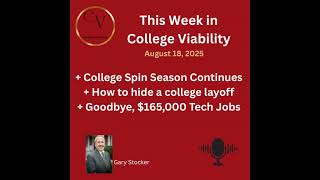
In this episode of the "This Week in College Viability" podcast, host Gary Stocker delivers a data‑driven briefing on the deteriorating financial health of U.S. higher‑education institutions. He critiques the pervasive "spin" in college press releases, highlighting how many schools hide graduation rates and focus on enrollment rather than outcomes. The show surveys a series of recent developments: UConn’s closure of seven programs and monitoring of 70 others; Utah’s 80 inactive courses; Monmouth’s phasing out of ten majors; Avila University’s leadership change, declining graduation rates, shrinking endowment and rising unfunded institutional grants; St. Augustine’s low 4‑year graduation rate (≈15%) and reliance on litigation to maintain accreditation; Suffolk University’s layoffs, thin net‑income margins, high endowment draw, and inflated senior‑staff salaries; Western Illinois’s misleading international‑student messaging; Aquinas College’s enrollment decline and profit margin erosion; Columbia College’s high proportion of >$100k salaries; a new Illinois law offering direct admission without applications; a City Journal piece on accreditation crisis and a proposal for outcome‑focused oversight; and a New York Times story on tech‑graduate underemployment, illustrated by Zach Taylor’s failed job search. Throughout, Stocker promotes College Viability’s data products (a majors‑completion app and free private‑college reports) and urges listeners to share the podcast. The episode ends with a bleak outlook: many colleges lack the financial and outcome metrics to survive, and market forces will force closures, leaving only a fraction of students to graduate.
Chapters
It is This Week in College Viability news and commentary for Monday, August 18, 2024. Hi everybody, Gary Stocker. I think I'm in front of the blue Yeti mic. Somebody says I'm behind the mic. I'm not sure that's it. And it's yet another hot, hot, hot, hot day in St. Louis. And of course, this is the podcast that talks about the financial health and viability of public and private colleges with data with details and perspectives offered nowhere else. And for those of you listening to the podcast, I'm grateful. Thank you very much. Make sure you forward the podcast link to those in your higher education industry friends, or even students and families, because as you'll hear later in the show, we have some new products for students and their families. There's no sense in just you getting the latest news and commentary on the whole industry. I had a I had a higher ed friend send me a story on Sunday, yesterday, about an Iowa private college. The spin on this story was silly. The spin was obvious. And a look at their financials suggests this is a college, this college is a likely closure candidate when the higher education tipping point hits in the coming months, coming years. And I could have pulled a half dozen of these types of stories in just the past week. This is an industry. Higher education is an industry living on spin. They couch their press releases in carefully worded avoidance of hardly any details, and the details they offer are often out of context or so couched in qualifications they're not worth much. Graduation rates are hidden. You've heard me talk about that many times. And with the hiding of graduation rates, it's just reinforcing my view, my view that too many colleges, almost all colleges in my mind, too many colleges are all about enrollment and not about outcomes. They can say whatever they want about outcomes, but the graduation rates are indicative. Fewer than half of all public and private colleges in this country graduate even half of their students in 4 years. And this will not end well for individual colleges. This will not end well for this nation or hundreds of thousands of students that have been or will be negatively impacted by the abysmal financial health of hundreds, hundreds of public and private colleges. Top news and commentary this week, lots continuing, lots Lots of cutbacks, lots of layoffs coming up. It's spin season. We talked about that already. We have a college that kind of sort of hid a June layoff announcement just now coming into, in my mind anyway, just coming out in the news. St. Augustine in North Carolina won a temporary injunction against its accreditor. And this is a college, ladies and gentlemen, boys and girls, that graduates 15, 1-5% of its students after 4 years. I'll have more on that. And the final story, goodbye $165,000 tech jobs. Student coders seek work at Chipotle, and that's of course that fast food Mexican restaurant. And instead of coding, they are selling, selling tacos, selling tacos. Layoffs and cutbacks. UConn, the University of Connecticut, closes 7 academic programs after a low enrollment review. This is from Andrew Larson on August 12th in the Hartford Business Journal. They've closed 7 academic programs and placed dozens more, dozens more under monitoring following a comprehensive review. This is from the university's Board of Trustees. There are 4 graduate certificates and 3 degree programs there in mathematics and medieval studies. Okay, interesting dichotomy there.
An additional—
interesting here also— an additional 70, 7-0, programs across multiple colleges at at UConn will be monitored annually with plans to improve enrollment and completion rates. Good luck with that. And, and, you know, I've got the product, the 2025 College Majors Completion App. Anybody interested? I've already done the compilation for all public and private colleges, 4 years. You get both internal and external market share analysis. And for about 2 more weeks, I'm almost giving away at $199 That's down from the $799 retail price. Go to collegeviability.com, click on the apps link to see if that's something you'd like to take a look at. University of Utah details course cuts. This is on August 5th. This is internal communication. The board there finalized a list of program cuts and cutbacks, and just over members signed off, the board of trustees signed off on a list of just over 80, 80, they're calling them inactive courses, okay? 80 inactive courses. Certificates and degree programs. There's a list. I'll have that link in the show notes. Monmouth College phasing out 10 majors. The list continues. Enhancing other programs following an academic prioritization process. I guess that begs the question, why now? How, how long have these programs— for all of these colleges this week, previous weeks, upcoming weeks— how long have these low-enrollment majors been out there? And they're just now saying, you know what, You know what, nobody's enrolling, or very few are enrolling in these. We should think about cutting them out for lots of reasons. And the details again will be in the show notes. Avila, slightly different tack here. Avila University in, I believe it's the Kansas City area, announces a leadership transition. This is an internal document from Avila University, that's A-V-I-L-A, on August 5th from Mr. Jonathan Jackson. I'll of course have the link. The story says the Avila University The Avila University Board has announced after 3, 3, 3 impactful years of growth and leadership as president of the university, Dr. Jim Burke is stepping down. He's going to a college in Florida, St. Leo's. The board goes on to say, during his leadership, Dr. Burke's tenure, he has focused on— now listen to this— strategic growth, financial stability, and access to education. Might as well have said hot dogs, apple pie, and Chevrolet. They go on to say he's helping to expand the university's reputation and reach— after 3 years, mind you. Should we actually go to the data? Yeah, let's do. To show you how out of touch this board is, to the data from 2016 to 2023, 4-year graduation rates hovering around 33.0%. Success rates bounce around and below 50%. And this is, this is a typical example of a college focusing on the enrollment, on the enrollment front end, and effectively abandoning getting students through to graduation. Tuition fees at Avila are down $8 million and decreased every reported year from year to year since 2016. The endowment— they've broken open the piggy bank at Avila. The endowment appropriation was 33% in 2023 and 38% in 2024. Of course, the normal one is somewhere in the vicinity of 4 to 5%, and there was no endowment appropriation reported for 6 years. I don't know if that's a data error or they just didn't appropriate any money. That could be. The endowment is less than $12 million. The unfunded institutional discount— you and I know that as merit aid and most scholarships—
was up $2 million.
Total revenue was up 21%. Total expenses up 27%. Do the math, that's not where you'll be going.
And the net tuition revenue was down 39% in 2023.
It came up a little bit in 2024 and was down only 14% from that 2016 starting point.
And you have to wonder You have to wonder how engaged this board is that a president leaves in 3 years, 3 years, and their press release suggests he focused only on soft goals.
Hot dogs, apple pie, excuse me, strategic growth, financial stability, and access to education.
College drivel, college drivel this week. This is a local college, let's talk about local colleges in the Davenport, Iowa area. KWQC, Kayla Page had the story on August 13th. Local colleges navigate uncertain times. Interviews with a bunch of colleges in that area about the challenges with getting international students.
That story's out there.
I'm not going to talk about that because this is college drivel— D-R-I-V-E-L— silly college statements. I'm going to read one of the— I'm going to read the quote from one of the universities contacted. It was Western Illinois University, and they are a frequent flyer on this show.
Western Illinois—
quote, I'm going to read this word for word: Western Illinois University supports our international students and provides resources throughout the application process and after students arrive on campus. Over the past several years, our percentage of international students has remained steady as a percentage of overall enrollment.
I'll pause for a second.
The enrollment has plummeted, so you know what that means to the international student percentage and how they couch that. It goes on to continue, expect that trend to continue this year. Okay, great. Although international student enrollment typically occurs closer to the start of the season or the academic year, we offer competitive tuition for international students. We are proud to be the educational destination of choice for students from Illinois, the United States, and beyond. Now draw your own conclusions, and I say that a lot. Mine— I can draw mine, right? My show, I can do whatever I want.
Mine is that this This is a college without a clue.
This is a college that just isn't gonna get it done. Page 2, Chloe Schwolfatter and Michigan Live had a story about Aquinas College. And the headline reads, Aquinas College is growing but still provides the sanctuary of a smaller school. And this is another spin story. Maybe that's the theme this week. They're taking limited data at Aquinas College and drawing— I'm going to call them misleading. They're, they're mathematically accurate, but misleading conclusions about enrollment growth. And I'm going to share the data. Aquinas is not growing, but they are spinning the enrollment data. The net income margin profitability— I'm sort of giving that a better title— the net income margin has plummeted since 2020. The full-time enrollment is down 23% since 2016. The net tuition revenue in that same period is down 31%. The 4-year graduation rates—
what do you think I'm going to say?
Yeah, it's below 40%. And their 2023 endowment is $43 million. Of course, my threshold, the college viability threshold, is $55 million. Time after time I share these stories, and it's going to continue. And then when this market crashes And it's going to be sooner rather than later. These kinds of colleges are the ones that are not going to survive. Suffolk University, kind of a hidden ball trick, I guess.
Suffolk University laid off 35 people earlier this summer. This is from Ross Christentello on August 14th at Boston.com. And of course, they rationalize a number of factors, including federal policies that are harming international student enrollment. Of course, that follows the theme: don't blame me, blame somebody else. Again, to the data I go. Bear with me. Net income margin at Suffolk University has barely been above zero over the past 8 years.
The endowment draw, taking money from the piggy bank, the savings account, the endowment account, has skyrocketed above 5% in the past 6 years. The 2023 value—
2023 and 2024 values exceeded 10%.
Typical is about 4%.
The— get this one— the unfunded institutional grants— and again, this is most merit aid and most scholarships— these unfunded, no money actual transfers, unfunded institutional grants increased almost $37 million since 2016. Divide $37 million by 8, that's $4 million and change every single year on average since 2016. They're giving away the store. They're giving away the store at Suffolk University to get students in the door, and that's not good. Undergraduate enrollment has decreased more than 500 students since 2016, 4-year graduation rates below 50%, and tuition revenue is down. Operating expenses increased $27 million. This is in the face of fewer students. And, and get out your pen and pencil for this one. We have a category in the Private College Advanced Financial Compass report that shows employees paid over $100,000. This comes from the IRS 990 form. The employee at Suffolk College— the number of employees paid over $100,000 annually is so high, I'm not going to share it. It's hard to believe how high it is compared to other private colleges. And, and if you want, we can add Suffolk College to our show list for the College Financial Health Show that we do every Tuesday morning. If you would like it added, drop me a note through email to gary@collegeviability, through a LinkedIn message, whatever works for you. And, and for really all the, the data things I reported to you today, this is, this is the most startling part of all of this. It took me about 4 minutes, give or take, 4 minutes to compile this summary for this one for Suffolk College using the right tools. And so if you're a reporter If you are a reporter, reach out to me through LinkedIn or my, or my email address, gary@collegeviability.com.
I can get you professional access to these same tools. You can use these in your reporting. It will save you a lot of time. For all others, there is a fee. Gary has bills. Gary has bills to pay. Page 3, I'm going to step away for a moment.
And share with you a new college product available from College Viability.
It's a free report, free report on any private college you select, and it will share with you and compare graduation rates, financial health, and much more for private colleges that you would like compared. If you're a college student, if you are a parent, if you are a college faculty member, or just a concerned community member, this is a free app, a free report for you.
Go to some—
go to the new site that I have out there called My College Viability, the word my in front, mycollegeviability.com, and select the free report menu item. The app will step you through everything else and you'll get that free report immediately sent to your email address. And again, that's mycollegeviability.com. To North Carolina we go. St. Augustine's University announces September start, September 2nd start for fall semester, and they have a new board chair appointed. Now again, St. Augustine has been a frequent flyer on this show, and they announced that the HBCU will remain fully accredited through the fall as it fights to maintain its accreditation status. And Miss Sophie Gibson, Miss Sophie Gibson, G-I-B-S-O-N, has been appointed the new board chair. And this is from WRAL News on August 15th.
St.
Augustine, 4-year graduation rates, 15%, give or take. 6-year graduation rates, undergraduate degrees, 30%, give or take. This isn't a college in my mind. This is a tuition collection agency. They're not graduating students. Colleges graduate students, at least something higher than 15% and 30%. Over 4 and 6 years. St. Augustine is a tuition collection agency. And this, for now, this one is not the creditor's fault. I say that with some trepidation because the college is open as a result of litigation. The college secured a preliminary injunction, so they're jumping up and down over a preliminary injunction to maintain the university's Accreditation. And they've got some, some spin in there, but I'm tired of reading spin today. And, and, and the spin is one of the items they say is, we remain steadfast in our mission to provide education grounded in integrity, faith, and excellence. Now with renewed optimism that St. Augustine's University accreditation and legacy will endure. Well, it won't. No way it will endure long term. And so really, really, how about a legacy? How about a legacy of graduating more than 15%, 1-5%, of your students in 4 years? Do you want to talk, St. Augustine University, about the gifts you have received? How about the fact that your donors have gone from giving $2.6 million back in 2016 to $292,900 Not million, thousands. $290,000 in 2024. That's not even college couch money.
And so that, you know, so in the data on that is they had $7.9 million of income in 2024, and that equates when you do the, the math to this, they had an equivalent income of $6 million from 2016. So, so St. Augustine fell behind for the past 9 years by about $700,000. That means that their 2024 revenue had the same purchasing power as roughly $6 million did in 2016. I should go to video someday so you can see my head shake. New Illinois law set to shake college admissions. All right, nice headline. High school seniors in Illinois will soon get direct admission offers from public colleges and universities without submitting an application under a measure aimed at saving students time and money. Okay, nice, Ben. This is from Mark Balbrun, uh, the Columbia Chronicle. Interesting source for this. This is on August 12th. And again, I'm going to graduation rates. Columbia College, 40% at 4 years, 50%, give or take, at 6 years. And the real story here at Columbia College is not the, the shake and shake college admission story, although I'll talk about that in a second. The real story is Columbia College has a lot of employees paid over $100,000 per year. The raw number is in the vicinity of the 90th percentile. It's really up there. And, and if you adjust that for students and you adjust that for total revenue, the number of employees paid above $100,000 is consistently above the median for all private colleges. And back to the story. So colleges, colleges and their public officials continue to push what I'm going to categorize as unwilling and unprepared or underprepared students toward enrolling in a college. No focus on graduation rates in this story. And accessibility to a college, accessibility to a college education and realistic degree completion opportunities are completely different. Why do we use accessibility to lead more students to borrow money in almost all cases? Why do we use accessibility to lead more students to borrow money for a degree they probably won't earn in something like half the classes or even less? Accessibility, needs to be matched by student capability. We must get away from a focus on enrollment and a focus on completing those degrees. How about a better model, a better model for college accreditation? Vilda West Blank had this story in the City Journal on August 13th. This is from those 6 public colleges in Southwest, is a basis of this story. And I'm going to read a little bit from Ms. Blank's story. She says higher education accreditation is in crisis. Accreditation was once an important signal, giving parents and students useful information about the value of a college degree. She goes on to talk about the six colleges. I've talked about those before. Used to be accreditors were partners in educational quality, not petty enforcers of Byzantine rules. Now, this is not me talking. This is the reporter for City Journal, Velda West Blank. Today's system, she says, by contrast, is dominated by a handful of national and regional bureaucracies. She's right. These agencies represent sprawling and intrusive compliance regimes that force universities to spend millions of dollars in total with little results effect, little resulting effect on teaching. Over time, the accreditor standards have grown more subjective and less tied, less tied to measurable learning outcomes or an institution's mission. I said this before, and the group, the CPHSC, which is a commission for public higher education, those 6 colleges, public colleges in the South Southeast, they're going to, rather than measuring an institution's compliance with procedural minutia I call that I-dotting and T-crossing. This group asks a few pointed questions. Are students actually learning? Are they graduating? No. Are they getting jobs? Well, we'll talk about that in a minute. And then Ms. Blank nailed it. She did. She stayed away from the fact that current accreditors don't monitor— do not monitor the financial health of colleges anything close to a timely manner. I guess, I guess that's my job, and I'm okay with that. Page 4, the headline reads from the New York Times, Natasha Singer, on August 10th: Goodbye $165,000 tech jobs. Student coders seek work at Chipotle. Ms. Singhal writes, among college graduates ages 22 to 27, computer science and computer engineering majors are facing some of the highest unemployment rates at 6.1% and 7.5% respectively. And this doesn't even talk about underemployment. And that's more than double the unemployment rate of recent biology and art history graduates, which is just around 3%.
So there's a story about Mr. Zach Taylor, 25 years old.
Who enrolled as a computer science major at Oregon State University in 2019, partly because he loved programming. He loved programming video games in high school, and back then, 2019, tech industry jobs seemed plentiful. They were plentiful at that time. Since graduating in 2023, however, Mr. Taylor has applied for 5,762 tech jobs. His diligence has resulted in 13— that's one, three— job interviews but no full-time job offers. Mr. Taylor notes this— the job search has been one of the most demoralizing experiences I have ever had to go through. Now, the electronics firm where he had a software engineering internship last year was not able to hire him, he said. So this year he applied for a job at McDonald's to help cover his expenses. Okay, but he was rejected. His application at McDonald's was rejected for lack— for lack of experience. He has since moved back home to Oregon and is receiving unemployment benefits. Now, I really don't know, I really don't know what to make of this. Certainly technology has changed rapidly, and I can't really blame colleges for offering a hot major at the time. Folks like Mr. Taylor, in my mind, are mostly victims of timing and circumstances. Doesn't make it any easier, I understand, It does provide more evidence though that a 4-year investment of time and resources is probably too long for learning in this era, for advanced learning in this era. And as, as, as this continues to develop, do these sharp students, like sharp students like Mr. Taylor, do these sharp students look to other resources to learn? Do they teach themselves the skills? Lord knows there's tools out there to do that. Do they become more entrepreneurial and pass, pass it, pass altogether on college, teach themselves everything? And I, this is not a positive development for higher education, this whole underemployment, unemployment for really sharp folks. Who made the investment of time and resources in technology-based degrees, STEM kind of degrees in this case, and it didn't work out. Does it impact higher education finances? Does it impact college closures? Does it impact mergers or acquisitions? I've got to go with a nice strong maybe. If you really push me on this, yeah, it probably does because these sharp folks And there will be thousands, if not hundreds, tens of thousands, or even hundreds of thousands like this young man, like Zack Taylor. And if they start teaching themselves stuff, mm. So let's do the wrap. And of course, the fall college season is off to the proverbial races. And I had a few colleges on the show today that probably shouldn't continue to operate as colleges. They can't graduate students. How many times did I say that today and in the past months and years?
They don't have the resources to provide a quality education.
And why, who do they stay in existence for? Who do these underperforming across all sorts of parameters, who do these underperforming colleges stay in existence for? Themselves? Yes.
Their students? I'm not so sure.
I'm not so sure. It strikes me as disingenuous that these, these financially weak and outcome-weak colleges try to present a public persona that they are a solid option for college students. And ladies and gentlemen, they are not. In this market, there are way too many colleges already.
Those colleges without, without financial resources, sufficient financial resources, will ultimately fail.
We see it all the time. It is in the best interest for all that those colleges step back and give current and future college students financially stronger colleges to choose from and not theirs.
And even if these colleges choose not to, to do the right thing now, the market pressures will ultimately make that decision for them. And we know the stats from colleges that close: only 55% of students will continue, and of those 50% who continue, only 50% will go on to graduate. And on that sullen note, let's call it a wrap. And again, thanks.
Yes, I can be a downer. I am here to provide that perspective that colleges aren't what they appear to be.
Too many, not all.
There's some certainly strong colleges out there. But for those making time to listen to the podcast, to share the podcast with others, I am grateful.
Let's do it again for College Viability next week. I'll be back with another podcast episode of This Week in College Viability. Until then, Gary Stocker, take care.
More from Gary


What does it look like when a college increases both total revenue and total expenses?



College Financial Crisis? We look at the financial health of Bay Path U. (MA) and Coe College (IA)


Private College Financial Crisis? We look at the financial health of Hobart William Smith College


Financial Compass tutorial (Private college version.) Financial statements compiled 2016-2025.

