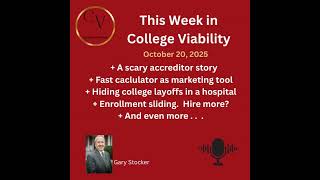
In this episode of the This Week in College Viability podcast, host Gary Stocker delivers a data‑driven commentary on the financial health of U.S. higher education. He begins by cataloguing recent layoffs and staff cutbacks at a range of institutions—from Massachusetts schools and a North Carolina college to Thomas Jefferson University and the University of Louisiana Lafayette—highlighting the disproportionate targeting of non‑faculty positions and questioning the efficacy of such cost‑saving measures. Stocker then introduces a new online calculator launched by about two dozen private colleges that estimates a student’s net cost using only family income and sibling enrollment, noting both its market relevance and his cautious stance. The discussion shifts to accreditation, focusing on the National Accrediting Commission of Career Arts and Sciences (NACAS) and its oversight of beauty schools, where Stocker critiques the agency’s conflict‑of‑interest structure, lax enforcement, and the broader implications for federal aid. Finally, he examines declining public trust in higher education, citing Pew, Lumina, and Vanderbilt surveys, and argues that low four‑year graduation rates (under 50% at many schools) are a core driver of that mistrust, using analogies to faulty consumer products to illustrate societal acceptance of systemic failure. Throughout, Stocker urges listeners to share the podcast, engage via email, and consider the broader viability challenges facing colleges.
Chapters
It is Monday, October 20th, 2025. Time for yet another episode of news and commentary for This Week in College Viability. Hi everybody, Gary Stocker. Thanks for making time to listen to this week's podcast. And of course, this is the podcast that talks about the financial health and viability of public and private colleges with data and with details and with perspectives offered nowhere else. And as always, please, I encourage you to forward the podcast link to your higher education colleagues, your family, your friends, your neighbors. No sense in just you getting the latest news and commentary on this whole challenged industry. And here is where the show is headed this week. Of course, layoffs and cutbacks, it's higher education. There is a new fast calculator, a fast calculator for need-based grants and scholarships. I have concerns, but it's the market moving, and I'll talk about that. There is a new accreditation story that is scary, and I have been nice to the accreditors for a few weeks now. We're going to change that here in a couple minutes. And another higher education decline story— that's how I'm going to wrap up the podcast today. And, and, and I draw a fun, I think, An interesting analogy from days gone by. And first, of course, as always, layoffs and cutbacks in Massachusetts. More than 400 jobs over the last 6 months since May of 2025, the Boston Business Journal found 400 jobs in the higher education sector. Of those colleges referenced, it included Worcester Polytechnic, Clark University, Harvard University, Boston University, Emerson College, and the Berklee College of Music to North Carolina, laying off approximately 50 staff. You ready for some spin here? 50 staff to address a budget deficit. There is a review on positions to be completed here in, in November, and no faculty layoffs scheduled. We hear that time and time again, so staff only. And of course I think I talked about last week, what were these staff doing before that they can be laid off and faculty not? I know what it is, but I'll leave that alone for today. And here's the number. So short $14 million, one, $4 million, 50 staff positions. Do the math, $14 million divided by 50, and you get $280,000 per year per person. Now you and I both know that's not likely. But that's all the story talks about, as if these 50 layoffs address a budget deficit, fix a budget deficit of $14.14 million. And, and, and, and by the way, the 4-year graduation rate for these colleges in North Carolina from 2016 to 2023 averaged less than 30, 3-0%. I have more on that later. Thomas Jefferson University to lay off about 650 employees. This comes after $195 million operating loss layoff. This is from KYW News Radio, Matt Coughlin, on October 15th. And what's interesting about this one is Thomas Jefferson University also has Jefferson Health System. And both are included in the layoff of about 650 employees. It notes that about 1% of Thomas Jefferson University's 65,000 employees are being laid off. So what's happening here? Here's, here's what, here's what's happening. Whatever layoffs are taking place at Thomas Jefferson University per se, the college per se, are being buried buried with layoffs from the healthcare part of the business. If I'm wrong on that, Thomas, Jefferson University, I'm at gary@collegeviability.com. Page 2, Leslie Turk at the Current, currentla.com on October 16th has a story. Ms. Turk writes, as its undergrad enrollment slid, The University of Lafayette, the University of Louisiana Lafayette, hiring sword. UL Lafayette went on a hiring spree even though their enrollment declined by 1,700 students since 2015, resulting in something like a $20 million loss in revenue according to Ms. Turk. Despite the downward trend, despite that downward trend, Developing in plain sight over many years, the university's hiring nevertheless continued on an upward trajectory. Now they say with 554 positions created, I'm not sure I buy that writing, Ms. Turk. I'm sure 554 positions were hired. I find it hard to believe that many were actually created in that timeframe, but I did want to read some of the hiring titles, the hiring job titles from that job ad— job addition, job creation, I guess— since 2015. A chief scientific officer, $2,900. That's just a salary. I'm not including the benefits because that would really get you to fall out of your chair. Chief operating officer at $275,000, maybe. An executive director, I don't know what, $220,000. Get this, at University of Louisiana Lafayette, an assistant an assistant football coach, $207,460 plus benefits, an associate vice president, $207,000, associate vice president for advancement options, $188,000, and both a chief innovation officer at $160,000 and change, and a chief strategy officer. I hope they share offices. And a chief strategy officer at $156,000. $1,000. And the list goes on, just to point out what many say, and that is higher education, both on the public and almost certainly on the private side, have way too many non-faculty hires taking place. And this is just an example at one public college, the University of Louisiana Lafayette. Page 3. Do you want to know— have you ever wanted to know what you'll pay for college before even looking? At a college? Well, a story in the New York Times, Anne Carnes, C-A-R-N-E-S, on October 17th, said— new— shows that nearly— or writes that nearly two dozen private colleges are offering an online tool that factors in need-based grants and scholarships to estimate a student's actual cost. Now, all right, the market is moving. I can understand that. I have no serious concerns with trying something else. But two inputs, here are the two inputs. The two inputs are their family's income. And the second is the number of siblings they have in college. Just a number, not where, not how much. And so this was two dozen colleges. Yeah, private colleges. And I know it's trying to happen. Ms. Carnes addressed this. They're trying to get more students, more families to say, hey, let's take a look. By showing that the actual paid price will be less than the list price, and we know that to be true in a preponderance of situations, and they're using a rather modest tool to make that argument. Nothing wrong with that, nothing wrong with that at all. A little spin going on, and that's, that's why I'm here, your higher education quality control coordinator, just to make sure that the perspective of others is shown for these things as well. Let's Let's go back to accreditors for page 4, and I'm going to talk about cosmetology. Cosmetology without accountability: failures of a beauty school accreditor. This is Jeremy Bauerwolf and Antoinette Flores on October 16th for New America. Of course, that is a think tank. I think it's a left-leaning think tank, as I recall. And we're going to wrap this up, but I want to read some of the details from the story that Mr. Bauerwolf and Ms. Flores wrote. And first, they did a good job of talking about that accreditation is supposed to signify that a college has met certain quality standards. All right, doesn't reference financial ones, but I can live with that for now. That a school has proven to an outside entity, the creditor, that it has the staff, finances, laugh, laugh, laugh, facilities, and academic track record to educate students. Accredited colleges are the only institutions that we know— of course, accredited colleges are the only ones that can accept federal financial aid like Pell Grants and student loans, which taxpayers fund. And of course, this arrangement is to make sure it helps cut back on fraud. Understood. Granted, so stipulated. Pearlands, P-A-R-L-A-N-D-S, Pearlands Innovative School of Beauty. I need one of those at my age. Pearlands accreditor is the National Accrediting Commission of Career Arts and Sciences. The National Accrediting Commission of Career Arts and Sciences, or as you and I are going to talk to it from now on, is NACAS. N-A-C-C-A-S. And, and I'm going to spare you the details because it's long and it's detailed and well done by these two writers, actually by these two reporters. But this accreditor, NACAS, is just not getting it done. I have a link to the show, to the article in the show notes. And here's the issue that Mr. Barrow-Wolfe and Ms. Flores report on. The issue is this accreditor for Pearl Lands, I think other colleges, learning organizations in their purview. They address one transgression at a time and envision a transgression in documentation, policy, finance, whatever. So NACAS then enables institutions to maintain their accreditation even as problems proliferate. For instance, they write, a college on sanction might have a year to correct a problem. But if a new issue arises during that period and the college resolves the original one on time, it gets another year, even if it's the same issue. And schools, of course, can and do, I presume, cycle through these violations for year after year after year. NACAS accredits more than 740 schools receiving federal money. This is from the Education Department. These colleges, those colleges took in more than $1 billion, with a B, in federal aid and enrolled 109,000 students in the 2022-2023 academic year. Do the math as we do here at This Week. Do the math and that's $9,100 per student in federal aid for those colleges that NACAS accredits. It goes on to note that beauty schools yield much lower compensation than other majors, and that many of the folks who complete this requirement don't make enough income to cover their loans, and it puts them behind the 8-ball right off the bat. And interviews and focus groups, some of these students and graduates told New America that their programs were often second-rate. And that they contended with problems ranging from outdated curricula to high instructor turnover. And of course, this environment raises questions about whether programs like these are worthy of federal subsidies if their graduates, whether it's cosmetology or anything else, have difficulty landing work and instead are burdened with what can be crushing student debt. And I'm going to go back to what I've said many times before. This accreditor and all the others, this accreditor, NACAS, NHLC, and Middle States, and the Southern Count— accrediting agency and others, they have a conflict of interest. The colleges, even this beauty college, even Pearland, even Pearland Innovative School of Beauty, pays its accreditor fee. I don't know what that fee is. So when an accreditor sanctions and ultimately closes a college, it's a negative impact on the revenue for that accrediting agency. Tell me that's not a conflict of interest. And I know others have shared, and I've talked before on this podcast, that these accreditors say, well, we've got systems and processes in place so that there is no conflict of interest. Yeah, yeah, I'm not sure I'm going to sign off on that. And it notes that colleges must report their accreditation status, and I think they do, especially for the major colleges, maybe not for some of these, because that's the case with ProLands. They're not reporting their status, and they did a little silent customer query, and I think 2 folks from this organization didn't even say to the prospective students that they were on probation. And I think most colleges admit that. However, it's my experience, because I've looked for these things, it's a game of hide and seek. It's a game of hide and seek to find those references to a college being on sanction from their creditors. And you've heard me say many times that major accreditors exhibit a consistent inability, in significant part, to focus on the financial weakness of so, so, so many colleges in this country. Let's do a wrap with the story that Emma Pettit at the Chronicle had on October 15th, and the headline read, Americans' Faith in Higher Ed Has Declined Even Further. Okay, this is the dime-a-dozen story, I know. But it's a reminder. It's yet another reminder. And she cites some stats and she says mistrust has grown in the last 5 years. This is from a survey from the Pew Research Center. It's down. Numbers don't matter right now. She also notes that there have been some more recent surveys that show the perception is up of colleges and the value they provide. One is from the Lumina Foundation. The other is from the Vanderbilt The Vanderbilt Project on Unity and American Democracy. Okay, interesting. And the numbers are up. Okay, again, I will stipulate that to be the case. Still, she writes, the trust deficit is unlikely to be closed anytime soon. While there's evidence that Americans think positively of higher education's research capabilities, there remains ample concern over things like price and political bias. Now, why, why do I close with this? Why am I wrapping with this? Two words, and those regular listeners are not going to fall out of their chairs. Two words: graduation rates. All of these surveys referenced above, all of these surveys are effectively generic, non-expert perceptions of the survey participants. All right, entirely valid. That's the way surveys work. That's what we get from those. We take them, we do our own critical analysis, and move on. What happens though? What happens though if some enterprising survey company asks the same question with the added context of how many colleges graduate less than 50% of their students in 4 years. For example, what about a survey question? Could be something like this to the participant: Research shows that most public and private colleges in America don't graduate even half of their students in 4 years, period. Does this give you confidence in the American higher education system? All right, made that up, but what if, what if there was some context added to these survey questions? It's negative, I understand. It's biased, I understand, but it's a fact. It's quite almost certain that those confidence numbers— I would do air quotes if this were a video show— those confidence numbers will plummet. And, and again, you've heard me say before, there are millions and millions of both traditional and non-traditional college students in this country who successfully complete college degrees. Yet there are at least that many— if we look at that 50% number, there are at least that many who do not. There is a decades-old joke about Microsoft, and it goes something like, if Microsoft built cars, for no reason whatsoever, your car would crash twice a day. Occasionally, your car would die on the freeway for no particular reason. You would have to pull over to the side of the road, close all of the windows, shut off the car, restart the car, and reopen the windows of the car before you could continue. And for some reason, back in the earlier days of Microsoft Windows products in particular, for some reason we would accept that. And I, I make the case we accept that today for colleges that can't graduate even half of their students in 4 years. That same analogy holds for graduation rates. We are accepting and/or ignoring unacceptable failure even catastrophic failure with low college graduation rates that would be immediately rejected in systems like cars or computers or refrigerators that didn't work half the time, transportation arrival times, electricity, and much more. You know, think about turning on your air conditioner and in, in the summertime, and maybe on occasion it triggers a cascade failure that permanently blows the power transformer of your entire neighborhood costing you something along the lines of $50,000 or your portion of that. It's kind of similar— not perfect, but kind of similar— to sudden financial need for students when there is some kind of irreversible system failure. Not enough sections, the course not offered, the major not offered any longer. How long would we accept that? Yet we accept with effectively next to no protest, no pushback, we accept that less than half of all college students graduate in 4 years. Today's higher education is a failure on the margins, on the margins for many, and they're rather large margins at that. But nonetheless, there are millions of successful stories. But on the margins, there's too much acceptance of colleges that simply don't work for too many students. Agree, disagree, have another thought, drop me a note. I'm at gary@collegeviability, one word, gary@collegeviability.com. As always, thank you so much for making time to listen to the podcast. Make sure to share that link with others. I'll be back next week with more on This Week in College Viability.