This Week In College Viability (TWICV) for Sep 29 2025
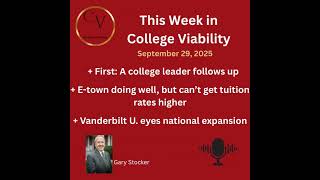
Gary Stocker and Matt Hendricks survey financial stress across U.S. colleges: Brown cut $30 million and 48 jobs, Champlain drew 25% of its endowment, and Bethel reset tuition to $26,700 and gained market share. The hosts argue the sector is entering a consolidation era of mergers and closures.
Chapters
It is September 29, 2025, time for yet another episode of This Week in College Viability News and Commentary. Hi everybody, Gary Stocker back in front of the blue Yeti microphone. And this, of course, is the podcast that talks about the financial health and viability of public and private colleges, the data and details and perspectives I believe offered nowhere else. And if you would please forward, forward the podcast link to your higher education friends and family and neighbors. No sense in just you, just you getting the latest news and commentary on the whole higher education industry. Access, access does not equal success. I heard this phrase on an international YouTube clip and I didn't get the source. Access does not equal success. You have heard me say many times that too many colleges focus on enrollment and not enough on graduation rates. I'm a broken record. Access does not equal success. This phrase captures the essence of that. Getting into college—access—does not mean a student will be successful and graduate. Yet, yet enrollment, enrollment is the focus we read and hear about for almost all colleges, and not the pathetic more than half, less than 50% graduation rate in 4 years for their students. This week, what else we have going on? A college leader at Bethel University, Minnesota, reached out with clarifying information from a recent story I had on his college. I was both impressed and touched. We'll talk about that. I'll give some of the details. Elizabethtown College, Pennsylvania, really doing well. And I've got some details on that, but the tuition and fees per student keeps shrinking. And Matt Hendricks and I talk about that many times on the College Financial Health Show every Tuesday. That's not— E-town is doing well even though they had some layoffs recently, but they just can't get the tuition fees up They're shrinking. And the Education Department— the Education Department hasn't even begun to fight. You gotta wonder what that's about. I'll have some details. Vanderbilt University in Tennessee— Vanderbilt University eyes national expansion. This one is really intriguing. And much, much more on the September 29th episode of This Week in College Viability. Layoffs and cutbacks— Brown University, big boy. Ivy Leaguer, Brown University to lay off 48 employees and eliminate 55 vacant roles. The Ivy League institution is making the cuts as part of a broader effort to shave $30 million from its budget. This is on September 24th from Natalie Schwartz at Higher Education Divide. And as always, I'll have the link for all these stories in the show notes. Southern Oregon University, one coast to the next. Southern Oregon University to cut 23 programs and lay off 18 employees. The media announcement reads, the public institution is no longer a comprehensive university, no longer a comprehensive university, and must pare down its academic offerings according to a new board-approved plan. This is also known as can't be everything to everybody. I've talked about that before. And again, this was on Higher Education Dive. Laura Spitalniak had that story on September 25th. They'll also lay off these— lay off 18 employees and cut roughly 3 dozen jobs. The cuts are intended to stabilize Southern Oregon University following years marked by unprecedented financial crisis, according to a plan approved by the trustees. In a 7-2 vote last week. Champlain College in Vermont, going back to the other coast, closing its Ireland and Montreal campuses next year. This was from Jackson Silver on NBC5 in Vermont. And when offered a chance to comment to NBC5, Champlain danced with the statement.
And when you dance with a statement, you're going to dance on my sensitivities.
And so that set off my data alarm. So to the data we go. Champlain College in Vermont, total operating revenue up 2%, total operating expenses up 12%. Do the math, that ain't good. That's from 2016 to 2024.
The net tuition revenue is down $21 million, from $71 million in 2016 to $50 million in 2024.
And interestingly, in 2020 '24.
To check that number, might be 2025. They took out a 25% draw of their endowment, 21/4 of their endowment, in one grab, in one year. And of course, the typical amount is somewhere in the 4 to 5% range. This one, the good folks at Champlain College, 25%, and that is a crisis dollar grab And, and to show they're in trouble, their unrestricted net assets, cash, are down 12% in the last 9 reported years since 2016. Bradley University—
let's go to the flyover country, to the middle of the country.
Bradley University, Peoria, Illinois, continues to see decline in freshman enrollment. This is from Zach Roth, the Peoria Journal on September— Peoria Journal-Star, excuse me, on September 23rd. And so what I did, I, on my own, I looked at Bradley's complete financial picture last week and then posted a note on social media, LinkedIn, that this college, Bradley University, would be a strong merger partner for other private colleges. While their enrollment certainly is down, they have strong financials, stronger financials that would bring value to merger partners.
And again, remember, we are in the consolidation period Others have been stealing my phrasing on that.
It's closures now, large-scale mergers in the coming years. College Drivel, D-R-I-V-E-L. Let me read from an annual report. Said the university, the university remains focused on academic innovation, student success, and strategic enrollment initiatives, including new programs, expanded online offerings and enhanced recruitment strategies for the years ahead. This came from one college, but could have been said by every college in America, folks.
Too many colleges, not enough students.
Most of the stuff they talk about will not work in this day and age. And let's go back to the Bethel University story. And I tell anybody who'll listen, it's obvious from my podcast, that I poke, lovingly poke, the higher education bear. Somebody's got to do it. Somebody's got to question so many of these things that have been assumed to be correct for years, if not decades. And so I had the story on Bethel University last week, and in effect, I questioned some of their points. Where's the data? All right, one was increase in market share. They said their market share had grown 19%, and I said, source that data, please. And they said also, 1 in 4 parents said Bethel's clear price was an important factor in their students' decision. All right, Mr. Tim Hammer, whose post I grabbed on this, dropped me a note. It was a fine note. I appreciate the note. And he really responded, and he cited the source for the market share that grew 19%, and he cited using Western Interstate Commission for Higher Education projections for Minnesota, where they are, high school graduates. Bethel's new student market share grows from 0.522% to 0.620%. Now again, that's, that's less than 1%, but it did rise, and it did rise by the 19% noted. So credit to Mr. Hammer for responding. Small market share gain, market share gain nonetheless. And then the one about 1 in 4 parents, and again he cited an internal survey that said 26%. All right, that's 1 in 4. 26% of Bethel— 26% of Bethel parents said our clear price was an important factor. In their student's decision.
There was also a point in the story— I think a big point of the story was Bethel's repositioned—
you know, I call this tuition resets— Bethel's repositioned tuition of $26,700.
This is from Mr. Tim Hammer at Bethel. Is intentionally transparent and eliminates inflated industry sticker prices.
Okay, duly noted, so stipulated. As with— and he goes on to say, as with any school's tuition Financial aid can still lower the price. And all colleges say that financial aid can still lower the price. That is a given. Not always. The goal of the repositioning tuition reset was to eliminate the inflated price. All right, I'll give you that. That too often includes confusing discounts, scholarships, and price cuts. We want our families to be able to plan with more confidence. Great. I will add a sidebar note. I don't think I mentioned this in last week's story. That I've talked with college presidents, and he suggested their parents prefer the high price, high discount model. And I've talked about this before. He said parents prefer that high price, high discount model. And you know why? So they can report to grandpa and grandma, aunt and uncles, neighbors and friends, my child got a $30,000 merit aid academic scholarship, whatever, to a college. And you and I, of course, know, like Tim Hammer would know, that's just a discount. But what if, what if, Bethel University, what if there are 75% of your students or your family— excuse me, your families— who prefer the high price, high discount model? Something to think about. But again, Mr. Hammer, grateful, grateful for your follow-up. It's, it's a tough market out there, as you well know. It's a tough market, sir, and I wish you and your organization the best in that very, very tough market. Page 2, Elizabethtown College. Ranks among the nation's best.
Okay, this is, this is spin.
Ranks among the nation's best in the 2026 U.S. News and World Report. Now I see versions of this story all throughout the media, as I'm sure you do as well, and they're citing a regional number, and I'll give you a couple of those in a second, and trying to make the headline read like it's national. It's not. And this is from its internal story, E-Town News, on September 23rd. Of 2025. And the SPIN takes— doesn't take into account anything about their financial health. I'll talk on that briefly. Moved up 7 spots, you know, best regional universities. It's now 40— number 45. So there are 4 basic regions, so 45 times 4 is one of the top 220 best undergraduate teaching programs, regional universities, number 6. I don't know how you apply multiple— that one, what the regional universities are for education. Best value regional universities, number 27 times 4 is about 120. And you see where I'm going with this. They spun the data to a headline that makes it read more than it really is. No question about the data, they're up in those things, but the headline is misleading. It's misleading. So let's go to the data, and this is interesting. The net tuition revenue is down 13%, 1-3%. It was $22,400 in 2016, and it's down to $16,000 and change in 2024. This is a good college. Their graduation rates are strong. They're hovering around 70%. Their total operating revenue was up 27%.
The expense is only up 15%.
They're doing something well, but they must be giving away the store on tuition discounts. When I looked that up in my iPad's data, it didn't post for some reason. So I'm guessing that the tuition discounts that Elizabeth Town College are up too high. All right, so I will cede the self-serving U.S. News and World Report story. Everybody does it. Colleges can say we are number 46 as many times as they want. In my mind, that is unlikely to move students. This is a solid college doing more than a decent job of managing everything. Yet the fees they can attract to get students to attend keep getting lower and lower. And they know this, and I know this. It's a trend that cannot continue indefinitely. And I still believe, fix the scale. Maybe, maybe Elizabethtown and Bradley University should start talking about, about a merger. It would be best for both to have already started internal discussions about what a merger or two or three could do for this college. The Education Department. The Education Department hasn't even begun to fight. This is a New York Times story on September 27th, Jonathan Hellwink, and the subheading reads, thanks in part to Biden-era regulatory changes, the Trump administration has a powerful set of tools it could use to threaten institutional eligibility for federal student loans.
Again, Jonathan Hellwink on September 22nd. He notes in part of the story, the department has the power to conduct an invasive review of an institution's administrative capability if it determines that the college was subject to significant negative action by another federal or state agency. Notably, he says, notably, Mr. Hoang says, the Biden administration did not provide a meaningful definition did not provide a meaningful definition of what constitutes a significant negative action. Mr. Hellwig notes, arguably, even the pulling of a single federal grant for any reason would satisfy this provision. He goes on to write, it is hard to say, hard to say how the Trump administration will interpret this and other similar regulations, but with federal agencies ending grants left and right, And with a multi-front assault on higher education, it is easy to imagine Ms. McMahon embracing the power that the previous administration provided to subject institutions to massive penalties or the loss of student loan eligibility. And this, he writes, is just the beginning. Other changes to institutional financial standards create more ways for Ms. McMahon to turn the screws And this includes a minimum requirement of a 10% letter of credit, 10% letter of credit. That is a demand that colleges convince a private lender to back 10% of the total amount of federal student aid funds received by the institution each year, even if the department merely suspects certain violations. I've said this before, whatever your political beliefs— I remember I don't do politics, sex, and religion— the what's happening with whatever federal policy changes now, or even in the future with a different administration, these are just another market factor for an already troubled industry, higher education, to consider. And maybe, pure speculation on my part, the Trump administration plans to do what they can to decrease the number of colleges, maybe both private and public, as part of their plans to make higher education better in their mold, whatever that may be. Page 3. Page 3, Vanderbilt eyes Vanderbilt University in Tennessee. Vanderbilt eyes national expansion. The university plans to build a campus in Florida. And has leased a site in New York City and aims to establish a foothold in California in its quest to grow beyond Nashville. This was by Josh Moody on September 25th from Inside Higher Education. So Tennessee, Florida, New York City, California— get your map out. That's some interesting geographical coverage, and count me as a big fan. Count me as a big fan. I will follow this for Vanderbilt and track others. You gotta think, track other big players, big boys and brand names that do likewise in the coming months and years. Page 4, let's do a wrap.
From the James Martin Center for Academic Renewal, Graham Hillard had an exceptionally strong article, exceptionally good article on September 26th. And Mr. Hillard's title read, College is Worth Saving. Amen. Universities are broken. Fixing them should be a national imperative. And I'm going to start off by reading just parts of what Mr. Hillard talked about.
He knows he could go on, but needn't dwell on the corruption of the curriculum, the utter worthlessness of the accreditation system— amen— the perseverance of illegal admissions preferences the decline of the liberal arts, the foreign student racket, or the ability of faculty and administrators to dodge public accountability. All right, that's quite the one-sentence indictment and accurate across the board. He goes on to add, Graham Heller goes on to add, what is so often missing from the college debate is something far less easy to measure.
He notes that universities turn callows boys and girls inexperienced and immature, turn callow boys and girls into confident men and women.
He says, perhaps that is not worth the expense, the bother, or the ideological headaches, but it is certainly worth something. Much is said about the college return on investment, Mr. Hillard continues, a worthy measure that asks students to consider what they will get for the tuition they pay The idea, however, that university ROI is exclusively financial overlooks what makes higher education beneficial in the first place, nor can such calculations account for the social value. What ought to not be forgotten, however, Mr. Hillard concludes, is that American higher education is the work of many generations, the envy of the world, and the source still of ever— still, still of life-altering value, life-altering value for countless men and women. Amen. I say amen. I and many of my immediate and extended family are a testament, as are millions of others, to the value of a college education.
I've lost track of the number of master's degrees my family has earned.
Two of us have terminal degrees. College— you see, you heard me talk about my college viability, that process. College is worth it. Go if you can.
The factor not addressed— the factor not addressed by Mr.
Hillard is that there are hundreds of these colleges, both public and private, not financially capable, probably not even operationally capable of being able to move callow boys and girls into confident men and women.
They just don't have the resources.
They're not going to tell you that. That's why I'm here. That's why College Viability exists as a business.
The news the data, the apps I use, all lead to an objective evaluation of the financial health and viability of these colleges. And I would argue their ability to, as Mr.
Hiller says, move callow boys and girls, like you have done for me and millions of others, into confident men and women. As always, let's call that a wrap.
Thanks for making time to listen. To another episode of This Week in College Viability. I'll be back next Monday with more news and commentary. Until then, thanks. Gary Stocker for College Viability.
More from Gary


What does it look like when a college increases both total revenue and total expenses?



College Financial Crisis? We look at the financial health of Bay Path U. (MA) and Coe College (IA)


Private College Financial Crisis? We look at the financial health of Hobart William Smith College


Financial Compass tutorial (Private college version.) Financial statements compiled 2016-2025.

