This Week In College Viability (TWICV) for September 8, 2025
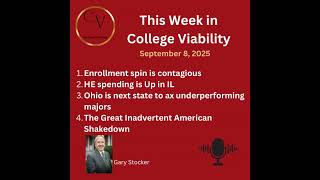
Gary Stocker examines how colleges misrepresent their financial health through selective data. LaSalle College in Pennsylvania shows declining graduation rates and enrollment while its president calls it a hot institution. Huron Consulting predicts up to 370 private colleges could close or merge in the next decade.
Chapters
It is Monday, September 8th, 2025. Hi everybody, Gary Stocker back behind, in front of the blue Yeti microphone with another episode of This Week in College Viability News and Commentary. And this, of course, is a podcast that talks about the financial health and viability of public and private colleges, and we use data and details and perspectives offered nowhere else. And as always, please add and forward this podcast link to your higher education friends, your neighbors, your families. No sense, no sense in just you getting the latest news and commentary on the whole industry. Share and share a lot. This past week, I continued wading through just dozens and dozens of fall 2025 enrollment stories. And as I shared 2 weeks ago, some are indeed legitimate. Some colleges are growing. They, in almost all cases, are big colleges with brand names, but not always. But most, most of these enrollment announcements— I'll tell you some logic behind that here in a second— most of these enrollment announcements are so spun, so spinning, as to make it difficult to read. And they have conditions and qualifications that they don't even state. And that's why I'm here to point those out to you. And here's some, here's some general observations. This is what higher education is trying to do in specific instances, specific colleges, to say they're doing well when, when all suggestions, all indications, all financial data suggests otherwise. And in many cases, these colleges are just giving away the store. In the form of tuition discounts. I know this because I track the data, because their net tuition revenue is down, even their price per student is down. And yet what do they pronounce loudly on their media? Enrollment is up. Well, sure, if you give away stuff, of course you're going to sell more of it, of course you're going to get more of it. And many, many times are using short segments of data, maybe last year, maybe last semester, maybe a couple years ago, maybe just post-pandemic, and they take small amounts of data and try and make a meal, a meal conclusion out of a morsel of data.
It's not good.
And there was one college, Keuka College, I think it's in Iowa, I need to check, K-U-E-K-A, said they're small on purpose. Well, okay, okay. That strategy defies all odds of scale. And as I recall, not a particularly financially healthy college. I have to take a look at that. Many of these stories are internal reports. That's fine. Colleges are welcome to report anything that they want. I'm here to point out when they're being silly, when they're not being upfront, when they're not being transparent. And more disturbingly, many of these reports are external sources, news organizations, some big ones that I'll talk about here in a couple minutes and some smaller ones. And too many times they're engaging in what you've heard me say what you heard me call regurgitating— regurgitation reporting. They're simply sharing the data that colleges give them and sharing with you as analyzed news, and it's not. And so many times these colleges say we're improving access. Well, that's fine. Making college affordable is fine. But what about the financial health of college, of colleges, of individual colleges? Don't they need a couple bucks to be able to meet payroll? And to keep the lights on. And nobody in these announcements ever talks about their graduation rates. Many, many of these, even though I don't check all of them, many of these that I do check have graduation rates, graduation rates less than 50%. They are coin toss colleges. Some even bundle in dual credits from high school students in their enrollment numbers. You have to look carefully to be able to see that. And there was one going back to graduation rates, One glowing report on enrollment increases from a college whose graduation rate was averaging 20, that's 2-0%, 20% over the past 8 reported years. That's Henderson State, Henderson State University in Arkansas. Their enrollment was down, their full-time equivalent enrollment was down in 6 of the past 8 years, down more than 1,400 students since 2016. But what do you think their pronouncement said? Their enrollment pronouncement said record enrollment, great enrollment. Didn't see anything about their 20% graduation rates. Oh, I messed up.
No sarcasm alert there.
And again, some of these are legitimate, 10%, 12%, something like that.
I did those numbers for you a couple weeks ago and I checked the numbers, not in all of them, and they're legitimate. And my standard is at least 5 years enrollment growth in the last 5 years.
And I go back as far as 8 and 9 years in some cases.
So I'm going to, I'm going to choose one college because they were in the news a couple times last week. I'm going to focus on the announcements, pronouncements of LaSalle College. It's two words, L-A space S-A-L-L-E. LaSalle College in Pennsylvania. Their president is a doctor, I presume, Dr. Daniel J. Allen. Their four-year graduation rate's about 55%, down 3 points. Six-year rate's about 65%, down 6 points. Now both of those are above my threshold of 50% of 4 years, uh, and 70% of 6 years, so a little bit below the 6-year ratio, but they're both trending downwards. All right, retention's about 70%, down 6 points. The unfunded institutional discounts I talk about many times— merit aid, most scholarships— they've actually decreased that amount, $34 million, over the last 8 reported years. The data is from the National Center for Education Statistics and its IPEDS database. The enrollment is down 1,476 students, down 5 consecutive years from 2019 to 2023. The Advanced Compass, Matt Hendricks' Advanced Compass, has it down from 35% to down 43% just in 2023 to 2024. The net income margin, also known as profit, is down 35 points since 2021. Their net tuition revenue is down 46%. Their net tuition revenue is down 46 points. Total operating revenue is down 42 percentage points from 2016. The expenses though are only down 16. 42 minus 16, there's a gap of 26 points. They're spending too much money from the, from the revenue they gain. And their CapEx to depreciation— and that's my safety ratio—
is below the minimum threshold of 1 for each, for each of the past 8 years.
Their endowment is down 37 points, and their draw— they're breaking the piggy bank— their endowment draw, taking money out of the draw, out of their endowment to keep the lights on, to meet payroll, has been above 7%. In 7 of the past 8 years. In 2023, it was 13%. In 2024, it was 18%.
And as you well know, the general target is somewhere between 4% and 5%.
This college, LaSalle College, is breaking the endowment piggy bank to make ends meet. And yet what do they say?
We're doing well, our enrollment is great, we're gonna recover, I see a future.
And I continue. I pulled the 2023 audited financial statement for LaSalle College. And if you look closely and you do what I always do, which I search just for the words going concern, I'm going to read to you from the 2023-2024 audited financial statement. These financial results— this comes from the auditors—
these financial results, as well as the industry-wide and regional trends in declining undergraduate enrollment, raised substantial doubt, substantial doubt about the university's ability to continue as a going concern. However, the president, Dr. Allen, says LaSalle is a hot school right now. La Salle, he says, is a hot school right now. No data to support that. He says it's related to our hyperfocus. I wonder what that is. Our hyperfocus on student outcomes and student success, modest graduation rates at best. And I'll be honest, you look at the data, and outside of the graduation rates, which are modest, not awful but not modest, this is not In my mind, this is not a consideration-worthy college right now. It's not a hot school, it's a hot financial mess. Their approach, like I say too many times, this is a build it and hope they will come strategy college. Nothing they're doing is any different than the hundreds of other colleges watching their last dollars circle the financial drain. And even the Philadelphia Inquirer, Susan Snyder And the Philadelphia Business Journal, Ryan Mulligan, had stories essentially that were not much more than regurgitation reporting. There was a little bit of analysis, but not much, and not nearly the depth that I just shared with you. And so why, why, why am I doing all, all of the work here? The Philadelphia Inquirer and the Business Journal, the Philadelphia Business Journal should be more than, more than a college regurgitation reporting service.
Look at the data.
Use the data and do your own analysis. Don't take this stuff from colleges verbatim. And again, I've shared this before, drop me a note. Brian Mulligan, Susan Snyder, drop me a note. I'll make available the tools that I use to reporters as a professional courtesy. I trained 2 reporters just last week on the tools I just used to report on LaSalle College. I'll give you the tools, I'll train you on the tools. Again, to reporters listening to this podcast, And if you're not a reporter, share this with one. These colleges are taking you for a spinning ride, and you appear to be willing accomplices. Page 2: Higher education spending is up as enrollment plummets at Illinois universities. This is the story by Jim Talamonte in the Center Square on September 6th, and the story reports that a former state lawmaker says Illinois is now tops in the nation on per-student spending in higher education despite enrollment plummeting as Illinois high school graduates select colleges in other states. Illinois Policy Institute senior fellow and former state representative Mark Battinick says he gets, he gets tired of people saying state taxpayers are not funding Higher education enough. This Illinois Policy Institute found that state government in Illinois spending on higher education in Illinois actually increased over $2 billion with a B as enrollment dropped by more than 106,000 students between 2009 and 2024. But Tinick says he gets tired of people saying that the state is not funding higher education enough. He notes that his policy institute found that 43 cents— that's 43 cents, 43% of every state higher education dollar from general funds goes to fund the pensions of retired college employees instead of instructing students. He notes that universities have not lost funding even though they have lost students. He says we're spending a lot of money per student on higher education We're just not getting the return on that investment. Tinick said students are getting better deals in other states because Illinois has increased tuitions, and he notes some numbers that document that. And the Chicago Tribune adds— Jeremy Gorner in the Chicago Tribune adds more on a September 6th story, and he notes specific enrollment increases— excuse me, specific enrollment decreases at Western Illinois and SIU Carbondale. And my alma mater Eastern Illinois, Northern Illinois, Chicago State, all with significantly decreasing enrollment over the past many years. There are exceptions: University of Illinois flagship campus in Champaign-Urbana and Illinois State did have enrollment increases. And all of this from the Tribune story lends strong support to what Mr. Bertinik is suggesting. Keep in mind, keep in mind that I did not bring up graduation rates in the Illinois publics. If you want to start your Monday off with some disturbing news, now, now you can take a look at the 4-year undergraduate graduation rates for these Illinois publics. In, I think, every case they are below 50%, and Illinois privates are generally not any better. There are exceptions, of course. Kasia Lundy, who's a partner and principal at EY Parthenon, had a story on September 3rd, The Impact of Federal Policy Shifts Higher Education Enrollment Cliff or Moderate Decline. Is it going to be a cliff or decline is what Ms. Lindy wrote about, and she did some good work here. I'm just going to point out the highlights. She notes, when modeled across 3 student populations, EY Parthenon and Ms. Lindy estimate about a 1% to 3% decline in aggregate enrollment by fiscal year '31, '23, uh, 2031, translating to a headcount loss of 100,000 to 700,000 students. She notes this is a meaningful shift, of course, especially when compared to historical forecasts of a 1% cumulative growth over the same period. Graduate enrollments may actually be more positive, she says, but overall the graduate segment represents a higher variability and greater downside because they get— colleges get more tuition dollars for for graduate students. And about 75% of the anticipated declines Ms. Lundy notes will be driven by international and graduate students, and about 25% by domestic undergrad students. She has, of course, can't do this on a podcast, but I've got a graphic in front of me. She does worst case, pessimistic case, middle case, and optimistic case scenarios, and that's all fine. That's good work on her part. But here's the interpretation. This is not a rosy picture. This is not a rosy picture for higher education. It is a big-time consulting firm with big-time talent putting a range of options out there for the industry to consider. And even though it's based on a bunch of assumptions, that, that's fine because that's what predictions do. This is yet another statistical nail in the current business model for higher education. Page 3, let's go to Ohio.
Senate Bill 1 is forcing Ohio universities to cut dozens, dozens of degree programs. We've seen this before in Indiana. I reported on this from Texas.
This is published on September 7th by Laura Hancock at cleveland.com. And as always, I'll have the link in the show notes.
She reports Senate Bill 1, among dozens of other requirements, states that Ohio's public colleges and universities must axe—
A-X—
undergraduate degrees if the school confers an average, an average of fewer than 5 degrees a year over any 3-year period. There is the reporting notes Ohio University intends to eliminate or merge 29 undergraduate degree programs. Other colleges are doing likewise throughout the state.
Public colleges are doing likewise throughout the state. Of Ohio.
And so in the article, again, there will be a link in the show notes. There's a lot of whining from the professoriate in this article. And the reasons are before, and I'm not going to go into them in the podcast. And then here's my point. The professors, the faculty, the academics, they didn't, have not, and cannot historically manage programs and majors with, with, they have decreasing volumes, enrollments. They typically only add programs and rarely, if ever, cut programs. So as we saw in Indiana, as we've seen in Texas, and as we'll see in other places— I think Utah is also referenced in this story— so the state of Ohio stepped in and did it for them. So now my count is 4 states: Texas, Ohio, Indiana, Utah, with a cut them if you don't use them mandate for market-unresponsive colleges because they just haven't managed their product line, their majors line profitably. And it will be interesting, it will be very interesting across the country, not just in these states, to see if private colleges, some private colleges have the marketing prowess to pick up materially significant numbers of students from these public college program and major cuts.
I'm not betting the family farm on that, but it's possible.
And again, promo for College Viability, the 2025 College Majors Completion App, 64 common diverse set of majors for every one of the public and private, 2-year public and 4-year private colleges, 2020 through 2023, associate, bachelor, and graduate program completion numbers. And percentages, internal market shares per college, external market shares across any user-defined market that you want. It retails at $799 because I need to get this in the hands of more people through the end of September at least. It's $199, $200, $200 lousy stinking dollars to see how your college is comparing with others in a manner I don't think anybody else provides.
Page 4, Financial Advisor Magazine, fa.mag.com, September 4th, Amanda Albright and Elizabeth Rembert reported on a story, and this is from Huron Consulting story, but the headline reads, hundreds of U.S. colleges poised to close in the next decade. Now, this is one of many stories similar to one I talked about earlier in the podcast from EY Parthenon. They just— nobody's writing, hey, higher education is going to thrive and survive. Nobody that I've seen with any credibility is writing those kind of stories. Yet here's another one that says hundreds, hundreds of colleges poised to close in the next decade. I think it's closer, it's shorter than that. And it's again, a Huron Consulting report predicting the closure numbers. Give me a dartboard, I can do the same thing. I'll predict college closures for you. Give me a dartboard. I'll throw the dart at the dartboard. Whenever the number hits, that's my number. And here it says, a dwindling number of prospective students will drive as many as— there's a nice qualification— as many as 370 private colleges in the U.S. to shutter or merge with another institution in the next decade. Now, this is what caught my attention. This is from Peter Stokes. Who is a managing director at Huron. And Mr. Stokes says, essentially, the problem we have is too many seats in too many classrooms and not enough college— and not enough prospective college students to fill them. He adds, over the next decade, we're going through a very painful but necessary rebalancing in supply and demand. I'm guessing Mr. Stokes must listen to my podcast because he's essentially paraphrased what I have said time after time after time. He's effectively restating that argument that I've made for, for years. Too many colleges, not enough students. I can do it in fewer words. He notes that the projected closures, and he suggests mergers, I think that's going to be smaller number, will impact around 600,000 students and affect about $18 billion in endowment funds. He adds, these are schools where we see red lights, red flashing lights and warning signs that they're in significant financial distress, he said. Huron declined to disclose the names of these schools. They declined to disclose the names of the individual colleges that they expect to close. Why is that? Is Huron afraid they're going to make somebody angry? The data is publicly available. I use it all the time to call out financially unhealthy colleges by name. Now, like, here, and I'm never going to say a specific college will close, and that probably wasn't fair of me. I'm never going to say a specific college will close. I have a good idea which ones won't survive, but it's, it's tough. And that's why the, the apps I create, the data that I share, the media that I do, I make tools available so that the consumers can decide which colleges will survive, which colleges will need to close. I have kind of the Kelly Blue Book, if you will, for colleges.
Kelly kicks the tires on cars, I kick the financials on colleges.
It's kind of a reverse FAFSA.
I've talked about this before, where the FAFSA of course gives colleges families financial information. Why not a tool like I've created, like Matt Hendricks has created, that lets families look at the financial health of colleges. And I, I have suggested some colleges are not consideration worthy.
I did that earlier today.
Draw your own conclusions.
And what are some of those red lights that, that Mr. Stokes is referencing?
Net income margin, net tuition revenue, the imbalance between expenses and revenue I talked about before for LaSalle College, the low capital expense depreciation ratio suggesting colleges aren't properly managing their infrastructure and leading to potential safety issues. Those individual college red lights are obvious. They're obvious in the College Viability App, the College Majors Completion App, the Private College Advanced Financial Compass from Matt Hendricks at Perspective Data.
It's, it's for the consumers to choose.
Your aunt can throw a dart at a dartboard and say it's going to be 300-some-odd colleges. But the consumers need to know which colleges. Here at College Viability, we make the data available. So that the individuals can choose which colleges they want to invest their resources and their time in. And let's do a wrap. Dr. Peter Corey, I've had him referenced him in the podcast before. I think I might want to invite him on the podcast. So Dr. Corey, if you're interested, stand by. You may get an email asking you to join me for a special podcast episode someday. He wrote with the LinkedIn post, The Great Inadvertent American Shakedown. The Great Inadvertent, okay, American Shakedown. This is on August 31st. And of course, Dr. Corey is the president and CEO of Unity Environmental University.
And I've got the link for this LinkedIn post.
He starts with a quiet signature, and I'm going to read from his post. It starts, With a pen on paper, an 18-year-old, barely old enough to rent a car, signs a promissory note promising decades of repayment in exchange for the hope of a degree. For families across the United States, this ritual has become less a choice than a rite of passage. Unlike a mortgage or retirement account, a student loan is not about building wealth. "It has become," Dr. Corey writes, "it has become a lifeline to prevent decline, the middle class's quiet bargain to hold on a little longer." The numbers sharpen the picture. Since 1980, public college tuition has increased by more than 200% above inflation. Say that again, public college tuition has increased by more than 200% above inflation while median wages have remained essentially unchanged based on inflation. Federal debt— you've heard these numbers before— now exceeds $1.7 trillion, disproportionately carried by middle-income households. Dr. Corey concludes student loans are no longer simply about financing education. They function as a shadow safety net, filling the gaps left by stagnant wages Rising healthcare costs and soaring prices. Now, in this post, Mr. Corey, excuse me, Dr. Corey starts and ends with this paragraph, and I'm going to read it, that if colleges cannot stop extracting wealth, tuition payments cannot stop extracting wealth under the guise of opportunity, their unraveling will not be tragic but inevitable.
"It will be the overdue reckoning of institutions complicit in a system never designed for scale, governed by those who have never known financial precarity and founded with noble intentions that have been systematically corrupted." Dr. Khoury, amen. To those listening to the podcast, I'm always grateful. Thank you so much for making time to listen. Make sure to share the link with others. I'll be back next week and sitting in front of, in front of the Blue Yeti microphone, Gary Stock with College Viability. We'll be back next week.
More from Gary


What does it look like when a college increases both total revenue and total expenses?



College Financial Crisis? We look at the financial health of Bay Path U. (MA) and Coe College (IA)


Private College Financial Crisis? We look at the financial health of Hobart William Smith College


Financial Compass tutorial (Private college version.) Financial statements compiled 2016-2025.

