This Week In College Viability (TWICV) for July 8, 2024
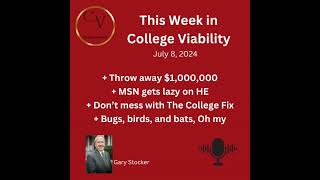
Gary Stocker surveys the financial crisis in U.S. higher education: Northwestern College closed abruptly, Goddard sold its campus for $1.1 million below book value, and public confidence in colleges has dropped to 36% since 2015. FAFSA completion rates are plummeting, and schools from MIT to community colleges are cutting staff while enrollment stagnates.
Chapters
It is a Monday in July, so that makes it another time for the This Week in College Viability weekly Monday podcast. Hi everybody, it's Gary Stocker back again with news and analysis for the higher education industry. And the competition for the 2024 Olympics is drawing near, and we are sadly seeing competition for the shortest notice of a college closure. More on that shortly. Today we also have how to throw away a million dollars. A private college shows us how to do that. Applications are not enrollments. Somebody get MSN on the phone because their reporting is lazy, as is the case in many other places. And don't mess with a website called The College Fix. I've had them on the podcast before. MIT is in their sights today, and they have added 1,200 students, and I'll tell you under what conditions in a minute. And the good folks at Hampshire College, they have been in and out of the news for a couple of years now. They show us that a morsel of good news, they try and make it into a feast, and it's not. And I'll tell you why it's not. We have a faculty story later on in the podcast about bugs, birds, and bats. Oh my. And believe it or not, there's another Is College Worth It survey. What I'm going to try and do as we wrap things up today is how that impacts potential closures this coming fall, all associated with the declining status of finances in many colleges. And of course, the FAFSA debacle that we have talked about many times before. Layoffs, cutbacks, and closures. I just have a closure today. It was how it was the 4th of July week, of course. And so not much news in the college layoffs and cutbacks front, but just this morning, Northwestern College in a Chicago suburb announced its closure. All right, that happens. Here's where they're in the Olympic competition. They closed their doors on Saturday, July 6th, and announced it today, which of course is July— Monday, July 8th. And this continues that concerning pattern of short notice closures, or in this case, no notice closures. And I'm going to be watching this fall. To see how many colleges that do have to close, and there will be many, how many of those colleges treat their students and faculty with some level of respect and even accommodation to give them a heads up. I, I got to think something along the lines of a year or at least a semester when announcing their closures. I could go either way. I really don't know which way that's going to go. The pattern now is not a good one. Page 2, I had to throw away $1 million. Erskine College at arptalk.org, article by the guy, by Charles Wilson on June 4th. And here's how I found out about this story. I got a text from somebody or an email from somebody, maybe it was on LinkedIn. And here's the text. He says, did you see that the trustees of Erskine College pulled out $1 million from their endowment, which is modest already, to lend to a charter school startup? All right. We all make business decisions. He goes on to say, as I understand, that was about 5% of the total endowment funds. That's probably a little low. Um, I'm jumping in there. The school promptly defaulted on the loan after exactly— this charter school promptly defaulted on the loan after exactly one payment. Erskine College has filed suit to recover some or all of the funds. His editorial was unbelievable with an exclamation point. And here's what this points out. It's an example. I'm not going to indict the college leaders. They deserve it. But this is an example of the lack of systems and processes in too many colleges. Somebody probably had a hair and thought this was a good idea. And so to the data we must go at Erskine College. Their FT enrollment is actually up a little bit from 2015 to 2022. Their 2022 endowment is just at $39 million and change. So not a whole lot available to give away. To not to give away, to loan to a charter school. Their unfunded institutional grants is up $8 million over the last 8 years. So they're trying to give away more of the store to get folks in the door. And their 4-year graduation rate is down 15 points, down to 41% in 2022. So here's an idea, leadership at Erskine College, maybe instead of lending money to a charter school, and Lord knows what the connections were, Maybe you should invest in helping more of your students graduate in 4 years. The sale price. Now we talk about college closures all the time. That's one of the things that I do. And Goddard College, of course, closed earlier this year. And the sale price, I think that's right. The sale price for Goddard College was $3.4 million. Now this is a kind of, um, auditing story, I guess. So $3.4 million is what they got for the campus. So I went to their financial statement and the line is called total, uh, plant power, property, plant and equipment, PP&E, property, plant and equipment was about $4.5 million. So property, plant and equipment was about $4.5 million. So the $3.4 million for the campus sounds right. And that's going to include, it's not going to include things like the prop or the, um, plant and equipment, computers, chairs, desks, file cabinets, all that kind of stuff. So in my mind, that's about right. And that's not always the case. Many times the sale price of a campus is much much lower than, um, than the value of the property is, the value of the PP&E is. So the good folks at MSN, their headline on July 6th— this is by Angela Johnson at MSN— reads, why HBCUs enrollment is exploding and what officials are doing to keep it that way. Well, their enrollment is not exploding. Their applications are exploding. So the headline is wrong. She's mixing applications with enrollments. And I guess the good folks at MSN and Angela Johnson were desperate for an easy news story. And again, I'll share what I've shared before. Applying to college isn't much more difficult than adding an ingredient to your pizza or taking away an ingredient to your pizza. You checkmark a box. And you get another item for your pizza, you check a box and your application goes to another college. It means next to nothing. It is the enrollment. And even the enrollment is only a minor consideration. It's the tuition and fee revenue that comes from those enrollments that matter. So Angela Johnson, get your terms right. Enrollment is not the same as applications. Page 3, Iowa colleges. Here's the headline. This is from Brooklyn, uh, Draysey at the Iowa Capital Dispatch. On July 5th. Iowa colleges see lower federal student aid completion rates. All right, well, we're seeing that across the country, but I wanted to share the numbers, and I have two colleges that were in that story. Luther College is down 18% prior year to date, and Drake University is down 15%. The numbers I'm hearing are closer to 10%, so what I'm going to watch is, is Iowa seeing a more substantial impact, negative impact, on the FAFSA debacle in other colleges. There was also a separate story that Old Dominican University in Ohio was down 15%. So interesting. I, we're of course going to be watching these numbers very closely in the coming days and weeks as we get closer to the start of that fall term. And all right, don't pick— please don't pick on thecollegefix.com. Over the last many months, I've had stories where they go in and they're trying to find— they are finding stories about colleges that have finance and other mismatches. And so the story from Micaiah Bilger, the assistant editor on the Fourth of July— good for him or her working on July 4th— the headline reads, MIT, Massachusetts Institute for Technology, grew staff by 1,200 students while enrollment barely budged. Enrollment was up a few dozen students, as I recall. So what this story shows As I'm sure there's many college leaders listening to this podcast thinking, boy, I'd like to add $1,200 when my enrollment doesn't change. This really just, again, in a different manner, demonstrates the difference between the haves and the have-nots. I don't know that the College Fix story is going to register with the MIT leadership at all. But again, to have some fun with this, don't mess with the folks at the College Fix because they're tracking stuff. and they're going to let the world know about it. Lakeland Community College tries to stabilize budget, another round of layoffs. This is from Ideastream Public Media, Connor Morris on July 2nd. So here's the details. Lakeland Community College in Kirtland— and I don't have a state on that, my apologies— in Kirtland is laying off 17 employees, the second wave of layoffs since 2023. The college is trying to right the ship as it contends With a $3 million budget deficit, as we've heard many times before, different number, same story, 17 positions, including people in higher-level management positions, is estimated to save the college about $1.5 million. That's not $3 million. I don't know where the rest comes from. Uh, the college had been dinged in an audit for not reducing its staffing despite enrollment drops by more than half since 2012. And we have seen that time and time again. And sadly, I believe we're going to see that time and time again. After that page for Hampshire College, and I touched on this, I think last week, Hampshire College cut 9% of its employees in restructuring. All right. This is the Massachusetts nonprofit, has a unique curriculum and a unique format. It is consolidating its institutional services and reducing administrative ranks Amid slowing enrollment growth. And this is a story from Higher Education Dive on July 1st by our good friend Ben Unglesby. And here is the interesting quote that I would talk about. The president, Edward Wingenbach, and he's been there for a while through the trauma they had a couple of years ago. He's quoted in the story. As saying we're still growing, enrollment is increasing, Ringenbach said. And he goes on to add, this is really more about ensuring that we can continue to be successful as the parameters of that growth change. Well, he's, he's correct in that the enrollment is increasing, but it's increasing from a tragic crash that happened from 2015 into the 2020, 2020, 2020, 2021 time frame. So again, let's go to the data. So from 2015 to 2022, the last reported set of data points in IPEDS, and that's the deal that we have to go with. At Hampshire College, the tuition and fee revenue is down $28 million. Enrollment, full-time equivalent enrollment, is down 64%, down 900 students. Revenue to expense ratio is 0.54, which means for every dollar in expenses, they only have 54 cents in revenue. And the endowment is at $40 million. That's actually down $6 million in that timeframe. And their expenses are down $21 million. You would hope it would be down a lot. And the graduation rate is just above— the average graduation rate is just above 4 years. The 4-year graduation rate average is just above 50%. It's above my threshold of calling a college a coin toss college, but nothing to write home about. And here's, you know, my good friend John Nichols. And of course, Jonathan wrote the book Requiem for a College. If you haven't read it, you need to. It details in both emotional and great detail what happens to his college that closed, St. Joseph's in Rensselaer, Indiana, back in 2017, I think. John Nichols says, be careful, the psychologist, be careful about taking a morsel of good news and calling it a feast. And if I were a prosecutor, I would, I would suggest that the good folks at Hampshire College are guilty of that. Yes, they're growing, but they're laying off folks. Don't be taking a morsel of good news and saying, hey, we're fixed, calling it a feast. That's not the case. So here's a headline for faculty. Notre Dame College delays final paychecks. This is from Signal Cleveland by Mark Niemiec and Michael Inviolo. This is on July 1st. And for faculty listening to this episode of This Week in College Viability, this is a reminder that your reliance, your sole reliance on your college leadership to be forthcoming with financial and other data is a risky proposition. The good folks at Notre Dame College probably relied on their, on their leadership for honest updates on finances, and they clearly didn't get it. And I will tie into that. Remember, I've created a special college viability app for faculty and staff, both on the public and on the private side. And, and I think I noticed a couple podcasts ago, The retail price is $300. That used to be for an individual license. Order it between now and the end of the year, December 31st. Order it between the end of the year and I'll make your license, make, make that license an enterprise-wide license. So for $300, you can share the capacity, the capability, the ability to compare private and public colleges in your region, in your state, whatever the case may be. Take me up on it. Don't take me up on it, but the good folks at Notre Dame College I'm guessing they wish they would have looked at the financials of their college a little bit more closely, a little bit sooner. Another faculty story, two in a row. My university closed. Now what? And this was a story in the Chronicle on July 1st, written by a faculty member who had lost her job. Her name is Brittany Carlson. And here's the quote I want to read. And again, the link to the story will be in the show notes. And Dr. Carlson, I believe she's quoted in the story saying, I joined a tiny department and enjoyed collaborating with two excellent mentors and coworkers. And she was at Iowa Wesleyan. Of course, they closed last year. Sure, the story goes on, the quote goes on. Sure, Iowa Wesleyan had its challenges and my colleagues and I, get this, my colleagues and I shared office space in a hall with cannibalistic hornets, occasional birds, bats, and various critters. But despite those minor inconveniences, Brittany Carlson says, I was on cloud nine. Now, I've been in a lot of buildings. I'm sure almost all listeners have been over the time, and we see the occasional bug, I'm sure. But it's been a long time, a really long time since I saw any of these creatures inside of a college or any building. In any substantial nature. Now, the reason I bring this up is I've talked previously about deferred maintenance. Maintenance that should be done on colleges to keep them in good— keep buildings in good repair and to keep cannibalistic hornets, occasional birds, bats, and various critters out of those buildings. This is just evidence. This is an icky indicator that this is almost certainly happening at colleges because, of course, Iowa Wesleyan closed They were almost certainly deferring funds that should have been, or could have been, maybe were budgeted for maintenance, but not actually used. And I hope that the consequences throughout the country are just, just the occasional bug bite and not something much more catastrophic. And so let's wrap this episode. With a poll. And this is from the Associated Press, Jocelyn Gekker, today, July 8th. Is college worth it is the headline. Poll finds only 36% of Americans have confidence in higher education. All right, we've seen these kind of studies before, and I'm going to come to a point here. Here's some quotes from the story. Overall, only 36% of adults say they have a great deal or quite a lot of confidence in higher education. And this report was from Gallup and the Lumina Foundation. That number used to be 57%, so down 21 points since 2015. And I'm going to go on with the quote. The dimming view, the dimming view of whether a college is worth the time and money cuts across all demographics, including gender, age, and most importantly, political affiliation. Now, among Republicans, it's a higher number. It's gone down a lot more for Democrats than it has for an independent and independents than it has for Republicans. So here's the final quote. And this is a cultural quote, even though it's from an individual person. It's so expensive. And I don't think colleges are teaching people what they need to get a job, says Randy Hill, 59, a registered Republican in Connecticut. And a driver for a car service is his job. He goes on to say, you graduate out of college, you're up to your eyeballs in debt, you can't get a job or a good paying job. That's my part. Then you can't pay it off. What's the point of going to college? I would add. Now I've had these types of stories before, as I shared, and I make the argument that each one of these stories move the higher education market, the students and their families adult students toward that cultural tipping point when going to a college becomes, instead of a primary consideration, a secondary consideration for many. And of course, millions will still go to college and they should, and they need to. And I'll share again, my College Viability Manifesto starts with 3 points. College is good, really good. Go if you can. I'm a benefit of that. Number 2 is graduation is better than just going. And the third one is some colleges will not survive, but many, many will. So how do we tie this all together? And I go back to a story that was in a Southwest Airlines book many years ago. As I recall, Southwest Airlines makes its money on the last 5 seats, the last 5 passengers that get on their airplane to fill it up. I can't remember the size of the Southwest plane, but the last 5 seats make the money. And it's really the same for every other business that I can think of. It is those last few cars or computers or phones, or in the case of higher education, those last few college seats where net revenue turns positive. The first hundreds or thousands or millions and billions or billions of cars, computers, phones, college seats, help meet payroll, and help keep the lights on. And again, cars, computers, and colleges all operate on the same business premise. It's an economic model. It is a marginal increase, those last few of anything, where the profitability becomes materially significant. And so when the FAFSA debacle plays out this fall, And those last 10 or 15 or 20 enrollment seats don't come through for financially challenged colleges, it will be then that many will have to turn off the lights for good. This is Gary Stocker for This Week in College Viability. As always, thanks for listening. I'll have links to all the stories in the show notes, and let's do this again next Monday.
More from Gary


What does it look like when a college increases both total revenue and total expenses?



College Financial Crisis? We look at the financial health of Bay Path U. (MA) and Coe College (IA)


Private College Financial Crisis? We look at the financial health of Hobart William Smith College


Financial Compass tutorial (Private college version.) Financial statements compiled 2016-2025.

