This Week In College Viability (TWICV) for June 9 2025
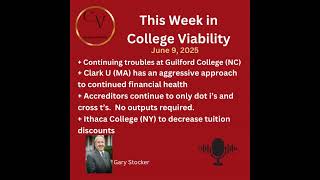
Gary Stocker surveys campus closures, faculty layoffs, and enrollment declines at schools like Harrisburg University and Clark University, revealing a pattern of too many seats chasing fewer students. He examines financial distress metrics and questions why accreditors like the Higher Learning Commission reaffirm struggling colleges despite negative cash flow and low graduation rates.
Chapters
It is June 9th, 2025, time for yet another podcast episode of This Week in College Viability News and Commentary. Hi everybody, Gary Stocker back again for this week's news and commentary on the higher education industry. Last, last Friday, June 6th, was the 81st anniversary of D-Day. Now I read a lot I read a lot about the soldiers and the leaders, the planning and the actions, and more about military events. Those stories fascinate me because they are stories of true life, stories of true life and death missions. It is this same group of sailors and soldiers and airmen that arguably started the higher education boom by using that GI Bill after World War II. Yeah, last Friday, June 6th, 2025, 81 years after these same soldiers risked everything on the beaches of France and elsewhere, I don't recall seeing one college or university news story, not one did I see commemorating the date. Now, there may have been some. I don't follow every single college out there, But I consume a lot of news every day and I didn't see anything. So these soldiers, these very same soldiers preserved the freedom for colleges to exist, arguably, but logically, these soldiers preserved the freedom for colleges to exist. They came back and funded the biggest period of sustained growth in higher education. And 81 years later, that same industry, our industry, higher education, that industry ignores their accomplishments and now their memories. Not good in so many ways. And to this week's news and commentary, let's start off with, as we always do, layoffs and cutbacks. Harrisburg University to close the Philadelphia campus. This is Josh Moody. Josh Moody had the story in Inside Higher Education on June 5th. And it's just, the details aren't important 'cause they're same as everywhere else. Too many college seats, too many colleges, not enough students willing to fill those college seats. And then Pennsylvania's only one of many states, many states with that college and student imbalance. Other states like Missouri and Illinois, Indiana, Ohio, Massachusetts, New York, and others, too many colleges, there are going to be more closures. And after the closure period is done, there will be mergers. Trust me, because that has happened in every other industry I can think of except higher education. Guilford College— Guilford College, North Carolina considers formal step toward possible faculty layoffs. Again, these kind of stories are common. Matt Hartman had this on June 5th for the Assembly of North Carolina. And here's a story from, from Matt Hartman's reporting. Interim Provost Kami Rowan— forgive me if I missed that— Ms. Rowan wrote in a May 21st email to a group of faculty that the board chair and executive committee informed the budget committee that financial exigency is imminent. She said that the fall enrollment was below the college's target. She goes on to add And this again from Matt Hartman's story: 'Without significant changes to our financial model, we simply do not have the cash flow or revenue to continue operating,' she wrote. Two days later, the college's budget committee, made up of faculty and staff, wrote a memo to the acting chair of the board of trustees, Mr. Dan Mosca, saying that they could not come to a consensus about declaring financial exigency. All right, it happens. Now keep in mind that the board can declare exigency without this committee approval at this college, and probably most. So Acting President Jean Parvin-Bordovich— and I always take note of acting president, never a good scenario— Acting President Jean Parvin-Bordovich, uh, says, I believe that the strategy for the Guilford of the future, she quotes that, must double down on what is unique and most valuable at our school. And you know the argument I'm going to make. There's nothing unique and valuable about any single college. It's a commodity. It's the degree that matters. The trees are different, the buildings are different, the faculty is different, the majors are different, but there is nothing unique and most valuable. It's a commodity service. He was— she wants to use that, or she says unique and valuable attributes, to recruit and retain a broader group of students "Who will be a good fit for Guilford and remain for 4 years," she wrote. But she adds, "It is clear that to be fiscally prudent, we must do that with a smaller administrative staff and teaching staff because we will have fewer students and insufficient revenue to support Guilford at its current size." So again, these arguments you've heard me share them before. Who is the leadership at Guilford? Who are the faculty at Guilford looking out for? Are they looking out for their students? I don't know that you can make that argument. Or are they just looking out for themselves? And they're entitled, they're entitled to look out for themselves. We all do that. But let's be upfront about it, that the mission of President Bordewich is to preserve the college at all costs. And not really what's best for the students. And so while, as the good folks at Guilford College watch the last dollars circle the financial drain, what possible kind of quality, competitive quality, can this offer its students? And I'll note that not, not one person from Guilford, not one person, referenced their students It was all about the college surviving. Draw your own conclusions. Clark University, interesting story.
Facing declining enrollment, Clark University to reduce faculty by as much as 30% over the next 3 years.
And I had a lot of sources on this. I'm gonna use the one from Camilo Fonseca at the Boston Globe staff on June 6th. Although Juliette Schulman Hill had a good story on it as well at MassLive. Coincidentally, Matt Hendricks and I had Clark University on the April 29th College Financial Health Show, and, and we reported a strong financial college, sustainable for the foreseeable future if not beyond. And even the core— there's a quote in the story from masslive.com that tells us a little bit more. It says, on top of the layoffs at Clark, the university plans to reconfigure its academic programs. It goes on to say that includes eliminating low-enrolled majors. Okay, good. More colleges need to do that. Most of them do it as a last-minute, hitting, hitting the panic button kind of approach. And I looked at my 2025 College Majors Completion app to check this out, and indeed Clark has a large number of low-enrollment bachelor-level majors. I didn't check the master's level. But many of those majors probably have courses in them that are gen ed related and embedded in those majors, embedded in those departments. So it didn't quite ring a bell. The employee count at Clark has only inched up a little bit from 2,700— sorry, from 2,500 to a little over 2,600 in 2023. And using Matt Hendricks' perspective, data science, the Advanced Financial Compass, I did note that employee earnings— interestingly, employees earning more, employees earning more than $100,000 per year had gone from 95 employees at Clark University in 2016 to 179 in 2023. Now, Massachusetts, high-cost state, I understand that that might be logical, but that's a jump. That's, that's a jump for sure, and maybe something that we need to keep an eye on. And that value of $179 is significantly above the 75th percentile for all private colleges. And even the vendor comparison table that Matt has in the Advanced Compass shows nothing of note. Almost all of the vendor prices that Clark pays hover around the median value, so even that doesn't raise an alarm for me. And the article did say that the university will miss its fall enrollment by about 100 students, 80 to 100 students, it said. All right, well, that's, that's noteworthy. That's a couple bucks for sure. But this is a financially strong college. Something doesn't feel correct here. And the more I thought about it— and I spoke with the reporter this morning about the same story— my best guess— and remember, I look at this kind of data all the time— my best guess is Clark University is simply getting ahead, getting ahead of the game of a forecasted plunge in higher education enrollment and finances in the coming years. The medicine does seem a little bit strong for the disease, but my gut tells me these guys are one of the few on top of things. UConn, as the University of Connecticut enrollment spikes, a housing squeeze tightens. What's being done across the state to address it? This is from Kenneth— Ken Goslin at the Hartford Current Sun on June 8th. And we've talked about this before, and I'm not going to go into the details on the story at UConn, but this is, in my mind, this is yet another indicator of something we've talked about before. There is, I increasingly believe, there is market movement toward big name, big brand public and private colleges. And the housing challenges referenced in the story at UConn are a reflection of that. And I've talked about that pretty regularly here. I think most of 2025. I think, I think we're in that midst of that market move and what it means for both the large colleges in terms of finding space and smaller colleges, less financially secure colleges, surviving. I do not know the answer. It will be an interesting set of circumstances for sure. Let's go all the way out to the left coast. Let's go to the University of Oregon.
Oregon, and they're bracing for deeper cuts as the deficit balloons to almost $26 million.
And this is, of course, the University of Oregon.
And Miranda Cyr Eugene on the Register-Guard on June 4th reported that story. And all right, start strong. The University of Oregon's financial outlook is bleak. Well, maybe. University of Oregon officials now project a $26 million budget shortfall for the fiscal year '25, and that's certainly more than couch money. This is a big boy public, big girl public with a strong brand name. Now, in my mind, even though it's in the Big Ten Conference, it's— their brand is mostly associated with athletics.
That's gonna, that's gonna tick some people off.
And then, you know, the house settlement was just reached yesterday, on Saturday, Sunday, whenever that was this weekend. If that house settlement on college athletics and their ability to pay $20 million and change starting essentially in July and going up to some to project $30 million per year by 2035, 10 years from now, that's gonna get ugly. That's going to get uglier when colleges focus even more now than they do now on athletics and not enough on academics. Again, I spent a lot of time thinking about this stuff, but I have no idea where that's going to go. I have my own concerns, not appropriate for this podcast today, but I have shared them with many, and they have to do with, with the— all right, I'll say it— with the degradation of athletics at the college level that has been for really the entire history of our country. And for better or for worse, it's changing, and I'm not sure it's changing for the best. And now page 2 Hastings College.
Hastings College earns reaffirmation of accreditation from the Higher Learning Commission. And those that follow me know where this story is going to go. This is from June 3rd. It was a Hastings publication, so internal document. And all the data I'm about to share is from 2016 to 2023. That's what I share almost all the time. So far, Hastings College— Hastings College, the Higher Learning Commission Net tuition revenue per student up 4%. Not a bad number, but they're only charging $10,000 and change per year for students. The net income margin has been below zero in 6 out of the last 9 years. That's not a good indicator. Their cash flow has been below zero from 2017 to 2024. Their enrollment of 960-some-odd students was down about 10%. Their 4-year graduation rate— and yes, I'm getting on the Gary soapbox— their 4-year graduation rate hovering just below 50%. That's right, not even half of Hastings College students graduate in 4 years. And yet the Higher Learning Commission says, go get them, boys. I just, I cannot make the connection. I know that folks push back on graduation rates as an indicator But folks, that's what we're paying colleges to do, to graduate students. Retention at Hastings around 60, high 60s percent, not bad, not great. Percent admitted around 70%, no big deal. Endowment a little over $100 million in 2023, not, not great but not bad. And again, I-dotters, T-crossers, these accreditors are only looking for inputs, they're not measuring the outputs. By and large, Hastings College is a financially troubled college. Will it survive? Heh. I look at the finances all the time, and if I had a child of college age looking at Hastings, I would be hesitant. And let's do it again for Middle States this time. Middle States, slightly different story angle here. Middle States Commission on Higher Education to approve Keystone College's request to merge with a nonprofit.
Now I'm leaving the nonprofit part of this alone.
I have concerns about that entity as well, but maybe that's a story for another day. And this story comes from the Times Tribune on May 31st.
Christine Lee wrote the story for the Scranton Times.
Looks like it was republished by the Times Tribune. All right, so I've covered Keystone on this podcast. I've covered Keystone in social media posts, on the College Financial Health Show with Matt Hendricks and Gary Stocker. I'm going to stipulate I'm going to stipulate that Keystone has substantial financial challenges.
Disagree if you want, but the financial data at Keystone supports that stipulation. And, you know, just for your information, in, in 2023 and 2024, Keystone had about $10 to $12 million in operating losses. That's not good. Here is what Middle States listed in the story. All right, as part of the change— this change is from— let me get this right—
this change is from accreditation withdrawn to non-compliance show cause. All right, there's some reasons for that. I just want to touch base on a couple of them. Um, the Middle States wants written evidence of review, a bunch of stuff, different organizations, different entities. All right. Input. It's a CYA exercise. They want documented funding base— I'm on a documented funding base adequate to support the educational purposes and ensure financial stability, which already doesn't exist, including a financial development plan, not results, and resources from any related entities. And there's more. I'm not going to go over those for the sake of time. The last part of it is— I, you heard me sigh there— the middle states wants a clearly articulated and transparent governance structure that outlines roles, responsibilities, and accountability for inclusive decision-making by each constituency, including the institution's legally constituted governing body and any related entities, and on and on it goes. Well, Middle States wants Keystone to submit a cookbook. Middle States wants Keystone to submit a cookbook on how to run a college, even though it's merged. I understand that nuance. I'm leaving that part alone for today. And Keystone has exhibited no substantive capacity on how to run a college, and yet Middle States says, go get them, guys. I don't even know anybody who would buy that cookbook if Keystone were to write a cookbook on how to run a college. And my apologies, I forgot to issue the sarcasm alert before I said that. And the article concludes with, Thursday's announcement is the latest positive development for Keystone. All right, I, I have to wonder if it is a positive development for Keystone's students. And it goes on to say the Commission changed the college's status from accreditation withdrawn— I don't agree— to non-compliance show cause. Not once, not one time does a show cause cite any requirements based on results. They only want I's dotted and T's crossed. And that's what accrediting agencies do.
No wonder they're under pressure.
And here are two outputs. I know I do outputs. Here are two outputs for you. For Keystone College, since 2016, 9 years, 4-year graduation rates have averaged below 40%, 6-year graduation rates below 50%. So after 6 years, Keystone College systems and processes in place at Keystone College and whatever nonprofit they merge with. Not even half, not even half of their undergraduate students graduate, and yet Middle State says go get them. Just miserable, miserable graduation rates.
But Middle State says Keystone is fine, Keystone is fine to carry on with this acquisition.
And I'm guessing someday down the road I'll have more on the partner, but I'm going to watch to see what new stories come out of that.
All right, I don't do politics, I don't do sex, I don't do religion on this podcast, but on occasion I touch a little bit on politics. Emma Tucker at CNN on June 4th: the U.S. Education Department threatens Columbia University's accreditation over campus antisemitism concerns.
All right, the target here probably certainly is Columbia in a certain regard.
But I make the case, and other, and other reporters have— I'm not a reporter— and others have in their reporting suggested that the target here is the accrediting agency, the one we just talked about, Middle States Commission on Higher Education.
The quote from Emma Tucker's story: the U.S. Department of Education's Office for Civil Rights said on Wednesday it notified the Middle States Commission on Higher Education— and they call it a non-governmental association, that's true— that conducts accreditation activities for higher education institutions. And then the U.S. Department of Education notified Middle States about Columbia's alleged violation. The federal agency said the university no longer appears to meet the commission's accreditation standard on civil rights. I think that's what the essence of it was. So what we have here is your classic catch-22 for Middle States, agree with the federal government that Columbia has violated standards, and watch for a rush of colleges running out the door from Middle States to another accrediting agency. Or the other part of that catch-22: flip off the feds verbally, flip off the feds, and run the very real risk of losing their ability to exist as an accrediting agency in the future. Let's go to a story by Kaylee Banda, uh, an internal Ithaca College document. And headline reads, Ithaca College to lower discount rate by 2028 as part of a plan to decrease deficit. All right, and, and that's fine. So Tim Downs is the chief financial officer and vice president of finance and administration at Ithaca College.
And Mr. Downes says, to con—
to continue to combat the college's financial deficit, the discount rate for first-year students will be dropped from 64%— from 64% to 60% by fiscal year 2028. So they've got a couple years to do that, and there's nothing wrong with that, absolutely nothing wrong with that. They're making a business decision.
Let's talk about the consequences.
But Mr. Downes goes on to say in this story by Kelly Kaley Banda at Ithaca, internal Ithaca.
The Board of Trustees asked me, what is your biggest concern with your model?
Lowering the discount rate.
And Mr.
Down said, for me, for me it is increasing enrollment while decreasing our discount rate, or not giving students as much of a discount as they have. So he goes on to say, we are going to be giving students less money for scholarships and merit aid and those kind of things while trying to get more of them to come to our college. And it's the classic conundrum that most private—
really most colleges in the country face these days. Now let's talk about Ithaca. The 2024 beginning of the year endowment was $370 million plus. Ithaca, like a strong number of colleges, is asset strong. But potentially cash weak. And so, and just like Clark University, my read on this is they're trying to get ahead of things. Good for them. Their plans to lower the tuition discount rate 4 points is noble and logical.
Gonna be tough.
Interestingly, their per-student net tuition revenue has effectively been flat. You can, you can kind of read in the numbers here how intense the competition has been for Ithaca College to get students in the door. In 2016, the net— the average net student tuition revenue was $21,600, and it was only up to $22,100, up $500 in 2023. That's over 8 years. And as I think about that, I, I can make a case, a logical case, that Ithaca students are quite price sensitive. The college has only been able to raise tuition rates $500 over 8 years. That's It's not much more than college couch money. And again, on the positive side, the college has managed their endowment well. It's been around a 4% draw over the last 9 reported years. And Ithaca is one of those colleges that will handily— Ithaca will handily survive the closure period we are in. They might, like I've suggested before, they might want to think about— if you're at Ithaca, you might want to think about consolidation. Consolidation in the form of identifying equally strong merger partner partners. I think it's got to be more than one. And better to plan for that today, Ithaca, than wait for more serious cash issues and endowment draws in the future. Page 3: Why Trump's $3 billion wake-up call to higher education is exactly What America Needs. And this is a story by Dr. Kent Engel, who's the president at Southeast University in Lakeland, Florida. And this was a June 6th article. Fox News had the story, and Dr.
Engel says, as university president, I believe restoring dignity to trade education— electricians, plumbers and the like, construction workers across the board, manufacturing workers across the board. I believe restoring dignity, Dr. Engel says, to trade education is one of the most urgent reforms we can make. But here's the truth few are willing to say, Dr. Engel says. Here's the truth few are willing to say out loud: not every student is called to a traditional university path. And that's not a problem to fix, he says. It's a reality to embrace. I'm not sure I follow that. And he concludes with, we need welders with wisdom, Dr. Engel says, carpenters with character, line workers with leadership, and institutions with the courage to say no. I believe he's talking about the traditional college model for everybody. Dr. Kent Engel, president of Southeastern University in Lakeland, Florida. Amen, brother. Amen. Page 4, Ohio, comes the story from Laura Hancock at cleveland.com. And a good story. The headline reads, budget would expand state oversight following college closures. Massachusetts was the first to do this a couple years ago. It was back in 2019. And to Laura Hancock, good story, good reporting. But here's my comment. Let's consider the state of Ohio's efforts to monitor financially challenged colleges as one really, really small step for students. As part of this bill, this proposed legislation, the state of Ohio will collect data from private colleges but not public but not publicly share— they will not publicly share poor financial health information about colleges with students or families and the public. And so I guess thank you, because already private organizations like mine and the good work that Matt Hendricks does on Perspective Data Science, we already have access to all the audited financial statements, the IRS 990s, the IPEDS data. Massachusetts or Ohio. I think Indiana is looking at that, maybe Wisconsin and other states.
You can't hide poor financial data about colleges from the public.
If you don't share it, others will.
And keep in mind, never ever ever will, from the words of Gary Stocker, from the mouth of Gary Stocker, will the words come, this college will close. I'm not going to share that.
In part because it's not fair to say a college will close, but it's certainly fair to say that a college has an unsustainable financial path. And as we do in the College Financial Health Show, it's fair to say that unsustainable path may be less than 5 years or it may be more than 5 years. We are effectively providing the Kelley Blue Book service for colleges. We don't kick tires. On cars. We kick financial statements, we kick finances on colleges.
And effectively, what those of us in this higher ed data entrepreneur niche do is we're kind of a reverse FAFSA for those millions of families who filled out that FAFSA form, sharing your private financial information with colleges. My College Viability apps and other apps out there share the financial information about colleges. It's only fair And I understand the release of bad financial data can lead to a self-fulfilling prophecy for financially weakened, potentially closing colleges. But here are my questions: who is the state of Ohio— any state— who is the state of Ohio watching for from the story? Are they watching out for the colleges? Are they watching out for the students, the communities? I will say it's certainly not the students. If so, they would publicly share or at least compare the financial health and viability of all colleges, not just the weak ones. And again, like I said before, Massachusetts enacted similar legislation in 2019, almost 6 years ago, after the sudden closures of Mount Ida, Newberry, and other colleges. And research shows that only 5 colleges— now this is an update from zero in this, in the original social media post I did on this, and my thanks to Juliet Schumann Hill at MassLive for the updated information. But research shows that only 5 private colleges in Massachusetts have been cited for, for poor financial health since 2019. Yet here at the world headquarters of College Viability LLC, also known as the extra bedroom in the soccer house, I spent 5 minutes worth of research time and it shows that only 38 Only 38 of 64 private 4-year colleges in Massachusetts had positive enrollment growth for the past 8 reported years, 2016-2023. 13 of those 64 had 4-year graduation rates lower, lower than a coin toss, lower than 50%. The private college financial health data market is already producing reports, like I said, similar to the Kelley Blue Book. Consumer Reports-like comparisons of colleges and reverse FAFSA tools like My College Viability app that show students and families the financial health of colleges. Shallow efforts— that's not even fair— short-sighted efforts like the state of Ohio is proposing are good For sure, but limiting. The first step that all states need to look at, especially if the federal government abandons its role for providing debt, and I'm not convinced they will, is to help the higher education industry weed out colleges, weed out colleges that do not have the financial resources to provide a quality college education. And if nothing else, I define that by graduation rates.
If you can't graduate your students, why are you in the business?
And let's wrap this up with the story from the Association of Mature American Citizens. I is one, although I'm not part of this group. American students squeezed out as colleges chase foreign funds. This was posted on Sunday, June 8th, yesterday, by Sarah Catherine Sisk. At the Association of Mature American Citizens, I think it is. All right, so the name reeks probably of political partisanship. I get that. But I want to share some data points as I wrap up this podcast and their sources.
Miss Cisk reports that foreign students now fill more seats at American colleges than ever before. In 2023 and 2024, you U.S. universities enroll more than 1.1 million international students, a record high, she says, and a 7%, 7% increase from the previous year. That source is the 2024 Open Doors report. She goes on to add the vast majority came from China and India, whose students interestingly make up more than one half of the total. Sarah Sisk continues, moreover, The cold reality is that every acceptance letter sent out to a foreign-born student is effectively a denial letter sent to an American applicant. She notes the statistic that combining federal, state, and local contributions, U.S. taxpayers provide for over $400 billion— with a B— annually to support American colleges and universities. Is it fair that the children of those same taxpayers are passed over for admission in favor of applicants who have never paid a dime in U.S. taxes. The more compelling motive, she suggests, behind American universities eager to court foreign students is a financial one. And she makes a statement that international students typically pay full freight. All right, I will cede her point, but I'm not convinced that's still the case. Those foreign students can read that American colleges can give discounts. And I gotta think— this is based on my own opinion— that those foreign students are negotiating discounts just like domestic students, American students, are. And she goes on to say, for colleges and universities hungry for revenue, getting students to pay less price is too good of a deal to pass up. In 2015— that's a long time away, I couldn't find any better data. In 2015, Ms. Sisk says, though they made up less than 5% of enrollment, foreign students delivered nearly 28% of all tuition dollars, a gap that has only grown as international enrollment climbs. And her source to that is GZERO. And this perverse incentive, she concludes, raises serious questions about what the priorities of American colleges and universities are and whom they ultimately exist to serve. When federal dollars or state dollars or local dollars flow to these institutions, there's an expectation that those funds advance American interests. And Ms. Sisk suggests that makes— that means making sure American students are taking care— are taken care of first. So here's— as I wrap up this podcast episode, here's what's going to happen. Some enterprising legislator is going to write a bill. Maybe they've already written it. It's going to write a bill somewhere that taxes— that taxes university endowments based on their percentages of foreign-born students. They'll tax university endowments, maybe at any level, who knows, based on their percentages of foreign-born students. The higher the percentage above some designated baseline, whatever that may be, the higher the percentage above that designated baseline will result in a higher tax rate on the endowment. It's logical. Is it politically feasible? I have no idea. But I, I, I'll believe that it can happen, and I'll believe that the higher education market will eventually adapt, will adapt. And maybe we get back to a scenario where the citizens who pay for much, both directly and indirectly, the citizens who pay for much of higher education can get more of that high-level college education for their children and friends and family and neighbors and get them into these high-performing colleges that graduate significant percentages of their students. So much information, so little time to cover it. We're going to call that a wrap for this week. Again, so grateful for those of you making time to listen to the podcast. Until next week, I'm Gary Stocker with College Viability. We'll talk then with another update of news and commentary on higher education.
More from Gary


What does it look like when a college increases both total revenue and total expenses?



College Financial Crisis? We look at the financial health of Bay Path U. (MA) and Coe College (IA)


Private College Financial Crisis? We look at the financial health of Hobart William Smith College


Financial Compass tutorial (Private college version.) Financial statements compiled 2016-2025.

