This Week In College Viability (TWICV) For March 31, 2025
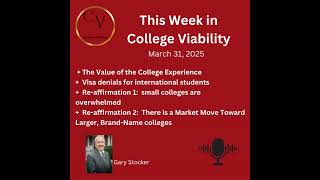
Gary Stocker examines pressures threatening U.S. colleges: Eastern Illinois saw a 9.8% enrollment drop from visa denials, Kansas implemented granular cost accounting, and Chico State published its budget online. Small colleges face closure without decisive action as enrollment shifts toward larger universities.
Chapters
It is the last day of March, March 31st, 2025. Hi, Gary Stocker back with this week's podcast episode of This Week in College Viability. Thanks everybody for making time to listen to the podcast. I saw the value of the college experience up close this past weekend. I attended a fundraising benefit for a local private college And amongst the 800 or so folks who are at the event, 20 were invited college athletes. And I'm still using the term student athletes for now, although I may change my mind on that. So these 20 student athletes, college student athletes, they put on their best clothes, they were introduced to the 800 people or so in attendance, they ate a really nice chef-prepared meal and helped excite the crowd during the live auction. And of course, they got to see a live auctioneer, which was impressive in its own right. And they had the chance to shake hands and learn how to be better meeters and greeters. So why do I open today's podcast with this? Because as you'll soon hear, today's podcast continues to chronicle the financial and cultural and operational challenges many colleges face. But the college experience is so good for so many in so many ways. It is a simple fact that our society has tried to convey that college is for everyone, and that is not the case. And I'm going to close today's show in a few minutes with another recitation of my college Viability Manifesto. But for now, college is a really, really good thing. Really good thing in so many ways. It's just not a really good thing everywhere or for everyone. Let's take a look at layoffs and cutbacks. Eastern Illinois University, my alma mater, had announced on March 26th, Ali Haussmann in the Daily Eastern News 'EIU spring on-campus enrollment down 9.8%—almost 10%.' And the subheading reads, 'Losses come primarily from international student decline.' Well, okay, first of all, before I get into the story details, the picture on this internal Daily Eastern News story looked like a dreary prison yard. And of course, I'll have the link in the show notes. You're welcome to go and take a look at that. Not a very good image if I'm a college leader. Of the college I'm trying to lead and grow. On-campus enrollment, as I said, was down about 10% compared to this time last spring, and it's the largest on-campus enrollment drop in the past 10 years outside of the COVID year 2021. And the COVID— or the drop came from international enrollment. And this is according to the Vice President for Enrollment, Josh Norman. He said, we planned for some decline in international enrollment "But we definitely didn't anticipate the level of decline we saw this spring," he said. They had anticipated about 240 international students, but all those 240 international students had their visas declined. That number last year was 196. So they had international students, but a lot more of their visas were denied than they were this time last year. So again, this college is my alma mater, so I followed a little bit. I got my Bachelor of Science in Medical Laboratory Science long, long time ago. I'm going to watch this story, and I'm going to watch for other stories that reflect decreasing acceptance of international enrollment from visas and all those things that go with that. University of Kansas, big college, middle of Kansas. This is from the Office of Chancellor on March 25th, and the headline reads— again, this is an internal document from the Chancellor's Office— Financial Stewardship During Uncertain Times. Well, again, the link will be in the show notes. I'm not going to delve into that, but there were two things I noted in this note from the Chancellor's Office. It was, it was very balanced. I tried to find some college drivel content in there, but there wasn't any that I was comfortable using. There are two things they're going to do that they made special note of in this, in this update to all faculty and staff and students at KU. They're going to engage in a position review process. All right, I understand that others have done it. And they're going to have judicious budget management. Judicious budget management at the unit level. Now I presume that means at the department level, maybe at the major level, maybe—I hope not—at the program level. What this suggests to me is that KU is looking at cost accounting at the lowest business level they can. Ideally, it's at the course, the classroom level, but the course level probably works as much. So if KU, a relatively renowned and well-known college, is doing this, I wonder how many other colleges will get to that level of detail so they can say, hey, Biology 101 is doing well, but Biology 425, upper-level class, is not doing so well and we're losing money on it. That's what all other products— that's what many other industries do with their products and services. They do the cost accounting down to the lowest level possible. Are we selling more green root beer or red root beer? Silly analogy, but that's what they're looking at. Page 2: you can't create 18-year-olds. I suppose I should elaborate that. You can, but it takes 18 years to do that. You can't create 18-year-olds. What colleges What can colleges do amid the demographic upheaval? And this is from Ben Unglesby. He's been on the podcast before at Higher Education Dive on March 27th. Raising retention and attendance rates and accommodating diverse student bodies could take on existential importance as the number of traditional age college students fall. So a couple of quotes from that article. Nathan Grau, who's the famous guy at Carleton College, who wrote the book of Demographics and the Demand for Higher Education that's been quoted ad nauseam for the last 10 years at least. But Dr. Grau says closures may represent institutions that didn't act strongly enough soon enough, or else they were just overwhelmed by forces that were bigger than were possible for them to overcome. Yeah, so what I see here in this statement is he's essentially talking about the colleges that have essentially become mom-and-pop colleges. They are set in their ways. They talk about the good old days and only give superficial, non-actionable lip service to the changes needed to survive. And another quote, this is from a visiting scholar from the Philadelphia Fed's Consumer Finance Institute. I don't have a name. Especially full-time traditional age students are looking to go to the bigger name universities if they can. He goes on to say, which is further stressing some of the smaller colleges that are already facing enrollment declines. I had— I wish I had a name for this guy. A person, it might be a woman, because I would say welcome to the— welcome on board, because I've been saying this for a long time. I think— I still believe— I don't think— I still believe we're at the early stages of college markets, students and their families choosing the big names or the larger colleges. Maybe not the big names as in basketball and football and that kind of stuff, but the big names that have academic reputation and are, I don't know, 10,000 or more students. We won't know that. Maybe we'll see a definable pattern this fall, but in the coming years, I believe I'll bet a free pickleball lesson if I'm wrong on this, that we're seeing that move away from small and toward large and, and well, better named colleges. And really, this is this whole article on you can't create 18-year-olds. It's another reaffirming article of what I've said for a long time. And it nicely discusses the challenges in higher education that have been around for years. Page 3, Chico State, California. Chico State unveils new webpage dedicated to the university's budget. Interesting. Okay. I found this on the web for Chico State, California. Chico State. Interesting. That was Siri interrupting my podcast. Chico State unveiled a webpage. It's a good webpage. It's a very thorough webpage, and even the page that has the article on it has a link to the new webpage for the budget. And again, I'll provide the links in the show notes. They're very well done. But here's what I noticed from this, and I'm not gonna go into the details for the webpage. They were pretty good. They were probably beyond pretty good. Both, especially the dedicated webpage, was fact-filled. And I really didn't see many judgments on there. There might have been a few judgments on there, but it was— here's what I see. It's the efforts. These efforts by Chico State reflect the growing realization in higher education that more data, Moneyball, more data is being used, is being needed to inform faculty, to inform students and communities of the financial realities across higher education. And I rarely see this. I can't even think of another instance. I'm sure they're out there where a college has a dedicated budget page or financial challenges page for their students and faculty. But this one, was really well done, and it will be interesting to see if others follow along those lines. Page 4, like I promised at the top, the College Manifesto. This has been out, I think I did this back in 2022, and I did that because I realized that my business was going to evolve around really taking colleges to task for not managing their finances and ultimately impacting their students in a negative way. And college is good. Number 1 on the college manifesto that I wrote: college is good, really good. Go if you can. Number 2: graduation is better. Graduation is better than just going and getting courses. So for those looking to go to college, dedicate yourself to doing what you have to do to get her done. And getting her done in 4 years is better than getting her done in 6 years or not at all. Number 3, some colleges will not survive. There is no way around it. I know which ones are higher risk by versions of my College Viability App, and you can know that too. Follow the College Financial Health Show on Tuesdays with Matt Hendricks and Gary Stocker, and you'll know which ones are at risk. Many, many, many will. It's not just identifying the colleges at financial risk. If I'm— if I had a college-age student or high school-age students right now looking at college, the very first thing I would look at is their financial health. And I would buy my own app and I would look at the graduation rates. First of all, are they graduating students? What have their enrollment trends been for the last 8 to 10 years? What about their endowment? Is it growing? Is it very big? Is it too small to support a college? And there's other factors available that that compares colleges. It just lists— it just doesn't list data by one college. We have as many colleges as you want. You can compare. And number 4, like I just said, only consider colleges in comparatively good financial health. And the comparatively is an important qualifier. Number 5, your FAFSA. Your FAFSA tells colleges about your finances. Your FAFSA tells colleges about your finances. The College Viability App shows you theirs, shows you the finances of colleges you are considering. Nothing can be more fair than that. Number 6, enrollment trends matter. Graduation rates matter even more. You gotta graduate, you just don't go. And number 7, popularity indicators are important in colleges. That's called admissions yield, what percentage of students actually are accepted and show up That's a market indicator saying, hey, we like your college. And number 8, closing colleges will cost you a lot of money, and I've done estimates as high as $50,000. Number 9, support higher education in the United States. It does make a difference, a positive difference. So we're at federal policy changes, real or perceived, proposed or ultimately implemented, are getting a lot of news these days, and they're simply, in my mind, another burden All these federal policy changes are another burden bearing down on the higher education industry. Those changes will bear heavily on financially struggling colleges, no question. But, you know, college costs, return on investment, public perceptions of college value, federal policy, supply and demand, and much, much, much more continue to push this industry to a point of mass consolidation. And that will be in the form of both closures and mergers. For students and family, your first research— like I said a few minutes ago— your first research should be on a college's financial health, especially if you are considering smaller, non-urban private colleges. Look at the enrollment trends, the endowment values, graduation rates, and others, and other measures available on my College Viability app for students and family. And for faculty and staff, these next few years will test your patience and your career stability. While most colleges will continue to operate without massive changes, there are too many that will struggle to survive. Compensation will be pressured lower. Program job cuts will be present at a majority of colleges, I believe, both public and private ones. And my College Viability App can give you the data comparisons to help you assess the risks at your college, don't buy the full version. Search for the College Viability App for Students and Families. It's just $39. Gives you 10 comparison reports for every private, private college, nonprofit college, and public 2- and 4-year colleges in the country. And for college leaders, for college leaders only, using your internal data is an increasingly risky business practice. If you want a private, no-cost look at tools you can use today, drop me an email. Gary@collegeviability.com, and I'll be glad to set up a quick demo to show you the tools that are out there. Hey, I'll be back next Monday. Next Monday, it'll be in April. I'll be back next Monday with more on This Week in College Viability. Thanks as always for listening. We'll look forward to coming back again next week.
More from Gary


What does it look like when a college increases both total revenue and total expenses?



College Financial Crisis? We look at the financial health of Bay Path U. (MA) and Coe College (IA)


Private College Financial Crisis? We look at the financial health of Hobart William Smith College


Financial Compass tutorial (Private college version.) Financial statements compiled 2016-2025.

