This Week In College Viability (TWICV) for April 1, 2024
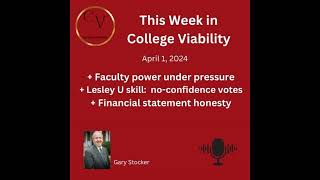
Gary Stocker warns of imminent college closures across the U.S., citing financial stress and recent shutdowns at Oak Point, Northland, and Birmingham Southern. He found that audited financial statements at recently closed colleges rarely flagged going-concern warnings, and examines struggling institutions like St. Martin's University with stagnant enrollment and Western Connecticut with declining graduation rates.
Chapters
It's This Week in College Viability for April 1st, 2024. There will be no tricks in this news and commentary podcast. Hi, it's Gary Stocker. Thanks for listening. Thanks for making time in your day to listen to This Week in College Viability. Hey, happy Easter Day plus one. I have to start with trauma in the Stocker household. My wife hid 6 of those Reese's Easter eggs I have only found 5 and she won't tell me where the last one is. I'll survive, but it's tough. Hey, we are probably headed toward a heavy period of college closure announcements in the next 2 months to 6 months, something like that. The warning signs are all there. We talk about them all the time. We read about them all the time, and we'll touch on some of those in today's podcast. And leading the way, layoffs and cutbacks and closures all this week. Faculty power under pressure in Kentucky. St. Martin's University in Washington is on the watch. Bluffton— I've got some comments on Bluffton and the University of Findlay merger. It's not enough. And the Western Connecticut University president has pom-poms. Well, that's my term, not his. Lesley University faculty— I think that's in Ohio, I have to check— Lesley University faculty is really good at at no confidence votes. Now, if they could only graduate more than 50% of their students— and financial statements, are, are those auditors that do college financial statements, are they hiding something from us? We'll talk about that and much, much more in this edition of This Week in College Viability. And as always, we start off with layoffs and cutbacks and closures. Oak Point University announces imminent closure. This is in Chicago. It's a healthcare College, I believe, um, it's closing. More will come in that in the coming weeks, I'm sure. In the category of not enough cupcakes in the world to save Northland College, Northland College employees are, and alumni, are seeking more time to raise funds. That's $12 million they needed in about a month as the college faces closures. And the Northland Board of Trustees said last week that The college is far from the $12 million needed to avoid closure, and it looks like the best they've done is cupcake sales. I'm making that up, but that's the equivalent. And my perception on that one, just quickly, is— this is from the stories I've read— is that this is a mom-and-pop operation. Small donations that don't really make any materially significant dent in the $12 million needed. And while it's important, that Northland— well, it appears that Northland has an important niche in higher education. The market has spoken. Not enough students want to travel to Northern Wisconsin to go to college to study what Northland offers. And of course, Birmingham Southern College closed last week. That was big news across the higher education world. We've got a brief comment on that. Page 2, the University of Kentucky president proposes to strip Faculty Bodies Power. And again, like all stories that I offer here that have webpages, I'll send you the link in the show notes. And this is from Inside Higher Education from Ryan Quinn on March 28th. And it is what it is. It's a singular story about the University of Kentucky, but I'm seeing this across the country that both public and private college leaders are increasingly working to find ways to modify, limit, reduce faculty's power. And I think it's being done in the context of economic flexibility, business flexibility. I believe it will continue, and I believe we'll have these kinds of stories in the coming weeks. And a subpart of that, and this is from Rick Seltzer's newsletter, kind of comments on a Megan Zahnheiser story. Seltzer talks that faculty governance is under fire. And I'm gonna read from his newsletter. The bigger picture, and this is Kentucky and elsewhere, the bigger picture, Seltzer says, major forces are eroding faculty power even at flagship universities like Kentucky. Financial pressures, critics who decry faculty political activism, okay, that's for another day, and leaders who tire of faculty groups' propensity to interrogate changes are slowly rewriting shared governance and tenure protections through cuts, through parallel governance and through legal changes. And what does this mean? I believe this is another area where the market is pressuring colleges to look for more rapid flexibility. There are countless stories of faculty decision-making processes making glaciers look speedy. And I doubt— there could be, but I doubt there are many evil intentions from college leaders and their boards And while not readily apparent, it's possible that these leaders see that financial iceberg coming and are trying to establish systems and processes to deal with it. And best bet, as always, some will, some will deal with it, some won't. And those that will will gain some relief from the onerous faculty deliberations, and they'll lead the market in change and probably in share growth. To Birmingham Southern, the headline reads from Taylor Pollack in the WBRC Fox News, "It just breaks my heart." Parent of a Birmingham Southern student athlete reacts to the school's closing, to the college's closing. And it's, it's the student athlete part of the headline that got my attention. As you may have heard or read, many, many smaller colleges rely on student athletes to boost enrollment. Nothing wrong with that, and they do. What they also do, what those student athletes also do, is put a drag on net revenue. The expenses associated with college athletic programs are almost, almost always a drain on net revenue. Expenses for coaches and travel and officials, insurance, and much more all put a strain on finances. Now, not for one second do I doubt the trauma that these student athletes experience when their colleges close. Sports are a big deal. I love sports. Sports is a really big deal in the United States. It's an embedded part of our culture. And many families, many families view athletics as a way to a college education, and they are. And student athletes have been and will continue to be impacted by closing colleges. If I had a child, on a side note, if I had a child that was good at one of the so-called Olympic college sports, I would also be concerned. Their college may not close, but there is much, much speculation that those Olympic sports—tennis and track and field, wrestling—will be at increased risk for elimination in the coming years. But we're going to make that a topic for another day. Dire financial issues behind the potential cuts, says St. Martin's University. In Washington State, St. Martin's University president. And this is from Drew Mickelson in the March 25th King 5 News out of Seattle, I believe. And I just went to the data on this. This is St. Martin's University in Washington State. The enrollment is up— the FTE enrollment is up 96 students over the last 8 reported years, 2015 to 2022. The total enrollment is down 110, so some part-time students have cut back. At St. Martin's University. Yet your expenses is up— yet your expenses are up $10 million on what is effectively flat enrollment. Interestingly, the revenue-to-expense ratio is 1.07, which means for every dollar in expenses, the college in 2022 anyway generated $1.07 in revenue. That's a good thing. Their 4-year graduation rate— their 4- and 6-year graduation rates are 48% and 60%. I've seen a lot worse. That's still not hitting the minimum thresholds I have. At college viability of 50% and 70%. And the slash rate, the graduation slash rate, is 48%, 60%, and -5%. That's the 4-year, 6-year graduation rates and the admissions yield. A good slash rate is 72%, 92%, and +10%, something like that. And as much as I think this one needs to designate someone to turn the lights off, my gut tells me there's something else going on. I'm going to keep my eye my eyes open for more stories coming out of St. Martin's University in Washington in the coming weeks. And I think it was 2 weeks ago that Bluffton College and the University of Findlay announced their merger, and good for them for trying. And I posted a response on social media to one of the followers, one of my followers, about the, about this merger over the weekend, and I made 2 points. First, this is a case of a large university absorbing a much smaller one. Findlay is much larger than Bluffton. Second, a 2Z merger is not sufficient to gain the scale needed to lower the cost base and grow the net new revenue to anything close to materially significant. 10+ is still my number. It will happen. We'll see those 10+ colleges merge when we end the, the closure phase that we're in now and enter the, the 'I survived, now what?' stage when mergers from the colleges that survived the closure period that we're in now, start looking at those larger-scale mergers, just like we've seen with almost every other industry in the world. Page 3: WestConn president vows to grow university, not just survive budget cuts. And this was my pom-pom announcement from the lead. Uh, this is from Michael Gagne, staff writer for News Times. This is on March 30th. I'm just going to go to the data. This is a president cheering without any substantive base to it. And let me warn you, this warning to those who don't like bad news, this going to the data phase will be uglier. And again, the data from the 2015 to 2022 National Center for Education Statistics and its IPEDS database at Western Connecticut University, a public college in Connecticut, The 4-year graduation rates are at 30%, the 6 at 50%. Awful. The FTE student enrollment is down 760 students. The FTE undergrads alone decreased 1,500 students. Admissions yield is down 8% at 15. Both are bad numbers, although remember most colleges have decreasing admissions yield these days. Grad enrollment is up a couple bucks, a couple students at 90. And slash line is 33.51 minus 8, and again, a good slash line is 72% graduation of 4-year, 92% give or take at 6 years, and plus 10 for the admissions yield. Retention is 74% for Western Connecticut University, not awful but not good. The, the non-operating revenue was up $39 million, meaning subsidies from the state in the form of taxes and whatever, and the operating revenue from tuition fees was up $10 million. That's not a bad number I, it's not a good number over 8 years, but it's not a bad number. Again, Western Connecticut's not going out of business, and I don't recall off the top if Connecticut has an aggressive merger plan in place for their colleges, their public colleges. If not, Western Connecticut probably needs to suggest they look at one because they could certainly be a part of that. And while we're on page 3, in the category of let me keep you entertained And the headline from Josh Moody at Inside Higher Ed reads, "A third vote of no confidence at Lesley University." And the headline, the story reads, "Amid job cuts and alleged lack of transparency," where we heard that before, "faculty have repeatedly registered their discontent with President Janet Steinmayer. But will it change anything?" Josh Moody writes. And again, quoting from the story, the no confidence votes at Lesley University, the no confidence votes have emerged as a form of protest in themselves. Get this, in addition to rebuking Steinmeier twice, I'm sorry, Steinmeier three times, the faculty assembly has voted no confidence in the board of trustees twice, including once last month. Interim Provost Deanna Yamin was also subjected to a vote of no confidence last month. And the faculty called for her and Steinmayer to resign. All right, we've seen this before, we've heard this before. Don't tell anybody this, but the 4-year graduation rate at Lesley is around 50%. So Lesley faculty, the next time you get together for a no-confidence vote, could you add one item and make a no-confidence vote on yourself that you can't graduate your students? You know, maybe, maybe, maybe I need to start to include a weekly Lesley University update. I have to think about this, kind of like I did with Birmingham Southern. And maybe with luck I could— you know, they seem to be good at this— maybe I could receive a no— a vote of no confidence from Lesley University as well. This is a, this is a double geesh on this one, and it's no fun. I know it's no fun to go through the challenges and traumas Jonathan Nichols in his book Requiem for College talks about the trauma of going through it. It's no fun. However, I would offer, for better or for worse, it's past time to realize that market economics that are in play, that no amount of no-confidence votes are going to change that. Page 4, making college mergers easier in New York. And this is simply a reaction to the market again. Kind of different context, but the politicians, the leaders in the state of New York are looking at making it easier for colleges in New York, I think private colleges, to merge with or to consolidate, whatever term you want to use, with other colleges in other states. And this is an excellent story from Jessica Blake at Inside Higher Education, and it discusses the New York, state of New York's challenges in the broader context of the higher education market. A couple points I want to make, and the first one is a quote. This is from Kevin Cavanaugh, who was at the College of New Rochelle. He was a leader there when it closed in 2019, and he shares that his leadership team tried to explore mergers inside the state of New York, and, and it wasn't successful, and they turned to in-state institutions, but But the challenges persisted, he says. And Kavanaugh reports that the folks at New Rochelle spoke to over 30 schools, 30 colleges in New York, but had just serious conversations with a handful. He adds, there were costs in time and energy of executives that not everybody was interested in pursuing. That makes sense. Also, Gilbert Hetschinski, who's a consultant for higher ed consolidation solutions, says he can't see a downside to the amendment. I think he's thinking like I am, this is, this is a market scenario. He goes on to say there's a saying in the trade— I don't know what trade he's talking about— that two turkeys don't make an eagle. And what he's trying to say is you can't bring two relatively weak colleges together, although Finley is much stronger in terms of size than Bluffton, and expect it to be golden. And this is kind of in line with what I shared just a couple minutes ago— twosies don't work. 2Zs won't work. Those mergers, those consolidations need to be for larger numbers to get the scale that is needed. And the point is, the higher education market is clearly getting more competitive. There will be more closures, there will be more mergers, there will be more consolidations in some forms. Saint Norbert College students stage a walkout protesting recent cuts. This is from Daniel Duclos in the Green Bay Press Gazette on March 27th. And of course they protested. It happens at almost every college. And okay, we are a country of protesters. Nothing wrong with that, although I do wonder on occasion if that is maybe the biggest and best skill set we have in this country. But that's getting too close to politics, and we don't do politics. On This Week in College Viability. And the students' main gripe appears to be lack of transparency. Okay, that's probably the case. It usually is. But the bigger issue, students, is supply and demand. No amount of increased transparency is going to change that basic economic fact. And St. Norbert is not the first to go through this, and certainly they're not going to be the last. And kind of a sidebar note on this, we talk about the economics associated with higher education. I wonder, it would be interesting to see if any economics majors were in the group of what was reported 70 protesters at St. Norbert College protesting recent cuts. And I'm going to wrap this up, this episode of This Week in College Viability. It's a post, it's a follow-up to a post I did over the weekend about financial statements, and I've just started doing some research on this. And as a matter of routine, I read audited financial statements for private and public colleges in the U.S. You know, I belong to the college division of the Warren Buffett School of Reading Financial Statements. And for those of you that don't know that, Warren Buffett got his start by reading hundreds, if not thousands, of financial statements. And when I do it, there are a handful of line items I look at to supplement the research that I do on the financial health and viability of colleges. None of the financial statement data is included in my series of college viability apps. I don't create anything that can't be automated. But when I get to these financial statements, one of the first looks— one of my first looks— involves searching for the accounting phrase going concern. Now, going concern is an accounting term for a company that has resources needed to continue operating indefinitely. In other words, going concern is a good thing until auditors express doubt about an organization's ability to continue as a going concern. In that case, the financial statements should, should include additional references to the auditor's concerns about the college continuing and explanations of the auditor's conclusion and the auditee's, or the organization's, the college's response. In two— in the case of two recent college closures, Fontbonne University here in St. Louis and Notre Dame College in Ohio, the accounting firms used to audit those colleges— and I'm not going to name them— made no reference in the 2022-2023 audited financial statements that suggested either of those colleges could not continue as a going concern. The auditors implied that these colleges were going to survive. Yet, as we know, both closed, and a reading of their 2022-2023 financial statements gave no indication that the auditor saw the end of either as a going concern. So this begs the question: why did these audited financial statements not indicate that these two colleges were in danger of closing? The only references to going concern that I saw were boilerplate phrases used in most audited financial statements that suggest nothing at all. They're just a responsibility for the auditors and the management. And I understand there is an element of professional subjectivity in the assessment of a college or any company continuing as a going concern. But here's what I'm going to do in the coming weeks, and I'm putting time on my calendar to do this. I'm going to engage in a project to match, I think, the 2023 and 2024 closed private colleges with their financial statement categorization of status as a going concern or not. Hey, it's time, time to wrap up this episode of This Week in College Viability. As always, I am grateful for you making time to listen to this news and commentary. I hope I provide value to whatever your professional responsibilities are. As a higher education leader, faculty, staff, student, parent, whatever the case may be. My name is Gary Stocker, and I am with College Viability. Let's do this again next week.
More from Gary


What does it look like when a college increases both total revenue and total expenses?



College Financial Crisis? We look at the financial health of Bay Path U. (MA) and Coe College (IA)


Private College Financial Crisis? We look at the financial health of Hobart William Smith College


Financial Compass tutorial (Private college version.) Financial statements compiled 2016-2025.

