This Week In College Viability (TWICV) for July 21, 2025
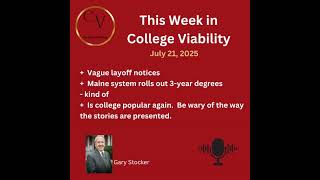
Gary Stocker analyzes five higher-education crises: Xavier University lost $4 million in tuition from a 200-student enrollment drop, St. Luke's College is merging with Morningside University, and the University of Maine System is launching 90-credit degrees for adult learners. Public confidence in colleges rose 6 points in a Gallup survey, but mostly reflects perceived prestige rather than actual job outcomes. Guilford College raised $6 million while cutting $4.1 million in expenses and remains on probation.
Chapters
From Denver, Colorado, it's the July 21, 2025 podcast episode of This Week in College Viability. Hi everybody, Gary Stocker back behind the microphone this week. Big layoffs— there's a big layoff announcement we're going to talk about, very vague. We got a merger we're going to talk about up in South Dakota. The Maine University System approves an accelerated degree program. Interesting the way they couch this. And there's been some recent surveys out there that says maybe the perception of higher education is getting better. We're going to say that maybe the data isn't quite what it seems to be. And of course, we have much, much more. Let's start off with layoffs and cutbacks. Headline reads, local university to cut jobs as it sees declining enrollment numbers. And of course, we've had stories like this for a long time. What's interesting about this is the headline did not name the college. So let me help with that. It's Xavier University to cut some jobs. This is from WKRC on July 18th. The university spokesman, again, no name, Xavier University spokesperson said the job cuts will not impact full-time faculty. It will affect temporary workers and 2 executive positions. Sounds like a small number to me. Last year, the story concludes, the university welcomed nearly 1,000 freshmen. They're looking at a number somewhere in the vicinity of 800 freshmen when classes resume in August. Do the math, 200 less students, say it's $20,000 per year in tuition. That's a big loss. A merger, St. Luke's College up in South Dakota to join Morningside University. Brandon Martin had this at KTIV on July 15th. St. Luke's College will enter an agreement with Morningside University as part of a shared vision to continue to enhance educational opportunities in healthcare and support academic excellence. I should have that in the dribble section. In a press conference, St. Luke's College at UnityPoint Health said it will become part of Morningside University, adding to the university's ability to educate healthcare professionals in South Dakota. The merger is expected to be completed by the end of 2026, with the first stage of approvals expected by the end of the fall 2025 term. Page 2: the Maine University System— not the University of Maine, but the whole university system in Maine— approves an accelerated degree program to address workforce gaps. This is from Isha Pardipendharkar on July 14th at Maine Morning Star. The University of Maine System, the story reads, will seek approval to add 90-credit-hour bachelor's degree programs in public administration, business management, and psychology online and at campuses in 3 of their locations— 4 of their locations. Here is what is the higher education tiptoe and tap dance at the University of Maine System. This concept has been in development for more than a year. With universities putting forth proposals for these accelerated programs. Here's the tiptoe: the programs will be limited to adult learners, adult learners who have prior college credit but have been out of higher education for at least 2 years. So, all right, credit for trying something. This kind of 3-year program is all the rage in Great Britain, and I just saw a story this morning about an increasing number of American college students going to college in England because it's a 3-year program and costs a lot less. But what I don't see here in this story, what I don't see are any quotes of praise or excitement from the faculty at the University of Maine system. I'm guessing that the very tight restrictions— adult learners who have prior college credit but have been out of higher education for at least 2 years is what the administration had to yield to get the faculty to at least not protest the 3-year degree program. Of course, I'll keep an eye on that in the coming weeks and months as well. Page 3, Brandon Bastide, uh, he posts a lot and he talks about the data that we mentioned in the lead, uh, that the perception of colleges was up about 6% in the most recent survey. And he said, in further dissecting the data, it's important to understand what is and what is not driving the overall rating. For those who are from the survey, for those who are confident in higher ed, here were the biggest positive movers year after year in the survey. Again, these are folks who are confident in higher education. U.S. colleges are some of the best in the world jumped from 7% to 14%. All right, we'll give them the double on that. Universities are at the forefront— universities are at the forefront of innovation. That's a quote. Jump from 5% up to 12%. But also, among those who are confident in the higher education industry, the following items went down year over year. In other words, these are not definitely These are definitely not the drivers of increased confidence. Again, this is from Brandon Busteed. Those 3 items are: when quoted as good professors, instructors, and administrators in American higher education, the number dropped from 7% to a measly 4%. So, do you have good professors, instructors, and administrators? Down to 4%. That's a low number. The second one, need to— need a degree to get better jobs and make more money, dropped from 17% to 11%. And the third one, prepares students to get ahead in life, dropped 9%, again to a very low 5% number. Now, now, Mr. Busteed goes on to say, these nuances are so important to understand, and a big takeaway from these is that messages about the public good of higher education—public good—are resonating much more than messages about the private an individual benefit. So I've got a second story on that. This is from Courtney Brown from the Lumina Foundation survey with— I can't remember— oh, Gallup. Lumina Gallup survey, same topic. Is America falling back in love with higher ed, or are we measuring the wrong things? Kind of a continuation of what we just talked about with Brian Macedo. And Ms. Brown writes, after nearly a decade of free fall Confidence in higher education has ticked up 6 percentage points. This is current, again, from a Lumina Gallup survey. 42% of Americans now say they have a great deal or quite a lot of confidence in colleges and universities, up from 36 points last year. Ms. Brown Rice, on its face, this is good news, right? But she goes on to challenge it. She suggests, what if we are misreading What if we are misreading this uptick? What if this isn't about institutions changing— not institutions changing, but about focusing on the wrong signals or measuring the wrong things? But as we dig into why people feel more confident, she notes, an odd pattern emerges. This reaffirms what Mr. Bastide said a minute ago. More people now cite innovation as a reason for their trust in colleges and higher education. More think U.S. colleges are among the world's best. More think U.S. colleges are among the world's best, but few mention that higher education leads to better opportunities for graduates. And she makes the comment, that's odd. She goes on to write, it suggests It suggests a shift from outcomes to optics, from what a college does for me, individual level, or what college symbolizes at the big picture level. Kuribishi writes that higher education is regaining symbolic status without a clear focus on individual outcomes. You heard me talk many times about graduation rates. She notes that belief in higher education is shaped by personal experience. People with a degree, Ms. Brown says, are far more likely to be confident in higher education. Those without a degree, less so. That makes sense. It's not necessarily because they reject the value of education. It's because they haven't experienced it working for them. So for those colleges who are inclined to take this 6-point bump and to shout from the college mountaintops— I guess that's appropriate from out here in Denver— to shout from the college mountaintops that higher education has turned things around, Courtney Brown from the Lumina Foundation says, not so fast. This polling shows some possible gains, Some possible gains in industry, but nothing, nothing for individual colleges who can't even graduate half of their students. Half of their students in 4 years. Page 4, spin, spin, spin Guilford College. Headline reads from Matt Hartman, does some really good work at the Assembly NC, on July 15th, Guilford College raised $6 million. Matt's headline reads, It may not be enough. The subheading reads, the school exceeded its fundraising goal, but declining enrollment means it still hasn't met its revenue targets. All right, Acting President Jean Parvin-Burdovich. And you've heard me say before, one of the most significant leading indicators of a college in trouble is counting the number of leaders who have acting or interim in front of their titles. Acting President Jean Parvin-Bordewich's announcement earlier in the week that Guilford had exceeded its goal of raising $5 million. It had more than doubled the number of donors from the previous year, from 900 to a little over 2,000. The school also surpassed its goal of cutting its budget by $3 million. Keep in mind, this is the college saying this. Communications Director at Guilford Robert Bell told the Assemblyman and Matt that Guilford reduced its 2025 fiscal year expenses by $4.1 million compared to the previous year. Okay, let's, let's break this down. All right, the number of individual donors went from 900 to 2,000. What, what was the average donation? Was it $5 just to get another name on the list? What was the median donation? What was the median value of all those donations? If there were mostly $5, $10, $20 donations, was that part of what Guilford wanted to do just to get the count up of donors as a public relations gimmick? I'd love to see the fundraising letters. Even $5 helps. You've seen that before. And how can a college announce a $4 million reduction in expenses still in the fiscal year, although just ended, I understand, without having the benefit of an audited financial statement. This is one-sided, college-sided speculation, and it may indeed be close, but they're taking way too much poetic financial license with that kind of number. And still, the college has not achieved its third goal, which was generating $3 million in new revenue. And they say it takes time. All right, that's fine. So let me ask this: is Guilford College— is Guilford College a charity or is it a business? If a business cannot generate positive net cash from operations, it will eventually go out of business, no matter how many donors How many $5 or $5,000 donors are out there? And to their credit, Dr. Bordowich, I presume, and other school leaders acknowledge that further changes are necessary to ensure Guilford's survival. Well, good for them. Thanks for doing that. I credit them for honesty and transparency. And as Matt and the Assembly reported just a couple months ago, Guilford's creditor, the Southern Association of Colleges and Schools, Commission on Colleges placed the school on probation in December of 2023 for financial reasons. The school has already technically defaulted on two outstanding bond agreements which require some specific financial parameters. They're just not meeting those. Same topic, different details. And I will say Guilford is a Quaker college that is mentioned in the article, in Matt Hartman's article as well. And it's a college dedicated to Quaker practices. They're pretty upfront about that. So stipulated. That's fine. It's— there are too many colleges. You've heard me say this many times. Too many colleges and not enough students willing to pay even ridiculously discounted tuition. Why does this college watching its last dollars circle the financial drain year after year, continue to think it needs to exist. There are plenty of colleges to take these students. Will they have the same Quaker focus? Probably not. Does it matter? That's not a question for me to answer, but it's a fair question to ask. And if colleges like Guilford and many, many, many others, if they really want to prioritize the efficient and effective education of their students. Help them find a college. Help them find a college with the financial resources to provide a quality education. And yes, I am fully aware that job losses will result, and that's not good. But higher education is in a consolidating market. You don't need me to tell you that. You don't need me to know that. There will be college closures. There will be job losses. So let's do a wrap with sticking on this same focus on, focus on a college and focus on students at that college. The many, many colleges with dire financial challenges have every right, every right to try and stay open. However, that very act of self-preservation at any cost, at any delay, has a negative impact on their students. If these same colleges want to really focus on their students like they say all the time, do the right thing by them. When you're watching those last dollars, circle the financial drain before you have to send somebody to turn off the lights. Help these students find the best opportunity to finish, to even start their college degree, their college education. When you do that at a college that's not watching its last dollars circle the financial drain. Hey, as always, grateful for you listening to the podcast. I'll be back next week on July 28th with another episode of This Week in College Viability, and I look forward to speaking with you then.
More from Gary


What does it look like when a college increases both total revenue and total expenses?



College Financial Crisis? We look at the financial health of Bay Path U. (MA) and Coe College (IA)


Private College Financial Crisis? We look at the financial health of Hobart William Smith College


Financial Compass tutorial (Private college version.) Financial statements compiled 2016-2025.

