This Week In College Viability (TWICV) for August 19, 2024
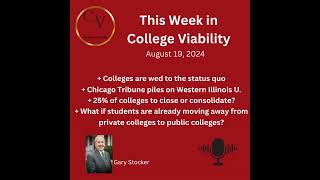
Gary Stocker surveys higher-education crises across multiple institutions: Ohio Northern cut 48 jobs and 21 programs; Western Illinois enrollment dropped from 12,000 to under 6,000; Wittenberg proposed 30-faculty cuts with a negative 23% net-income margin. Michael Horn forecasts 25% of colleges will consolidate or close within a decade.
Chapters
Welcome to the August 19, 2024 episode of This Week in College Viability. If, if you think colleges are having troubles, as usual, I am recording this week from St. Louis, and St. Louis is where we can't even get the city kids to school. The Great St. Louis Bus Catastrophe kicks off today. The The school district couldn't find buses for lots of reasons to get students to schools. And my friend Blythe Bernard at the St. Louis Post-Dispatch has done what I think is Pulitzer-worthy investigative stories on the colossal failure that is the St. Louis public school leadership. It's not the kids, not the families, not the employees. It's the school board and its hired and now ousted leaders. Hi, it's Gary Stocker. Great to be back with you for another weekly podcast episode of This Week in College Viability. Hey, send your questions and comments to me at gary@collegeviability.com. This week, some stories about colleges and the status quo. It's a story from the James Martin Center for Academic Renewal. The Chicago Tribune has an editorial. They, like me, are piling on Western Illinois University. We'll talk about that. Wittenberg University— a lot of folks sent me some information on this. Is playing hide and seek, the old kids' game, with information on its layoffs and cutbacks. And Michael Horn asked the question, are we really on pace for 25% of colleges to close or consolidate? Michael Horn thinks we are, and he makes his case. I'll talk about that. And then we have a low-end— sorry for the insult— low-end local news media takes a small private college's enrollment numbers without checking anything I even provided the evidence that the numbers weren't correct. We'll talk about that. And are students bailing on private colleges to go to financially safer public ones? I've speculated on that for a while. I have some limited and anecdotal evidence that that might be the case. As always, let's start off with layoffs and cutbacks and closures. I've got one. Ohio Northern makes job and programming cuts. This is a private Christian college in Ohio. The story was from June 26th. Somehow I missed this one, and it was from limaohio.com, and Mackenzie Kleeman has a story. Here's a quote: Ohio Northern University is eliminating 48 jobs and phasing out or realigning 21 major and minor degree programs with low enrollment. And of course, this is triggering a no-confidence vote against the university's Dean of Arts and Sciences. I don't know what he or she did wrong. Incoming students will no longer be able to major in subjects such as religion, physics, public health, youth ministry, forensic accounting, or Spanish starting this fall of 2024. Though general education courses and minors for some of those programs will continue, the university officials started renewing Reviewing— excuse me— university officials started reviewing its programs when projections revealed the schools would be short $7 million by 2025. Boys and girls, ladies and gentlemen, that can't possibly be short notice news. They had to see that coming for a long, long time. Page 2: Colleges are wed to the status quo. And the subheading on that is, ideals that were once a grounding have become an anchor. And this is from the James G. Martin Center for Academic Renewal by August, it's on August 14th, by Clark Ross. Dr. Ross taught economics at Davidson College, home of Steph Curry, from 1979 to 2024. That's a long time. And he served as Dean of the Faculty for nearly 15 years. Dr. Clark writes, Kara Miller and Brian Rosenberg— and Rosenberg is a gentleman we interviewed on this podcast last year— wrote the book Whatever It Is, I'm Against It. Resist. Kara Miller and Brian Rosenberg, who wrote Whatever It Is, I'm Against It— Rosenberg did. Whatever it is, I'm against it. Resistance to change in higher education. They write on different articles of the difficulty of fostering meaningful change in our colleges and universities. All right, we've talked about that before. Private businesses, they reference, in the United States demonstrating such inflexibility as colleges would quickly endanger their viability and existence, Dr. Clark Ross writes. Dr. Ross goes on to say, in today's world, these are some strong words here. In today's world, the intransigence of our institutions of higher education is exactly getting them to the irrelevance they deserve. My words, not his. In prior years, the status quo filtered down. He makes a good point. In prior years, the status quo filtered down from elite universities, and he argues helped ground post-secondary education with some positive warnings. All right, we'll grant him the premise. Today is different, Dr. Ross goes on. American post-secondary education confronts a bevy of challenges that threaten its stability. And he concludes with adherence, adherence to the status quo has become an anchor preventing meaningful change. Now, Dr. Ross goes on to offer some important ideas, and I'll include a link to the story in the show notes. Some important ideas and details to move colleges away from their resistance to change. Their anchors, he calls them. Now let me offer the Gary Stocker addendum. And again, Dr. Clark offers some logical, well-meaning, possible anecdotes, possible solutions. Here's my addendum: none, none of the changes and recommendations from Dr. Clark will move forward until the economic imbalance of supply and demand, and we have talked about that many times, the imbalance of supply and demand for colleges and college students reaches something much more, much closer to economic equilibrium. When I say when enough colleges close, or when more of them merge or otherwise consolidate into more efficient and effective organizations, and there's talk about that but not much action these days, If they don't merge or consolidate, then we will witness the withering away of this chronic industry-shattering resistance to real economic and business model change in higher education. So until supply and demand balances more, there's not going to be change of any substance industry-wide. Yes, there will be bits and pieces here and there, and of course none of this applies to the top 30 or 50 public or private colleges, the Ivies, the Illinois, Ohio States, Texas, USC. None of this applies to those kind of colleges. Change there, the pace of change there will match that of glaciers in an icebox. And I wanna thank the Chicago Tribune editorial board for joining me in piling on Western, Illinois University. They did this on August 13th in the, in that edition of the Chicago Tribune, and I'll read what their editorial said in part. Western has announced two big layoffs. On Friday, the school announced it was eliminating 89 positions, including 57 non-tenured faculty and 32 staffers. That came after some 35 faculty roles had been nixed or not renewed last month. I presume they mean July. Adding to that is a hiring freeze and the disappearance of several vacant positions and a pullback from another Western Illinois University location in the Quad Cities area in Illinois and Iowa. In 2000, 2010 to 2014, the editorial goes on, the number of students at Western Illinois hovered around 12,000, but then it took a dive over several years. In the fall of 2023, Last year, the university enrolled 7,000 and change. Interim President, and we've talked about that, Interim President Kristi Mindrup has said she expects enrollment this fall, get this, Interim President Kristi Mindrup has said she expects enrollment this fall to be between 5,500 and 6,000 students. It was 7,000 and change 12 months ago. Months ago. The editorial goes on to say that might change. I don't believe that, but it's still a big drop. Yeah, you think it's still a big drop in one year, not something so easily blamed on demographics. That's the Chicago Tribune's nice way of saying Western is screwing up. Again, thank you for joining me on Piling On. They also conclude with, we'd also wager most Illinoisans don't know that some of their state universities are currently operating at about 50% of the enrollment that they had previously. I don't know what to add. Will Western Illinois close? I don't think that's likely. It's public. It still has some handful thousands of students attending, but man, it's going to shrink. It's going to shrink to a size I can't even begin to guess, something less than 5,000 probably something more than 2,000 or 3,000 in the coming years would be my guess. And they'll have to downsize to match the revenue that comes from that source. It's highly unlikely in my mind the state of Illinois subsidizes such a drastic drop in enrollment. Page 3, Wittenberg University. I think this might be the first time they're on the show. Reaction to Wittenberg cuts mixed. Of course, faculty frustrated, leaders look to long term. Of course, that's what leaders always do because it gets them out of the current bind. The board of directors at Wittenberg University says details of 30 faculty and 45 staff cuts will be finalized by September 15th. Now, this story is from the Dayton Daily News. Eileen McClory, Jessica Orazzo, and Brooks Burlock all report on this. There's an update on August 16th from this. In the category of tough to believe, This is from, from the reporters. At a board meeting, the cuts were announced. It used to be it was 60 professors would be cut along with 50 to 75 staff. Get this, there are about 100 faculty on campus and the initial proposal was to cut 60, and now it's down to, what'd I say, to 30. 30% of faculty are proposed to be cut on the campus of Wittenberg University. Now, Laurie Asklund Askeland, maybe, is the American Association of University Professors advocacy chapter president. That's awkward. Chapter president at Wittenberg. And she said that cutting 30 faculty and 45 staff is still a big number. Okay, we know that. And the devil is in the detail, she goes on, which we don't yet know. Here's what really gets me, and we've seen this kind of stuff before. Ms. Asklund goes on, no faculty, not even the provost of the university, were allowed in the room where this plan was crafted. Asklund said the board, she goes on, has exhibited a shameful degree of ignorance about the basic logistics of running an accredited academic institution so far. I don't know the faculty would be much better. And that body created the financial situation. She's talking about the board and leadership. They created that financial situation over decades of mismanagement. Okay, we've heard that before. So she concludes that I am not optimistic that this Hail Mary cutbacks slapped together plan— there you go— will best serve the institution or the students. I guess it's time for me to recommend that the good folks at Wittenberg University start accepting resumes for someone to turn off the lights. And let's go to the data. The 4- to 6-year graduation rate was 50% and 57%, respectively. Not bad, but not great. And tuition fees decreased $11 million over the last 3— $11 million over the last 8 reported years. Total expenses were up $5 million. Total revenue decreased almost $6 million. That's an $11 million total change. The endowment is at $108 million, and of course my college viability minimum is $50 million. And a quick look at Matt Hendricks' Perspective Data Science visualization shows Wittenberg University has really increased its draw on its endowment. We'll be talking about that in a future— I think it's the August 26th College Financial Health Show with Matt and myself. And they can do that, they can draw against their endowment, but that's not a good practice for many reasons. And I guess I'll wrap this one up, but does anybody know who the accrediting agencies are? More importantly, where is the accrediting agency for Wittenberg University? Are they going to have some out-of-the-blue announcement of closing Wittenberg University like they've done at Wells College and other places, UArts in Philadelphia? I'll leave my i-dotter and t-crosser conversation for another day. And same tone, where's the federal Department of Education? Do they not think— do they think Wittenberg is a fine university with exceptional financial capacity to continue on indefinitely? I'm not going to throw a geesh at this because it's a new story, but how many more times, how many more times will I have to report on these pathetic College Management Stories. Michael Horn writes for Forbes, among many other things. His headline in a recent Forbes article is, Will 25% of Colleges Consolidate? An Update on a Prediction. And here's what should really scare folks from Matt— excuse me, from Michael Horn's story. He says if roughly 10% of private nonprofit colleges have closed in the last 11 years, and that's actual data. Given the looming challenges and all the things we've talked about in terms of financial health and enrollment and all those things, given the looming challenges, do people earnestly think that 15% more off of the 2013-14 number of schools, roughly 250 more colleges, will not close or merge over the next 9 years? To hit that number would be just 28 a year, or just over 2 a month, and we're already about 1 a month this year. And I still expect that the demographic— the FACA debacle will up that number to 2 or 3 per week, per week, over the next many months. And again, Horn reminds us the demographic decline really hasn't even hit in earnest. Yeah, page 4. Olivia Mazzel, KOMU, I think it's TV, it might be radio, on August 15th had a headline that says William Woods University welcomes its largest class of new students. Now I'm seeing this all the time and I look at all these stories. I don't put them all on the podcast because there would be too many. But this one caught my attention in part because it's regional. It's just a couple hours west of where I am here in St. Louis. And the story link will be in the show notes, of course. And so here's the note that I sent to Miss Mizzell. Again, KOMU, August 15th, Olivia Mizzell. Miss Mizzell, I— the subject matter reads, did you, did you double-check the William Woods University enrollment data? Miss Mizzell, I pulled William Woods data from the 2024 Private College Viability App. That's the one I wrote. It uses data from the National Center, blah blah blah blah blah. And I gave her some screenshots. And I go on to say, clearly William Woods University has had much larger numbers in the past reported 8 years than they're showing now. I am confused, I say, how they can claim, in quotes, its largest class of new students in its 154-year history. They go on to say, this is the second year in a row the university has broken its enrollment record with 556 undergraduate students starting classes today, on Monday. They are either confusing terms or using a data source not available to the public. I conclude now their enrollment has clearly decreased. To, to claim that has increased looked to be at best misleading. And I, I'm happy to share the courtesy link to the 2024 Private College Viability App to Ms. Mazzel, but crickets. Nothing. Crickets from Ms. Mazzel. And just as a point of reference, They say 556 broke its enrollment record. I show in 2015 total enrollment was 2,100, almost 2,200. 8 years later it was 1,500, almost 3 times what they're saying is their most— their largest enrollment now. And their fall, their full-time equivalent enrollment, which I think is a little bit better, shows 1,300 in 2015 and a little over 1,000 in 2022. Now the 2023 data won't come out until in BIPEDS for a little while. Um, what's our source to confirm that? And I went to Matt Hendricks' visualization tool, and William Woods had a negative 23% net income margin in 2023. In 2023, they had a surge in endowment appropriation that was far above normal. Normal. Now, they can do that— it's not a good practice, like I shared earlier— and they had a cash deficit of about $3.6 million in 2023, again from Matt Hendricks' tool, they issued $830,000 in new debt, sold $5.6 million investments, and borrowed $4 million from the endowment. Now that doesn't add up. I don't know what's going on there. And then the good folks at William Webster— excuse me, William Woods— William Woods University are certainly allowed to do this. Nothing inherently wrong with it. The big question is when, if ever, Will they generate positive cash from operations? Their operation is they run a college. They should have students paying tuition that helps pay the bills and have college— leave the college something left over for investment in its future. And here's a question for the media folks. I've done this before, I'm gonna do it again. Media folks, ask colleges when they're giving you their line for fall 2024 enrollment, ask them what was the average tuition discount rate for the fall 2024 class. Send it to me. Isn't that discount rate along with the college? I'll tell— I can, I can guesstimate how much revenue they're bringing in from that. And remember, reporters, free courtesy link to the 2024 Private College Viability App for any reporter who requests it. All I ask is that the domain that you use in the email address is from a media source of some sort. And finally, let's talk about something I have speculated on recently, and this is one of a few stories I saw in the last week or two. The University of Missouri— this is by KBIA, by the Columbia Missourian, that's a newspaper— University of Missouri students worry about overcrowding on campus as enrollment surges. University of Missouri students worry about overcrowding on campus as enrollment surges. The university plans to admit 6,200 and change students this year, an increase of 18— 1-8% from last year. With limited dorm space, the story shows the university is contracting a nearby apartment complex to accommodate students. And there was more to the story. So here's my operating premise. I don't have much data to support this. That's strange for me. What if we are seeing early signs that the class of— class of the 2024 college freshman class is staying away from private colleges in general and moving toward public colleges in large part because there is developing concern about the financial health of private colleges. Now, of course, that doesn't apply to all private colleges. There are hundreds that are fine and solid financial shape, provide good academics. But I think if we continue to see these kind of stories about other major land-grant colleges, both public on the land-grant side and private on the other, on the other side, there's reason to think that I might be right. Especially if we see lower numbers or no numbers from colleges with bad, bad data for fall of 2024. And if the FAFSA debacle starts that closing rate increase we talked about, from about 1 per week, not quite, to as much as 2 to 3 per week, colleges closing starting sometime this fall and extending into next spring sometime. And I want to do a wrap with higher education friend Kate Colbert, and she's the author, co-author of Commencement: The Beginning of a New Era in Higher Education. And this was a social media post, and it was talking about higher education in general. And I'm going to read, uh, I guess it was focusing on Wittenberg, now that I think about it. I'm going to read her quote. This is Kate Colbert: At the end of the day, it's a business, talking about colleges, and when academic enterprises fail to provide enough value for enough people and fail to capture enough value for the institution. Something, Kate Colbert writes, has to give. Reducing the workforce to better fit the workload is a good start, but it's usually the beginning of the end. It's usually the beginning of the end, Kate Colbert writes, for schools that won't innovate. The vast majority of small private Religiously affiliated liberal arts colleges aren't willing to serve modern students in the way they deserve. Schools like Wittenberg, Kate Colbert writes, would rather die than change. In the end, the industry, she concludes, will be strengthened by this right-sizing. But for alumni, students, and employees, there will be pain. Kate Colbert, I could not have said that any better myself. As always, thanks for making time to listen. Make sure you send your questions and comments, even insults, to me at gary@collegeviability.com. And I will close with two items from my College Viability Manifesto. There are 10 all told. The first one is: college is good. College is really good. I'm an example of that. Go if you can. And the second one of the 10: many colleges will close. Many will. Most will not. Until next Monday for This Week in College Viability, I'm Gary Stocker. Let's do it again in 7 days. We'll talk then.
More from Gary


What does it look like when a college increases both total revenue and total expenses?



College Financial Crisis? We look at the financial health of Bay Path U. (MA) and Coe College (IA)


Private College Financial Crisis? We look at the financial health of Hobart William Smith College


Financial Compass tutorial (Private college version.) Financial statements compiled 2016-2025.

