This Week In College Viability (TWICV) for Nov 24, 2025
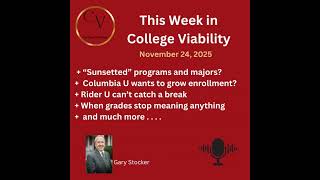
Gary Stocker surveys financial strain across U.S. colleges: Simmons University cutting five majors, Rider University on accreditation probation with a 14% salary cut, and Columbia expanding its class by up to 20%. He also examines UC San Diego's math scandal and warns more colleges will close as operating expenses outpace revenue.
Chapters
It is Monday, November 24th, 2025. Goodness gracious, only a month away from Christmas Eve for all the good boys and girls that are out there. And as always, it's This Week in College Viability, news and commentary sitting in front of the blue Yeti microphone. Hi, I'm Gary Stocker. This is, of course, the podcast that talks about the financial health and viability of public and private colleges with data and details and perspectives offered nowhere else. This Thanksgiving week podcast includes stories on— I guess we're now sunsetting programs and majors, a little wordsmithing going on. Columbia University considers expanding undergraduate enrollment by up to 20%. I wonder why. They're hiding the reasons. Rider University in New Jersey. Rider University's financial and accreditation troubles continue to make news. I have two stories on that one. And in a dog bites man story, a dog bites man story, the University of Nebraska Faculty Senate votes no confidence against its chancellor because he had the temerity to actually try and change things. And finally, when grades stop meaning anything. This is a story, a follow-up story from that University of California San Diego one last week. Kelsey Piper on her Substack site has a fascinating story I covered a little bit of it today, and I just posted a little while ago on the internet for everybody to take a look at. A fascinating story, fascinating writing, and really, really good research. So we always start off with what? We always start off with layoffs and cutbacks. Simmons University— maybe it's called layoffs, cutbacks, and sunsetting this week. Simmons University, Massachusetts, I believe, proposes sunsetting 5 undergraduate majors during a town hall. The story reads, the undergraduate majors that are currently proposed to be sunsetted are economics, accounting, physics, humanities, and applied Spanish. The board will vote on the proposal in December. This is a story from Alana Quirk-Abujadi, the editor-in-chief of the Simmons Voice, which is apparently their internal story, their internal newspaper, on November 22nd. And The Office of the Provost hosted the town hall on the Simmons academic planning process, and they were discussing majors to be cut— not the word they used. They're going to be, according to the Provost, sunsetted or reimagined. And when majors, they say, are sunsetted, students currently enrolled in the majors in that major are permitted to finish their major. And that's usually the case with colleges that do Sunsetting. You and I call them cutbacks, cutbacks and dropping programs. And, and they don't say cutbacks, they don't say eliminated, they don't say removed. Sunsetting— is that, is that even a word? I have to look that up. Do these folks at Simmons University really think that this kind of wordsmithing— that's a word— this kind of wordsmithing will fool anyone? Goes into a geesh category. And then, and I'll remind you, the 2025 College Majors Completion App, I'm going to give it away through the end of the year. It retails at $799, but I'm gonna have a new one in 2026, and I want some more users, so I'm going to give it away. It includes 64 common majors for the, for the years 2020 through 2023, 4 years. It includes 64 common majors across associate's, bachelor's, and master's degree programs. You drop me a note to gary@collegeviability— that's gary@collegeviability, one really long word, collegeviability.com— and say, Gary, send me the college majors completion app. Call it whatever you want, make some kind of reference to it, and I will send you the full functioning link through the end of December, uh, who knows, maybe into January, until I finally get the 2026 version of the app out, which is going to have 5 years worth of majors completion data. And right now it looks like more than 100, maybe as many as 150, 160 majors in the 2026 version of the app. University of Central Florida— the University of Central Florida lays off 60 employees as federal research funding dries off— dries up. Ryan Lynch from the Orlando Business Journal has the story included in the cuts. He writes are 57 workers from the Florida Solar Energy Center. The center has been open since 1975. Let me do the math. 1975, 2025, fingers, hands, and toes— 50 years the Florida Solar Energy Center has been available, has been open in Florida, and, and they're going to lay off some of the workers after 50 years. You make your own judgments there. Columbia Columbia University considers expanding undergraduate enrollment by up to 20%. The university plans to finalize a decision by the time it releases its early admission results sometime in mid-December. Matt Luo had the story for the Columbia Spectator. Again, I think that's an internal news story at Columbia News Source at Columbia University, and this was on November 21st. So let me just read a couple lines that Matt Luo shared with us. In history, facing losses of up to $100 million each month of the COVID-19 pandemic. Columbia, again, back in 2021-22, launched inquiry into expanding its undergraduate population by between 5 and 20%. The inquiry resulted in 9— almost 2 handfuls— 9 faculty reports 3 years ago, which recommended— now SOC— which recommended support— let's try that again— which recommended postponing expansion considerations and focusing on— read this— focusing on improving areas of campus life associated with peer-to-peer connection. Please feel free to send me a note as to what that is. And at that time, the Faculty of Arts and Sciences agreed to postpone expansion discussions. Fast forward to today. The number of students Columbia admitted through regular and early decision for the 2023-2024 year was about 2,300, 2,300, and for the 2024-25 cycle, about 2,600, not quite. However, the number of students admitted off the waitlist this year, '24-'25, is about 60% more than the growth in the number of students admitted in regular and early decision. Listen to this next part. Suggesting that the university primarily used its waitlist. Columbia University primarily used its waitlist to expand the first-year class. Now, nothing wrong with that. They can do whatever they want. 1,800 students, let's say it's 20%, that's 360 students more, give or take. Will there be a trickle-down impact? Will other colleges lose those 360? Almost certainly. And where have we talked about that is going to most impact students? Not in the upper echelon colleges, but in those at the low end of the enrollment, the admission cycle, the low enrollment and admissions feeding area, the low performers, the financially challenged colleges. And I've already seen social media posts questioning the rationale for these, for this 20% addition. Is Columbia University adding some 360 students to buffer financial losses from elsewhere They're impacted by the government cuts. Could be. Nothing wrong with that. Absolutely nothing wrong with that. It would be nice. It would be nice to be more transparent, but it is silly to believe that most colleges are even familiar with the term. Oh, oh, oh, sarcasm alert. Whoops. College Drivel. This week, the undergraduate majors that are currently proposed to be sunsetted or economics, accounting, physics, humanities, and Spanish. Of course, that's from Simmons University. And a story earlier in the show, page 2, Rider University can't get out from under it. November 13th, Rob Jennings at newjersey.com had this story and another one I'm going to share in a second. A New Jersey— a major New Jersey university is on probation. We had that story last week. Here's what that means for students, and there's a long list of things it means for students. I'm going to pull a couple of items. The accrediting agency— this is from Rob Jennings at nj.com— the accrediting agency has taken the unusual step of placing this university on probation as the school tries to get itself out of a financial crisis. Salaries for all employees will be reduced by 14%, and retirement contributions will be suspended. Some, there's some cutoffs that go with that as well. And a monitoring report A monitoring report aimed at ensuring Ryder has a viable path for continuing is due on January 12th. So 7 weeks out, something like that. So Middle States is their commission, is, is their accrediting agency. Middle States wants a plan described, written about, drafted. It doesn't— as is usually the case, it doesn't actually want results. Just tell us what you would do. What you might do, what you think you will do, what you tell us you're going to do, but no actual results. And you want results? You want proof? Kean University— Kean University, K-E-A-N, also in New Jersey— was placed on probation in 2012 after falling short in several areas, and it was reaccredited by adopting a new academic integrity policy, academic integrity policy, and making other changes. Well, I can, I can You need a policy, I'll adapt one for you. Does it mean I have to follow it? And I went over the bad— going back to Ryder, I went over the bad financials at Ryder last week. Not good, not good at all. But I guess— sarcasm alert, I know— but I guess a plan will fix all of that, even, even, even in a declining market with intense pressure on tuition revenue and a high cost basis. It's, it's a daunting, if even possible, challenge. Then Mr. Jennings, Rob Jennings, second story on November 17th, uh, the headline: New Jersey University plans to cut 20-25% of its professors, but shock of shocks— my words, not his— shock of shocks, its union is pushing back. And of course, for those of you that follow the podcast on a regular basis, and there are 13,000 on the downloads right now, Faculty will protest everything. Everything happens all the time. So, so let me make this easy. I used the College Financial Compass and pulled the total operating revenue and total operating expenses from the audited financial statements for Rider University from 2016 and 2024. In 2016, Rider had $1.02 in operating expenses for every dollar in operating revenue. So 2 cents more in expenses for every dollar in revenue. In 2024, Ryder had $1.18 in operating expenses for every dollar in operating revenue. That's $141 million in operating expenses and $119 million in operating revenue. And I rounded up all the numbers, but that's a 9-fold increase if I'm doing the math right. So for the past 9 years, Rider and its faculty has to be complicit— Rider University's expense base has grown faster than its revenues. Boys and girls, ladies and gentlemen, that's a trend, and that's not a good trend. If— and let me do this, uh, last week Matt Hendricks substantially reduced the price on his College Financial Compass. It's only $219. 219. It used to be a multiple of that. Here's why. He wants everybody and anybody to be able to have access to it. Gotta charge a fee because you got to make a buck. This is business. This is America. And I'm going to put the link in the show notes to purchase it, but if you want, drop me a note to gary@collegeviability.com. I'll not only send you the link, I'll send you a tutorial on how to use the link. If you're a faculty at Rider or Wittenberg or Albright or any other college in dire straits, this is a tool that you can use. Trust me, you can use it to compare your college to others to make the case of how you can fix things if possible, but to have a source of information with which to make your own plans as faculty, staff, or even students in conjunction with what your leadership team, your administrative team may have. Margaret Spellings. LinkedIn post last week was talking about the Department of Education changes. And these are the ones where the Department of Education last week announced moving a lot of functions other places in the federal government. So Margaret Spellings is the second— is the president and CEO at the Bipartisan Policy Center. I have to check that one out, the Bipartisan Policy Center, because her writing doesn't sound bipartisan. But anyway, she said, she says in her LinkedIn post, I wanted to share some thoughts about the changes. She goes on, too many students today aren't able to read at grade level or do basic math, and the gaps between the highest and lowest achieving students are growing. There are urgent needs for our students and the country to be focused on education. She goes on to say the conversation in Washington is focused on the wrong things. She provides some details about moving the programs from one department to another. She talks about where the focus should be, and she finally concludes, "We've come together before in a bipartisan way." Okay, you need to cite some specs on that. "A bipartisan way to improve education for all Americans." She says, "We know how to partner with states." I don't know who "we" is. "And to use the federal role to better prepare students for the future." Stop. Stop everything. No, no, they don't. They clearly— this established system and processes clearly don't know how to improve education for all Americans. This is just someone working to protect the status quo in American education. Did not the current Federal and state system, set of systems and processes have decades, have decades to make things ideal for students, to help them learn to read, write, and do arithmetic. Decades. This is a proposed change to try and streamline things. Will it work? I have no idea. Beyond the scope of my intellect and capacity to even care at this point. Yet we see stories like the one from out of the University of San Diego last week that showed really low reading and math competency skills. And we see these stories regularly. And so here is my question to Ms. Spelling and others who were protesting— and there were many articles all over the place last week, many on LinkedIn and other sources in social media that I looked at— to those folks, how many decades do you need How many decades have you had to fix the very problems the system you describe and you defend and you support created? Page 3, colleges ease the dreaded admissions process as the supply of applicants declines. And I've talked about this before. This is John Markus at Hechinger on November 18th. Long story, and talks about how colleges are making admissions easier. Of course, I have, of course I have the link in the show notes. So what I've started doing when I see these kind of enrollment stories is I look for one word. And again, those that follow me can probably guess what that word is. It's graduation. And in this story, with quotes from all sorts of higher education folks and organizations, the word graduation does not appear. Anywhere in the article. Now, it's not John Marcus's issue. This is a source issue. This is a direct admissions article, one-click and admit kind of process. There is a qualification that says it depends on grades. That's a weak qualification because in this continuing era of grade inflation, that, that hurdle to get the one-click admission is pretty small. And so, as I've shared so many times before, we are still encouraging high school students without sufficient academic preparation and financial capacity to enroll in college. And as I've said before, damn the consequences. University of Nebraska— dog bites man. Don't have to get your pencil out for this one. The new— the University of Nebraska Senate votes no confidence against its chancellor. Mike Nitzel has a story in Forbes on November 19th, and I spent way too much time trying to decide how to cover that story earlier today as I was preparing the podcast. And no-confidence votes are not much more in my mind than sophomoric reactions, sophomoric reactions from college faculty who hide behind the facade of doing nothing and calling it shared governance. You have heard me share, share before, tongue-in-cheek, that if a college changes the font, changes the font on its business cards, there will be protests. The essence of colleges has become one of an industry that can't even graduate half of its students in 4 years and overreacts, overreacts to almost every Proposed change. When does it stop? When greeds— when grades— language issues today on this end of the microphone. When grades stop meaning anything. The University of California San Diego math scandal is a warning. Kelsey Piper, great, great, fabulous, top-of-the-line story on November 18th from her Substack account. And this is a— this article is a follow-up to last week's story on California, on California and San Diego University. On poor math and reading skills in the country. And it— and here's what Miss Kelsey writes— excuse me, here's what Miss Piper writes: In fact, many of the students didn't just need remedial high school math. Their scores indicated they needed remedial middle school or even elementary school math. These are high school students. Only 39% of the students in the remedial class knew how to round the number 374,518, 374,518 to the nearest 100. The answer, of course, would be what? 374,500. Reviewing test results like these, you would expect transcripts, report cards full of C's and D's, or even failing grades. But alarmingly, Ms. Piper writes, these student transcripts did not even reflect those profound struggles in math. The students were broadly receiving good grades. More than a quarter of the students needing remedial math— more than a quarter needing remedial math— had a 4.0 grade point average in math. The average was 3.7. But they didn't have the math skills. Instead, she writes, here is the absurd image that the report slowly and painstakingly paints: a number, a large number— my words, not hers— a large number of high schools are awarding A grades to Advanced Placement calculus students who do not have any calculus skills and who would get the lowest possible score on the AP Calculus exam if they took it. And, and really good story. There's much, much more to the story. I'm not gonna make time to cover that in the story. It's the second week in a row that I've noted that students are starting college, students are starting college without anything close, anything close to the needed skills to complete college-level assignments. Colleges accept them, they charge them tuition and fees, And they know that some absurdly low percentage of these students will end up graduating anyway. Folks, those on the academic margins are getting burned, and they're getting burned badly by education in America. Yes, I know there are millions and millions that have the skills and do well. They graduate, they get a job and a career that's fruitful. But there are millions more who are falling, who are falling for the cultural expectation that college is good for them, and yet they don't have the academic and financial capacity to do it or pay for it. They pay for it in lost time and in debt. And then finally arrived, 2 weeks after Trinity Christian up in the Chicago area announced its closure, the city they live in, the city the college is in, Palos Heights, knows little about the college's sale plans. This is from Olivia Stevens, who posted this in the Daily Southtown News, and I think it was also published in Chicago Tribune on November 19th. Chad Muse, M-E-U-S-E, heard about the pending closure of his alma mater, Trinity Christian University, and he said he experienced a lot of a kind of a devastating feeling. I reviewed Trinity Christian's data last week and I did a quick look again today, and it's somewhere in the 2016 to 2019 timeframe that Trinity's financial health started a decline year after year. So it's been a while. It wasn't something that happened yesterday, last week, last month, last year. And there are other college leaders and board members that as I record this, as you listen to this, are in the process of making decisions to close, just like Trinity Christian did. And in every case when that happens, we have seen and will see the same story: shock, indignation, protests, many times a belated attempt to financially revive the college. And here is what those colleges will say when they announce their closure. Despite strategic efforts to adjust our growth model and eliminate the deficit, the fast-paced evolving economic and cultural realities made that impossible to do. Post-COVID financial losses, persistent operating deficits, a decline in college enrollment, increased competition for students, and shifting donor giving and financial circumstances, the college will say. And you know what, that's exactly what what Trinity said. I took that quote from their announcement. These are not sudden events. There are clear multi-year trends. It's one of the reasons we lowered the price of the Connect— the College Financial Compass to just $219 last week. If you want to check on your private college's financial health as an alum, faculty member, community leader, even student or family member, The $219 might be a little bit pricey, but it's worth $219 if you can rule out a college whose financial health doesn't meet your specs. And, and we provide tutorials. Matter of fact, drop me a note to gary@collegeviability.com. I'll do a quick tutorial for you one-on-one. This kind of tool needs to be in the hands of every college person— faculty, staff, leaders, board members, trustees, students, faculty, community leaders. It's, it's just shows who's doing well, and there are many, and who's not doing well, and they're way, way, way too many. There will be more closures. I've said it before, I'm saying it again. I look at the data every day and I know which colleges I would not send my children to. Your call, your call. Hey, best of the holiday week to you and yours. I'll be back next Monday on, I believe, the first day of December. Is that correct? On the first day of December with another episode of This Week in College Viability. As always, I'm grateful for you making time to listen to the podcast. Make sure to share the podcast link with your friends, family, neighbors, relatives, and anybody else you can think of. Thanks for listening. I'll be back next week.
More from Gary


What does it look like when a college increases both total revenue and total expenses?



College Financial Crisis? We look at the financial health of Bay Path U. (MA) and Coe College (IA)


Private College Financial Crisis? We look at the financial health of Hobart William Smith College


Financial Compass tutorial (Private college version.) Financial statements compiled 2016-2025.

