This Week In College Viability (TWICV) for June 16 2025
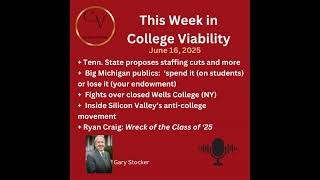
Gary Stocker surveys higher education's mounting crises: Tennessee State cutting $13 million in staff while sitting on a $500 million maintenance backlog, Michigan slashing $572 million in university funding, and Syracuse offering $20,000 annual discounts to admitted students. Tech founders increasingly skip college, citing opportunity costs, while accreditation crises and tuition hikes signal widespread institutional distress.
Chapters
It is Monday, June 16, 2025. Time for another podcast episode of This Week in College Viability news and commentary. Hi everybody, Gary Stocker back with lots of stories this week. Let's look at some of the headlines. Lives will be impacted. This is Tennessee State University, a public college in Tennessee, is proposing some staffing and scholarship cuts. They're not quite a frequent flyer, but they're getting close. We'll talk about them. The Michigan House has included huge budget cuts for the University of Michigan and Michigan State University. There's a moral to this story that I'll talk about. And then a New York college, Wells College, closed last year, has alumni fighting over its future. And I'll talk about this show's emotional and maybe even irrational attachment to our colleges. And then an interesting story inside Silicon Valley's anti-college movement. Some good points there, even though they're anecdotal stories. I'll talk about that. And I'll wrap things up with, with a Ryan Craig article on the wreck of the class of 2025. But before then, as always, let's take a look at layoffs and cutbacks. No closure announcements this week. Stay tuned. Shuttered New York college has alumni fighting over its future. This is Bloomberg on June 11th. Elizabeth Rembert is the author, is a reporter on that. And again, like I said in the headings, two groups fighting to get control of the college. One offered $10 million, the other $11 million. I think the story said neither have the resources on their own. They're looking to put together groups or consortium of folks to buy back the shuttered college. I don't know what that looks like, but again, I understand, you know, my alma mater was a big deal to me. I like my alma mater, but I don't know that I would pay $10 million or $11 million to keep it open if it closed. And in Michigan, Beth LeBlanc, Beth LeBlanc, L-E-B-A-L-A-N-C, from the Detroit News on June 11th had a story that the Michigan House, their higher ed budget includes huge cuts for the University of Michigan and Michigan State University. Let me read part of the story there. House Republicans unveiled a spending plan that would slash state taxpayer support for the University of Michigan and Michigan State University by more than $572 million annually. Get this part, in large part, in large part due to the UM and MSU's multi-billion dollar endowment funds. And there's some details about what college would get what cuts. And the House Republican-authored plan also cuts funding for the state's 13 other public universities, but at a lower level. Here's what's going on. This is another way that, in this case, state are looking at college and their financial resources and say, hey, on the endowment, use it and use it to support your students' education, or we're going to find a way to help you lose it. And they're doing that by lowering the state subsidy for public colleges in Michigan. Use it or lose it. If you've got a multi-billion dollar endowment use that for what its purpose is— keep students, educate students— not just to have an endowment growth for the sake of its own growth. To North Carolina. North Carolina's Guilford College scrambles to keep cash, for cash to keep its accreditation. And this historically Quaker institution has until the end of the year, December, to show its accreditor— and I think that will be Middle States, have to check— a balanced budget for the 2026 fiscal year. Now, the story was on June 12th, Ben Unglesby at Higher Education Dive. Of course, I'll have the link to this story and all stories in the show notes. Guilford College, the Dive brief says, is scrambling to raise cash and balance its budget amid an anticipated decline in enrollment revenue. It's not anticipated, it has been happening for a long time. The college— the story reads— the college needs to provide a balanced fiscal budget, fiscal 2026 budget, by December in order to remain accredited. Now, all right, and again, this is yet another example of creditors just— creditors just wanting input. They want a balanced budget. And then you've heard me say this before, balanced budgets aren't much more— in many cases, not all cases— aren't much more in most cases of dartboard exercises throwing a dart at a number and that's what the budget number is going to be. It hardly has any value, especially— think about this— especially for colleges on the brink of closure like Guilford College could be. And acting President Jean Bordovich says the college is between the proverbial rock and hard place. I will grant the point, but again, look at the modifier for her name: acting. Acting president. How many times Have I had stories, and I've got more later on in the podcast, where it's an acting president or an interim president or an interim CFO. I've not done statistical research on this, but I kind of think that modifier behind a leadership's name, a leadership position's name, has got to be a leading indicator of a college in trouble. And Bordewich noted that college had private gains in fundraising progress, no numbers attached. And signed a conservation agreement with somebody called the Piedmont Land Conservatory worth some $8.5 million. I didn't see the details on that. And Guilford has been on probation for almost 2 years, and that's the limit. This is the Southern Association of Colleges, so it was not Middle States. The Southern Association of Colleges for 2 years due to financial issues, and that's the maximum time allowed. So the— to stay accredited Guilford must show it has the financial resources and ability to manage them to sustain this mission. And again, year after year after year, they've not been able to show that. Why an accrediting agency thinks a one-time show at the point of closure, at the point of closing, has any validity escapes me this time and every time that I read it. Let's go to Kansas, the middle of the country, flyover country. Jason also did alleted from the Topeka Capital Journal on June 12th, shows here— writes about here's how much tuition fees are going up at Kansas universities. Now I'm just going to talk about KU. It's a 3% increase, $165 per semester, plus $11 increase in fees. So I did some math, so I added those two together, it's $176, um, per semester. So that's $7 million per semester, $14 million per year. If there are 40,000 students at UK, or KU I guess it is, and I didn't take the time to actually look at it, I just ballparked it. So 40,000 is going to be close, yields about $14 million in incremental new income for the public university, for that public university in Kansas. The chancellor, Doug Girod, said it's important for the university's tuition to be competitive. Well, it is, particularly in this environment of downward pressures on enrollments. And he's right. Interestingly, he notes we've got some major challenges, major challenges around salary and wages for our people, especially, he noted, with base state funding remaining flat. And this is a big-time college. This is a big boy, big player, big-time, big-name brands. They're going to be fine. But again, it's just a reflection of the market. It's challenging. I give Kansas University's credit. I don't know that the $176 per semester is going to be a big deal for students. It could be for some, but you got to be able to drive net revenue to keep the stores open, to keep the doors open, to pay faculty competitive salaries and all the other expenses associated with running the colleges. And to Tennessee State University Lives will be impacted. Emily R. West writes for the Tennessee Tribune and NewsChannel 5. Lives will be impacted. Tennessee State proposes staffing, scholarship cuts to stay open. Well, that's probably a little dramatic. I don't know that it closes, but it's certainly going to have to continue to cut back. And so her story reads, Tennessee State University is proposing up to $13 million in staff cuts and capping scholarships for each new freshman class moving forward during the next 5 years. Recently, the state gave Tennessee State $250 million in capital funding. However, I'll note the school has $500 million deficit in deferred maintenance. It has been suggested that the school start fundraising to help those capital costs. That's not going to happen. The state wants the college, a capital campaign to raise $100 million in 2 years, so 1/5, 20% of what's needed to address just the current deferred maintenance. In addition, Tennessee State, in the story here, wants to use the $250 million that the state forwarded them for operations, not for capital funding. Now the university has already made millions in cuts. We've talked about that before. They laid off, I think it was last year sometime, more than 100 staff members. And it also is reported in Ms. West's story They eliminated 117, 117 contracts that duplicated services, saving $3.5 million. All right, that's a big number. 117 contracts that duplicated services, saving $3.5 million. So, so there were 117 contracts with duplicated services, and Tennessee State University just now found them. Just now under the pressure of a financial gun, they just now found them? This is something to audit in my mind. Who did those contracts go to? Were there relationships with Tennessee state employees? When did those contracts start and how much was spent? And that's an issue that was touched on in, in Miss West's story, but not in much depth. Maybe she's got a future story coming up. And she does write, those, those cuts are about to get deeper. I'll spare you the details. Um, moving into the class of 2025, the school will have $31 million to give out to incoming freshmen. All right, let's talk about give out. The $31 million, as I have shared many times, is not cash being transferred from one account to another. The $31 million is essentially a discount And it's the amount the college has budgeted that they're gonna discount from list price tuition. And it's used by colleges, almost all colleges, almost every college across the country, just to get students in the door. And there's nothing wrong with that, nothing at all wrong with that. Good for the students, not so good for the colleges. And Tennessee State is one of many, many, many facing that challenge of getting students in the door at substantially discounted tuition. And still having enough financial resources to run their business. Page 3, Syracuse. Now this story came out, I think I originally saw it, um, Jeff Salengo, I think, might have posted it in his weekly or monthly newsletter. After the close of the May 1st deadline for students to effectively make their college decisions and send deposits, after that, Syracuse University engaged in I guess we'll call it aggressive post-commitment discount. And they have done this in their stories. In the story, uh, Ron Lieber in the New York Times had this story, and he's got some specific stories about, about Syracuse University going to students referencing up to $10,000, up to $20,000 per year after that May 1st discount. And interestingly, the, the email sent from Syracuse says spaces will be filled on a first-come, first-served basis. Well, they're trying to add a little time pressure. I don't fault Syracuse University for trying something aggressive. It's— if it's mimicked throughout the market, and I think, I think Lieber's story talked about this, there will be more and more families next year ignoring the May 1st deadline or making a soft commitment by May 1st and just waiting for the last best offer from colleges like Syracuse University for their discount. And, and I think it was the Libra story said this is a used car salesman approach in higher education to getting students to enroll. And I looked at the numbers. Syracuse is a financially strong, financially healthy private college, and my educated speculation is maybe they are aggressively trying to run some of their competitors out of business with steep discounts. And the example of that is Jeff Bezos at Amazon did that many years ago, and I can remember specifically with diaper companies and shoe companies. He added so much discounts to their— to the Amazon prices that his competitors were unable to afford it and had to go out of business. Maybe that's what Syracuse is doing. It'll be interesting to see if those— if those discounts are being offered to a certain set of colleges which would suggest maybe they're trying to be like Jeff Bezos, or if it's just universally so, I'd be hard-pressed to know what the logic is behind that. Page 4: Tech's newest recruits and founders are young, male, and hate, hate higher education. Julia Hordenstein on June 11th in the Business Insider. Now, Hordenstein covers tech and other startups. In the defense sector. And she's noting one increasingly common refrain from some leaders is their disdain for higher education. Now, this isn't new, but some interesting tidbits from this story, and these are anecdotal. I note that it doth a trend not make, but it still reflects a growing, maybe cultural trend away from the traditional higher education model. And a student who's quoted in her story, Sebastian Tan, is quoted as saying, "There's such an opportunity cost." Excellent point. "There's such an opportunity cost of going to college." He goes on, "In the tech world now, things are moving so fast. If you're in school all day, the world just passes you by." Well, can't argue with the logic. I don't know if that's a day-by-day assessment, but it's logical. He goes on to say, "The phenomenon is also sustained." By a swelling stream of founders— this is from Julia Bornstein— the phenomenon is also sustained by a swelling stream of founders who bailed on higher education to start companies as early as high school. We've seen this story many, many times. We see the successes, we clearly don't see the failures. And whether this generation of techies run a company or write code, they are saying, hey, right or wrong. And they're right in some regards and a little naive in some regards. They make a lofty proclamation: real builders have never sat in lecture halls. Yeah, it's certainly true for some. I don't know that that's a universal statement. And several people told him, told the article, they'd rather learn from builders than ivy-towered professionals. Okay. Ivy-towered professors. That's a trite reference. Adam Guild, another student, read Walter Isaacson's book on Steve Jobs, and he says, if I can study— this is Adam Guild— if I can study how they became successful, that is a fast track to getting the guidance from people that have done what I want to do. Great point, Mr. Guild, versus getting a bunch of theory that was taught in the MBA program. So again, great points Absolutely correct. Does it make a statistically significant trend? No, but it does reflect the culture change. More and more sharp people, I might say, view college as a burden. The opportunity cost referenced earlier— they're spending 4 years where they could have been doing something more timely, learning from others in the same time frame they were paying college tuition and not in their minds getting much out of it, especially in today's higher education market. And Guild finally says people like him are better off learning from biographies, or better yet, from AI-trained services like one to be like Steve Jobs than, and get this, better off than being with professors who have never built anything of themselves. And of course, This pushback, David Deming, who's a Harvard economist, says he is less convinced of the anti-college movement. Of course he would be. He says very, very few people are truly— I'm going to share this word— Dr. Deming says very few people are truly autodidactic. Nothing like a college professor to use the word autodidactic. He says he compares the self-taught, often AI-driven approach to copying a friend's homework. I don't agree at all. And then trying to solve the same question on your own during a final exam. I have no idea what that means. Now, I understand this is a limited sample size. I understand that many, but not all, many, many, but not most students gain value from college. I did. I know countless others who did as well. But this story is yet another example of how American culture is moving away from the tired and old sit-in-the-class-and-be-lectured-to model. And keep in mind the trickle-down impact. You know, if these sharp students don't go to the big boys, the Ivies, the big states, if the big colleges like these need more students, they'll guide them, they'll get them, they'll reach out and get them by any means necessary. They'll build on their brand recognition. Financial incentives is appropriate, it will be those colleges at the end, colleges at the end of the higher education food chain that will suffer. They have less financial resources, fewer financial resources to use, lower enrollments, and not enough capacity to absorb financial hits. And finally, "The Wreck of the Class of 2025." Ryan Craig always writes good stuff. And I've had him in the show before. This is from a Forbes article on June 13th. And Craig always starts off his main stories with a reference to the story. And this one, he talks about the Canadian folk singer Gordon Lightfoot, who wrote and recorded that song about the wreck of the Edmund Fitzgerald up in the Great Lakes many, many years ago. And Craig makes the case in his story that the graduating class of 2025 is analogous to the famous shipwreck from decades ago. There's a couple bullet points that I want to pull. It's a long article from Craig. Again, the link will be in the show notes. And the first one is, but this is from Ryan Craig, but college graduate unemployment pales— he says pales— graduate unemployment pales in importance to underemployment. 94% of recent grads have landed paid work. But if they're working in jobs where most employees don't have degrees, jobs they should have been able to get without investing years of their life and tens or hundreds of thousands in dollars, he makes the analogy their main hatchway has caved in like the wreck of the Edmund Fitzgerald. And so he quotes a student and says it's dispiriting. For all, soul-crushing, soul-crushing for some, said one student. It's not so hard to send out 100, maybe 200 job applications, but when you start getting to like 500 or more, 1,000 or more, and you've been doing it for 6 months, it can take a toll on you. Undoubtedly, it can take a toll. LinkedIn's May labor report finds that Generation Z workers report the lowest confidence levels of any generation recently hitting an all-time low. And Craig goes on to say, if we want to keep college graduate employment and underemployment from skyrocketing past something like 70 or 80%, accreditors— he starts off with— accreditors must put an end— and I agree with this— accreditors must put an end to schools' willful ignorance and neglect of employee outcomes, willful and ignorant neglect of employment outcomes. Schools must equip young people with AI skills. All right, we see that a lot. Not only in supportive learning, but actually for doing things businesses need them to do. And he goes on to add, which necessitates an epic shift from the classroom work, from the classroom to work-based learning. And here's the takeaway. And this kind of story, this story in particular is sad for those impacted. The market will adjust, it always does. But the adjustment will be at what cost to colleges in terms of perception, image, revenue, enrollment? My perception is more college professors are worried about AI cheating than finding ways to get their students to constructively use artificial intelligence as they might use it in the workplace. And you know why? You know why? Most college professors have never been in that workplace. They only know the tired and antiquated teaching they have always done. The AI impact on new grads specifically and recent college grads more generally will moderate in time. I said that a minute ago. In spite of many colleges not helping with that process. And again, I'll close with this. At what cost? At what cost to higher education will all these changes take place? I know what it is. This market will continue to consolidate, and that consolidation, as I have said many times, will be closures today and mergers— probably large-scale mergers tomorrow. As always, I am grateful for those making time to listen to the podcast. This is Gary Stocker with College Viability. I'll be back again next Monday with another podcast with news and commentary.
More from Gary


What does it look like when a college increases both total revenue and total expenses?



College Financial Crisis? We look at the financial health of Bay Path U. (MA) and Coe College (IA)


Private College Financial Crisis? We look at the financial health of Hobart William Smith College


Financial Compass tutorial (Private college version.) Financial statements compiled 2016-2025.

