This Week In College Viability (TWICV) for January 13 2024
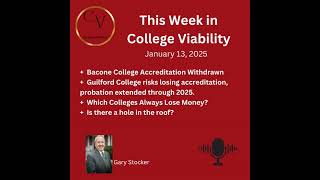
Gary Stocker surveys the financial crisis in higher education: Bacone College lost accreditation, Guilford extended probation, and Brown, Portland State, and others posted major deficits. About 40% of private colleges and 20-25% of public colleges have posted operating losses over the past decade.
Chapters
It's This Week in College Viability news and commentary for Monday, January 13th, 2025. Welcome back, folks, and just plain welcome to new listeners. I can now report that my driveway here in suburban St. Louis is visible. We have survived what will probably be the only snowstorm of the year here in St. Louis. I hope those are not famous last words. And of course, as colleges restart throughout the nation last week and again this week and probably in the coming weeks, the pipeline of higher education news stories, of course, is also heating up. This week, here are the headlines we have on the story. Bacone College accreditation withdrawn. That's been around for a long time. I've got Bacone's response in College Dribble section. That'll come up here in a second. Guilford College in North Carolina risks losing its accreditation. They didn't get things fixed in 2024, and the probation they were on with their accrediting agency was extended through 2025. All right, I guess that's fine. Interestingly, there is not really a president at Guilford now. The board chair is leading the college's effort to get out of probation from their accrediting agency. We've had Guilford College on the Financial Health Show, and I've had it, I believe, on the podcast as well. And of course, another college dribble section is on for today. We have a story on which colleges always lose money, a story about how many years colleges have lost money, and then we have one on from Kiplinger. Kimberly Langford at Kiplinger had a story on why you should check your college's financial health, and we'll talk about that. And of course, much, much, much more. Boccone College accreditation withdrawn. Bacone is not enrolling students until further notice. This is from Jared Moore at MVS Koke Media. I don't know what that is. Bacone published the following statement to its website concerning the withdrawal. This is from their accrediting agency, and I don't have which one it is in my show notes here. Bacone College— again, it's from the college itself— Bacone College is not closing. This is despite the fact they've lost their accreditation and plans to graduate another class of our outstanding students. Again, this May. Like many small profit nonprofit colleges, Boccone has experienced several difficult years. Okay, the Board of Trustees are committed to the future of this historic college and believe that Boccone will continue to provide a quality education for our students for decades to come. And it concludes with, the staff and trustees will make no further comment at this time, but we'll be providing a detailed revitalization plan in the near future. And as of publishing of this article, Boccone College website was still operational. Okay, all right, I'm not going to go into too much, but briefly, the data: Boccone College 4-year graduation rate less than 10% over the last 8 reported years, retention somewhere around 30%, Their 2022 endowment was just under $6 million, down $1.3 million from 2015. Huh. Bacone College Board of Trustees, if you could graduate folks, if you could graduate folks, which is the purpose of a college, there might be some empathy. Lacking that, none from these quarters for sure. Inside Higher Education, Josh Moody had a story on January 6th about a series of cutbacks that happened in December, early in the year. And I just wanna quickly go through the list, again from Josh Moody at Inside Higher Education. Columbia College cut back $17 million from, has a $17 million budget deficit and plans to drop 11 programs and cut up to 25 faculty jobs. That was from the Chicago Tribune. Portland State is giving 15 non-tenure-track faculty members layoff notices. They have an $18 million budget gap. William Jewell, just north of Kansas City, citing significant financial challenges William Jewell brought, William Jewell brought about by increasing costs. Officials at William Jewell Institution announced last month that it was declaring a financial exigency. University of Connecticut is looking at an initial, an additional 18 academic programs to cut. It remains under review. University of New Orleans plans to axe 70 jobs over the summer. They did that last summer. They had a $15 million deficit. More cuts are on the horizon. San Francisco State declared a financial emergency last month. President Lynn Mahoney wrote to faculty that every unit will be making hard reductions and program changes likely. And then lastly, interestingly, Brown University, not an organization short on assets, announced a $46 million— that's a big number— announced a $46 million structural deficit last month. I think that was December, might have been November, citing flat undergraduate tuition revenue growth, increased financial aid inflation, and rising salaries and benefits as factors. Now, Brown's not going anywhere, and although Brown did not announce job cuts, it will review vacancies and limit hiring. So, so $46 million is probably couch money. In Brown's overall financial landscape. But the fact that they have an operating deficit is interesting. Again, Brown University is not going anywhere. They're a strong organization, one of the biggies, one of the Ivies, and that will continue to be in existence. But they're losing money and they can't do it forever, but they don't have any imminent issues of any sort at all. Guilford College— this is from Sarah Sowers on WXII 12 TV in Winston-Salem, North Carolina. On January 7th. And let's just take a look at the data from Guilford College, right? Their net tuition revenue is down 39% since 2016. Closed colleges are down 42%. The set of 9 colleges that Matt Hendricks has in his Advanced Compass— revenue is down 11%, but expenses are up 5% over the same time period. Their endowment is $90 million— not bad but not good. Tuition and fees are down $11 million, and their admission yield is in the mid-teens— not necessarily that good. Their 2022 4-year graduation rate was around 40%, um, and 6 years was around 50%, a little bit lower than that, uh, at, at Guilford College. And they haven't even released their 2024 audit financial statements that I've seen. I haven't checked in the last couple days. So, so it's uninformed, it's uninformed to think that a college with that kind of data can survive the financial position that they've created for themselves. So here's, here's my prediction what's going to happen. I don't know that they're going to close for sure. I would never predict that they're going to close. I just don't do that. Certainly their current financial path is not sustainable. But here's what I think will happen. The college will scramble. Guilford College will scramble and create documents to send to their creditor, which is SACOC, the Southern Association of Creditors. I can't remember what the acronym stands for. On what they will do. So Guilford will say, hey, accreditor, here's what we're going to do. And the good folks at Guilford College will dot their i's and cross their t's, and their accreditor SACOC will say, hey, okay. The college will then have a press release that will spout out all sorts of we work so hard, we are great, we will be here forever stories. Students will continue to not graduate, not to graduate in large numbers, And I think eventually the financial realities will hit and someone somewhere down the road will finally reach for that off switch on the wall. College drivel, Boccone. I shared the story up front. The Board of Trustees are committed to the future of this historic college and believe that Boccone will continue to provide a quality education for our students for decades to come, if only If only they could actually graduate folks. And this, I've talked about this before, this management by PR has gotta stop. And it won't, it's got to, it won't because it's embedded. It's embedded in almost every college out there to spin and spin and spin data some more to make the college look good in the eyes of the world. And all right, in theory, there's nothing wrong with that. In practice, there's nothing wrong with that. But I've heard from, from too many inside higher education folks to believe anything is going to change. But of course, that is why I'm here. I'm here as your self-proclaimed college quality control and alternative media source to point out the silliness of many of these things that colleges are trying to do. Page 2: college operating costs rose a little over 3%, 3.4%. Fiscal 2024. It's common, happens. This is from Ben Unglesby, uh, at Higher Ed Dive, and Ben was on our podcast last year sometime. And here's, here's the one Dive insight from Higher Education Dive that I want to read: any slowdown in expense growth is welcome news for colleges, of course, but that doesn't translate to lower prices, and costs are still at painful levels following past spikes. These costs are made, according to Dive Insight, these costs are made all the more painful if stagnant or falling enrollment constraints continue. Reaffirmation, reaffirmation, this is a troubled industry. Dr. Robert Kelton, University of Tennessee, had a story out on his blog, his website, I guess, which colleges always lose money. And as always, I'll have the link on the show notes. And here's— I've got a couple of graphs I'm looking at here that Dr. Kelton, Robert Kelton, posted. And from 2014 to 2023, so 10 years, about 40%— I'm looking at the graph— around 40% of private colleges had losses over that time period, some of them for multiple years. And to look at the other chart, that— and for the publics, it was about somewhere a little over 20%, 25%, something like that. Privates, there were 20% of private colleges with financial losses for 2 years. Over 4 years, there were about 16%. Over 6 years, there were about 8%. Let's say 10%, just round up the numbers to make the math easy for those that didn't pay attention in math class. So 5 years 10% of about 1,300 private colleges means about 130 private colleges have had losses for at least 4 years, some as many as 6 and a few as many as 8. Again, what's the purpose of this kind of story? It just reaffirms the challenges, the trauma. It's at a macro level for sure, and that's what most folks do. Of course, we don't do that here at College Viability. We look at it college by college. A LinkedIn post from a gentleman by the name of Mark Sclero. He's a CEO, higher education specialist. I believe his organization is called Educator, uh, from LinkedIn. And it's kind of a spin story for independent education counselors. Maybe Mr. Sclero is part of that organization. And it's, it's an attempt, as I've seen before, as we've seen before, and I've shared before, to rationalize— I guess they didn't read the data above— to rationalize the dire state of higher education. And the reason I put this post in the podcast is that Mr. Sclaro, like too many others— Derek Newton for Forbes, for example— they just aren't thinking deeply enough. They take somebody else's report and write it to support a position that higher education is fine, right? That's a generalization, I know. And that's contrary, very contrary, to everything those of us who actually look at the individual college data day by day, week by week, month by month, and now year by year. It's, it's, it's, it's opposite of what we see at the individual college level. The issue is not the enrollment cliff. It's not enrollment. It's not even new programs. It's, it's the endemic financial weakness of so many public and private colleges. The market is speaking, and too many folks are trying to verbally prop up verbally prop up an unwell industry. And you hear it on this podcast, you see it on the show with Matt Hendricks and Gary Stocker. The financial health and viability of too many individual colleges, and that's important, is not good. Now, this, this organization, Independent Education Counselors, I see, I see an increased need for college counselors. And here's something I'll offer: I think that need needs to focus on adding financial health and viability guidance to their clients that they advise on what colleges to go to. So, so here's what I'm going to do. Let's do this. I'm going to give away 10 free links, free copies of the 2025 College Viability App to any private college counselor who can identify that's what they do, who asks for it. 10. I'll give away 10 freebies. And, and let's, let's do this. Let's give it to the end of the month. January 30th, drop me a note if you're a private college or college counselor. I don't care if it's public or private. Confirm for me that I know that you're a college counselor. And when that, when that app is released, I'm thinking by the end of the month, I'll send out free links to the first 10 who dropped me a note. And I have Jeff Salingo a couple times on, on the podcast today, on his content on the podcast today, and he had a Chronicle story titled Higher Ed's Grim New Normal. Overcoming demographic headwinds will require more austerity. And austerity is never a good word, particularly in the context of higher education, because nobody wants to talk about cutbacks. And as always the case, Jeff Salingo writes good stuff. Even the show that he does next, the newsletter next, and the show he does, just good stuff almost every time. The second part of that is Rick Seltzer at the Chronicle took Selingo's post and made some comments. So that's kind of what I'm going to focus on. And Seltzer's headline was Thinking Outside the M&A, the merger and acquisition box. And Selingo said in his post, M&A is hard. Colleges often wait too long to get started on what is a long, arduous process. Very few institutions, very few institutions, Jeff Selingo writes, have the financial heft necessary to acquire and operate struggling campuses. Okay, fair enough. Are partnerships the answer? And Jeff Slingo has written about network universities. They had a book that was a big part of, and perhaps course sharing, consolidated career services, things you've heard about before. And then it goes on to ask, could we imagine, could we imagine a group of struggling colleges spinning off their weakest, their weakest academic assets into a new institution that can actually take advantage of size and perhaps even invest in majors that some campuses see as distressed. Again, just lingo. And advertisement, self-promotion, the 2025 College Majors app is essentially ready to go. If you want to be able to compare almost 3,000 public and private, 2- and 4-year colleges and which college majors are strong in— we've got more than 60 in the app— and which majors they're weak in. Purchase, purchase a link, purchase the College Majors, the 2025 College Majors app. I've got some initial demo out there on YouTube. I'll have more tutorials and promos on that coming. It's a, it's a, it's a tool I've not seen out there before. So if you are a college academic leader, or even a non-academic leader, take a look at that app. There's ways to use it to compare where you're strong at and where you're weak at. I will also have a version out for students and their families later this winter. And here are some observations, and this is from Rick Seltzer, um, your Daily Briefing author, is how he says that. He says people must be managed carefully. Institutions have unique workplace cultures. We know that saving money often means administrators lose their jobs. Sometimes board members jockey for power, alumni get upset. Time is of the essence, he adds. Institutions don't give themselves enough runway. Salengo talked about that, I've talked about it, others have talked about that. It continues to happen, and sadly, I think it will continue to happen into the future. And I guess the last one is regulation that I'm going to talk about before I finish up this story. Regulation resists innovation. It takes too long to get acquisitions or mergers approved. Now, I see early indications that that might be changing, but I'm not convinced it's for real yet. So the bigger picture is the parochial nature, the parochial nature and embedded cultures of too many colleges is something that really I don't think either Neither Mr. Salengo nor Mr. Seltzer notes, although they do note that institutions often don't give themselves enough runway. And again, like I said just a minute ago, I don't see that changing. Read the Coon College story. And I'll say this again, and I'll keep saying this. This is a macroeconomic issue in one sense. Too many colleges, too few students, blah, blah, blah. And while it is a macroeconomic issue, The level of financial detail, financial results at each college, at each college is what needs to be monitored closely. There will be hundreds, hundreds of colleges that survive and even thrive in this supply and demand imbalance. It's a challenge for students, their families, even faculty and staff to look at the data to see which ones are likely to survive and thrive and which ones who have little, if any, chance to be able to be categorized like that. I was in the Boston Globe last week. Hillary Burns dropped me a note, the Boston Globe staff, asking for some comments on Olin College. And it's the Franklin Olin College of Engineering in Massachusetts. And she shared— the story ran late last week. I can't remember the exact date, maybe January 10th. And here's the data for the Franklin Olin College of Engineering. Net income margin has been negative since 2017 as compared, uh, it's very comparable to the closed college set. Operating, operating cash has been in the basement at about 40% since 2016. Interestingly, net tuition revenue is up about 30%, operating revenue up 5%, operating expenses up 22%. That's an imbalance, and that's from '16. And looks like their 2024 financials are out as well. And enrollment has been for the most part flat. Their 2022 endowment is $450+ million, very strong. Their unfunded institutional grants, merit aid, most scholarships are up 43%. That's a lot from 2015 to 2022. Graduation rates are really, really good, really good at the Olin College of Engineering, up around 80% over the last 4 years, 4 years of graduation rates. It's a high-quality college, and I had St. Louis University, among others, that are— they're, they're one of many high-quality colleges that at least graduates students, graduates a really strong percentage of its students, but still has similar financial challenges as colleges that don't graduate even half or even 40% of their students. And if you're a reporter, I'll say this to you, Hillary Burns, thanks for reaching out. If you're a reporter looking for more than a generalized set of higher education urban myths and trite observations made by others. I have immediate access to the financial operational outcomes for more than 3,000, for about 3,000 public and private 2- and 4-year colleges. Drop me a note, reporters. Drop me a note to gary@collegeviability, one word, collegeviability.com, and I will get you a courtesy link. Doesn't matter how many apply for this, how many ask for this. I'll get you a courtesy link, reporters, to the 2025 College Viability App. You'll have easy access to look at and compare about 3,000 private and public colleges and compare over dozens of financial enrollment and outcome measures. And just a quick side note, I had one of my LinkedIn connections post a story last week about an individual he referred to me for guidance on a private college in New York. And I happened to respond right away to this person, and, and my LinkedIn connection shared my response and noted how quickly and thorough my response was. And I'll do that for you if you're looking at a college and don't want to buy the app. Please buy the app, but if you don't want to, drop me a note. I'll give it a cursory look and I'll get back to you. Page 3, why you should check your college's financial health. And again, this goes back to the Kiplinger story I referenced in the start. And Kim Langford, or Kimberly Langford, wrote this on January 8th. And here's the guidance that Miss Langford gave, right? Let me read it, I'll talk about it. Look at enrollment trends for parents and their families, review the Common Data Set, look at the College Scorecard, look at the iPads data, find and look at the heightened cash monitoring list, search Standard Poor's and Fitch's for guidance, and look at majors. All valid sources. All valid, valid sources. But, um, uh, here at College Viability, we bring all of that together in the College Viability series of apps. You know this, regular listeners know this. The financial enrollment outcome data in the College Viability app and the comparison of college majors that'll be coming out any day now in the 2025 College Majors app. We do it for you. We look at enrollment trends, we look at the Common Data Set, we look at the College Scorecards. IPEDS is our specialty. Height and cash monitoring is so old as to be not particularly useful. Standard Poor's pitches we follow, and Majors were— I think the College Viability app on Majors might be the only one out there that lets users compare how many majors or college graduates. And even we— this year we're adding a market share comparison, user-defined market share. Take a look. It'll be out very shortly. And how many moms and dads, grandpas and grandmas will really invest the time and have the expertise even to look at these references that Kimberly Langford shared in Kiplinger? That's one of the main reasons I'm here. You know, very few college faculty even go to those sources to look at. And I often wonder if very many college board members ever navigate and look at these sites. And for both of those group— college groups, college faculty, board members, the college viability app, and even the work that Matt Hendricks done has done at Perspective Data Science— the data is there. We bring it together, we compile it, we do comparisons. Take us up on the offers. Page 4. Finally, Jeff Selingo— again, I mentioned this earlier— had another LinkedIn post and calls this the year The Year of Great Reckoning. And he starts with a note that the roof is leaking. This is Jeff Sullinger on his newsletter Next on January 10th. The roof is leaking. The mid-aughts were a boom time. That's 2004, 2006 kind of time frame. The mid-aughts were a boom time for campus construction. Nearly 90 million square feet of space, of additional space, were built on campuses. This is according to Gordian, which is a construction consulting firm. Slingo goes on to note, if you own any sort of property, your house, whatever, you know what happens after 20 years. We have that here in the Stocker House— things start to fail. The age of plant— again, Slingo continues— the age of plant at colleges, that's a metric that bond rating agencies like Moody's and S&P use, continues to tick up. The median age of plant, age of a building, at private universities is not quite 16 years. Right now in 2017, it was just under 14 years. And Solingo notes up, up to $950 billion with a B in spending over the next decade for deferred maintenance, maintenance facility upgrades, and construction projects according to Moody's. And finally, Solingo notes the big picture. For years, most colleges tried to manage their growing deferred maintenance by using extra cash at the end of the year, their so-called profit margin. And they use that to fix the proverbial leaky roof— again, Jeff's lingo. But in recent years, those margins are essentially non-existent. And at some colleges, as we well know, those end-of-year dollars have turned into deficits. So let's take this to the College Financial Health Advance Compass, MET. Hendricks tool and how we use it on the College Financial Health Show with Matt Hendricks and Gary Stocker for colleges that have not fixed the roof. And we've used that euphemism before, and that's the one that Jeff used as well. In the College Financial Health Advanced Compass, there is a measure called CAPEX to depreciation ratio. CAPEX to depreciation, capital expense to depreciation ratio. And any value, the threshold we use, any value below 1.0 indicates a college is falling behind in maintaining its infrastructure, its maintenance. On the show, we see regular instances, regular instances of individual colleges not meeting that 1.0 threshold over many years. Some just don't meet it on occasion, but there are too many that can't, that don't have the resources, and that ratio stays below 1.0 year after year after year. And, and those that don't invest in their facilities, that should concern folks. That should concern faculty and staff, students, families, and others. Jeff Salingo reinforces at the macro level, the big picture level, what Matt Hendricks and I do at the college level. Let's wrap this one up. John Beckenstedt, who is the retiring enrollment vice president, head on at Oregon State— the entire— the retiring enrollment vice president at Oregon State University. On his January 12th blog— and I'll note that John Bockenstedt is like me, a data nerd, although he's a much better data nerd than me— and here's a quote from John's January 12th blog post: since my announcement of his retirement, something strange has been happening. Colleagues with whom I've had good open conversations over the years have been spilling the tea in ways I hadn't anticipated. He continues, and not one, and not one of my colleagues is optimistic about the future of our profession, admissions, or for that matter, he continues, the future of our industry, higher education. He concludes, the stories I've heard about the demands, expectations, and perhaps worst Worst, John Buckenstedt shares, worst of all is the facile solutions put forth would curl your hair. Not good. That's not good. And this is from a career-long higher education leader who now has nothing to hold back about this industry. Not that he ever did. He's always been an upfront kind of guy. And he had two recommendations in his blog post, and the first is get your trustees and faculty acquainted with market realities. John Bockenstedt goes on to note, one side yelling, 'You just don't understand,' and the other is generally not productive. And I've talked about this countless times. It is the market that is driving this. John Bockenstedt knows that. And he wants trustees and faculty to get a handle on that, and I don't see any sign of that happening soon. And then lastly, he says challenge every assumption. He notes you should know, you should know by now that when you raise tuition by 4%, you don't get 4% more revenue for a variety of reasons. And many of those I've talked about, probably all of those I've talked about on the show. And it's, it's the higher education market. I will say it again and again, it's the higher education market and the higher education's ingrained parochial culture that makes it difficult to see anything, makes it difficult to see anything but increasing economic trauma for the coming months and years. Agree with me, disagree with me, but please look at the data. Look at the data that I and many others make available, not just from your organization, but from those competitors, our competitors, those competing colleges around you. To continue, college leaders, faculty, staff, community leaders, to continue on a self-blinded path from the past continues to be a very, very risky model for higher education. Today. Hey, thanks as always for those of you who make time to listen to the podcast. I am always grateful. We'll do it again next Monday, and until then, I'm Gary Stocker for College Viability. We'll talk again next Monday.
More from Gary


What does it look like when a college increases both total revenue and total expenses?



College Financial Crisis? We look at the financial health of Bay Path U. (MA) and Coe College (IA)


Private College Financial Crisis? We look at the financial health of Hobart William Smith College


Financial Compass tutorial (Private college version.) Financial statements compiled 2016-2025.

