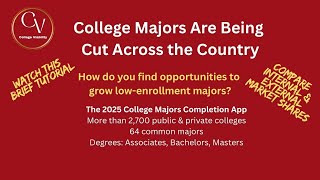
Gary Stocker demonstrates a data tool for college leaders that tracks enrollment across 64 majors at 2,700+ institutions using IPEDS data from 2020-2023. The app shows which programs have few graduates, how your school compares regionally, and four-year enrollment trends. Indiana's policy of cutting majors with under 15 graduates illustrates why this matters.
Chapters
Hi, it's Gary Stocker with College Viability. In the past few weeks, we have seen many colleges announce program and majors cutbacks, none more than the state of Indiana, which announced the cutback and consolidation of some 400 majors for the state's 6 public colleges. Earlier this year, we released the 2025 College Majors Completion App. It combines more than 2,700 public 2- and 4-year colleges and private non-for-profit colleges and compares the majors across 64 common and diverse majors across associate degrees, bachelor degrees, and master degrees. This brief tutorial will show colleges how they can identify not only their own internal market share issues of programs and majors with low enrollments, but how they can compare the same programs across associate, bachelor's, and master programs across all the colleges in the region, or really all across colleges across the country. First part of the app that we're going to look at is something we call internal market share. We will look at the percentage, the total number and the percentage of individual majors inside a single college. And what I have set up here is for all years, 2020 through 2023, is the last available IPEDS data. And I've got it set up for bachelor's degree, although we can look at associate's and master's as well. And we can look at it across majors. I've got to set up select all majors. And for this purpose, I'm going to kind of mimic what the state of Indiana has done, and I have just selected public 4-year colleges. We could also look at private 4-year colleges and public 2-years as well. And you may recall the news stories that the state of Indiana specified that college majors with 15 or fewer graduates, completed majors, would be eliminated from the college offerings in the future. So what we're going to take a look at here is those majors at each of the individual public colleges in Indiana to see which ones we know— we can tell by looking at the data from IPEDS— don't meet that 15-major minimum. And I'll just show a couple examples. This is Indiana University in Kokomo. And again, we can look at the 2020 data, but we'll go over here to the 2023 data, the most recent available. And you can see how many of those don't even come close to that 15-major minimum. Let's scroll down to another one. Let's look at Indiana University South Bend. And again, the pattern holds itself all the way through. Let's take a look at some of the bigger colleges. Here's Indiana State, and, you know, not as many low enrollment majors. There's a handful or two we see right here, and those would be the ones subject to that Indiana State discipline. And let's take a look at one more. Let's take a look at Purdue and the Purdue University main campus. And again, they have not even a handful of low enrollment majors from those areas. It would be easy enough to switch from bachelor's degrees to master's degrees, and I don't recall that Indiana has a limit on master's. They may have that one, but again, the same analysis holds. We can see which of these master's, these graduate-level courses, have small enrollments. You can see the numbers here, you can see the percent. Again, this is internal market share. So we have up here, we have the University of Southern Indiana right here. We can see the total number of majors for each of those years, and we can see the count and the percentage of internal market share for each of those majors. Criminal justice, public administration, kinesiology, and so on. The second part of the 2025 College Majors Completion app that might be more readily available to assess where there might be opportunities to grow market share for given majors. So again, I'm staying inside the state of Indiana. I'm looking at the publics only, and I've got accounting and accounting-related services lined up. What we're looking at here is these are the public colleges in Indiana. And this is the external market share, like every other industry calculates what their market share is of hamburgers and cars and computers and watches and chairs and all those kind of things. Let's zoom in on it a little bit, and we can see in the public— for public colleges in the state of Indiana, we can see which don't get to that 15 minimum. And in the case of accounting and accounting-related services, only one, Indiana University East. We can apply this same approach, and let's take a look at it— not accounting, let's take a look at marketing in her public colleges in the state of Indiana. And we can see really that all 5 or 6 of these colleges meet that 15 major completion mark. And let's look at one more example. This example is for chemistry. And we can see that there are more than a few, there are many public colleges in Indiana that don't meet that 15 major completion threshold. University of Southern Indiana is one. We can see the role at Indiana University Northwest, and you can see them all across. You can scroll on top to see what those are. You can see the color coding on the right-hand side. One other feature that I want to show is the capacity to look at trends, 4-year trends for any of these 2,700+ public and private colleges across 64 common and diverse majors. Is this icon right here shows us, will let us track the trends for each of these majors. So again, I've got accounting and related services, and we can see that Ball State University has grown from 291 up to 380+. And you can see which colleges are flat and which are all over the place. You can select your own Colleges if you wanted to. Here, let's take a look at Indiana University, let's look at Indianapolis, let's take a look at Ball State. And again, you can see the patterns or trends, if there are any— this has got a data reporting issue here— for any major that you want. I'll bring up one more. Let's take a look at economics. And again, you can see the trends associated with each of these majors. Now I'm going to wrap up this brief tutorial with an external market share for all of the state of Indiana public and private. I've added private colleges to this one just to show you what this external market share comparison can do for your organization. This exclusive 2025 College Majors Completion app from College Viability retails at $799. It is time to get the app in the hands of more users. Through August 15th, 2025, we have promotional pricing to get this entire app available for $199 through August 15th. On August 16th, the price goes back up to $799. If you'd like a personal demo of I'll leave my contact information in the show notes, and you can reach out to schedule that private demonstration.