TWICV Special with Jeff Spear CEO of CFO Colleague (July 11, 2024)
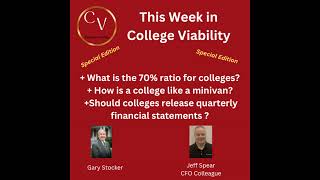
Jeff Spear, CEO of CFOcolleague, explains why less-selective colleges serving low-income students face closure. He introduces the 70% rule: schools should keep salaries and benefits under 70% of net tuition revenue. Recent closures like University of the Arts and Welles College happened due to cash-flow crises that could have been caught with more frequent financial disclosures.
Chapters
Welcome back to another episode of This Week in College Viability. This is a special edition where we have today the chief executive officer, Jeff Spear, of CFOcolleague, and he's going to tell us all about CFOcolleague as we chat. Jeff and his company are one of the many higher education data entrepreneurs that I think are changing the way we look at higher education, and of course we'll find out more about that in a minute. Jeff, Thanks for making time on this summer afternoon to join us.
It's great to be with you, Gary, and I look forward to our conversation together.
Well, excellent. So, you know, there's an elephant in every college room and every college discussion these days, Jeff, and the elephant in the room right now is the FAFSA debacle. So from your perspective, Jeff, share with our listeners best case and worst case.
Yeah, well, it's clear that there is a, a deficiency in the number of FAFSA completions this year. Unfortunately, everything that we're seeing indicates that this deficiency is going to hit the less selective schools much heavier than those who are more selective, even though there were gallant efforts out there to try and get people to finish the FAFSA. Schools invested a whole bunch of time and effort and people to get it done. but the reality is those who tend to enroll a lot of first-time, uh, students, first-generation students, minority students, those who, uh, perhaps don't have a whole lot of money, the very people that the government was supposed to be helping with the FAFSA simplification are the people who are not completing FAFSAs. And the schools that enroll a high percentage of them, which are the less selective schools, are the ones bearing the brunt of this. And add to that the fact that the, the less selective schools are the ones with the least amount of resources and reserves to handle this. So we call it an accelerant, essentially. That is, it's going to speed up the demise of some schools. It's going to cause other schools to have to make some really big decisions in terms of restructuring and reorganization.
Yeah. And worst case from your perspective is what?
Well, I mean, this will mean that a lot of schools are gonna wind up having to close their doors. In fact, I know of one school in particular that I probably shouldn't share their name, but their closure was the result of their anticipation of the fall, and that anticipation showed a significant decline in the number of students who were showing interest in the institution. They just said, we can't do this anymore.
Interesting. Because I worry, I worry about that, that there are many families making that very same decision. They're choosing between colleges and they say, boy, it's just too small. It's private. And we won't know until after the fact that these families have decided to go public or to go to other colleges because they're scared about the finances. So, so, so Jeff, if anybody ever charged me, charged me with being a data nerd, I would have to plead guilty. I don't know if you would plead guilty or innocent to that charge, but you've got a, I'm going to call it a rule. That may not be what you call it, but you have this 70% rule that you've used for a long time. And I know our audience includes a lot of folks that would be interested in what that is and how you use it. The floor is yours.
Yeah, well, what we found was that people were not connecting revenues with expenses when they put their budgets together. They would pour in the water of COVID relief funds. They'd pour in special gifts that came from perhaps a legacy gift. They'd pour in net tuition revenue, auxiliaries, and all that kind of stuff into a barrel. And it's all considered to be the same. And they turn the spigot on the bottom. What do they do? They hire people with it. So During COVID we saw a number of schools that actually increased their hiring, all the while net tuition revenues were declining. And the rule that we have used as part of our 30 benchmarks we have on our website, but one of the benchmarks is that you should not be spending more than 70% of net tuition revenue on salaries and benefits. So compensation divided by NTR should be no more than 70%. Well, we've seen some schools that are at 170%. Now, in that case, they had support from some endowment. But you have to ask yourself, are you using your endowment strategically when it's plugging a hole like this? So those who are above 70% tend to struggle. As you approach 100%, you're in really big trouble. And we track this over time and we graph it and we can show one school we worked with, they were at about 50% a number of years back and now they're at 103. Well, it's because they never made the connection between that critical revenue piece, which is the largest source of revenue for any institution, that is net tuition revenue, and of course the largest expense, which is people cost. So that's why we look at that and we track that over time. And in many cases, the deficit that we see for the institution would be wiped out if they would go from their current level of spending on people to the 70% standard. So anyway, that's what we've seen. That's what we share with people and we show them graphically, and we think it's a critical ratio along with a number of others, of course.
Interesting. So one of the things that I share with, with both the social media posts that I do and on my regular Monday This Week in College Viability podcast is I make the case, and Jeff, tell me if you think I'm right or wrong. I make the case that the die is cast for most of these colleges watching their last dollars circle the financial drain. Am I right or am I wrong?
Well, I think in many cases, unfortunately, you're probably right. But I have an analogy for this, that for too many schools, we're all in a speeding minivan with no driver on cruise control heading for a cliff, and the occupants are arguing over what DVD to watch. I mean, this is really the nature of higher education. We're so focused on everything else, all the other stuff, when in reality we've got a demographic cliff coming. We've watched our net tuition revenue decline. We've watched our enrollments get smaller. And so we need to be focused on the things that are going to improve the operation. Now, our practice is a bit unique in that part of what we do is we find money. For people. In fact, there was a school just a few weeks ago that we found $10 million through some of the real estate transactions that we do. We actually have a company that buys campus real estate and leases it back to the school, and that winds up giving them a gain and gives them the ability to, to show a better ratio. And then we have a way of converting that into a cash benefit for the institution. So anyway, we do this. But however, if you throw $10 million at a situation, that has been run poorly for a number of years and people say, wow, you know, that's a sigh of relief. We're going to at least be around for 2 more years while we do something versus giving it to somebody who has a definitive plan for restructuring, retrenching, relooking at reimagining their institution. I would go with that second group more than I would with the first one. We don't like to change the way that we've done things. So in some ways, we hate to find money for somebody who's just going to keep on going as they have in the past. We see about 300 schools in trouble as you go out to the end of the decade, and they're either going to change how they operate or they're going to be gone. That's just how it is.
Yeah.
Yeah.
Interesting. So kind of changing the tone of the conversation a little bit, Jeff, in the last couple of months, 3, 4 months maybe. I've noticed a trend in the colleges that close, and of course in 2024, the common number cited is about one private nonprofit college per week. But a lot of these closures have been really short notice, and those are starting to stack up. University of the Arts in Pennsylvania, Welles College, and others. Do you think we'll see more of these short notice closures as colleges run to the end of their cash?
Well, I was reading just this morning about Big Lots, the retailer based in Ohio, and they lost $200 million last quarter and their sales were down 10%. They are indicating that this is because of high inflation and the fact that the market that they serve, which is probably lower middle class, has been hit hard with discretionary income reductions due to inflation. When or if they declare bankruptcy at some point or liquidate, it'll be a sudden announcement. Bankruptcy typically is not telegraphed. You know, in a year from now, we're going to— we're going to declare bankruptcy. But for now, we'd like you to come here and buy all your stuff you can from us and buy extended service contracts that we won't honor after we go out of business. So schools really are no different. I don't see short notice closures changing. Many of these schools have been used to living on nearly nothing for years, and they always think something is going to happen. A miracle. A miracle. The loaves and fishes are going to keep them going forever and ever. And all of a sudden they realize, gosh, we don't really have the resources to keep ourselves alive. I mean, you look at one of the schools recently, Clark Summit University, they, they wound up furloughing everybody.
Yup, that's right.
In the beginning of June. Well, you furlough everybody in your school right before you're supposed to be bringing new students on board in the fall, preparing for your fall, and that seemingly says, pretty sure we're going to close. By the way, they had problems with their accreditation as well that they had not resolved. So sure enough, 3 weeks later they said they're going to close. In the meantime, They're making all these optimistic statements. We've got big plans for the fall. We're going to have record enrollments and all this stuff. And it's a big head fake in the midst of what is a dumpster fire. And they wound up, of course, closing, and that hurts a lot of people. So anyway, that's, I think short notice closure is going to be frustrating. But if you tell people a year ahead of time, what are they going to do? I'm not going there.
Yeah, they're not going there.
They'll close right now anyway. So that's what I think.
So one of the things I've come to, I think, find out and discover in the last year or so when I talk to finance guys like you, and I'm making some assumptions, so feel free to correct any that are wrong. Is it reasonable to assume that there are countless colleges violating their bond covenants? And if you can envision behind closed doors in these colleges that are in trouble, and they know they have violated their bond covenants. Speculate for us how bondholders in your mind may be reacting to college closures and the millions of dollars they have outstanding to colleges that may not survive, Jeff.
Yeah, I think, you know, you're talking about the issuers, which would be the banks. The banks issue these or funds issue these, and the actual bondholders are these funds. And people will invest in like PIMCO or something like that that has these in a mutual fund. So the reality is they are a portion of the total portfolio that these mutual funds have. We are already seeing significantly higher interest rates for those who are of a more significant credit risk. And that means that schools have to pay more. Right. The schools that have to pay more are the ones who can barely afford to pay more. So that's one piece of it. The other piece is that a school may miss a payment, like Casanova College in New York State near Syracuse missed a payment on their bonds. And as a result, the bondholder, the trustee said, we're sorry, but we have to call these bonds. Well, their campus is in a very nice suburb of Syracuse. And right now I think it's being used as a training center, maybe for the state police. I'm not sure, but they have options. If the bonds are called, then there are options for the sale of these properties. But think about Wells College, middle of nowhere. I mean, near Cayuga Lake. I actually grew up across the lake from Wells College, so I'm familiar with Wells College, a little village of Aurora that they're in, a beautiful setting. Lovely setting, how do you sell that place to anybody? So if you're going to call the bond, you've got to be prepared to do something with the real estate that supports it. And that's going to be easier for a Casanova College or Eastern Nazarene in Quincy, Massachusetts, than it would be for someone who's in a rural area.
Interesting. And I've had others who have some expertise in bonds suggest that some of the bondholders may not call those bonds because they don't want to have to run the college. Do you agree with that?
Yeah, well, if you call the bond, you're not going to be running the college. You're basically going to be dealing with, you know, owning real estate. The college will close. So that's kind of how that works.
Interesting. I've just learned something. So thanks for that. So you and I talked before we started recording on the podcast today about the delays in college financial data. Again, the IPEDS data is close to 2 years old before it comes out. The financial statements are posted once per year. And yet you and I and many folks listening to this podcast know that most for-profit businesses in every other industry release quarterly financial statements. Is that something that might give both consumers, bondholders, and many, many other stakeholders a better handle on those colleges in trouble and those colleges doing well if there were quarterly financial statements released, unaudited or audited?
Yeah, I think because of the nature of higher education, we tend to have a fall semester and a spring semester. And I have— and most, most banks that we've worked with over the years, they want to see a statement that's mid-year, 6 months. And the reason is that you've closed out a cycle at that point. And at that point you can say, yep, our tuition's been fully earned and we've spent the money for the fall and here we are. It's December 31st or November 30th or whatever the number is. We're at 6 months and we have that out. Now the question is, when should that be reported? For a lot of banks, they want preliminary financial statements in 45 days. And that's an SEC standard that you need to have your financial statements available in 45 days for quarterlies. For annual, it's a little bit longer. But I think there would be some benefit to saying that colleges need to publish at least a preliminary financial statement at the 6-month and 1-year interval, 45 days after the end of the year. And schools will say, my gosh, how in the world can we ever do that? Let me just say this. Every industry in the world does this.
Yeah.
And higher education— I've been involved in accounting for higher education for many decades. I can tell you it's not that difficult. It's not that tough to do. We have an accounting division in our firm that helps people with their closings. We can get done in 45 days, no problem. Generally, we're done in about 15, but you have to have it set up so that you're not trying to move mountains at the end of each of these periods. But we need to have that. And then there's a new liquidity footnote disclosure that's required that came out a year or two ago that shows here's how much cash they really have. Because if someone, if Great Aunt Tilly gives me money because she wants to have a brand new building built in honor of her husband Fred, then, and we don't build that building right away, what happens? The cash that she gave me shows up in my cash balance, but that cash really isn't available for use for the institution. That's got some hooks on it. So this footnote shows us how much of the cash you have is available for operations, and that should be clearly spelled out with every financial statement. The reason why people close in general, almost 100%, is they're out of cash. And banks are wonderful. They give you these lines of credit. They let you go through the summer and they say you need more line of credit. Sure, that's no problem. They convert to permanent financing. I mean, banks have been contributing to the demise schools, eventually they pull the line of credit and the school has no money. So I agree. I think there needs to be more frequent financial statements, certainly.
So kind of a self-serving premise is the next question that I have in mind. And I'm making the case, and I think you and I again talked about this earlier, that there's an increasing number of what I call higher ed data entrepreneurs. TuitionFit, me at College Viability, CFO Collegue, Sightline, Matt Hendricks at Perspective Data Science, and many, many others. I've shared many times and talked with others and posted that I think higher education is in its Moneyball era. What's your thoughts that these higher education data entrepreneurs are changing the industry or not?
Well, they're clearly having an influence, but here's the interesting thing. In the era that we're in, the Department of Education is responsible for the vast majority of funding for higher education in America. That is the largest source of funding that there is. And the higher— and the, and the Department of Education is asleep at the switch when it comes to putting together an effective gauge to identify the financial viability of an institution. They've been using virtually the same factors for maybe 25 years or more, and those factors don't adequately assess liquidity. I was talking with a CFO who had been at, um, St. Francis. Julie Gard is her name. Very bright person, finished her dissertation, um, recently, and she had a, a measure that she created for her dissertation, and she applied it to a bunch of schools that had closed. And she said 80% of them had a red, which was, you know, bad, and around 20% were yellow. I mean, honestly, she nailed it. And we've got a sustainability index. You've got the viability app. So we have the data available, but nobody's asking for it. The Department of Education doesn't want to change the way that they've been gauging institutions. So more than half of the schools that closed were in good stead with the Department of Education's ratio. So you tell me, you know, when are they gonna start listening to people? A group of people could get together and put together a wonderful mechanism for evaluating financial viability with help from people like you. But the federal government is not interested in changing anything that it does. It's similar to how they buried their head in the sand when it came to the FAFSA debacle. This is a very serious problem in our country.
Interesting, because I think there will continue to be push for that. And just imagine, you know, Mark at TuitionBit, you know, what a fabulous tool it has. It lets families compare offers. Now, I know there are other tools out there besides that, but Mark's is, it was the first one out there. And that wasn't available, I don't know, 3, 5, 10 years ago, something like that. And I think that's one of the many, many data entrepreneurs that are going to change what's going on here. All right, a couple more questions. All right, so you're going to put your king hat on here. And Jeff, I'm going to stand you in front of every college president in the country. What is the one message you would give to them? Large, small, public, private, what's the one message?
Well, I think like any other industry, we know that we have to make sure that we are adjusting to the changes that are existing in society. There are social changes, there are technological changes, there is information that's available today that wasn't even around before. So even if you are a very well-heeled institution that is doing very well, that should not lead to complacency. But for the others who are non-selective and are struggling, my reaction is you need to figure out a way to reimagine who you are and what you do. And if you don't do that, frankly, you're going to lose essentially your entire student body at some point. Schools are being criticized now for getting rid of, you know, the liberal arts and humanities and how could they do that? But the reality is it's actual dollars and cents. For whatever reason, our students coming out of high schools do not have the demand for these programs that they used to have. So make sure you're pushing the right programs and stop the positive spin on everything. Presidents are just these big marketers. It's sort of like, you know, the Music Man or something like that. Patents.
That's funny.
Medicine salesman. And it's just very frustrating. You know, this is, this is part of the frustration, of course, with, with when, when Clark Summit University was going down, there's all these positive statements coming out. Well, how are you going to do that? How do you justify that? And then all of a sudden you wind up losing the entire institution. So That's— there's work to be done clearly, and we can't sit on our laurels.
Amen. Amen to that. And I see that all the time. Some of the posts that I do, or some of the things I do on my Monday podcast, is I point out how silly some of these announcements are. And, you know, they— I think it was MSNBC this week said some colleges, I can't remember the names, had increased enrollment, and their story said, well, their applications were up. Guys, it's not the same thing. Enrollment applications are not the same thing. So a couple more questions, Jeff. You and I both know that college leaders and their boards have that fiduciary responsibility to the college. And one of the cases I try and make with most, with college liability is that I'm kind of, I'm trying to be the fiduciary for faculty and staff and students. So my question, Jeff, is, is, is, does the fiduciary responsibility of college leaders— find that any way you want— extend to faculty, staff, and students?
Well, the way that I view higher ed as a business, as an industry, is that we all need to be asking ourselves at all times whether we are doing what is right by the student and their family. Without the student, there is no revenue. There is no purpose. In fact, I've yet to see a mission statement that says, we will be the best fundraisers in America. We will have the most beautiful buildings in this area of the country. You know, all the different things we think we're going to have more sports teams than the Olympics has. I mean, this is, you never see that. And yet you look at what they do and you say, That must be in their mission statement because that seems to be their focus. No, their focus in the actual mission statement is on students, on transforming the lives of students. And when you lose that, I mean, you've got— I read recently how some schools are doing what they call direct acceptance, where they find students who meet certain profiles and they send them an acceptance letter to their institution. Not knowing whether they're a fit at all for the institution, but we're going to give them an acceptance letter.
Yeah.
And I'm saying that's, that's not a higher ed that I think is even similar to anything I've ever seen. So the fiduciary responsibility should primarily be to students. And when it is, you'll be a lot more healthy because the student experience will be better, the student graduation rate will be higher, and the earnings will be better. Think about a student graduating in their 20s from college and going out in the world and getting a job as a teacher, making $44,000 a year. Redfin just came out with the average rent. It's $1,654 a month, almost $20,000 a year, average rent. And that new grad has to pay for debt on their, on their education. Maybe a car, they might want to eat something along the way. I mean, this is just crazy what's happening. So if we're not focused on the student, their experience in particular, what life is like upon graduation right then, I don't care if they make $1 million more in their lifetime. It won't happen in their 20s. So if we focus on that, we're going to be a lot healthier than if we focus on whether there's, you know, free food available for faculty at faculty meetings.
And then we're okay on time. So I had you in front of college presidents, every college president in the country for a fictional scenario a minute ago. Let's wrap this up with same opportunity, Jeff. You're going to get to stand and talk to every college family parent in the country. What's looking at colleges, maybe with their high school junior, their high school senior, what is the one piece of guidance that you would give them?
Well, I'm going to first of all say to them, do not give up on college because it's a critical period of time for young men and women. My life trajectory was transformed at a little place used to be called Houghton College, now Houghton University. And I went there, I met my wife there, my parents went there, and her parents went there, and all three of our kids went there. So this was, this was our home. And It was transformational on a generational basis. Don't give up on it, but be really careful and judicious about where you go because the program could be cut, because the school could be shut down, because there could be accreditation issues. You need to do more research than just, oh, I had a wonderful time on my visit. Wasn't it special? I think but I don't wanna think that people will give up on their education at this juncture.
So Jeff Spear, the CEO of CFO Collegue, has been my guest today. And Jeff, I've had lots of guests, sir, you are one of the best. I've been fascinated with your responses today. So my thanks for that so much. We will have the regular Monday episode of This Week in College Viability posted about 1:00 PM every Monday afternoon. We look forward to that. And as always, we appreciate you taking time to listen to our podcast. Jeff, thanks again for joining us.
Thanks, Gary. So grateful for you. And, uh, I hope we can talk again.
Very good. We'll be back soon. This is Gary Stocker for College Viability. Take care.
More from Gary


What does it look like when a college increases both total revenue and total expenses?



College Financial Crisis? We look at the financial health of Bay Path U. (MA) and Coe College (IA)


Private College Financial Crisis? We look at the financial health of Hobart William Smith College


Financial Compass tutorial (Private college version.) Financial statements compiled 2016-2025.

