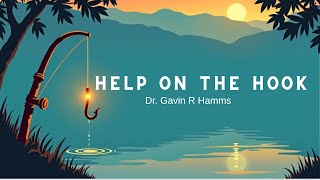
Gavin Hamms teaches on Matthew 17:27, where Jesus tells Peter a fish will contain a shekel for the temple tax. God provides extraordinary resources for ordinary needs through ordinary skills when believers follow His direction. The sermon uses the internet's origin and hidden aquifers as metaphors for unseen sources of blessing.
Chapters
There is an exegetic invitation I want to extend to you. I pray that you accept. You've been invited to fellowship with me today in the Matthean Gospel, the Gospel of Saint Matthew, chapter number 17. St. Matthew chapter number 17. One will swallow water. St. Matthew chapter number 17. Y'all want to hear a word from God today? We'll begin the reading down verse number 27. Word of God reads, however— this is Jesus talking— not to give offense to them, go to the sea and cast a hook, take the first fish that comes up, and when you open his mouth, you will find a shekel. Take that and give it to them for me and for you. You may be seated. Thank God for his word and for the perpetual nature that lies there. Jesus instructs Peter, I don't want to offend these guys, so I tell you what, go take your hook. First fish you catch gonna be a coin, a shekel, inside the fishes. Might want you to take that and pay the tax for me and for you. For the time that God has given me this morning, I want to wrestle from the subject help on the hook. Help on the hook. 1960s, this nation was at the height of what we know as the Cold War, fresh between Soviet Union, United States of America. And during this time, one of the major concerns was communication, because during war, going to be important for devices to be able to communicate one with the other. At this time, people were able to communicate via telephone and to communicate via certain forms of mail. However, due to the potential threat of war, they decided that it's not only important for us to be able to communicate with each other, but it was also going to be important for computer devices to be able to communicate with each other. That's a simple problem. However, from that simple problem, they developed this web network that allowed computer devices to be able to coordinate and communicate with each other. The name of that development was what we know as the ARPANET. It was a device and web-based system that allowed devices to communicate as well as people. Y'all catch that name, ARPANET? And from that simple mundane problem, they came with the ARPANET, which then grew into what we know today as the internet. Gavin Hamms, what's the point in that? The internet today is something so great and grand that is almost to the point that we literally can almost not function in this world without it. We are now connected socially in social media. We now have internet banking. The internet itself has changed the entirety of how human civilization functions. Everyone listening to me this morning must agree that the internet is one of the greatest advances known to mankind. But the tension in that, if it had not have been for a common problem, an extraordinary solution would not have been developed. And child of God, that's the message this morning in Saint Matthew's Gospel, chapter number 17. Jesus and his disciples are entering into Capernaum, and when they enter into Capernaum, some of the temple tax collectors approach Jesus with a simple question. Matter of fact, they don't go directly to Jesus, they go directly to Peter with this critical question: Peter, does not your master pay his temple tax? Contextually, brothers and sisters, the temple tax was a common tax paid for atonement, atonement, by all male Jews over the age of 20. And it was believed at this time those collectors looked at the account and saw that Jesus's tax was not paid. That's a simple problem. They saw that Peter's tax was not paid. That's a simple problem. And Jesus, in his wisdom, in his omniscience, and in his power He speaks to Peter and says that, really, since I am not a foreigner to God, I shouldn't have to pay this tax. But Peter, here's what I want you to do. Jesus did not pull out his pocket a shekel. Jesus did not go into the treasury and pull out a shekel. But what Jesus did— Jesus had Peter to go to the sea, let out his hook, and he tells Peter that the first fish you see is going to have the, the need that you need. Y'all missed that because you know the story. Jesus had so many common way to fix this common problem. Jesus had so many ordinary ways to fix this ordinary problem, but Jesus is teaching his disciples, and he's teaching us today, that since he is a great God, he can perform great miracles in ordinary problems. Translated, you may have an ordinary problem that you're dealing with today, but don't make God abide by the ordinary, because perhaps he wants to do something extraordinary with your ordinary problem. You may have sickness in your body. He may want to use medicine, but he may want to use a doctor. Or he may want to do it himself. But our stance should be, any way you want to bless me, God, I will be satisfied. And I want to ask Pilgrim Rest this morning, is there anybody who has an ordinary issue in their life, something that you're dealing with, and you think that God has to deal with it in the ways in which he always does? You think that he has to fix it the way that he's always fixed it? But perhaps today God has sent me on assignment to let you know that there is no telling how God wants to move in your life. You looking for God to come on the left, and God will come on the right. You looking for God to come on the north, and he'll come from the south. You're looking for him to come on the east, and he'll come on the west. But since God has all power, since God has all access, since God has all knowledge, we need to open up in our minds that if we just go like God tells us to go, we can see the extraordinary miracles happening in our life. It don't always have to be like this. It don't always have to look like this, but God may want to move some miraculous ways if we just take the brakes off God. And what I came to preach today is that God has an extraordinary supply for our ordinary demand. I'll say it one more time, and I'm gonna say it slow. God has an extraordinary supply for our ordinary demand. In other words, look to God and just let God work in his life however he decides to work. Look to God in all things, and in all things you will see that God can move in all ways. And I want to ask, before I get into my hermeneutical highlights, Has God ever blown your mind in something simple? Has God ever blown your mind in something ordinary? Has God ever blown your mind by just simply waking you up in the morning? Has God ever blown your mind by putting food on your table? And when other people look at it, it seems like it's ordinary, but you don't know the miracle that God had to do in my life. To just keep my lights on. You don't know the miracle that God had to perform in my life just for me to be able to stand up and walk. You don't know the hell I've been through. It looks like I ain't been through nothing, but God has been doing miracles in my life over and over and over again. And I've grown to this point in my life that I don't have to put God in a box, but God can move in miraculous ways even in my ordinary situations. I ain't gonna wrestle with y'all too long today. I've gotten to my destination. Now I got some nuggets with some hermeneutical highlights in it. Give me about 20 minutes to unpack these hermeneutical highlights, and I have a decision to make which way I'm heading up 167. This text teaches us that we serve a God and we have a Redeemer who has— here it is— inexhaustible options. Inexhaustible options. What do you mean, Ham? I mean that God has options that you will never even scratch the surface of. God has options that you and I will never be able to fully explore. Can I show it to you in the text? Sloppy reading of this text will force us to believe that Jesus and Peter were broke if you read this text sloppily. But what happened in the text is that they had just come from Capernaum and it was tax collecting season for the temple tax. And since they were out of town, they had missed, of course, a portion of the collecting season. Are y'all here with me this morning? The text does not say they didn't have it, because if you read the Bible, it tells us— if you're gonna help me this morning— that the disciples kept a purse, and the keeper of the purse was a disciple by the name of Judas. And if they made it back into town, they made it back because they had some type of resources to get back. Are y'all gonna help me argue this thing this morning? So we cannot assume that Jesus and the disciples did not have the money. Jesus simply tells Peter Peter, don't go bother Mims, Diakonos, and Cowards asking for a check. I know we got it in the bank, but in this case, don't ask the brothers to sign a check. I want you to go to the sea, let out your hook The first fish you catch is going to have a shekel in it. Here it is. It was not because they did not have, but it was more so because of all that Jesus had. I feel like preaching. If you want to have fun with me this morning, Jesus asked Peter to go to this resource not because he didn't have it in the purse, but Jesus said, since the earth is the Lord's and the fullness thereof, I am not limited to the purse, but since this whole world belongs to me, I can go in the whole world and get what you need. Is there anybody who God has saved you from exhausting your own resources by giving you things from resources that you still today cannot figure out? Have you ever gone to the checkout counter and you had the $20, but by the time it was your turn, it was already paid? It's because God is not bound to just your resources, because God is the source. He says, fellas, it's not about what we got in the account, but it's about me and everything that I own. Brothers and sisters, hear me well. God is not limited in your life by your lack. Gavin Robert Hamms, if you don't preach this morning, I'll say it again because it felt good to me. God is not limited in your life by your lack because God can provide from his resources when your resources are not enough. And if God can create ex nihilo, out of nothing, God can create beyond what it is that you have or do not have. In other words, it may be time for you to take your eyes off of your possessions and take your eyes on your provider. And if your eyes on your possessions, you may start crying, but when your eyes are on your provider, you'll start shouting. And I Triple dog dare somebody on this 4th Sunday to take your eyes off of your possession and put your eyes on your provider. The one who can heal your body, the one who can dry up an issue of blood, the one who can raise Lazarus, the one who can heal a fever, the one who can save a soul. That's my provider. So if I don't have it, I thank God he does. He has inexhaustible resources, and he's teaching Peter, Peter, if you're gonna serve me, if you're gonna be the first pastor of my New Testament church, one thing you're gonna have to learn is that you gotta understand that walking with me has its benefits, that walking with me has its privileges, that walking with me is worth it. And if you walk with me and not worry about what you don't have, I will point you exactly to where you need to go. Uh, uh, uh, uh, uh, uh, uh, Dr. Mason, I try to be scholastic, I try to be professorial, I try to be didactic, I try to act like I got some sense because I went to so much school and I, I've defended dissertations and I've done all of these things in the academy, so I try to act like I have some sense. So therefore I ask the question, Jesus, why the fish and why the sea? If you got it, why not just use what you got? If you got it, why not just pull it out of your pocket? If you raise Lazarus, why you didn't snap your finger and make a coin come in your hand? If you can spit and open up blinded eyes, and if you can spit and open up deaf ears, why not do that? If you can touch a casket and make the widow of Nain's son get up from the dead, why not just speak and make the coin come? Why Do you got to use a fish? And why do you have to use the sea? And he gave me an answer that's so complex, that's done changed my life. Here is what he told me: because I feel like it. And I want to challenge somebody today, change your prayer. Because you've been trying to tell God how to do it. You've been trying to tell God when to do it. You've been trying to give God your deadline. You've been trying to give him your timeline. But I want you to get on your knees when you leave here and say, God, I just want you to feel like it. And however you feel like it, I'm just gonna lift up my hands and say, thank you, God, that you feel like it. I'm not gonna get in your business. I'm just gonna get in position and receive every blessing that you have for me. You can't let what it looks like make you believe that you're not really blessed, because if you read it sloppily, it looks like these old fellas ain't got nothing. You can't always go by what you see, because there is no such thing as Jesus not having. Whatever Jesus has as an heir to the throne, we have what he has. And what God has for me, it is for me, no matter what forces against it. What God has for me, it is for me. I don't care how many reds I see, I don't care how many diagnoses I see, but whatever God has for me, the one who has all, it is for me. I feel like I'm not making sense, so let me give you a window to look through it from. And I knew when I saw this, I knew God was showing me something in it I couldn't put my finger on. For the past two days, I've been trekking through the state of Oklahoma. Got back from there yesterday evening, last night sometime, and, and, and I saw something that preached me, but I just didn't know what it was preaching. Passed by this Frostmist Bridge, says Canadian It was Canadian River past the bridge. It says Canadian River. When I looked out over the river, I expected to see a lot of water, but what I saw was a lot of dirt. Stay calm, Gavin Hamms. And my question for the Canadian River. Mr. River, how dare you call yourself a river? Because I've been crossing the Mississippi and I see water through the Mississippi. I cross the Ouachita, I see water over the Ouachita. Cross the Arkansas River, And I see water on the Arkansas River. Mr. Canadian River, how come you gonna call yourself a river and you ain't got no water? He says, thank you for asking me. I want you to preach this to your people tomorrow. It says, Hamms, when you talk about this point It lines up with the fact that you can't let what people see cause people to identify you, because what you're looking at is me in a season, but it's not the depiction of my whole life. I just look like this now, but sooner or later some rain is gonna come, and when the rain comes, I'm gonna look like what my name is. And Ham, I want you to go look something up for me. I want you to go look up the term aquifer. I say, what is it? An aquifer is a source of water that's underground that's supplying me. So while you are looking at what you don't see, I'm being provided by something that you can't see. It's underneath the ground and it's keeping me right now. And I may not look like a river But I got water flowing in places that you cannot see. Is that somebody's testimony this morning? That you may not look like a river, but when you look down in your heart, God got anointing flowing through you. He got power flowing through you. He got blessing flowing through you. Don't you let folks label you by what they see. Oh, Katie Rivers said just come back. You calling me— were you telling me what I can't be? You want to name me a ditch, but I'm a river. I don't care what you see, I know what God has called me to be. I am not a ditch, I am a river. I worked real hard to make sure y'all heard the D. He has inexhaustible options. But as I close, I'm doing good on time this morning since the choir quit on me. Last thing this text teaches us is that we have an inhabited occupation. How I told you how Jesus just does stuff that he feels like. See, see, I, I still wrestle Why he just didn't— that was me. Watch this, that's why I'm glad he ain't me. Notice how simple yet complex this is, the instructions that he gives Peter. I'm ready to go take my nap. Here it is, he tells Peter Peter, I want you to get your hook, go out there. The first fish you catch is gonna have a coin in it. I'm already shouting because it tells us that Jesus says the first fish you catch don't have a coin in it. But did you notice that Jesus didn't tell Peter to stop fishing after that? You know why? Because God gives us the power to not just meet the need, but he gives us the power by him to do exceedingly abundantly above. And I want you to pray and say, God, that you use me to not just meet the need but to go beyond my need. Father, don't just heal the cold, but Father, make my joints feel better too. Father, go beyond what I think I need. I don't want to chase that rabbit too much, but it's shouting at me because he didn't tell him to stop fishing. And here it is, it guarantees us that Peter is not going to waste his time. Peter, I want you to go out there. Your question for me is not if they biting today. I would go, but they ain't biting right now. I ain't caught nothing. Such and such say he went Friday, he ain't catch nothing. They ain't biting right now. But he says, you just go, I'm guaranteeing you gonna catch something. And that's God's word. You just try, something's gonna work. Oh Lord, I'm having too much fun. Here it is. Notice this. I'm gonna have to really work hard to get you to see this. He tells Peter to go take your hook. So I can make you see. Peter, take your hook. Y'all remember Luke 5 when they were fishing? Jesus came on the boat and preached the revival from his boat and told them, they said, oh, you, you ain't cast nothing, cast out, and, uh, we ain't caught nothing all night, but nevertheless, at thy word. He told them then to let out your net. Because during this time, they typically fish with nets. But the problem with that is, if he would have fished with a net in this time, Peter would have had to waste time going to everybody, every fish's mouth. That's a word for somebody. Every fish ain't your assignment. While you trying to cast out a net, God saying just cast out your hook and do what I've called you to do. And if you cast out your hook, your corn is going to be in the fish that you caught with your hook. Some of us tired today because you've been fishing with a net and God told you to fish with a hook. And if you fish with your hook, you'll save time and have more than what you need. Something else I gotta show you in this. Something else I gotta show you. Something else I gotta show you. He didn't say, Peter, go collect the tax. Didn't say Peter, go find the tax at the sick person's house. Here's what I want to argue, is that if the directive was to go collect the tax, he probably would have called Matthew. If the answer would have been in a sick person, he would have called Luke. Because Matthew was the tax collector, Luke was the physician, but Peter was a fisherman. So Jesus says, Peter, I want you to go do something that you already know how to do, and I'm gonna add grace to what you already know how to do. To give you more than what you've been getting. Who am I talking to? Is there anybody today who knows that you don't know how to do everything? You can't do what a sister so-and-so can do. You can't preach like Reverend so-and-so, but you know how to fish. God said, go take your hook, go take your rod, and go do what you know how to do. And if you go do what I told you to do like you know how to do, I can blow your mind in the ordinary. Oh, child of God, you may be intimidated because you can't pray in tongues, and when you touch people they don't fall out, and you don't know how to speak in unknown languages, but you know how to say, my God, my God. You know how to say our Father. You know how to say, God, I stretch my hand unto thee, no other help I know. And just do that and watch God have a hook and have a fish with a corn in his mouth. God says, I want you to do what you know how to do. Do what you know how to do. Under my direction and watch my divinity. Oh, perhaps the question should not be, what do you want me to do new? But Christ, how do you want me to see you? That rhyming, y'all didn't like it. You looking for something else that somebody else doing because they seem to be blessed and prospering and I'm barely making it. God said, just wait on my voice and do what I'm calling you to do. It can be simple, it can be mundane, but when you do it under my direction, some great things can happen when you do it under my authority. I'm gonna say this, and I hope y'all don't get offended. I hope y'all don't get offended. I promise you I don't mean no harm when I'm about to say it, okay? But I don't know no other way to say it. I'm gonna just say it. Many of y'all in here are a little bit older than me, so that means that you remember well the typewriter. Sitting there punching letters, and that letter or number that you punch goes on a sheet of paper. However, today we do the same thing, but we do it easier. Are you with me now? Typing is still conceptually the same concept. You want to see a C, press a C. You want to see a 2, press a 2. But now, by using the same process, it's easier. Let me teach— let me teach you through it. Typewriters were invented, and it was a more manual process, which means it took more effort from the person. That's because of the device that we had to use during that time. But now, due to technological advances, you can type a lot more faster and a lot more efficient. Same process, different path. Oh, that— now I got my MacBook in the back. If I want to type, I can just type and undo however I feel like doing it, because now I have more power than what I had under a typewriter just doing it myself. And that's just how God does with us. And while we are stuck in typewriters, God said, I want you to do the same thing but use me as your source, and watch how I can take what you used to do and add new life to it, add freshness to it, add more power to it, and you can do it better because you're trusting a new source. I'm done, I'm done, I'm done. I can't leave you like this because I looked at my license the other day, told me I've been ordained to preach the gospel. This story is much deeper than shackles, coins, fish, and hook. And we teach for about 2 minutes, I promise you. I'm gonna imagine I'm in E-flat. And we gonna have a good time. This tax that was paid was instituted around the book. It was an atonement tax that was for the upkeep of the kingdom. It's similar to a tithe, similar to— it was a tax implemented for Jewish males over the age of 20 I'm about to get this. Over the age of 20, a tax to help keep the temple, which was the place of God, which was the place of worship where it was believed that God's spirit was at. Automatically, you should feel uptight about that because Jesus did not need to atone for any sin. He didn't have to pay, but he paid. Peter needed to pay it, but Jesus didn't need— Lord, I wish I can— who— to pay it. But here's what happened. Jesus says Peter, when you preach about me on Pentecost Sunday, I'ma show you the text I want you to preach, that I got a debt that I'm gonna pay for you. I'm gonna provide the payment for you even though I don't have to pay. Jesus got a bad habit. Of paying other people's debts because he paid a tax he didn't have to pay so that Peter could have access and atonement in the temple. Hold up, there ain't no shout. I used to think that Jesus was the fish because he was the hook, and that symbolized being pierced, and that provided the payment that he needed. Oh, but there's another character in this story. It said, Gavin, would you please look at me? Do y'all want to know what that character is? I want to declare that the character who's Christ in this text is not Peter, it's not the fish, It's not the hook, but it's the coin. It's a shekel, which was enough to pay for Peter and Jesus. Gavin, why do you think that Christ is the coin? I'll tell you why my belief that Christ is the coin. It's tailored in the fact of how the corn ended up in the mouth of a fish. In order for the corn to end up in the mouth of the fish, the corn had to be cast out, had to be thrown away, had to be discarded. Had to have been buried in the sea. But Jesus Christ, who symbolizes God, say, I know that the coin went down, but I'ma use what went down. I'ma raise that up, and I'ma use what was raised up to pay for your atonement. Good night. But I want to let somebody know today that there was something thrown away There was something cast down, there was something that was discarded, but God got it up. And since he got that was thrown away up, now we have atonement, now we have access, now we have power, now we have anointing, now we have salvation, because God got something that was thrown down right back up. And that's the help that he had on the hook. I want to offer you the coin today. The coin is still available. It's enough for two, it's enough for more than two, it's enough for whosoever will. You ain't got to be latest Freedom 410. Brothers come in, if you wear a jacket you get $10 off. You ain't got to do none of that. Whenever you show up, it's already paid. Don't ask me where I learned it from. He got enough for you. Accessing now. He'll do it in some extraordinary ways. He'll provide in some weird, strange ways. I am a living witness. You looking for God to the left, he's tapping you on the shoulder on the right, say, I'm over here this time, buddy. He's that type of God, and we thank him for who he is. Why don't you give God praise today? We pray that you receive that. There is help for you on the hook. It's something that you just, just do what you know how to do. What do I need to do? What he tell you? That, nothing more. He has every provision. That you need. Give God praise one more time for that.