How AI Agents Cut Insurance Costs By 90% | Agentic EP 06
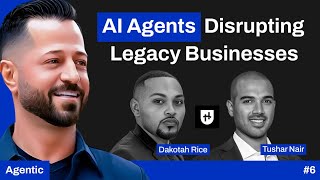
This is a YouTube video titled "How AI Agents Cut Insurance Costs By 90% | Agentic EP 06" published in January 2025. It features a detailed conversational interview hosted by George Bandarian with Dakota Rice and Tushar Nair, co-founders of Harper, an AI-driven insurance brokerage. The discussion covers the origins of Harper, the use of agentic AI to transform insurance services, technical insights into building autonomous AI agents with human-in-the-loop processes, market focus on excess and surplus insurance, voice AI innovations, business scaling strategies, and future milestones including fundraising and technology development. The content is a multi-speaker conversation centered on AI applications in insurance and startup growth.
AI agents can also help take just manual searching for things, writing the email, filling out the application. If you're able to reduce 50 steps to 5 steps times all of the customers that you have and that type of revenue, you can also just build a business that's just a massive revenue business with a crazy margin.
Koda, what is Harper and why is it so special?
Harper is an insurance brokerage. It's a services business. But the core thing in our core belief is that every legacy professional services business will have an AI native counterpart that has 1/10 the staff. Because we're using agentic AI solutions to help us reduce the amount of people you need to do those processes.
One of the stories that I loved in your pitch, which is insurance, in order for it to be the policy to be binded legally, you need a human to review. It surprised me when we met that you said that. No, the calls come to you guys, you guys are insurance licensed agents or a couple people on your team. So I thought that was really interesting.
That's where the human component comes from the beginning because you know, the human component is like giving features feedback back into the system. Hey, this action was actually really great or it was not that great and you want to take that information and create a flywheel that goes back into the system, improves it self heals it and it's able to continue to improve.
The core thing that you should focus on is just building your business but don't get distracted. Do you have a business that's adding value? That value creation should be the thing that makes you hungry.
I have a simple mantra to tell people. Action leads to information and you know, you got to move as fast as possible, take action so you can get more information and that that will give you enough to navigate the maze.
Welcome to the Agentic podcast where we dive deep with the pioneer AI founders reimagining business and investors betting on them. We bring you the war stories, insights and perspectives you won't hear anywhere else. I'm your host George Van Darren, a general partner of untapped ventures, a VC fund that invests in early stage AI startups. Let's go. Hello and welcome back to the AgentIQ podcast. I'm your host George Bandarian and today we have two very special guests with us. They are the co founders of Harper, a new age insurance brokerage built using a network of AI agents that's electrifying the legacy insurance business. The CEO was an investment banker at Goldman, an investor at the Carlyle Group in CO2 management and the CTO was previously VP of software engineering at Goldman where he led the digitization of private wealth and institutional asset management, operationalizing intelligent workflows in highly regulated environments. So with that said, let's welcome Dakota Rice and Tishar Nair. Hello and welcome back to the Agentic podcast. I'm your host, George Bandarian and today we have two very special guests with us. They are the co founders of Harper, a new age insurance brokerage built using a network of AI agents that's electrifying the legacy insurance business. The CEO was an investment banker at Goldman, an investor at the Carlyle Group and CO2 Management, and the CTO was previously VP of software engineering at Goldman where he led the digitization of private wealth and institutional asset management, operationalizing intelligent workflows in highly regulated environments. So with that said, let's welcome Dakota Rice and Tushar Nair. It's great to have you guys here. Welcome to the show.
Thanks George. Appreciate it. Great to be here.
Yeah, thanks George. Great to be here.
Awesome. So let's dive in. And Dakota, let's just jump in. What is Harper and why is it so special?
Yeah, Harper is an insurance brokerage. It's a services business. But the core thing in our core belief is that every legacy professional services business will have an AI native counterpart that has one tenth the staff. Because we're using agentic AI solutions to help us reduce the amount of people you need to do those processes. And as we lean more into AI, we also believe we can create the best most concierge experience for small and medium sized businesses. That is like the sort of service they might get if they were an enterprise because we're leveraging those agents to do so.
Very cool. So we'll want to break that down further and understand that. But that sounds really exciting and knowing what you guys have built, definitely a very exciting story here. So let's back up a little bit. Maybe we could just take a moment, have you guys properly introduce yourselves and tell me about the origin story. What was your backgrounds that led you here? How did you guys meet and how do we get to Harper?
Yeah, I can get started. So I'm Dakota. I grew up in Alabama and I'm from an insurance brokerage family. So it was kind of always around, but something I felt was super manual, boring, stodgy and I didn't want to go be a part of that family business and so left. Studied political science at Brown, went into finance. I worked at Goldman, then like George mentioned, Carlyle and CO2. I met Tashar back when I was at Goldman. I was working in banking. He was doing a lot of work on the engineering team and there was some cross collaboration and we just stayed in close touch. I eventually left Coatu to start a company called Pool it with Tushar and Pool it was all about democratization of alts. And as we left that business behind and thought about what we would do on the next frontier, we thought there was a really interesting opportunity to, to transform services businesses leveraging agentic AI. And so that is what we decided to do.
Hello everyone. I'm Tushar and I grew up in India and then sort of immigrated here in 2008. I went to college in Chicago and then went to Goldman Sachs and started working on the commodities trading desk actually, and then built out a whole bunch of different platforms over the years. I really focused on taking really complex workflow ecosystems, really complex processes across multiple operational teams, hundreds of people. And how do you sort of streamline that process and make sure that we have high efficiency within sort of the asset management space. So I focused on that for many years and then met Dakota during Pool it and that's how we got started in our journey.
Okay, great. So now let's go back to what you shared. So you've effectively built AI agents for insurance and you're using this for yourself. You've built an insurance agency. So you mentioned that you guys were in a startup together with Pullet that ended. When did that end exactly? When did you guys realize you wanted to do Harper? How did that start and how did we get to where we're at today?
Basically ended like towards the end of 2023. And then we decided to start to think about what we were going to do next. Tushar and I realized that we obviously wanted to work together. We really enjoyed each other and I think we kind of knew we wanted to continue on this journey together. And so we sat back and thought, what is the best business that we could build today? And I think in general, most people, when you see the power of what's happening with the transformations you can have with AI, specifically agency, I think a lot of people would think to build in that space. At the time, a lot of people were building autonomous sales systems. And in general, what Tishar and I decided to do was to focus on fintech, where we have deeper backgrounds. When we thought about applying autonomous agents to the fintech ecosystem, it was very difficult because people need 100% correct solutions in order to be able to, you know, we went to check, maybe we'll be a Fund admin as an example. And people didn't want autonomous AI agent fund admin. And so what we ultimately realized was that there had to be a human, human machine guided kind of hybrid symbiotic relationship in order to provide high stakes services. And so what we decided to do was to blend those two together. And ultimately where that landed with us was to do bpo, which is basically outsourcing for insurance agencies. What, you know, the common today phrase that people would say that is, is like, you know, services, a software. But the way we think about it is as BPO service where we use the agents. Right, but that's kind of what people would describe that as.
And what service were you doing initially for the insurance agencies?
We were doing sales. So basically what happened was traditionally it's really hard for people to hire the sales role and insurance. They, it's a massive talent shortage. So we said, hey, we'll do it. But when we went to go to people and try to give them AI tools like sell them software, it doesn't work. They didn't know how to use the software, they didn't want to use the software. People had no willingness to pay for the software, but they would pay for outcomes. Again, all of the literature out there about services software, all of it talks about what they'll pay for outcomes. That is true. When you go talk to. That is true. And so the amount that they would pay for the outcome is equivalent to what they would pay in commission to the insurance agent, which is like 2 or 3% of the overall amount. You know, that's being made from what we saw. And also we had some guidance from other folks and talk to people in industry, etc. There was a lot more, there was a lot more left on the table. And so by becoming an insurance brokerage, we were able to not leave all those pieces on the table. And candidly, there are a bunch of things beyond just AI agents for sales that you could just use also off the shelf to make a higher margin services business. And there's just more pie and more margin. That's just a better business. Right. So like that was the idea behind everything.
And, and so what was that journey like? Like how many insurance agencies did you have the chance to work with to get that learning? And then if I remember correctly, you guys started maybe working with some carriers as well and kind of like you just, it's almost like the market was expanding. And then at what point did you figure out that no, we can definitely build a more successful company doing this ourselves instead of for other people.
I think at our peak, we're working with like 10 different agencies. I mean, we got like a decent amount of traction with that part of the business. The problem is that in order to get people these really great outcomes, it requires a bunch of service and a lot of people. It's like because, because of the fact that AI can't do everything autonomously, like end to end, you still have to step in. And so there was a limitation to how much that business could ultimately scale. And then every agency does things a slightly different way. And at the end of the day, we were already selling insurance for all these other people. So it was basically like we were multiplying the number of people that we needed to do the core function. So if we instead just registered an agency, I mean, it's not, I'm making it sound way simpler than it is. Insurance is regulated state by state. We're in 48 states. There's a lot of other things that go, you have to go get a license. There's a lot of stuff that goes along with it. But essentially if we were taking those steps so that we could do this outsource service, we could just do that for ourselves and make much better models by fine tuning them. Because we're using our own data and our own processes in our own systems. And when you go work with these customers with software, software, there are limitations to which parts of the system they will let you access. For us, we embedded in our email, we embedded in our slacks. And so ultimately you could build a much more fine tuned model that's way more accurate and better for yourself. It's also different when you productize something for somebody else versus for yourself. If I'm productizing something for a customer, it has to be perfect. The interface, namely the front end code, has to also be perfect for somebody to interface with this thing. If you have a system of people who are committed mostly to making sure the underlying model itself is better, it's, we don't care how we interact with this thing or if it gives us a 90% outcome one time and 70% the other time, we just fix it. Right? You can't do that with customers. So I think in general, what people are learning is selling AI as software is actually very difficult to do. You know, it's very difficult. But when you mix a person into the mix and you figure out how these systems can work with people, you get much better outcomes. And that's sort of what we found.
One of the stories that I loved in your Pitch, which is why we invested early on was, I remember when you were selling to the agencies and you said that basically the AI agent using email, text and voice gets a hold of the customer, is able to qualify them, is able to gather all the information, is able to handle objections. But because insurance, in order for it to be the policy to be binded legally, you need a human to review it. And at this point in the pitch, I thought you were going to say you have these customers and they, you know, it goes to the owner or their insurance agents. And you know, you surprised me when we met that you said that. No, the calls come to you guys, you guys are insurance licensed agents or a couple people on your team. And so yeah, you, you really are providing the entire service and you're providing the outcome finalized insurance package of a binded policy that you're now like, you know, as we say in sales, like slipping under the door of your customer. So I thought that was really interesting. And, and, and also the point that you're making about the humans in the loop. So maybe we could ask Tushar, because Tishar, you're the one that, that built this. And, and there's a lot of talk about, you know, how do you build effective autonomous agents, you know, that work, you know, how do you get the efficacy there? And there's a lot of debate about, you know, human in the loop versus not human in the loop. And so having somebody sign the documents at the end is different than what we're talking about now, which is a human in the loop to ensure that the process is going correctly. So maybe you could just kind of walk us through technically, how did you build this? What worked right off the bat, what didn't and how have you got it to the point where it is today, where it's completely autonomous?
Right.
Or is it autonomous with specific human endpoints as you've built it for yourself and been able to fine tune it like Dakota was talking about?
Yeah, I think just to start off with today in the landscape, it's autonomous with human intervention for escalation cases. And so that's how you would want to picture it. So let's go back and see how we got started. So some of the major components of building AI systems is really context is king. So you need data and access to data and you need to have really good orchestration of it. And I think about like, you know, Tesla self driving ecosystem that goes from L1 to L5 is like the range of autonomy that you have. And so whenever you start off with AI systems, you want to start off with L1 because you want to start looking at, you know, how are these AI systems interacting? So I call that more like guided agents. Right. So the first goal was to kind of bring in context. So, George, I think you mentioned we had voice AI calls via emails and text messages, etc. Flowing into the system. That context is really important. Today we actually go gather more information than just the context from like interactions with customers. We have research agents that go to the web, that go to the Department of Transportation as an example, extract information from there. We use Excel AI, which again is a really good search engine for basically going and collecting information from the web. So you want to bring all this context in, which is the fuel and the source for decision making by these AI systems. The next component of that is really how do you take these AI systems and make a decision and then take actions? Because, yeah, you have all this context, you have these AI systems making some kind of prediction, but you also need to take action so that you don't really have to intervene. And so you start that off as a guided AI agent that you limit the scope of what it can do. And it makes maybe just one step reasoning, meaning it gets the information, it makes one small decision and takes one small action. And then you add on capabilities where it starts adding on multiple steps of reasoning and multiple avenues of action. And then you move into like not just having one agent, but having multiple agents that are specialized working together and what I call that swarming of agents, or almost like a hive mind of agents that are working together. And to. But to be effectively, to be able to do that, it's very important. And I always tell people who are starting with agents that evaluations, evals is a very key component of that. You have to have observability into how these agents are making decisions and how they're taking actions. And that's where the human component comes in the beginning, because, you know, the human component is like giving feedback back into the system. Hey, this action was actually really great, or it was not that great. And you want to take that information and create a flywheel that goes back into the system, improves it, self, heals it, and it's able to continue to improve. So I would describe that component as being a very key component to building these reliable, resilient agents. Now the landscape is also shifting around us. So that was kind of like maybe a couple months ago how you started off. Today you have an ensemble of different models you saw recently with OpenAI coming out with O3, the level of reasoning that you can get from these systems are improving the level of intelligence that you're getting. So now you have a bunch of these models, these foundation models that have different ranges of reasoning. So now you have to figure out how do you take an O3 model, an O1 model, and maybe like a meta model and Deep SEQ as an example that recently came out, how do you layer all of these different intelligence models together to make that final outcome? And that's where today, like for example, we use very sophisticated models for planning steps as an example, so that you can have really great execution plans that these agents can take on. But when it comes to simple executions of, hey, like let me send out an email, let me cure an email, you can use more lower cost models, maybe like a deep seq model, llama3 or gpt4o. So there's a lot of these models. And so in the process of doing all of this, the most important vector that we always think about is throughout the course of this is how do we create our data catalog. It's very important for us to capture this data because that is one vector of scaling that we can completely own. And that vector of scaling, by completely owning it, you can kind of create more synthetic data, expand on it. And to Dakota's point earlier about fine tuning these systems, that's a very key vector. While the industry is using other vectors to scale out intelligence, that's a vector that we can control completely and fully in house.
Yeah, that was awesome. So are we at the point where like from a technical perspective, where the agentic market has evolved, that there's like a standardized or semi standardized, like tech stack or is it still hundreds of tools? Like if there's a, if there's a founder listening, they have a great idea for an Agentix solution. Do you have any advice on tooling to get started?
Yeah, that's a really good point. I would say that the tooling is ever evolving and whenever I ask people when they get started, I think Anthropic is doing a really great job of providing standardization material. So I would always tell people to go look at their blog posts because they really recently came out with MCT, which is basically you had JSON for APIs back in the day for programmatic control, they're coming up with more like model context. So like protocols of how do you, how does these agent systems interact with each other and communicate with each other? And I think Anthropic has been doing a really good job of like Setting those foundations. Now coming back to like, how do you get started? You know, a lot of people will jump in and start thinking about orchestration day one, like let's use LangChain, let's use Llama Index, CrewAI, etc. In fact, I actually tell people get started simply because it's very important to get a pulse of what's really happening. And I recommend people use instructor Jason Liu, who's like, you know, one of the people that I follow, he's really great at like, you know, creating a very simple wrap around it. You have a lot of control over it and it's very good to get started. But really from a, you know, how to get started point of view, you know, just use simple, you get, get the soda models, get like the state of the art models. So because then that way you can test it out real quickly. Get a simple wrapper so you can test it out. Have a data store that you can actually get all your context into. Maybe use Pinecone as a simple vector store, use Postgres, a simple database and then just start experimenting with that very simple framework and add on complexity over time. Because I think a lot of people just start adding complexity from day one and they don't really know how that system is really sort of even interacting the first place.
Yeah, that's great advice. Okay, awesome. So we'll come back to, you know, advice to founders back at the end again. But, but let's go back to your core business. So, so your, your, your focus, your initial niche within the insurance vertical is the ens, Excess and surplus.
Right.
Which effectively covers the specialty insurance that covers businesses with unique or high risk exposure. And it is that like, talk to me about that market. How did you guys pick that? And is that a beachhead or. And then you're gonna go into other insurance lines or is that a big enough market that you just want to focus exclusively and dominate that?
Yeah. So what I'll say is this. X's and circles, how do we get there? I think that there are types of insurance that are very commoditized. Like people just want the cheapest price and you don't need intermediation. In the excess and surplus markets, it's highly regulated because the insurance carriers are not admitted into various states. So what does that mean? That means the insurance carrier can't talk to an insured person. They are represented by what's called wholesale brokers. Those wholesale brokers also can't talk to the insured person. And we're the retail agency that sits kind of between that insured person and that broker who represents the insurance carrier. So we just found also a market where there need to be market makers because there needs to be market makers and because the risk is like harder to, to categorize and there is not a lot of standardization. So there's more manual paper pushing. Every quote that we get is like a person literally reviews the risk and underwrites. We don't do the underwriting. We represent, you know, the insured person. But ultimately what that means is that there is way more that these agent systems can do. There are going to be way slower moving people in a much more fragmented market. So we have the best potential for capturing large market share quickly. In terms of, you know, where, where do we ultimately go? I would, I would say this look in US markets are roughly like an $85 billion market. If you think about the types of risks that are covered in. In US markets. It's everything from an adult daycare, home health center, medical practice, med spa, to a trucking fleet and to you know, airports, minefields, farmers. I mean there's just so much that's there. So I think that what we found as niches inside of this is we mostly focus on truckers, transportation and we focus on garage which is like used car dealers, new car dealers, etc. All people who need these into insurance or regulatory purposes. We ultimately believe that we can capture the full scope of the NS market. And our goal is really to be the only place that a wholesale broker or insurance carrier has to ever go to. Right. That's like really what our kind of.
Goal is for ENS.
For ENS 5 minute ENS category like the ones you mentioned. Then you're going to have the full suite of services for me. You know, professional liability, general liability and auto insurance and all that.
Everything I would need workers, comp, everything you already need. And today we do that for those couple of segments I talked about. But we want to go beyond doing that for truckers and people who do garages to you know, airports, home health centers, med spas, hospitals, I mean you could hotels, it all gets categorized there. The last thing I think is really important for me to say is that there is a tailwind where more risk are being transferred from standard markets to ens. Great example of this. Once upon a time, if you were a coffee shop on the coast of Florida, State Farm would insure you. Now that's an ENS risk. California state farms, leaving California. So even traditional risk of like your car insurance are becoming more E and S risk because of the complexity the world is producing with all these other factors. So that's sort of what we also really like the market.
So ENS isn't like some niche business for circus act and stuff like that. It's basically there's like the traditional business, whatever safe that insurance has been doing for all these years. And then anything like you said, trucking and other things that are just higher risk fall into this. And you're saying more and more things are going into that, including like just being a normal company in Florida, like A or in California. So that market is growing and then you're doing the full service for them. And your idea is to be able to do the full service agentically, as agentically as possible.
I think that there are some elements that especially as you move to bigger businesses, we're even noticing this now. Like we have some businesses we work with that are $6 million revenue businesses. There is some element of person that goes into that. But what you can ultimately do is make it so that person can focus on the relationship and they can focus on hundreds or thousands of relationships versus just one. Because the AI is doing all of the work. They are just the human interface to talk to that person. I think the more commoditized and smaller the businesses, there's a lot of ways to ultimately make agents be able to do everything. I mean to the point where like it could hop on a zoom call with you at midnight if you want to talk about your insurance policy, that for sure. But with larger accounts and complex risk, just like enterprise sales, I think there are elements that will be taken over by agents, but there's some human element that stays in the loop because it's just such a complex risk.
So when you started, all you had to worry about was getting a hold of the prospect and selling them the insurance. But now in your new model, now you're doing the full service. So yeah, you're going to have to manage. There's going to be some humans for the larger accounts. But also now you have to build a claims piece, right?
You have to do all that stuff. Claims, we have to take their payments. They most of them finance their agreements. You have to make relationship with financing providers. We have to make it programmatics with regular APIs so that when we get things in, we can make a financing agreement. You have to do their claims, you have to make COIs for them. When you're a huge trucking business, you want COIs every single day. So there's so many things, but that is why I think the services business part was the right nut to crack. Because a lot of that stuff are counterparts. Competitors are like mom and pop shops with two people trying to do everything themselves. They can't even take all the clients. But if we're building systems, even some basic ones that can just help process basic things like a coi, you're able to get so much margin leverage. And if you're getting a tech go to market, like really aggressive and you're thinking about optimizing that the right way versus just going and passing out your business cards at barbershops, you know, and you combine that with technology, some agent, you focus on putting the agents on the hardest problems upfront, but also some of it like better software. And then you pair it with agents over time, you're just in a much better place to really expand margin. And the ACV is so high already in a space like this, it just is a great pairing for a big business.
Right. And then also. So you started off needing to sell essentially a sales solution to small insurance agencies. Now you're selling insurance to kind of specialty E and S category kinds of companies. So, so I guess what's the go to market now? How are you, how are you approaching customer acquisition marketing? How are you getting customers and how are you thinking about scaling that out?
So what we do today is there are a lot of these service, basically if you go to a standard risk provider and you put information in and it doesn't match their criteria, they push you over to this series of like lead transfer services is kind of how you can think about them. We can pay, you know, I won't go into a lot of details on the numbers, but essentially we have something like a 25% conversion rate and we can, we get a payback of like a week by using these sort of providers. And there are hundreds of thousands of people get transferred to this network today. So as an early company, you know, in the early stages, this works quite well and you can optimize your system of bidding for those leads, which we do to really get the leads all day. At this point we have enough of a system that if we wanted to process 1,000 people in a day, we could. Right. So that's what, that's what I say about that. We're just building up to get to that point. Right. So that's, that's how it's it. The next piece is obviously at some point you, insurance becomes a marketing business when you get the throughput perfect like at the point where we could have a person drop in and process them in like a couple of minutes or even like an hour or whatever the case may be. All with AI, it becomes a matter of, okay, well, how do we just increase the exposure of this brand so that people know this so they come organically. We have intentionally focused less on building Harper as a brand new. And so you won't see like even a lot of stuff on like our LinkedIn pages because we get so much lead flow just calling in all day. But over time, what you have to do is build what I think is like traditional inbound marketing, candidly to make sure that people know about your brand and that they come in the door.
Yeah. And you said so many people calling in, and it made me realize that we made the mistake. When people that know deeply about something just get to talking, they forget that maybe the listeners don't know. So I think we kind of like maybe glossed over a little bit of the fact that a big part of this agentic AI solution that you guys have built, and one of the main reasons we invested it was the voice AI. Right. There is a very friendly voice AI that you guys tuned on insurance that is able to take inbound or make outbound calls and have a full conversation. And I know because I've played with it, I've done keynotes on stage where I call, you know, that demo number you gave me and, and, and, and people are just blown away by how great it is. You know, I think we use a mechanic shop example and, you know, it asks me what kind of services and, you know, goes through and is able to, you know, quote me, gather all my information, you know, give me a quote and handle some objections and schedule, follow up, call with me and all that, Anything else you want to share about the uniqueness of what you guys are doing, which is to me, in large part the voice AI aspect of it.
Yeah, what I was thinking was I will share with you guys a number where you all can call in at some point and test it out. And so, George, I'll give you a number and then people from the podcast can come and call that number, test it out. And so to give you some context of what's happening with Voice AI and what we've gotten to. So initially we were focused on Dakota's Point, highly commoditized businesses. Now we've gotten to places where you have to have 30 minute, 40 minute conversations. In fact, some of the things that we are doing right now in the process is how do you have a voice AI call that sits alongside a human operator. So those are things that we are working on, currently underway. But really what's happening there is that how do you take this really massive talk path and be able to collect information and also have a human sometimes in the loop and kind of work alongside them. And so initially, a lot of times we have, I'd have a human just say hi, build a relationship for a couple minutes and you know, just to kind of build that rapport. That's one of the things we found is really, really important to kind of build like large long term relationships and then transfer that over to a voice AI call, which will then be like, hey, I'm going to transfer you to my assistant who's going to collect all this information from you. And whenever our customers, now let's say they are actual customers, want to call in for a policy, there's a voice AI that will greet them and say, hey, let me give you. And they have a little PIN code that they get. They can input that pin, they can get information about their policies. They can also get information about the requests like, hey, I have a claim, I have a service request, I want to do a coi. And we can log all that information and process it, send an email back to them and if there any escalations, push that to our team internally. So that's sort of like how we've been leveraging voice AI, not just for the sales aspect of it, but also on the servicing aspect. In fact, there's a couple other components of voice AI that we are working with, which is like the intelligent, I call it intelligent pipelines. A lot of times you might have a human operator that's really busy talking to a lot of different folks and there's an escalation case you want to get to contact them immediately. We have a voice AI that calls our internal team member and saying, hey, let me give you a quick briefing on this person so you can go and get that started. So we are using it, even internal operations, and not just for sales and servicing. So there's a lot of different components and ways that you can use voice AI and we are still experimenting with a lot of different ways of really using that modality to its fullness. And the one thing that's actually coming out more recently, I think it's the last month or so, is video. So voice is the modality of last year. The modality of this year is going to be video. And I think that is a modality that we're very excited by as well. Especially when it comes to internal use, but also for certain customers that are more the larger set of customers who want to really interact with us over video. So that's another modality we think that is going to be really useful to sort of get into and actually exploit in a way that we can really provide really high levels of service.
So, so what I'll say is that like, look, there are the, the flashier demo pieces of how people think about AI agents. What I'll also say is that there's a lot of things that happen in this sort of insurance that result in a $10,000 payday for revenue that may have had 50 steps. And the AI agents can also help take just manual searching for things, writing the email, filling out the application. You, it can reduce 50 steps to 5 steps. If you're able to reduce 50 steps to 5 steps times all of the customers that you have in that type of revenue, you can also just build a business that's just a massive revenue business with a crazy margin. So I think there are like the ways that like some of these pieces like voice, etc. Will also help us to make these great hyper personalized experiences for people. And I think that will be fantastic. I also think there's a lot of ways that we're using agents to reduce the amount of workload in the 50 steps. Going to five steps that I think massively increases the margin profile of a business like ours, which is another massive opportunity I think that's coming out with, with a lot of the AI agents.
Very exciting. So let's go ahead and take our crystal ball out. So, so where does this go in the future? You know, is this still, are you still playing the tech unicorn game? Is the goal to get to 100 million ARR, go public or. Now you're an insurance brokerage, right? I guess. Are you playing by insurance business metrics and how they look at, you know, their businesses? I guess walk us through the future and what does success look like?
Yeah, I mean there's lots of insurance brokerages that are billion dollar revenue businesses. So I would, I would say we're aiming even higher than $100 million of ARR. I think it's big to be a billion dollars of ARR and it's like a 90% renewal rate. Right. Like in general. And I hope we could be even better than that. I think the way that we think about our, you know, the key ways that we think about our business, the efficiency layer, how much stuff is being done by a person versus, you know, A system I think is a very important part of us getting to not just the revenue scale, but the margin scale. I used to be a public markets investor. So when I think about what makes something public market scalable, it's great if you have $100 million, but and then if you have like no margin and there's some examples of that that's been in public markets or 5% margins or something like that, you know, that's great. But that business is not going to always trade on the revenue. That's only what's happening in venture. That's when it gets in the public markets, it's going to trade on the, the profit. So I think that there's also this element that you can have. Even if it was, I'll say there's some businesses that'll be even $100 million, but not at like a 15% margin, but trading at, but you know, you're at 50, 60, 70 software, like margins. I mean these will be public companies that could be the likes of a J.P. morgan. I just think that like the core thing not to really get away from, at least in the way I kind of think about it. We are using AI to solve real problems. So it's not like my goal is not to make the flashiest, sexiest company where every video I put is like the coolest thing. Everybody's like, oh my God. My goal is to basically, and our goal is basically to make something that super serves our customers and makes the most hyper personalized concierge experience they can ever have that doesn't cost us more people, but is actually better than if you had more bodies thrown at the problem. It is to focus on areas where we can make large amounts of revenue because the ACV gets higher and higher and reduce the amount of human steps that are required to get to that outcome. And ultimately our goal is to build a business that can be the scale of businesses that typically have to buy books and be very inorganic in their acquisition. But because we're leveraging AI agents at the core, we're able to do that with a fraction of the number of people. So that's what I would kind of say like success looks like for us. But candidly I would say an insurance broker. But in other domains people will make businesses that are like this, that are the scale of like a huge company. It could be a trillion dollar market cap. I mean if you think about the sort of things that people do because of the way things trade in public markets, because margin is so important, even if the Revenue scale is not JP Morgan scale. If the margin is like 5x JP Morgan, it's like a software company, you're going to have huge outcomes.
Yeah, that's really exciting. And, and that, that should also help with attracting funding. So let's talk about that for a minute. What's been your fundraising journey so far and you know, kind of what's the next milestone that you're looking at?
We don't like to talk too much about fundraising either publicly. We kind of keep a lot of our stuff to ourselves with that. Um, but what I would say is that like our next milestones from our perspective are like, we are looking to get to our million dollar ARR mark and that's something that we feel like is achievable within the next few months is how I would sort of describe it. And I think from there, you know, just continuing to grow that piece. I think a lot of what we're focusing on today is like internal building. So we brought on more members of the team who have deeper applied AI backgrounds, which we will, we can talk about more. But like, you know, people who have done AGI and Amazon for example, and like bringing those sort of people onto the team to build out more of the tech benchmark. Early on, the focus was build a business where you have real problems for people to solve. And now you've created this almost lab environment in a sense, for people who are really, really bright on the bleeding edge of all the research, but want to apply it to solve a bunch of problems. Because in the services business there's a myriad of these sort of problems. So that's how I would describe it. I don't know. Tishar, do you have some thoughts about sort of like our milestones on the engineering side?
Yeah, on the engineering side, you know, if I really think about what is the milestone is that I always tell people, like, what is the biggest bottlenecks that we have for throughput today? So the most important key factor is, I think about two verticals, throughput and reasoning. Right. So for throughput today, what are the biggest bottlenecks? So everything from like, you know, data collection, being able to extract information, but creating memory is what I call it like an intelligent memory so that we can have all this context and it's predicting what is the next important things to do to being able to do all of the processing of like payments and being able to do all the back end reconciliation. So all of those things need to be tackled. And I think what the core, the core for the next 34 months is like if whatever bottlenecks are there in the process of doing that, those are the places that we focus on to improve throughput. And we don't think about roadmaps in months, we think about roadmaps in a week, in a day. How do we really bring that velocity into the process so we can squash those bottlenecks and improve the reasoning layer so we can take on more and more complicated steps along the way? And the goal is you'll have a high throughput system with a really good amount of reasoning. And then as you add on O3 and 01, as they become more commoditized, because today they are expensive to run, but as they become commodities, your reasoning is going to improve even further, be able for you to tackle much more complicated deals, etc. With the same level of throughput that we do today with smaller deals. Right. So that is, I would say, the progression at the highest level of the roadmap. Of course there's many specifics along the way, but. But that is the principle, the core guiding way of like how we go about engineering that for the next, over the next couple months.
Gotcha. And at the end we'll go into a quick fire round and I'll want to come back to some of the exciting things you mentioned like this weekly or daily execution velocity. You mentioned video. I'm curious what video platform and a couple other things. But so, so the million dollar Air Dakota. So, so what kind of a funding round are you hoping that that would unlock for you?
I don't like to talk about fundraising publicly. I just think it's, I don't think it's. Personally, I don't think it's a good idea because it gives investors benchmarks about like, I want the funding round. That's candidly, I think you cap yourself in the. Like, I feel like people may give us $10 million the next time. They may give us 20 million, you know, depending on how things go. So I just generally stay away from talking too much about fundraising. But what I will say is this as advice too, because this is like for founders and stuff, the core thing that you should focus on is just building your business. If you build a business that in, you know, X amount of months is making a million dollars of ar, you won't have to think about fundraising. People will come to you to talk about fundraising. And I would say where we are today is a lot of inbound investor interest because people realize services businesses that are transformed by AI will be massive JP Morgan scale style Businesses with the right leadership, in the right team. And I think if you can show a path towards execution, not for the flashy thing, but for the thing that's creating real economic value and people can see it, you will never have a problem fundraising from anybody. And that is like the core thing. But don't get distracted because it can be a really big distraction to focus on that. The core thing that matters is like, do you have a business that's adding value? Are people really, really buying into it? And like that value creation should be the thing that makes you hungry, not the, the flash of any other pieces. Even though that's important. You need to fund your company and find the right people to fund your company.
Yeah, exactly. I think that sometimes people get it mixed up and think that the name of the game is fundraising. The name of the game is solving a problem, having customers, creating revenue. And if you do that, then the fundraising will come. Okay, cool. So that makes sense. And so let's expand on the advice to founders. So I think that was a really good insight that you shared. Dakota. What else have you guys learned in your journey and think that might be relevant to, you know, founders that are in the earlier stages or even in some of the similar stages as you that you think would be helpful?
I would say think big, start small, don't over engineer something too quickly. Make sure you have a real problem to solve. Let somebody telling you, are you seeing it in your business that there's a problem to solve? Be the guide of your product versus your theory about how you think it would be so amazing to build xyz, that's one I would say to Char.
Yeah, I have a simple mantra. I tell people, actually information and, you know, you got to move as fast as possible, take action so you can get more information and that that will give you enough to sort of navigate the maze. I think when it comes to going back to what I was saying before, like the velocity, I think about how do you do everything that increases velocity that could be like, how do you find the customers that will move as fast as possible so they can give you information as to if they're a good customer or not? Are they a good icp? Are they not a good icp? Whenever any of you are building tech, if it takes you too long, that means you're going to take too long to find out if that tech is actually going to work for you. So figure out how to bring, you know, bring that down. So in the beginning it could be like prototyping, making it as quickly as possible so you can test the feasibility of it and test if it's actually something that, you know, you can put in the market and you can get that feedback real quickly. But a lot of times, especially with, I'm talking more in the engineering lens, people want to build this complex system from day one. People want to build this beautiful, shiny, gentic system from day one. But forget that. You have to go really fast in the beginning to test it out to see if it's a feasible thing that can actually create value and then double down on it, fortify it, make it an actual product that can scale across hundreds and thousands of people. But find ways to bring in velocity and that includes communication between the team as well. Figure out how, because communication and speed is the lifeblood of an early stage startup. And I think you've got to figure out how do you really bring that communication with people and like, you know, make it really rapid and get that feedback cycle really rapid. So those are kind of just, you know, off the bat.
And I know you have like this mantra of move, move fast, break things and fix them faster. And what you were just sharing moments ago. So you know, sometimes what happens when people work in corporate jobs like Goldman, right. Like it's such a slow moving culture and you know, it's waterfall in many senses and so much red tape, it's hard. And I've, you know, just even from as an investor and founders that leave corporate jobs, they don't have the pace that you're talking about. Did you always have that pace or did it take a readjustment? Talk about that for a minute.
Yeah, I was working in a corporate environment which is much more slow and Goldman, yeah, there's a lot of decisions but you're moving a large aircraft carrier and in that case change is slower. And even though you can try to push speed and velocity into the system, the system resists that change because the nature of the decision making cycle. I think when it comes to this concept, my philosophy has been an evolving philosophy from the process of me working with Dakota over the last couple years. Candidly, like, you know, you learn from, you know, kind of burning yourself a little bit and learning that hey, this is an actually really core component of being able to provide and build high velocity teams. And I think it also inspires really great people to come and work with you because you can move fast. Right. Most people don't want to sit around and you know, wait for a year to figure out, hey, this is actually a good, good product or not. Most really great people want to just be able to come in, execute ruthlessly and see that product, you know, be, be shown in light and like, you know, have customer feedback and have that traction. So I think Velocity in my opinion cures a lot of things, right? Including like having great talent, including go to market and so and I think that, you know, I was inspired also by the story of Ramp and how Ramp, you know, was able to scale and I think was one of the fastest startups to scale to 100 million ARR. And they've kind of like sort of built out the entire sort of ecosystem and operations and engineering to really focus on Velocity. And I was really inspired by, I listen to this podcast, Lenny's podcast, they have a whole bunch of people on there. So that I was inspired by a lot of that, that tutelage as well. And you know, and how I think about Velocity.
Yeah, that's awesome. And what was that the video platform that you think is going to be. Because I have my hey Gen AI avatar and all that. But that's prescripted. I think what you're talking about is like a human like lifelike, dynamic like video avatar, right?
Yeah, so I forget the name, I can send that to you. But it is definitely a YC company that is working on it. And beyond that, I also think that heygen is also kind of going to be evolving in that nature because I think that if you look at Agent version three, I think they're slowly getting to the point where they have not just your face and your body moving, but they have an entire life like Avatar. And I believe that that's also in the works there. So I do think that because of one compute being growing exponentially right now, which is very important for video modality, you see what's happening with Sora, which means that there's actually a world model being built out using video and which is going to be a really important point for reasoning in the future. I do see that video being a huge modality, not just like you know, maybe a video call, but also in the case of improving reasoning and that's a secondary step, but improving reasoning in the models that we use on a day to day basis as well.
And one of the things you guys said earlier was, you know, you said that you decided to do this because you know, you love each other as brothers. You know, the co founder dynamics is so important and you know, many times there's co founder conflict, there's co founder breakups. So I'd love to just learn and Understand a little bit more what you guys mean when you meet, when you say you love each other. Like, I guess, what kind of friendship did you guys develop back at Goldman? And like, how does that come into the type of relationship that you guys have today and how you address small and big conflicts that come up?
I would say our relationship back at Goldman was a shallow one. It was nice, but it wasn't like anything that was super, you know, super deep at the time. I think going through the cycles of watching a company grow where we did a pool it watching things also not work out in some ways. Dealing with angry customers, sometimes maybe an angry investor, just the pressures that come along with scaling something, whether it works out or not, can really bring people closer together or cause a lot of infighting. And I think what I found with Tushara was someone who on a human level really just I had great chemistry with, could, could really vibe with and was somebody who I felt like I could approach and tackle hard problems with. Fun ones like figuring out how to build, you know, a JP Morgan scale, insurance brokerage, but also not so glamorous and not so fun ones that involve being really upset and frustrated about things that are going on in life. And I think that's really important. I would also say that, like, what really drives our relationship is that, you know, Tushar knows that on the business, the non technical side of the business, he drops something to me and I will relentlessly execute it. And there's no second guessing that will be done in the same way that I think about when we come together and think about things that we execute. On the engineering side, there's nothing that I believe Tishar can do. If Tishar doesn't know how to do something today, I know he'll figure it out. And I think he understands the same thing about me. And so it builds a culture where like anything is possible and you can actually make your imagination sounds fluffy, but it's really important and you can only do that if you have. It's only so you can only build the future insofar as you have a team that can. Can actually execute that and like relentlessly execute that. And I think it has to come from a place other than we want to make this huge company is worth a billion dollars, which I think is great too. But I think personal connectivity and feeling a sense of obligation to the team that you work with is a really critical part of that dynamism.
Yeah. Now I would just kind of add on. It's like, you know, this battle testing the relationship. Right. You battle tested across, you know, all the ups and downs of kind of being part of the journ. But I think there's also some core principles of how we approach life in general is also something that kind of brought us together. We both very gritty individuals and we will go as long as possible, as long as needed to kind of figure something out in the process. But I also think that, you know, this is my other mantra, strong opinions loosely held, which is basically like we both are very, have very strong opinions of how to go about things, but at the same time they're very flexible, adaptable. We listen to reason and be able to have that conversation very openly, even if it's a good conversation or if it's like a very terrible conversation. But we have the respect with each other to be able to listen to them fully appreciate that it's coming from a point where we all are going to get better from it and it's not, you know, and so, you know, when it comes to conflicts, we don't, you know, we have like really good debates about everything that, you know, that needs to be done from an important perspective, but be able to take that, you know, and kind of move on in a unified direction every time. Right. And I think that most co founder relationships, I feel like break is when there's no unified direction that is going forward. And, you know, you need to find a way in your process of conversation or even like dialogue or whatever it is that how do you get to that unified direction? Because without that you don't have velocity. Because velocity requires direction as well, not just speed. Right. So that's kind of, you know, a really key part of it.
Yeah, I thought that was a great episode. You know, I think you, you know, so from a podcast episode, I thought you guys did great. You know, from a portfolio company of ours, like, definitely loved hearing everything and reminds me of my interview with Maven AGI. Like a lot of similar similarities in terms of the, the quality, the co founding team and quality of thinking and focus and execution velocity and all of that. So. So yeah, you know, I think, I think this is going to be a valuable episode. We're excited to share it with the community. Yeah, I think it. So I just want to say you guys did great.
Thank you. And yeah, I think as we kind of exit, one of the things that we, I don't think we ever really talked about this too much or never really mentioned it, but I do think, like, you are definitely one of our favorite investors and I've had a number of investors over the past like three years.
Thank you.
But I think the way that you curate community with founders and the way that you hyper focus yourself on the problem spaces that we inhabit, it also helps people respect your perspective on our companies a lot more because you're deep in the weeds of it. But, but yeah, I just wanted to just also just say that. I don't think we ever talk about that, but you definitely are like someone I would highly, just candidly, authentically recommend to people as an investor. For sure.
Thank you. Thank you, Dakota.
Yeah, you know, and George, I want to, I want to echo that as well. You know, like I love the focus of the agent AI ecosystem because, you know, I really do believe that in the next 10 to 15 years, every company that's going to win is going to be an AI company. It has to be. Otherwise, you know, every other company is going to get left behind. And I think that your focus on that I think is fabulous because I think that all, you know, kind of, to Dakota's point of building this community of people who are hyper focused on kind of building out the next generation of these companies that are going to really win the market. So, you know, super excited for you to be part of our journey here.
Yeah. And I think it's a nice balance of hands on, hands off. Like it's not like forced, it's great community but not forced community, which I think sometimes people either do no community or forced community. So.
Yeah, totally. That's great feedback and I agree with you Tushar. I mean, you know, the future is all about AI and at least in the business context, it's all about agentic AI for sure. And excited to be doing this together on the same journey, hand in hand. Dakota, Tushar, I just want to thank you so much for sharing your journey and insights and passion with us today. There was a lot of great specific insights. Right. I like the co founder relationship, the importance of that and again, you guys are a balanced co founding team on the vision and technical side and the execution velocity. We talked about the importance of that and breaking it down into weeks and days even. So you've given us a lot to think about as it relates to building in the gentic AI space. I think the future with video and different modalities is going to be really exciting. So for those of you listening, I'm sure the Harper team's vision as sparked some inspiration and so I appreciate you tuning in. If you enjoyed this episode. Don't forget to subscribe, share and leave us a review. And if you're an agentic founder raising around, reach out to us. As you know, we're actively investing in the space. Until next time, keep reaching your untapped potential.
More from George

The AI Agent Getting More Supplier Data in 5 Weeks Than a Team Did in 2 Years








