How to Invest in AI by George Bandarian - EO DX 2024 - Keynote Speaker
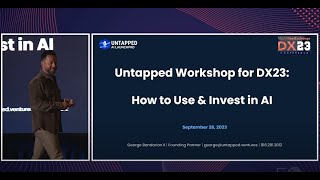
This is a YouTube video titled "How to Invest in AI by George Bandarian - EO DX 2024 - Keynote Speaker" created on June 19, 2024. It features George Bandarian delivering a keynote speech focused on strategies and insights related to investing in artificial intelligence.
Foreign welcome back to day two Thursday morning. We have a very powerful day ahead of us today and it's going to be a lot of fun. I want to kick off this morning with an introduction to our next speaker. His name is George Bandarian. I've known George for a number of years. He's from EO Los Angeles and he has done a number of things. He'll tell I think part of his story. Been very successful young entrepreneur, built a company very quickly, sold it with a very successful exit a few years ago. And now he started his company general partner. He's a general managing and founding partner of Untapped Ventures, which is an early stage venture fund investing in AI and emerging technology. And I'm super excited that he's going to be here today. He graduated from usc, Go Trojans. Lives in Los Angeles. His three boys, Gio, Grayson and Gianni. And I am super excited to bring him up to the stage. Now, please give me a warm welcome for George Bandarrian. Thanks, man. All right, showtime. All right, good morning, everybody. Let's try that again. Good morning, everybody. All right, you guys ready to rock and roll and go down the AI rabbit hole? Perfect. So let's do it. Thank you, Alan. Thanks for having me. I'm delighted to be here again. My name is George Bandarian with Untapped Ventures and I just wanted to start off my chat today with a video that I created for you guys. So let's go. Artificial intelligence, or AI, has come a long way. In the short term, AI will continue to enhance our daily lives. Medium term advancements will revolutionize industry. But what about the long term? The possibilities are endless. AI could reshape the way we live, work, and interact. The future of AI holds both excitement and challenges. Are you ready for the AI revolution? You guys ready? All right, so what's the guess on how long that took my content and video production and editing team to create that video? Five minutes. I didn't use them. I used AI. All good guesses. In reality, it took me less than 10 seconds. Single prompt inside this app, Vizsla. This is one of a handful of tools I'll introduce you to today that are coming out of the generative AI field that you can use to essentially gain superpowers in your business. And also what creates some amazing investment opportunities as there is a gold rush happening in the AI space. Although you got to approach carefully and not everybody in the gold rush gets rich. So that's what we're going to talk about today. How to use AI in your Companies and how to invest AI in a smart way. So let's go ahead and continue. So we all know who this man is. Elon Musk. He's one of my role models. I actually nicknamed my middle son after him. And we know what happens when he goes into an industry, right? We saw what happened when he went into banking, cars, space, social media. We'll see about that. But I'm confident he'll figure that out. And of course now he's in AI. He created a, he left OpenAI, didn't like where Sam Altman was taking it and created X AI. So everybody's getting in. Reid Hoffman from LinkedIn is a co founder in an AI company. So there's a lot of big players doing some big moves in AI. So something you gotta pay attention to. Speaking of Grayson, Elon Bandarian, that's him on the left, that's GIO, GB3 in the middle and that's Gianni on the right. And I met Genevieve today. If we have our girl, we want a girl. A fourth one either gonna be a Genevieve or Gianna. Yeah, I like Genevieve. There you go. That's my wife Miriam. And so yeah, a little bit about me. So I know some of you guys here, but a lot of people I don't know. So let me do a proper intro for those of you that don't. Born and raised in la, went to sc, grew a company called ami which was in the business process automation space. We help companies eliminate paper and automate their workflows. And I was in Eola for most of that tenure. I launched two forums, those guys are some of my best friends and I had a great run. I exited in 2018 and I started just angel investing and fund investing. With this personal investment thesis around, I want to invest in technologies that help humans essentially move up Maslow's hierarchy and become the best version of themselves. So that was kind of like my impact focus. I'm a big personal development guy, big Tony Robbins guy. So I was like, okay, I could see where the technology is going and it's becoming more accessible and democratized and in the hands of people around the world. And I could see that you know where the world is going and we need help, but we need to make sure we pull everybody along. And so that was my personal kind of investment thesis. And I invested in an AI life coach back in 2018. And so that was the start of my journey which led to launching Untapped Ventures, which is a small early stage venture fund. We invest in AI and emerging Tech that helps uplift humanity. And so basically, fellow impact investors got together. We have about 25 investors. And I took my experience in EO Forum and I brought that in. The whole forum concept, guys, is missing in the world of venture. There is no such thing. So that's one of the unique things that we do as a venture fund is when we invest, we put our portfolio CEOs into forums. Basically, I call it masterminds, but same concept of forums that we're used to. And then just recently, we launched the same thing for our investors. So now we have put the investors in an investor mastermind, kind of like tiger 21, if you guys are familiar with that. All right, so it's a little intro about me. Just the last thing is my fascination with AI started when I was in my twenties. I read this book by Ray Kurzweil, the Age of Spiritual Machine, when he talked about that, we're gonna start building machines that are as smart as us and then eventually smarter than us. Um, and. And so it's really interesting what's happening and where this is all going. Uh, but in order to really understand all of that, we need to start with, where are we at today? Okay, so here's what we're gonna cover. I'm gonna give you guys a crash course on the state of AI in general. We're gonna drill down to what's happening in vc. We're gonna talk about what tools you could use, and then we're gonna talk about for the. You know, if you're here. Actually, let's do a show of hands. How many people are here mainly focused on. I'm here to grow my business, and I'm trying to grow my current core business. Let me give you three options versus second is I'm working on a new business, and I'm here to learn about how I can launch that business, how I can grow that, raise money for that, or something like that. I had some nice conversations with a couple of people last night. And then the third one is how many people are here looking for investment opportunities, looking to invest and things like that. So let's start off with the first one. How many of you are here? Focus mainly on how do I grow my core business. Okay. Looks like about the majority of you guys. And then how many are here because you're working on something new? EOers are famous for that. Multiple businesses and trying to get that launched. Okay. Some of the same of you. And then lastly, how many of you are here from an investor standpoint, you're looking for deals, looking for opportunities. Okay. All right, great. And so some of you fall in multiple categories, which is all great. So hopefully I'll touch on all three buckets as we go through this. And then my gift at the end is you'll get the whole deck. I'll give you a QR code. You can get the whole deck. I also have a cheat sheet, and you'll get all of that. Feel free to take pictures if you'd like and take notes. But you will also get all that if you complete a short survey giving us feedback about what you thought of today's session. Does that sound good? All right. Okay, great. So for those of you that are coming at this from a company perspective, I'm trying to grow my company. Where are you at with actively using generative AI tools to. And let's just take ChatGPT as our proxy. No shame in your game. How many are not actively using ChatGPT? No shame in your game. Come on. All right. It's a very small portion. About 10, 15% of you. How many are actively using the free version? Okay. Majority. How many are actively using the paid version? A good chunk of you. And how many are super users? You're using the paid version, the plugins, you're using, other tools you're familiar. Familiar with Vista. All right, good stuff. Awesome. So hopefully everybody will be able to learn something new and take back some tools when we get to that section. Unfortunately, from an AV standpoint, we weren't wired here for me to do live demos like I normally do when I present to ypo and angel groups and other audiences. So I have a recording. We'll play that, see how that goes, but should be good. And then how about on the investing side? Where are we at in terms of angel investing and investing in AI? Anybody here kind of skeptical or scared of AI and just, like, really don't understand what's happening? Again, no shame in your game? No. Nobody. Nobody's scared, skeptical, or doesn't understand AI. Okay, so who here is trying to learn and start investing in AI? Okay, awesome. And then who's already made investments in AI startups? Few of you. Genevieve was telling me about a hot deal, so that sounds pretty interesting. We'll talk more about that afterwards. All right, so my goals for you guys today is three things, because I'm gonna throw a lot at you. I know this is the intro part. It's kind of the slow warmup, but once we get started, we're gonna roll, we're gonna go fast. I'm gonna throw a lot of stuff at you. I don't want you to get overwhelmed. You're gonna write down a lot of things, but ultimately it's number one, I want you to walk back and commit to AI in a way that you haven't. For those of you that aren't already 110% all in. Number two, I want you to build your AI team, figure out what that's gonna look like. You probably need somebody internally, you probably need some people externally. I know we have a chat tomorrow where a couple of people are gonna talk about how they can help with being part of your AI team. And then thirdly, figure out how you want to invest in AI. Okay, so why is AI so important right now? Let's kick it off, take a look at what's happening in the market. First of all, this is not another fad or pure hype cycle like certain recent trends, right? So there is some hype and there's definitely some froth. But in general, what's happening is this is a foundational platform shift that's taking place and there's clear use cases as the technology is being adopted faster than anything we've seen by both consumers and businesses, because it's solving needs and giving us new capabilities in a way that we just haven't seen. And the way to think about it is each decade has had its main platform shift where we got a capability that we didn't have before, and it kind of changed everything, whether that's servers, personal computers, smartphones. I mean, you guys remember, right? There's a day that we didn't have smartphones, we had the flip phones, and there was, you know, there were the days where we didn't have cloud or social media. And that's what AI is going to be. AI is going to be in everything and everywhere. It's going to touch every aspect of your personal and business lives. The data backs this up. If you look at the adoption numbers, if you look at the most adopted technologies in human history, you'll see here that ChatGPT got there in two months, whereas it took everybody else multiple years to get to 100 million users globally. And then another slide that I really like is if you look at the open source communities of Ethereum, Bitcoin, Cockroach, Kafka, Spark, it took them about seven to 10 years for what stable diffusion did in basically a few short months. And if you're not seeing it, this is the stable diffusion exponential line, right? I love this slide. Have you ever seen something like that? On the chart. So yeah, that's what's happening guys. You got to pay attention. It's an exciting time. Wall Street's paying attention. So if you look at Nvidia's stock price, it's shot up 220% since the start of the year. Even Microsoft is benefiting from its commitment, from its investment in OpenAI. They've put billions of dollars in OpenAI and essentially are the strategic that and now they're incorporating it into all of their products and co pilots. So Wall Street's paying attention and the VCs are paying attention. AI is dominating the venture landscape. VCs believe that majority of the growth is going to come from AI in venture. 36% on the left, on the right. AI startups are commanding a much higher valuation than every other kind of startup. As you could see in the teal, the majority, the single biggest category in global venture funding in the first half of the year was AI taking about 20% of all venture funding globally and created the most unicorns of all categories in the first half of the year at 11. Of course, it's no surprise then that the top investors are all paying attention. So the tier one household names, Andreessen Horowitz, Sequoia Coastal Ventures are all making dozens of investments in the space. So let's take a look at what some of the specifics look like. The kind of the outliers are OpenAI. You'll see OpenAI twice on this slide, once right here raising 300 million at a $28 billion valuation earlier in the year, and then 10 billion at a 29 billion valuation from Microsoft. And then again just yesterday or two days ago it was announced that they raised another, I forget how much at an $80 billion valuation. Just insane anthropic. Also, you'll see twice here, 300 million at a 4.4 billion valuation, 450 million at a $5 billion valuation, and just two days ago, $4 billion investment from Amazon over a multi year period. So Amazon is falling behind. If you guys remember, Amazon had the early lead with Alexa. And doesn't Alexa now feel like kind of like your grandmother? Like she's just kind of gotten older and she doesn't work as good. Right. Like you talk to, you just get frustrated and you just want to like we've stopped using her because they just fell behind. They had the lead, they had the lead with voice AI and I don't know how Amazon just botched it. So now they've woken up to the fact that they need to get in the game. And so as Microsoft's aligned with OpenAI, Amazon's aligning with Antropic, now some of you may not have access to these kinds of deals, the big mega late stage deals. If you're going to be doing some angel investments, you're going to come in earlier. So let's take a look at what's happening in the early stage. So you'll see on the left that AI is a percentage of total seed investments is taking a larger and larger portion of the total. So in Q2 it took about 63% or 25% of the total, I should say. And here you have the valuation. So you could see AI startups at seed are commanding basically 16 million dollar valuation pre money versus a 12.7. And on the left they're raising more money, they're raising 4 at 3. So in other words, everybody else is raising basically 3 on a 15 post, as we say 15 million dollar post money valuation. Whereas AI companies are raising 4 million on a $20 million post at seed. Yesterday we were having a nice conversation about venture math and it is a different math. It's very different than the way AMI and the traditional folks do valuation calculations. And I'm happy to talk about that. Happy to be your AI resource, sorry, your VC resource in any way doesn't have to be AI. If you guys have questions about how does it work, how does the fundraising go and all that, we've made plenty of investments and non AI companies as well, just SaaS, fintech and stuff like that. So what's driving this? It's really generative AI. Generative AI is at the forefront of all this. You could see generative AI is what's getting the all the deal volume and all the funding. And then the good thing is, while I've been sharing all those mega rounds, those are the late stage rounds, there's a lot of new companies that haven't raised yet or are at early stage. And so that presents a lot of opportunity for all of us in this room that want to invest and participate in this innovation gold rush that's happening in AI. Okay, so I know that was a lot of data. So now let's just take a moment and kind of step back, pan out and say, well, what is AI anyway? Because some of us may not be clear. So it basically means creating a computer system that is capable of doing what we historically have thought of as reserved for the human species versus every other species on earth, like recognizing speech, making decisions, identifying patterns. And so that's what Artificial intelligence is, and here's kind of like a simple graph of where we're at, that there's more chapters, but basically we really got machine learning down and then we got narrow AI down, which is that it could do one thing better than a human. And then now we're at this point where we're Getting enhanced narrow AI down, which is like ChatGPT could do many things better than humans. And then where we're going, and I don't want to freak anybody out, is general AI and super intelligent AI where it's going to be doing a lot of things better than all humans. So we'll save that conversation over drinks tonight for why we're here today is how do I use it in my company, how do I invest in it? Basically how can I profit off of what's happening? Right? So there are six branches of AI. The one that we're gonna focus on is generative AI, which is basically a subset of machine learning and deep learning. Deep learning took how the brain works with our neural networks and created that. And then generative AI combined that along with nlp, the neuro linguistic programming from the previous slides. And now for the first time, what's really revolutionary is we can create new stuff. It's no longer looking at your data and predicting, not predictive analytics. It's not an expert recommendation engine like on Amazon. You bought this sock, maybe you might want this sock, right? It's for the first time, it's now creating text. It's creating a seven step email marketing sequence for you. It's creating image. You just tell it what image you want and it'll create. It creates a video like what I just showed you. It's creating music, it's creating code better than the best programmers in the world. And that's what's causing this mega tectonic shift that's happening. So like I said, unfortunately I couldn't do the demos live, but I did do this less than a month ago. I have some videos. Would you guys like me to play a video for like five minutes of me demoing four products that you may not be familiar with just to see what the capabilities are. It's going to be weird with me standing here with me kind of demoing, but Alan and I talked about it and we figured now let's move into some of the more practical stuff, right? So for example, here I have an email and one of the things that I want to show here is ChatGPT writer. So ChatGPT writer helps you with your emails, works Great works right in Google or Gmail if that's what you use. It still does the job if you're like an Outlook user. So in this case, I want to do an email and I want to write an email maybe to you guys. Right? I want to say let's go ahead and write an email that thanks that thanks attendees for attending my AI workshop on the top 10 tools beyond chat GPT and invites them to book a call with me if they're interested to learn more. So again, this is pulling from Chat GPT so it knows who I am, it knows the tone I write in, it even has my contact info. So there we go. So it wrote that email for me. It even put some emojis and stuff. So let's take a look at what it came up with. Thank you for joining the AI workshop exploring top 10 tools. Hey there, amazing attendees. I hope this email finds you inspired and excited about the future of AI and emerging tech. First off, I want to extend a heartfelt thank you. Blah, blah, blah. So anyway, you could see that it wrote a really nice email. It even again, it pulled from my custom instructions. Are you interested in learning more about untapped ventures, our unique investment thesis, and how we're shaping the AI and emerging tech ecosystem? Or perhaps you have some questions about our services that could catalyze your journey? Let's dive deeper together. And then I probably could put it. Give it my calendar link too. So you could just always insert it automatically and there you are. So Chat GPT is nice to help you with emails. You could use it in, you know, let's say you get a response from an employee and you don't know how to respond or things of that nature. So I think, I think that's a great example for practical daily email. Now let's go to strategy. Right. The next tool I'm going to show is called Rationale by Janai. So here what you could do is you could do Pros cons analysis, SWOT analysis, multi option analysis, and a causal chain analysis, among other things. So you could give it your Persona and then be able to run different business issues that you're facing through it. So, like, one thing that we're considering is how do we want to participate at New York Tech Week coming up in October? So you'll notice that, you know, I did a Pros cons here on the left. I'm not going to read everything. I just gave it the prompt, like, what should our strategy be for New York Tech Week and what events should we host or what should we talk about? So it basically went through like a pros cons of doing something. And then I said, okay, well what's the swot? And I did a SWOT analysis. And then I said, okay, should we attend New York Tech Week? Should we host an event on AI at New York Tech Week or just, just skip it all together? And so it, it did that analysis and finally I said, what if we attend New York Tech Week, get an Airbnb and host an event? And it did a causal chain analysis. So like, what are all the things that could happen good and bad if we do that? So this is kind of good as a strategy copilot. It's not necessarily going to come up with a new strategy, but it's going to help you think about things completely right when you're facing a decision. So that's another tool. Next one is the Otter. So hopefully all of you guys are using some kind of a meeting tool. They're all kind of the same. In this case, I have one called Otter. Right. And what was interesting is there was a board meeting for a group that I wasn't able to attend, but my otter went in my place. I'm not suggesting using it that way, but you can. So obviously it's in meetings, it records it, it provides a transcript, and with a click you could just jump to that section. So in this case, I missed this board meeting, but I'm really interested in this Launch beach initiative with Long Beach. I could just click on that and it has the screenshots of what's happening. And if I really wanted to hear what happened here, I could just click on this. We really want to dig into the accelerator as an event. I want to start off with just giving some highlights in terms of what's been happening with the Launch beach and the 100 tech startups now. That's right. So, so I could just find the section that they talked about what I'm interested in instead of 90 minutes and catch that update and then follow up with with her directly. So hopefully you're, you can use a meeting tool like this. All right, so let's keep it coming. So the next thing I want to show for who here has an app idea, right? Like you have that next unicorn idea and just to bring that to life is so difficult sometimes you have to go through and work with a designer and. Right. So UI Zord helps you do that instantly. So, so here I'm going to go ahead and tell it. I want to do a mobile app. I have this Idea for a product called Teamfulness. It's a guided business meditation app to help entrepreneurs and employees manifest their business goals and achieve breakthroughs using meditation. I want a modern esthetic, techy, young, and I'm going to hit create my project. So the whole idea is, again, with all these things that I'm showing you is not necessarily that it's going to do 100% of the work for you, but that in a matter of few clicks, right, in a matter of a minute or two, you're going to get 20% of the way there, 50% of the way there, 80% of the way there. Like in this case, the hope is that if it can create me something that I could just now go take the customers and take the investors. That's really powerful, right? So let's see what it came up with with just. Just the very little that I gave it. All right, cool. So we told that it's a business meditation app, so it named it Manifest, the team fullness app, and kind of created a bunch of screens, as you could see here, including one that looks like it's the audio. So this is one of the meditations and it's probably good enough. Now I could mess around with this or I could change the colors and I could, you know, take this into preview mode and it's probably enough for me to go show it to a couple businesses and say, hey, is this something you would be interested in? I have this new startup idea. It's called Manifest. Basically we have business meditations on there. Would you be, you know, is this something you'd be interested in getting a license for, for your employees and all that? Right. Like, so powerful, the capability that I just got. Next. Okay, what'd you guys think? So sorry again, that it was the video versus me demoing it. I would have loved to demo it live, but really amazing stuff, right? From just the basic chatgpt writer that helps with your emails to the last one that uisred that completely revolutionizes the app creation prototyping process. And there's others that take it even a step further. This just kind of helps with the prototyping, but they're working and others are working on just going from essentially idea to an actual functioning app. There's a demo of ChatGPT, ChatGPT just announced that has vision, so computer vision. So now it could see things. And so I saw a video where the guy just kind of like hand sketched a wireframe of a website and then took, you know, took a picture of it with his Webcam and then ChatGPT started to build a website, fully functioning website, based on his hand drawn sketch. So this is where we're going. What's making it by the way, Any questions so far? Yeah, I have them. It'll all be in that. So when you fill out the survey, you'll get the whole deck and you'll get a cheat sheet that has links to all those websites and all that. Yeah, yeah. So I think what you're asking about is what we're calling like long term memory. And so ChatGPT has that. So when I do my full training, that's I start off with ChatGPT and the first thing you want to do is, and if you guys, those of you that don't have this right. So my quick advice for how to become a power user quickly, and I think this is in the cheat sheet, but you might want to write this down, is number one, get on the paid plan ASAP, $20 a month, it's nothing. Get on the paid plan and immediately request or it'll enable the beta features, turn on the beta features, which is the, what do you call it, code interpreter, which is now called Advanced Data Analysis. And the plugins. And from the plugins you're going to want to use WebPilot, which brings ChatGPT current. You also should use Zapier, cause that will allow you to connect it to most of your other apps and most of you guys probably use Zapier in some way. So imagine connecting your ChatGPT to all of your core systems. So, and then the third feature of that, to answer your question, is the custom instructions, which allows you to put it who you are and then how you want ChatGPT to talk to you and how you want it to communicate the output. So for example, in my custom instructions I put in, I'm 43 years old, I'm married, I have three kids, I run on top ventures, blah blah, blah. So it knows everything about me, my business, I've given it my LinkedIn, my website, all that in the top part and then in the bottom part, I've told it because otherwise sometimes it's like it gives these long answers. I said, you don't need to tell me when your database stops. I said, just address me as George. And here's my writing style. I try to be dynamic, thoughtful, whatever. And so when I ask you to write content, write in this style, you could say write in the style of Henry David Thoreau or whatever. So you could give it whatever you want it to give you back. And so most of them are now developing that the ability to tell it who you are and what perspective you want it to give you the generative AI back. And I think this is part of the evolution to be able to, the more you give it, the better. Right. Input, output, garbage in, garbage out. I mean, it's not garbage out. Usually without anything, it'll still give you good stuff, but the more you give it up front, the better it'll be. Yeah, allow OpenAI to train on all of your data and have this data, whatever they want to do essentially. But how do you, how do you set it up so that if you turn that off, all the plugins stop working, all the browsing stops working. Is there any way to get all of those beta features and say, OpenAI don't use all my data for training? Yeah. So they knew that was the biggest weak point and they solved that with their Chat GPT enterprise offering. So the enterprise now, because the, the big thing, what, what he's pointing out is so you know, if you're Coke, you don't want to give the secret recipe to chatgpt and say like, hey, what do you think? Whatever data you're giving to Chat GPT, it's adding to its models. So you have to know you're, you're constantly giving it your ip, so you just have to be smart. And again, I go into this, into another presentation that I do, which is the full like hour to two hour workshop on how to use it and I do that for different chapters or whatever. We could talk about that. We won't have a lot of time to go too deep on this. But the short of it is be careful what data you're giving it. So like if you have it, build a marketing campaign, that's fine, right? Because you didn't have it and it just built you marketing campaign and no one's ever really going to see that in a way that's going to hurt you. But you know, if you're building some engineering thing, you're not going to want to put those designs in there and start messing with it because that will get added to the main model. So we're talking a lot about models. So this is perfect. What's made all of this possible, guys, are these large language models, right? So you'll see where it started and the size of the models started at some millions, 84 million. And you'll see what it's gotten up to with ChatGPT4 at 1.76 trillion. And we'll see GPT5 is gonna be coming out soon, so we'll see what happens. So this is what makes all of this possible. And essentially what these LLMs, these large learning, large language models are doing is they're mimicking human intelligence, but not the way you think. It's not like it's smart. It's actually using statistical models to guess what the next word is gonna be. So if we're like, hey, guys, we're in Miami. We should go out to dinner too, and it's just gonna kind of guess based on whatever it knows about us and what it knows about Miami, it's gonna guess. Which, oddly enough, that's also kind of how humans work too. So we're finding out a little bit about how we are by seeing how these things advance. There's four main engines out there, four main chatbot engines. So ChatGPT is obviously the king, king supreme. There's Bard, Google's, but you could pretty much toss that out. Google is. They're tossing out Bard for Gemini, which is coming out next month. That will be interesting. Pie is the empathetic one. It's the empathetic chatbot. If you haven't tried it, you should try going back and chatting with PI about anything about your life. Almost like a good friend or a therapist. And then Claude is the one from Anthropic that we talked about, and that's the one focused on ethics and security for highly regulated industries and education and healthcare and government and what's the right way and how do we handle data and how do we make sure that we don't have some dystopia in the future and things of that nature. So, I mean, we still mainly use ChatGPT. We'll see how the other guys play out, you know? Yeah, I was gonna give you guys an example, but for the sake of time, let's just keep going forward. Okay, so you have different kinds of tools. So what's cool is that you could start with text and go to image, video, or text, but you could also start from image and create a new image or create a video out of an image. Like, your family photo at Disneyland gets animated. And I'm not saying your whole Disneyland experience gets created, but at least that one photo can become a video now, which is kind of crazy. It could also convert back into text. Meaning, like, what's happening. You could chat with ChatGPT about an image. You could take a picture of it. And now that it has computer vision, you can now talk about what this product is and how it's made and stuff like that. Video, same thing. You could take the video to image, video to video and kind of if there's a, you know, if you missed my talk and you're catching it on the recording, you could submit the video and say give me a five bullet summary of George's key points and it'll just give you that so you don't have to watch my full hour talk. So there's all these capabilities that are ballooning. So one of the things I would encourage you guys to do is go back and check out some of these tools, the ones that I have in my cheat sheet. I'm not saying those are the best or those are the ones you should use. Those are good ones. But this is a fast moving field and as you can see, there's categories being created and filled very quickly. So what gets a lot of attention is all the marketing and sales ones. So definitely check that out. Kind of Jasper was quick out of the gates and then writesonic is interesting. Those are more like suites and then you have other ones that are more tools and then you have like the audio ones. You have like in yellow here, you have a lot of audio video ones. Every industry is going to be affected by this and so you should check that out. Yeah, every day there is amazingly smart founders creating a new AI startup. So yeah, absolutely. It's probably out of date. So anyway, so in terms of the use case, we're going to move to investing in a moment. But just to wrap up from understanding what it is and that, you need to go back and use it in your company. Don't do it because it's cool. Don't do it because it's hot. Do it because it's gonna increase your bottom line and you need to do it to stay competitive because your competitors are definitely doing this. They're going all in on it. If we look at some examples, or at least one example who's a user of Mindvalley, you guys know Mindvalley, it's like a personal development app. So Vishen, the CEO talks about how he saved one and a half hours per week by using AI. Okay, but also they eliminated 30 of 35 open marketing positions that they had because they got to using all the marketing tools for copywriting, automating, blog posts, generating scripts, presentations, sales meetings. So they've been growing Fast. They're at $100 million of ARR with plans to get to 200 million. Well, now they have plans to get to 200 million using AI and they predict they're going to be able to do it with less people. So basically he's not going to need. He's going to need half as many people to get to double the revenue. So do the math on the ebitda there. It's 4xing his profitability for 4xing his profitability. So that's pretty crazy. So do it for these reasons, not just because it's cool and stuff like that. So last thing on generative AI, just so that you guys can get a sense of where this is going and the specific use cases, because it's not just about using it in your meeting and chatting to ChatGPT about a question you have or using a marketing tool. It's really about how can you innovate in your business using these tools. What is it that you can add that's gonna provide a competitive advantage? So this is a deal Cambio, we ended up passing on it. It's a Y Combinator graduate and basically they help people with bad credit remove bad stuff from their credit. And what they did was they already had it. Where when you're talking to the debt collector, it basically it's listening and it's giving you prompts, telling you what to say. So the debt collector's like, well, we need, you know, I need that payment. It's like, well, wait one minute, blah, blah. So the latest version that they developed was you just give Cambio power of attorney and then the AI will call the debt collector and negotiate on your behalf. And this is not a, like a workflow with structured. Right. It's a live conversation. So he's just that you're going to hear the AI just handle the call and you're going to hear the debt collector try to close him a few times to try to get the money, and you're going to hear the AI kind of like back out of it and handle the negotiation and ultimately get what the consumer had no chance of doing on his own, but getting the right outcome. So let's have a listen to it. ABC Collection Agency. This is Brian. Hi, I'm Jay Patel and I have a debt with your agency that I would like to pay off. Could you please assist me with that? Yeah, I can help you with that. Do you have your account number? Yes, it's 870-68-782. Eklund. And your name? Yes, my name is Jay Patel. Excellent. Jay, let me pull that up for you here. While I've got you on the phone, Jay, can I just. I need to do some confirmation. Can I get Your current address? Sure. My address is 30 Stafford Road, Colonia, New Jersey. Okay, I've got your account up and looks like it's $78 to pay it off. Before I make the payment, I would like to receive email confirmation that the item will be removed from my credit report once the payment is done. Can you please provide me with that confirmation? Yeah, we can definitely confirm that once it's paid off, we would remove it from your credit report. Would you like some form of a confirmation that once we receive payment, that will remove it? I can send that via email? Sure. What information do you need from me? Give me a good email address that I can send that to you. My email address is jpay2del2ambio.com. Yeah, so I can go ahead and I can put that. Put that out there for you right now. So do you want to go ahead and make a payment now? No, I would like to review the email confirmation first and then call back to make the payment. Can you please send the email confirmation now? Yep. It'll be to you. If you'd like, we can put a payment out ahead of time so it doesn't process until Monday. All right, I will review the email and call back to make the payment once I receive it. All right, thank you very much. Thank you. Have a good day. Did you hear the frustration in the debt collector's voice at the end? So this is where we're going, guys. Now you might be thinking, well, wouldn't the debt collection agency have their own AI to. Yeah. So are we gonna get to the point where my AI calls your AI and they're hashing it out? Probably. And then we'll say, this is all silly. We didn't need the AIs having a fake phone call with each other. We could have just kind of done this in some other digital way, and that might be some new evolution. But for now, this is what's happening. It's being used in sales, and this is the whole kind of conversational AI side of things. Before I take your question, is Alan back there? Still Alan. How much more time do I have? Five hours. Thank you. About eight minutes. Okay. All right. Just hold that question, if you would, please. Let me get to the end, and then we'll open it up to questions. All right, so let's just kind of power through. So now you're like, all right, this is pretty crazy. This is fun. This is exciting. So how to invest in it. So I'll just run through this part of it. First of all, everybody is calling themselves An AI startup, they're slapping AI, especially the web. Three guys that can't raise, you know, they've changed from ETH to AI. So watch out for those guys on the left. Anything that's AI powered or AI enabled, I mean, all startups should be using AI. I wouldn't invest in a non AI startup who is not actively using AI because it would be a red flag for me. But when we're talking about investing in AI startups, the core product has to be AI and there has to be some innovation, but not just any AI. There's four layers of this. And so the way we look at it is a lot of what I showed you today is at the application layer and those are the apps that we use. That's actually the hardest one because it's not defensible. And many of those guys are just using the ChatGPT APIs to build something, so that doesn't create a moat. What's more interesting to us is the infrastructure, the actual models themselves, people creating the LLMs and then at the compute level or the hardware level. So I won't geek out too much on it, but happy to talk more about this if you come across a deal. Just first make sure, is this a real AI startup or not? Where on the value chain are they and what's their moat and how important is this? Right. You could apply some of the same basic diligence you would ask, but here is some extra specifics. I won't go through it for the sake of time. You'll have this in the slides. So let's talk about, so where are the investment opportunities? Right, so essentially the generative AI app space is getting crowded very quickly, so you have to be careful there. But you know, we have to kind of see the forest from the trees. There's a lot of stuff happening in AI, it's not just generative AI. So AI is being used in drug discovery and design basically to predict drug properties and create molecular simulations and understand biological mechanisms of diseases. It's being used in material science to create entirely new materials that didn't exist before. It's being used in chip development. It's being used to create synthetic data. And what that means is creating fake data to train the model in a productive way to be able to have the model do what you need needed to do. It's being used in autonomous vehicles for, you know, Tesla started it and now everybody's adopting it. And that's all using AI and digital infrastructure within cities and, and such. So if we take A look at some examples here. So here is open water. What they're doing is they've taken a. They've created a wearable device that's using AI, light and sound to be able to treat cancer and depression and other issues in a non invasive, no drug, low cost manner. It's really crazy. I don't have enough time to go into the details. But at a high level, the light finds the problem cells or neurons. The light frequency and then the sound frequency essentially sings to it like an opera singer. And if it's a cancerous cell, kind of kills it like the wine glass in the opera house and then flushes it out of the system. Or if it's anxiety, it brings the neuron down. Or if it's depression and it's under firing, it brings it up. Really breakthrough. She's getting a $50 million gift from a billionaire. Really exciting stuff. Lemurian Labs is building AI chips from the ground up using kind of a new math and a new kind of chip called a spu. Special Computing unit, sorry, Spatial Computing Unit. If all goes well, there'll be the next Nvidia. These are some of our portfolio companies that I'm sharing with you. So these are the kinds of investments that we've made that I'm familiar with and that we're excited about. Science IO is in that models layer, right? So they're creating a model for healthcare where to take unstructured. They call it kepler, trained on 2 billion medical records to take unstructured health care data and make it structured. They already have clients like Mayo Clinic and 50 other top enterprise companies, and they work with Snowflake and other enterprise players. And then synthesis AI who works with Apple, Google, Amazon, creating synthetic data to help them train their models, particularly in the 3D digital human space from text prompts. So for example, when we had the pandemic and Apple needed to update their facial recognition system because we were all wearing masks, they could have brought thousands of people into the Apple headquarters and done all the videos and used that data to update their algorithm. Or hire synthesis AI, quickly create fake human faces with masks on it, and then use that to train the models instantly. If you guys remember, during the pandemic, like right away, like when the mask mandate came out, we put it on and it could still recognize us. Why was that possible? In part because of synthesis AI. So these are just a few of the kinds of investments we make. And then just for the sake of time for sourcing, I won't go a lot into it. I'LL just say that, you know, you have to. If you want to invest in this space, you have to figure out how you're going to source the deals. The way we've done it is by having a thought, leadership and authority based kind of sourcing strategy, doing speaking, television appearances, hosting events like our AI Pitch fest, talking to people like Peter Diamandis content and all that stuff. So that's how we're getting into some of our good deal flow and a great way for angel investors that are looking to get into the space. Not just angels, Even the best VCs like Marc Andreessen, they invest in early stage emerging managers in Fund 1, Fund 2, who have access to a unique kind of deal flow. So that's a good strategy as well. It helps you learn the space, get access to deal flow. So find a fund that you like and make an investment if that's something that you're interested in. So I'm at the end, I'm just gonna do my takeaways here. So to recap, there's definitely a gold rush going on, but you gotta go in eyes wide open. Not everybody made money and the people that did were the ones selling the picks, shovels and Levi jeans. And those are the other three layers, right? It's kind of like the app layer is the people hunting for gold. The other three layers I showed you are the pick shovels and Levi jeans, as the saying goes. So look for that and then let's come back here to the commitment. So who's ready to commit and go all in with AI right after this? Hopefully I've inspired you. I've given you that shake up, that wake up call, that oh shit moment. Like, I knew I was using ChatGPT, but now I totally see it differently. So if nothing else, I hope you walk away with that. I've done my job. Secondly, hopefully you figure out how you want to build your AI team. Easy thing to do is make somebody internally your head of AI or your AI lead. It may not be your IT manager, it might be the 20 year old intern you just hired. Just somebody that understands and already geeks out on this stuff and make it a Q4 priority. If you're using EOS or scaling up or whatever system you're using, make it a Q4 theme to experiment with AI. Make it a 2024 theme to go all in with AI and figure out how AI could transform your business. We're a VC, but as I do these talks, people say, hey, I need you to come help me in My company, we have a service, we have a couple services for that. I could talk about that offline if you're interested in that. We have our Launchpad service where we come in and just in a few short weeks help you go from wherever you're at to fully adopting AI services. And then the main thing we do right is if we can help you in your journey of how you want to invest in AI. Let me know if you come across good deals like some people were telling me. Definitely. I hope that I'll be the first person you'll call for a great AI opportunity. If you're not quite there yet, having top notch deal flow and you still want to learn but you don't feel confident making investments, you could join our community. We have a great investor community and we do some things different in the fund. We have some great investments, we have plenty of opportunity for access and learning. We have like a little investor forum and compared to most venture funds, we have a very low buy in that allows it and makes it feasible for angel investors to be able to get in. So if that could be valuable in your journey of investing, feel free to talk to me about that. And with that said. Oh, here is the QR code. So definitely scan that. If you scan that, you'll get the full deck and the cheat sheet after just answering some basic question, some basic survey questions. There is my full contact info, my cell phone number, my email. If you want to book a call, you can go ahead and book a meeting there. Sorry about that. Yep, I'll leave it on this slide. Do we have a couple minutes for questions? How about two quick questions? Okay, two quick questions. Yes, two quick questions. How legal is it to use an AI bot to negotiate on your behalf? And how valid is it if the other party agrees? And then when you see what your AI bot had negotiated, you don't like the term terms. Is there any rule of law now that's addressed that? I think it would be similar to whatever would happen with any human you gave power of attorney to. Right. Because you're giving them power of attorney. And so then it's the same thing that would probably apply to what if you gave somebody a lawyer power of attorney and you didn't like the outcome. So I would assume it's similar for now. But yeah, we could take that offline. Yes. What about the rights of the creativity? When something is made by AI, who owns it? The software company, the people who gave the instructions, what are the rights? Yeah, so the IP ownership is another great area. So that's being duked out as we speak. Obviously a lot of artists and entertainers are highly concerned about that. But I think a lot of it comes back to. So first of all, is it original or is it an adaptation? Right, so if it's completely original, you start from scratch and you're just creating something. Give me something modern cubist with blue and pink swirls and then, you know, you refine that. You own that. This is no different than if you created it on your computer using, you know, Figma or some other app or if you hand drew it. Where it gets a little dicey is you take the Drake song which happened and then you just kind of put your voiceover on it, change a few words. At what point did you modify it enough? And so you know, I'm not a lawyer, I don't talk about that. But definitely something to look at. Good, Perfect. Thank you so much guys.
More from George

The AI Agent Getting More Supplier Data in 5 Weeks Than a Team Did in 2 Years








