Inside You.com’s Plan to Outthink Google and OpenAI
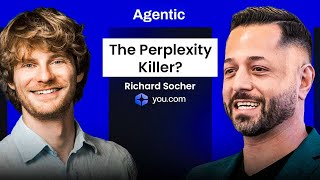
Richard Socher and Brian McCann, co-founders of You.com, discuss how their AI startup evolved from a search engine alternative into an enterprise platform. They detail ARI, their deep research agent, and explain why they think they can compete with Google and OpenAI by focusing on productivity and reasoning rather than just scale.
How would you describe how you.com is different than the ChatGPT, Gemini and the other LLM chat interfaces?
We actually focus on getting accurate answers and then not just over public data, but also over company internal data that sets us apart.
The actual underlying model is reasoning just fine, but it just didn't get some of the relevant sources. So it can't know. It's the kind of the fundamental problem with LLMs once they stop training.
So this is some of that idea that, you know, perplexity and others might be good at like fast facts, but you're going a little slow. So your end user can go fast and just be able to take that info and move forward with, with confidence.
I mean, in many ways, like having a quick answer of what's the weather tomorrow? Or what's the score of the game isn't really going to make people want to switch from Google because you can already get that answer within one second. So when you'd have to spend days doing work and you get that now in minutes or hours, like that's where people say wow, like view.com is a game changer for my organization. I think there are always areas of deep expertise that are less attractive and in a weird way, the less attractive they are, the fewer people will compete with you in them. So there's a lot more low hanging fruit still in real estate insurance brokerage than in movie making and the music industry. I probably have seen several hundred of AI psychologists at this point.
What are your thoughts on AGI and what role do you see u.com playing in action? Welcome to the Agentic podcast where we dive deep with the pioneer AI founders reimagining business and investors betting on them. We bring you the war stories, insights and perspectives you won't hear anywhere else. I'm your host George Van Darrien, the general partner of Untapped Ventures, a VC fund that invests in early stage AI startups. Let's go. Hello and welcome back to the Agentic Podcast. I'm your host George Bandarian and today we have two very special guests with us. They are the Co founders of U.com one of the most innovative AI startups based in the Bay. It started as a search engine alternative and has really evolved into a productivity engine. And we'll hear from the two co founders on where it's at today and where it's going. The two co founders are Richard Socher and Brian McCann. Richard is the CEO, CEO and co founder. He's a renowned AI researcher, entrepreneur, technologist. He previously built a company Metamind that was acquired by Salesforce. He was chief scientist at Salesforce where he led advancements in natural language processing and conversational AI. Prior to all that, he has a PhD in computer science from Stanford where he studied under the well known Chris Manning and pioneered early work in deep learning for NLP. And Brian McCann is co founder and CTO, a seasoned AI scientist with with deep roots in NLP, large language models and controllable text generation. Having co authored the influential paper on that topic around contextual word vectors which was the precursor to bert and later co developed control, one of the first controllable generative transformers. He also was in research at Salesforce and Stanford where his focus included multitask learning, controllable generation and protein sequence modeling. And the two of them left a few years ago to start u.com it'll be really interesting to dig in and understand the origins story and what led to the founding of you dot com. Welcome to the show guys. How did you guys meet? I'm guessing it was at Salesforce, although I'm not sure if maybe you were together prior to the sale of your company Richard to Salesforce. Maybe kind of tell us about how you guys met and ultimately how your relationship evolved. You know we, we, I think young founders are very interested in learning from successful founders, especially multi exit experience founders like yourself, Richard and Brian. So we'd love to kind of peel that back and learn a little bit about how you all met and how we got to where we're at today.
Yeah, I can take a first stab at that. So high level. We met at Stanford actually. I was a PhD student, Brian was an undergrad and we started working together one summer during Stanford and then Brian did his master's in computer science, I did metamind and then after the acquisition of metamind, Brian joined the research team at Salesforce is actually technically only folks with a PhD, but Brian was brilliant and didn't need a PhD to do cutting edge research right away. And so we started working together and for several years I had this crazy idea to try to just unify all of natural language processing with one model and just ask that model different questions and prompt it to give you different answers. And most people I pitched this idea to had told me like Richard, that's just too hard. Like also I want to publish a little paper every quarter and you know, this seems like for a quarter I'll just have to do pre processing of all these different data sets and so on and all these different communities and how they evaluate. So success in translation and summarization and question, like traditional question answering and a sentiment analysis and you name it, like. But Brian actually like saw that that vision and, and like also you know, wanted to work on really impactful things. And then he made this idea his own and really crushed it. And a year later we published DECA NLP together in 2018. And that paper, you know, was eventually cited by the first GPT papers from OpenAI and others as the first one to have that general purpose idea, to have a single model. In fact, I now like hear people say, oh, that's so obvious. Like, you know, it doesn't even deserve to like have someone who invented prompt engineering. But it was also so unobvious that the paper got rejected multiple times at different because it was just so out there. And you know, through, through some of those like ups and downs, you also get to know someone really well. And like, I was really fortunate. I've been able to work with a lot of really smart people at Stanford and invested in many incredible students and interns and employees and co founders, like yeah, co PhD students and so on. And Brian was the smartest of them all and also had the right sort of balance of just not giving and grinding hard and working hard into different problems. And so when, you know, we kind of sat on the prompt engineering paper for two years hoping that we'll get better answers from the world, but the world, like Google didn't really want to.
Give people better answers.
And so we said, well, someone's got to do it. And so I asked Ryan if he wants to co found it. I was very happy that he said yes. And yeah, Brian, do you have anything to add to that story?
And what timing was that? So when he, when he said yes.
2020 is when we started you.com 2020 got it.
Yeah, yeah. I think that it's always fun to hear from the different perspectives too because I was coming out of this kind of background in philosophy and philosophy of language. I was really interested in meaning and making machines that could make meaning, um, which I don't know that we ever really did, but they're very much more functional now. Um, and, and I remember, you know, going to the computer science lab at Stanford and there was really only one person at the time that was, you know, working on neural networks for nlp, deep learning for nlp. And when I saw that work, it was just like, yeah, this is, this is, this is the stuff, you know, and it was Richard's work. He was already deep into many papers of showing the Path and the future for I think a lot of people over the following decade or so now. So I was lucky to, I guess, run into him back then. And even at that time, Richard mentioned his vision for a unified model for natural language processing. And I remember him also just being obsessed with search and what search could be. Not just a search box tied to 10 blue links the way Google was, but could it really give you answers? Could it give you almost like infinite information, like a stream of information so that you're. We're still not doing some of that yet. To some extent. I think people are still trying to capture that form of both this deep research, but also kind of proactive search on your behalf. And all the seeds of the future seem to be there already in that summer when I was talking with him. So it was a easy choice for me when I had the opportunity to go to Salesforce and try to prove myself there. And then it was another easy decision as the world was changing and we saw the inflection point coming, the real opportunity, because back at the start the ideas were there, but we didn't. We know how to make it work, you know, and the models weren't ready. But as 2020 was rolling around seemed like, yeah, we should get out in the wild. We got to experiment and see what's going to happen because it's going to be technology, it's going to be search, it's probably going to be the economy. Like everything was going to change and. And so it has.
So. So obviously that was before the ChatGPT moment in November 2022, but still there was. OpenAI was doing a lot of work, there was a lot of papers, things were being built. The ChatGPT wasn't released to the public. So I guess what was that initial from the 2020, as you mentioned, to the ChatGPT moment, like for the. That infancy of the company, you must have gone through some early like product market fit journey, evolution from there to here, right?
Yeah. For the first year, we essentially built the foundations of search for us so that we could, you know, be somewhat recognizable as a product in that space. And we had baked in more and more AI over the. Over the following year after we launched, we'd launched some generative AI writing assistants, called it uWrite, we had coding assistants, U code and the interface at the time was more traditional search like and depending on the query, if it was relevant, we would bring up these language models as assistants for you image generation as well. It was when ChatGPT came around and kind of Flipped that into the conversational interface that we very quickly did the same and connected those actually the way that we did it under the hood, we basically took our writing assistant and just put it on the front page all the time and let it see the search sources. So that was how we were able to, from essentially the launch of ChatGPT to the launch of UChat, do it in a couple weeks and have something ready to go.
Nice. So that's exciting. And so you went from there, grew a great consumer audience, built the product, got lots of learning and iteration, improved the product and then at some point started to really focus on B2B in the enterprise. And that led to now with Ari, which is a very much an enterprise product that, you know, small to large businesses can use to improve their research across the board and in some areas really be able to derive additional revenue and or reduce expenses by using it. And so that kind of brings us up to speed here in April, May 2025, so you just launched ARI, which you call ARRI. And so we just had a chance to check it out, me and my team and it looks pretty exciting. So maybe you could tell us about this full blown research agent for enterprises. What is it and how exactly is it changing the game?
ARI is essentially the second version of our deep research agent that will go much beyond any other research agent out there, will go deeper, it'll write you reports, it'll create beautiful artifacts like PDFs that you can actually share with and soon also edit and actually build work products that aren't just your quick, trivial answer. We found that really Google is pretty good when it comes to asking like, what's the score of the game? What's the weather tomorrow? Who's the president of France? There's not much you can do there to actually be 10x better. But the deeper the work goes, the longer the reports have to be, the more you incorporate your own company internal data data with hundreds of different websites, the more you really start to build useful answers for enterprises.
Yeah, that's exciting. Now I'm obviously very familiar with you.com and for the listeners that aren't, how would you describe how you.com is different than the ChatGPT Gemini and the other LLM chat interfaces as well as how is it different from the other similar players like Perplexity and others? So help us understand what is u.com and where people should really be using it in light of this aria announcements.
So U.com is essentially where you see the future on all these other platforms. You Know, these days you have at most a 3 to 12 month window when you build something novel and then many other folks will copy it. Then you know, we have the patents and everything, everything to back up those statements and launch dates. But the main difference, surprisingly, is still the accuracy. A lot of folks spend a lot of resources on marketing to consumers and pretending to be the next Google or just Google doing its thing. We actually focus on getting accurate answers and then not just over public data, but also over company internal data in a trusted fashion. So those are the main differences. It's the accuracy, it's the depth, it's the connectivity between your internal customer data and your just general external web data that sets us apart. And then building also custom workflow agents on top of all of that that you can share within your organization. So we're not pretending to be the next Google or the current Google, but we're just helping companies actually be more productive. And we believe that even the various startups that try to claim to be the next Google, they're all going to likely fail at this because Google isn't slowing down either. And they're probably going to move and follow us into the enterprise once they realize they cannot quite break the monopoly that is Google.
That makes sense. So if we think about that, one of the things that's happening in the enterprise, Brian, is the move to agentic. And so where are you guys at with, I guess, how do you define your agents? Do I go in and set up each agent? Are you guys working? Or do you have the ability to make it agentic and string together a workflow process? And ultimately I guess how are you contributing to getting us to AGI? But I guess why don't we take it one question at a time.
Yeah, with our custom agents it really builds off of everything else that comes with the platform these days that is you dot com. So as Richard mentioned before, we have Ari and that's our flagship agent that can do all of this deep research for you, decide when to make additional queries to a search engine, pull in more results and go really, really deep on citing those sources so that you have very transparent research processes. But then on top of that you can build all sorts of agents that can start to automate the really repetitive parts of your job or whatever you're working on. So you know everything from headline generation to proofreading, some go to market plans, you know, product specs. These are things that people are starting to outsource to agents on you.com and it benefits from many times Using the public data to be as up to date as possible, but then capitalizing on the unique aspect of your company's private data to do things in a way that a GPT out of the box can't do, or some of these other systems can't do without being able to tap into what is proprietary about your company, unless you're spending a lot of time training up those agents yourself. Whereas u.com, you can get this full solution that uses something like ARRI for all the research, but then becomes a little bit more focused for use cases based on your data. And then in many cases we can apply those to a company's use case as an API or in the U.com interface itself. It's very flexible, very powerful.
Gotcha. So I know you're really excited about Ari. What have been some of the most impressive real world use cases that you've seen so far with your early customers using that?
Well, one of my favorite use cases was actually before we had even decided to call it arri, having a conversation with it about and describing to Ari what it was, that it was this deep research agent that had access to all these sources and it provided a really nice research report for us in the early days of this competitive landscape, wrote its own product specs to some degree and helped us develop some of the go to market plans. So it's this research report generating agent that a lot of people use for market research or I use a lot every time I'm going into a conversation with a potential customer or partner to understand that market, to understand their recent product launches, understand as much as I can, and become an expert as quickly as possible for them. But then you can use it for all of these other in depth use cases around product building. And these days it's very popular for consulting. Any sort of consulting or strategic decisions or strategy or advice you're giving to clients. It's almost indispensable to have this kind of deep research at your fingertips.
Got it. And yeah, it's a little, it's a fine line. Right. Because when we call it research, it's a very broad and it applies to everybody. But unless you can clearly articulate your edge in that, it sounds like something that all of the platforms do.
Right.
I can do research on and even deep research on Gemini, Claude, OpenAI and all that. So how have you guys navigated, if you're trying to own that and be the best at that, how do you. How have you guys navigated articulating and coining what you own in that so people understand, like, hey, we've decided this, like, we, we do this better than everyone, and this is what this is. And, and how it's different than just going in and using somebody else's research or deep research tool, or is that still a work in progress?
I can take a crack at that one.
Yeah.
So with Ari, what we started with was the angle on comprehensiveness. So when ARI came out, and even to this day, it's often gathering many, many more sources than any of the other deep research competitors. And the idea here is that even though we have depth in a lot of these offerings, you really want to be able to capture as much breadth as possible too. If you're bringing in 10, 20 sources, that might be okay as long as they're the absolute best perfect sources and they somehow capture everything that the Internet is talking about in relation to whatever topic you're researching. But re will bring in 300, 400, sometimes 500 sources, read all those live and pinpoint the exact sentences inside those sources that are the most important for what it's reporting to you. And that level of breadth is a very important foundation, I think, for a lot of agents moving forward too. It's almost like, how could you really trust an AI system to be making really important decisions for you in financial markets or with your clients if potentially it's missing some of the information? Maybe the actual underlying model is reasoning just fine, but it just didn't get some of the relevant sources, so it can't know. It's kind of the fundamental problem with LLMs once they stop training. So emphasizing that breadth on top of the depth is where ARI is very special. And then getting back into people's normal workflows, generating PDFs, slides, making it as easy as possible to distribute that information. RA shines there as well.
Got it. This is some of that idea that Perplexity and others might be good at fast facts, but you guys are really investing in the concept that I call going slow to go fast. It's almost like you're going a little slow so your end user can go fast and just be able to take that info and move forward with. With confidence. So it might take me a little longer if I'm doing an RE search versus somebody else's, but at least I know that I'm rest assured that I have the most comprehensive and the best, ultimate deliverable coming out of it.
Right?
Yeah. I mean, in many ways, like having a quick answer of what's the weather tomorrow? Or what's the Score of the game isn't really going to make people want to switch from Google because you can already get that answer within one second on Google. So when you'd have to spend days doing work and you get that now in minutes or hours, like that's where people say, wow, like you.com is a game changer for my organization. We have quotes now from journalists, from insurance companies, from hedge funds, from banking banks who tell us exactly that. And some of them we've made public and shared with the world, of course, agreements of those organizations. And that's very powerful to see. And that's honestly what, what I love to see also is like actually helping people be more productive with AI.
And so then by that same token, does it use the new. I saw you guys have the new auto feature, which you know, solves one of the problems where, ah, I don't know which of the engines to pick. You guys have all the engines, open source and not, and the APIs and you are always updating to the latest one. But it's like, I don't know which one I should use for this request. And so you solve that problem for users by just, you know, letting the system decide. But in the case of ari, so is it, is it kind of using the deep research of multiple models and then putting that together into the main answer? Is that kind of part of the benefit of your solution?
Yeah, with Ari, there is probably a dozen or so models actually underneath the hood, doing all sorts of things to ensure the citations are as accurate as possible, make sure we've actually collected as many sources as we possibly can that are relevant for a topic, generating more topics. And those models themselves, some of them are based off of open source models, some of them are based off of foundation models from other providers. All of them are put through our own testing frameworks and fine tuning frameworks with our own training sets and evaluation loops. But ARI is really a collection of models underneath the hood. And the auto feature that you're talking about that just came out as well is trading off not just between different models, but between the idea of doing a deep search versus a shallow search at all as well. Because yeah, you can get caught up trying to think about which model is best for which use cases, and we want to handle that for you. We also want to be able to switch into a deeper processing mode when it could be helpful without you necessarily needing to think about that decision too.
Yeah, that's great. Well, no surprises, you know, let's continue with this timeline and you know, are you guys planning on adding workflows and agentic and AGI? We never touched on that. So yeah, take us from here on out for the next few years, maybe the next five, 10 years. And what does this look like for you guys if you.com is as successful as you hope and envision it to be?
Yeah, we're moving deeper and deeper into workflows for companies, you know, insurance companies, publishers, healthcare companies, hedge funds and so on. And we love seeing that productivity increase and that knowledge work being more and more automated. I think we're moving from answers more and more to agents. So helping people actually create workflows and become managers of AI. And so we're leaning into that. We have training also so there's role specific training skus that come with Vue.com so you can actually uplevel all your employees. As it turns out, if you've been in IC for many years, it's not that intuitive to now just manage agents and delegate work in unambiguous ways to your agents and explain to them how to do that work. Right now we're mostly focused on knowledge agents. I think in the next couple of quarters you'll see more and more action agents too. There's still not a really, no really good action agent that will write emails for you and really know all the subtleties of doing that well. But that will happen also in the coming quarters. And yeah, we're just focused on revenue. Our revenue increased massively over the last few quarters and we're just very excited to see if we can break into another order of magnitude more revenue this year and eventually really become a partner to help companies on the path towards AGI. You know, I think we kind of summarize it with three things. Answers, agents, AGI and that AGI path isn't just going to come by like throwing it over the fence, but you really have to bring organizations along with them and that's why we offer all the different lms out there so you don't have to worry about all the change management and zero data retention and privacy preserving features and so on. But you just partner v.com and then you're future proofing your organization and you know you have certain requirements. We, we go deeper with our customers than just like here's a, you know, out of the box tool. We'll actually go and, and help them with their data sets with custom integrations so that the AI is knowledgeable about the organization.
Yeah, I was going to ask you guys about that. I mean, you know, it's staggering for me because I still do keynotes. I know you and I, Richard, met a couple years ago when we were both doing a keynote at Caltech. We were back to back. That's how we met, we became friends. Obviously we had the opportunity to invest and jump onto your journey or the you journey, you your journey. But you know, I continue to do that as I'm sure you do too. And I'm just surprised at two things. One is just the level of enterprise, lack of adoption of AI as much as I would expect by this point in April 2025. And part of it is I see that when people try they just there is the, there are the failed projects now, but then there's also the burnout and there is the AI overwhelm. And so like all these things are happening. And just lately in the last week I've seen open AI release a paper which is like a kind of a white paper on how to implement agents and Google had something and now OpenAI and Google have white papers webinars. So it's interesting that AI is, is, is reaching this new and you mentioned it yourself that you guys have some of these assets. So it's interesting how the industry is moving maybe in the cross crossing the chasm from like the super early adopters to you know, in order to bring the mass market you need, there's a lot of education necessary. So maybe that's just part of it. But I guess what, what are, what are your thoughts and what are you guys seeing out in the field on, you know, why is it the case that like RLP's, you know, we have 100 LPs, most of them own large companies, venture and non venture backed and they're all still trying to figure it out. Some are ahead of others, but they're all really just trying to figure it out. And I would have expected that a much higher percentage would have been using AI across the board or certainly in key areas. Yeah. What are your thoughts on that?
There are a few things I think many people spend some time trying to do as much of it as possible in house. Some people are doing that and they learn fairly quickly, some more quickly than others that the devil's often in the details with some of these implementations. So it has been some of my favorite customers over the last year and a half that you know, have spent 5, 10 engineers building a chatgpt like interface, setting up rag, setting up the vector database and a couple queries work. You can definitely get some demo able queries out of it. But it's really not robust enough or broadly applicable enough to get the kind of adoption you'd hope for. So you're talking low single digit percentage of adoption rather than 80% of the company using what they've built. And that's partially because it's just quite difficult to get the details right and to make it broadly applicable. It's also because the technology is still moving very quickly and the capabilities of what are possible are in many ways outpacing the ability people to just get set up with the basics. The basics being not just that rag setup, but wrangling the most valuable data for that use case, understanding what their postures are going to be from a security and privacy perspective, depending on their products. You know, all of these questions go into what they're going to do and their strategy. And even though there's often a huge impetus and almost a mandate to do something, that something is very unclear, especially when everybody is looking around at everybody else saying how is what we're going to do be, how will it be different from them? So there's that extra consideration. And then on top of all of that, as you mentioned, individual employees in a company being maybe afraid to some extent a little fearful or just confused or feeling like this not for them, or that they're going to be replaced. There's a lot of human factors that prevent adoption. And the raw tech and the kind of shininess of it isn't really enough to punch through that initial barrier either. You have to have a bit of a human touch, as Richard was talking about before.
Yeah, that's really interesting, Brian. Yeah, it's interesting because I'm experiencing it a little bit myself too as the end user. Richard, you and I had a chat sharing with you how I have a vision of creating some kind of agentic investment process, right, where a founder can hit my website and multimodal, submit a deck data room, interact be asked questions, video sentiment analysis, all that stuff and then have the AI reach an investment decision over time once we, you know, once we've done the evals and we're comfortable and we fine tuned it and all that good stuff. So I, I know it's possible. I know there are a lot of tools. I have people that want to work with us, PhDs that want to work and, and build it. But it's a little overwhelming because do I buy or build which one of these Agentix systems do I use? The developers want to just build the whole thing in house, not use any of the tools. So even as someone that I would say is, you know, more experienced. There's not a clear, there's certainly not a single path, but there's not like an easy button. And me having gone through this right now and experiencing this pain point, you know, gives me greater appreciation for what I think enterprises are going through, that it's, you know, I, I know the technical capabilities are there. I just want a solution. I could just pick it up, subscribe to it, tell them what my screening criteria is, tell them what my selection criteria is, have it go through, do a few, do 10, let me check it, let me say why I got it right, why I got it wrong and put it into like production. Like it should be that easy, but it's not.
Yeah, I mean the more complex workflows you automate, the longer it takes you to train that AI to do it for you. But I do think in the next few years most forward looking organization will use tools that when you use them, get smarter. And when you have to repeat a similar workflow more than 10, 20 times, you'd be like, wait, why hasn't AI picked up this workflow yet and has just given me a suggestion to click yes to like already audit that I've already done that in the software. Right. And that's when I think a lot of different enterprise workflow tools will really shift.
Yeah, I like that because you know, in, in operations management the whole, the whole rule is like if there's anything that you're going to do more than a couple times, then there should be an SOP around that. Right? So as a manager, as a leader, as a founder, if you do something a few times and you know you're going to keep doing it, just create that SOP and then you could give that to someone else. But now in an AI first mindset, what you're saying is if we know that there is something that we're going to do a bunch of times, then you know, there should be an AI that's learning it and being able to take it on from us. Right. Either assist in the process in a co pilot capacity or take it over eventually in a pilot capacity.
Right.
Okay, so really interesting stuff. So we were talking a little bit about the future and so moving from, you know, answers to agents to AGI. Yeah. What are your thoughts on AGI guys? Are we already there? How do you define it? What do you think it'll be like when we get there if we're not already there? And what role do you see u.com playing in that now?
I would Love to hear from Brian too, but high level indeed. Depending on how you define it, we're already there. In fact, when we built the first DECA NLP model and you could ask it any question and get an answer in natural language, you could argue, yeah, wow, that was a pretty general purpose intelligent system. But then of course, we keep moving that bar on how general. And at this point, more and more of us are separating super intelligence also from general intelligence. And just to show, yeah, you can go beyond a bunch of different human skills and go into being even better than people on some skills, which requires often simulations, because if you only train on human data, it's hard to be above superhuman. You know, if we're doing machine translation and we give it a bunch of human data, well, you know, the AI is not going to translate that much better than those humans. If we give it a bunch of human IQ tests, then the eye will have a hard time like being even superhuman in those IQ tests. And so like eventually realized there shouldn't even be this kind of test. There should be an even harder test that humans can come off because we're not intelligent enough. So there's a lot of space still.
That's how it learned, right? I mean, that's how it learned how to win at go. And even chess is not studying the moves that humans do. Eventually that initially that's what it did, but when it was given the opportunity to start from a blank slate is when it was able to come up with its own moves that humans have never done.
Exactly. Everything you can simulate, AI can solve. But we can't simulate biology yet, we can't simulate a cell perfectly yet, we can't simulate organs, humans and complex systems. But that will happen as AI gets better, as simulations get better, as computers get faster, as quantum computers may eventually have real breakthroughs and can be scaled up. That's when we can have like more and more super intelligence. So I'm really excited about it. I hope you.com will play its part in that and get humanity to that state. Because it is truly incredible what happens when technology scales massively into a field of, of the human condition and you end up in a state where a billionaire and a middle class teenager will use the same iPhone every day for hours. Right? And so you can look at like, what are all the other goods and services that are bottlenecked on intelligence and you can realize like, well, we'll all have personal assistants, personal tutors for our kids, personal healthcare teams for longevity and health and, and so on. So I'M I'm really excited for that. And AGI will unlock a lot of those use cases and, and you know, then there's sort of very pragmatic definitions of just, you know, if we automate 80% of the workflows of 80% of the digitized jobs, which is, you know, a couple trillion dollars worth of gdp, then I think we can actually get there in the next few years. But then you'll see the same thing you see with most other technologies, which is the future is already here, but not equally distributed. Anyway, I love the future. I'll pause.
Yeah, no, I love it too. So those are all. And I agree with you. I'm very optimistic about the future and look at what's happening. So if we go more into the short term, what do you guys see happening in the next year? Let's call it that most people, even Maybe some founders, AI founders and VCs, don't really see yet.
One of the ideas that I think Richard and I have put forth for the last few years and seems to be true, is that the quicker the validation and feedback loop you can have for these systems, the more likely they are to improve very quickly and then more likely that they're going to automate a lot of workflows more quickly. So, yeah, coming to the short term and coming to some of those more like programmatic years, as Richard was talking about, it seems like coding and software engineering is changing very, very quickly now, in part because that feedback loop is there and the validation cycles are so quick the code either works or it doesn't. And that's at the level of does it even compile or not before? Does it actually do what you want in the application? That level of feedback is super helpful for rapid iteration. It seems clear that next couple of years software engineering is just going to continue to change dramatically. Richard often says we're all managing AI, and that's probably true of these AI engineers as well. And then I think there's going to be a combination, you know, kind of jumping off of Richard's simulation point as well. There's going to be a need more or less to start automating those feedback loops in different areas as much as possible. Like there's, there's so many. You mentioned operations earlier. There's so much in the operation running of companies, economies, scientific laboratories or biology and science and experiments that I think we could sit here and say that there's no theoretical reason why that stuff couldn't be automated, but the process just isn't there for Collecting the data, validating it quickly. There's too much human feedback that's needed in the loop right now. So to a large degree, clever ideas on quickly validating whether an AI is successful or not might be even more key at this point where the Holy grail in any domain there is a full simulation of the state space and you can just play it all out. But in the absence of that, maybe on the way trying to build up these deciders that help us get the AIs better in incremental steps.
That's cool. I like that.
I'm super excited for AI, for science.
I'm really excited about that as well. I think it's my friend Peter. The Amanda calls it the longevity escape velocity. Him and Raker as well. And it's really, you know, just don't do anything stupid, stay alive. And in the next 10 years we'll figure out a lot of these diseases and conditions that we've been struggling with for so many years. And we've had, you know, we've lost so many lives to cancer and others. So I'm very hopeful about that. Let's spend the last few minutes maybe talking about helpful advice, lessons learned for AI founders, the next generation of founders that might be at your alma maters, at Stanford or MIT or wherever the case might be. There is what happens once you start. And I'm sure you guys have probably some good go to lessons learned and kind of advice, especially Richard, you're also an investor as well. But maybe before we get to the how to be a successful founder. I think the field is moving so fast. Let's just talk about what to build or what problem space. And you know, I guess putting on your founder, investor, you know, industry expert hats, both of you guys, you know, what do you think? Where do you think we're at if, if somebody was graduating Stanford and starting something later this year or in 2026 with the field moving so fast, like my personal opinion is, you know, AI, you know, the vertical AI, horizontal AI came and went, vertical AI came and went. All of those sectors are full and vertical, horizontal, vertical, agentic got filled up pretty quickly. And again we're talking about in the pre, in the precede seed, early stages, agentic, horizontal agentic, vertical got filled up pretty quickly. So we're already kind of looking at what's next. Whether that's, you know, BCI Robotics, Quantum. And not to say that those are completely nascent. There's many, many companies in those areas as well. But it's just interesting to see how 60% of all venture funding went to AI startups in Q1. You know, it seems like, and maybe there's some bias that I have, but it seems like all the bright minds are focused on AI startups. So there's a lot of quantity and there's a lot of activity and that also makes it a little harder. You can't just do another me too kind of AI solution. So those are some of my thoughts, but I'd love to hear your thoughts on what your advice would be. If you're teaching a class at Stanford or whatever, you're coming across a new founder that's in that open ideation phase. I'm not looking for a specific startup to create, but kind of general themes and how the market's evolving and where you see the problem. The opportunity spaces opening up over the next 12 months.
So high level indeed, everything purely digital, the low hanging fruits are going to get picked off really quickly. So you better have a very, very deep niche that you're focused on or you have a lot of resources to be able to compete in that. And you have to be, you have to be ready for just a constant, very fast pace. Whenever you do something somewhat successfully, people will copy you in 3 to 12 months now, not having to do the iterations but just, you know, copying the thing and building directly the right solution. I think as AI software development gets faster and faster and AI will write more and more software for you, showing it how to do something is essentially training data for the AI and so someone will be able to copy it very, very quickly. So you have to be in for that ride. I think there are always areas of deep expertise that are less attractive and in the weird way, the less attractive they are, the fewer people will compete with you in them. So there's a lot more low hanging fruit still in real estate insurance brokerage than in movie making and sat like music, like the music industry or you know, general chatbots or like I had probably have seen several hundreds of AI psychologists at this point and like, but you know, revenue cycle management still has like more now there are quite a few companies that do revenue cycle management at this point. In fact it seems unfortunately case that a lot of successful healthcare startups end up just in that. But like you know, there's, there's a lot there then I think the deeper in tech you go, the more you can actually rely on a technical moat. So if you do, you know, drug development, you create new kinds of compounds, new materials and things like that, that's where you Know, you can actually rely on technology modes rather than the standard things like go to market and so on. In many ways we're in a phase where mobile apps were when you know, Instagram started to kind of break out. There are like a hundred other photo sharing apps and just have to go back to like standard startup building skills like sales, distribution, marketing, brand and you know, to some degree technology. But certainly we've seen in our space also folks that have done better in marketing to a degree where it's almost lying, had worse technology, but it worked out pretty well for them. And so we, you know, you have to just go back to the basics in some ways of, of startup building if you want to compete in these very competitive spaces.
Yeah, no, that's really helpful. And then I guess so let's say they pick something good. Maybe it's not as sexy of a space or whatever it is, it's a good, it's a good one. And now they're off and running. Is there any one key piece of advice that you think you've learned in your journeys that you would want to impart on any listeners early in their process?
Find a good co founder, find someone who's, who doesn't easily give up, you know, who, who actually has the grit and determination and hard work ethic to, to go the distance. You know, if you look at most companies like that were started in the 2000s, there's a lot of them that died and then there are a few that just kind of kept going, right? And eventually they really grew into massive businesses. And you know, you look at their stocks and you know, there are some like three, four or five years where the stock was basically flat, but eventually, you know, you, you iterate and you got to, you know, keep iterating and improve your, go to market, improve your sales, improve your distribution and your funnel and everything and then you succeed. And I think in some ways AI is speeding all of it up, but some of those fundamentals continue to be relevant. In fact, the one thing that AI cannot increase and speed up massively is the amount of human attention that is there. And so you have to keep fighting for that.
You mean like the focus of the co founders and the early team? Is that what you mean by human attention?
That but also just the users, you know, like I will change so many things, but it cannot really, like it will improve massively the productivity of different industries, the outputs of, you know, the amount of illustrations and art and translations. We get. It used to be that if you want to travel the world and be able to communicate with others. You'd have to be very, very wealthy and have a personal translator. And every new country you move to, you have like your personal translator travels with you. So now you can communicate with people. Any backpacker can now do that. Now if you're a translator, you might not like that, right? But if you want, you're a person that wants translations. If you're a person who wants to, you know, have an illustration on your little blog post, you couldn't have afforded a $400 like illustrator in the past. Now you can have some nice looking illustration for your blog post. So whenever you care about the outputs, you love it. And anyway, yeah, those are some lessons that I think will continue to be valid.
How about you, Brian?
Well, I definitely echo that. Finding a good co founder is crucial. Find someone. I was very lucky because we'd worked together for so long. Richard had experience before. People are asking me all the time how to find a good co founder. And I guess I don't really know. I, I found mine a long time ago. But you should try because it makes a huge difference. And I think outside of that, fundamentals are absolutely crucial. I think especially early on, you can't really overestimate what people say in traditional startup circles around learning and quick iteration being vital and important. It's all about how much you learn and how quickly you're learning. But to go one layer deeper than that, I think one of the things that I've learned has been that in order to do that really effectively, you have to follow your intuitions and you have to follow your convictions as if they're like 100% true, even if you have doubts in order to learn as effectively as possible whether they actually are true. So I think those intuitions and convictions just follow that as much as possible. Then don't let anything get in your way of learning.
You have a big intuition about something, believe in it. But go validate it. Go, go bring it into existence. But also be open to being objective if it invalidates or, you know. So how do you draw that line? Right, Because I think this is where a lot of founders get messed up. They, they take it too far. Even when the customers, the world, the investors are telling them no. And when do you know when they're right or when you're right? Right. This is this fine line.
I don't know that you can know ahead of time, but if anything, I would lean harder into forcing them to show you you're wrong. And, and why do I say especially in the early stages because there were two, two points in U.com's history that were particularly hard for me and Richard. I think as scientists we have scientific backgrounds, so in many cases we are very data driven. We want to run experiments, we want to let the data show us we have our convictions, but then we want to be told by the world what is actually right or wrong so we can change our model. And there was one point where we were running a B tests around whether we should truly fully switch over to a chat based interface or keep the search based interface around. Now in hindsight that seems like an obvious question, but if you talk to a lot of people in the space, if you talk to investors or, well, is this whole chat thing, is that going to be, you know, is that a fad, like what's going on? And you know, you want to ap test because you want to learn. 50, 50. Every time, 50, 50, you have 50% of the users saying, oh, I like this the old way, 50% saying, I like it the new way. And so when you get into those situations, what do you do then? You, you just, you kind of have to rely on your intuitions and your convictions because no one's telling you what to do. And at the end of the day, that's part of what being the founder is about too. Like you're founding because you're taking a huge risk going in that direction. And, and like I said before, you're only really going to find out and you're only going to learn and tune your own intuitions if you test your intuitions. So you've got to push them as hard as possible until you're sure they're wrong. That's when you've learned. If there's any doubt in your mind, oh, what if I would have done this or that? Then you don't get to absorb the lesson fully. You also discount the lesson. Your brain won't fully update, so you've got to go all the way. Happens again. When we started shifting more and more towards Enterprise and B2B use cases, of course we have tons and tons of users asking constantly for consumer like features. How do you say no to that? Most of the world is telling you go in one direction, but you have to go in a different direction because of your own intuitions and convictions. And a lot of times it's delayed when you get that validated feedback. It's just a risk, it's pure risk in many ways.
I gotta say, Richard, Brian, this was an exciting.
More from George

The AI Agent Getting More Supplier Data in 5 Weeks Than a Team Did in 2 Years








