Is Big Tech Shaping The Future Of AI? | Wendell Wallach
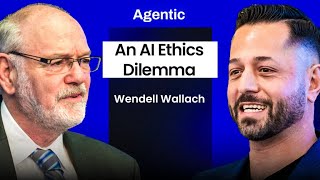
Wendell Wallach, an AI ethics expert, discusses whether big tech companies are controlling AI's future. The conversation covers moral decision-making in AI systems, safety concerns, deepfakes, and what global regulation might actually look like.
In terms of some of those agentic capabilities you've written about moral machines, can you walk us through what it means.
So we set this problem for us? Can AI make decisions in morally sensitive cases? And can it even recognize when it's in a morally sensitive case? For example, my focus has been on moral decision making. I don't see anything out there that suggests to me that these systems are going to be good at moral decision making in ethically difficult situations.
How do, how do you define AGI and asi?
AGI is comparable to humans and can do anything that a smart human can do. Artificial superintelligence is. Then you've made this exponential leap way beyond, and they're going to pursue their own goals. Then if we're lucky, as Marvin Minsky used to say, maybe they'll keep us around as the equivalent of house pets.
Hello, and welcome back to the Gentec Podcast. This is your host, George Bandarian, and today's guest is an internationally recognized speaker and thought leader for his work on AI ethics and governance. And we're going to have a really good discussion because as I present to lots of different audiences, including CEOs, boards, investors, a lot of the questions I get, besides the excitement of AI, are some of the downsides. Right? How could this all go wrong? Is my data safe? What can happen? Can the AI press the nuclear button? And all of these important questions that we'll explore with our guest today. His notable works include co authoring the book Moral Machines Teaching Robots Right From Wrong, and also authoring A Dangerous Master, how to Keep Technology From Slipping Beyond Our Control. Previous roles he's held include chair at Yale's Interdisciplinary center for Bioethics, and he's co director of the AI and Equality Initiative at Carnegie Council. He's widely regarded as a leading voice on AI governance. Wendell Wallach, welcome and thank you for joining us today.
Thank you for having me.
So let's dive in and maybe before we go to the downsides, let's talk a little bit about the upsides. And let's start on a positive not. What do you see as the biggest upsides of AI and how will AI uplift humanity?
Well, human intelligence is truly remarkable and in many ways able to do some things that I don't think we're going to see AI do for quite a while. But we are also limited. We're limited in our bandwidth. We're limited in how many thoughts we can keep in our mind at once. We have bounded rationality. As. As one of the fathers of AI once stated, about human intelligence. And what I'm so excited about with AI is the way in which it can enhance or augment that. So clearly AI is a different kind of intelligence. It does things in a different way than humans do it. I mean, AI is not one thing. And there are many different things going on within the world of AI, but I see the prospect of solving many challenges that we have difficulty doing alone with the enhancement or the augmentation of AI. I won't jump into that part, but I've been very suspicious about the degree of autonomy or agentic capabilities. I mean, we used to talk about this as autonomy, but we now have another new word out there that I'm very concerned about, where that's deployed and where it isn't deployed or what kind of guardrails we have in place. But that doesn't alter my enthusiasm for, for the problem solving that can take place with both the augmentation of AI, the tasks AI can perform that we cannot perform.
Yeah, that makes sense. And in terms of some of those agentic capabilities, you've written about moral machines. And so can you walk us through what it means for an AI or an AI agent to have moral decision making capabilities?
So Moral Machines is actually a relatively old book now, 15 Years in Technology, but strangely enough, it still is the go to text when people think about ethical decision making capabilities within artificial intelligence. So we set this problem for us. Can AI make decisions in morally sensitive cases? And can it even recognize when it's in a morally sensitive case? Now, one of the fascinating things about, about going through this exercise was to realize, well, there's a lot about human moral decision making that gets taken for granted. But when you're talking about building a machine from the bottom up, you can't take anything for granted. So humans have all kinds of capabilities such as consciousness. Something's called a theory, which is the recognition that what's in my mind may be different than what's in your mind and how we sort of deduce what's going on. Sociability, being embodied in the world, having a particular kind of body and interfacing with the world based on what that body is. So all of those can come into play. Oh, emotions. Emotions of, of course, has been the piece of that that ethicists have recognized for 2,000 years. And some think they're good, some think they're bad. There's moral emotions, there's being captured by your emotions and being irrational. So all of those are factors that come into play when you're thinking about decision making. And so it also becomes a question not just whether AI could go through the kind of reasoning process we identify with systems of ethics that have a lot of rules in them or a lot of principles or systems of ethics that are really about consequentialism or utilitarianism, which are really less concerned with following the rules and more what will be the result of your actions and then selecting an action based on the one that that would be the most positive in terms of the results it gives. You have to look at all of these other factors. So is consciousness essential? And if so, what kind of consciousness can it be implemented in AI? And how are. The AI system knows that this is a time, a situation where what that aspect of my intelligence is outputting is essential to, to the challenge at hand. So in any case, we laid out the fundamentals of looking at moral decision making from the perspective of what's historically been human moral decision making and whether that could be implemented in AI. And given that we looked at these other faculties, what we referred to as supra, rational faculties, meaning beyond reason, that we started to come up with a model for moral decision making that was probably more comprehensive than it ever existed beforehand. So this book becomes about something much more than just whether AI can have moral decision making. Now that said, almost nothing has happened since the book was written, except the book has gotten ready. We're cited a couple thousand times, which is, you know, quite remarkable for quasi academic academic literature. So we're still the go to text in that area. But a lot of people want to dismiss implementing that kind of moral decision making faculties into AI, largely because a lot of the people in the tech industry, they're concerned with one central ethical issue, which is super intelligence. And they think super intelligence is going to be able to get around any kind of system of ethical reasoning or ethical sensitivities such as compassion and empathy, and just do whatever it wants to do. So they kind of treat the AI ethics problem as if it's a totally different problem that has very little to do with, with what's going on in human history. I think that's small thinking. I think that is ignoring a lot of the challenges we have in ensuring that AI is going to be safe. And I think whether or not superintelligence is coming or whether it's right around the Corner or still 50, 100 years off, if not ever. Never. That's. In the meantime, we need to ensure that AI can recognize ethically sensitive situations and respond appropriately to them.
Gotcha. So the people that are at the helm of this are a lot of the big tech companies. You've kind of dubbed them the tech oligopoly. And so we're Talking about the OpenAI's, Google's, Microsoft's, Anthropics of the world. So why do you characterize them that way?
It's not just the companies, there are other people who have to be included in that, who have massive investments in AI, often have become the prime movers in some of these companies. But you know, the, the venture capitalists or the people who made their first billion through some application that, that they then sold out, but that's left them with large war chests to be investing in the newer technologies.
And so I guess what's the concern for these companies and people? What, what do they ultimately want and how does that shape, you know, things like data security, policies around ethics, access to AI resources, trust in the user market?
Well, originally what they wanted was for government not to get in the way of their innovations. And they were given kind of a green card initially that at least for the social media companies, that they were not going to be held liable for content that was put on their sites by other parties, you and me, in effect. But that was kind of a get out of jail free card that was initially put in place to stimulate innovation. Well, they want to be free to do what they want to do and do not want government to get in the way of squelching innovation. We have a cult of innovation, innovation in America. So they didn't need to be as worried about that. But the way they handled that was through the corporate capture of the legislatures. So they would basically go to the legislature. We have some people in our legislature who understand these technologies very well, but a lot of people don't. And so the line is we can't let China, we can't let China leapfrog us. These technologies are too difficult for you to understand. You don't want to put laws in place that interfere with the innovation and the returns from that. So trust us. And by the way, here's $100,000 for your reelection campaign. So we've had in effect, legislative capture, particularly in America. It's less true in Europe for a variety of different reasons, but AI alone is anticipated. Now there's some critiques of these anticipations, but that it could be bringing in $10 trillion within 10 to 15 years, a year, every year. And the nature of the investment in American society is such that 90% of those, 90% of the returns of productivity gains from that are going to go to roughly the same people because they're the ones who hold the stock. So we're also moving into a time that probably comparable to the 1880s and early 20th century when a small number of people had so much of the wealth that there was a question about whether we had a democracy at all or just have a ruling class.
Gotcha. So there's definitely a lot there. And if we want to start to unpack some of that, I mean, I think part of it is, part of it makes sense, right. To me that, you know, government at times has done bad regulation that stifled innovation. There's a lack of trust that they would get it right for AI. There is an important cold war with China and it is important that we win it. So you could kind of understand some of the rationale about some of the things that you said.
You said some things that I don't necessarily agree with. So the Cold war with China, if you look at the history of the Cold war with Russia, it looked like there were opportunities that we didn't have to go down that road. Some historians will argue, no, that's not true. But there are others who have made a very good case that all that happened as we got into this ratcheting. You know, I take a move, you take a move. You know, I raise terrorists, you raise tariffs, and I raise tariffs in reaction and so forth. And I've been in China enough not to be naive about who gping is or anything like that. But I actually think that this relation relating to China in this inevitable ratcheting up, which becomes quite mechanism. Get a point. May be losing some opportunities for more cooperation, particularly in that everybody wants the benefits of AI, everybody is scared of the possible harms, and it's clear that there's no way of dealing with those harms unless we cooperate with each other to some degree. There'll always be competition, you know, but that's. But whether we have to be in a full scale cold war with China. This is sometimes thought of as Thucydides trap, when you have two strong powers that they have to be in conflict with each other. I'm not convinced. And I think there's things about artificial intelligence particularly, but also biotechnologies and others where everybody wants to have the first innovation. They want to be out front, but they're also concerned enough about the downside that perhaps there's more room for cooperation here than we like to assume. But there's not cooperation. If you think I have to be way ahead of my enemy and the fascinating thing is we thought we were so far ahead in large language models and suddenly China does something which their large language model may not be quite as sophisticated as our large language models, but hell, it was dirt cheap relative to what we're investing in that kind of technology.
Right, right, right. The whole deep seq moment has been interesting to see it unfold. But one of the things you mentioned was this fear that we have about this idea of China and the Cold War. But the broader fear, and I think there's this Hollywood inspired fear that there's been a number of movies that make it seem like the AI will escalate one day and escalate, conflicts will grow, will take over, and might trigger nuclear disasters. Press the nuclear button. Is that part of your work? Have you thought about what are the scenarios? How realistic are pressing the nuclear button or other scenarios of. Of what's really realistic and a high risk that we should be aware of and really focus on versus the fear that's out there that's maybe unwarranted? You know, I think the way that I've heard it explained by some PhDs is right. There's three kinds of scenarios. There's the kind that the AI gets a mind of its own and does nefarious things. There's the scenario B, which is we didn't put the guardrails enough properly. And then scenario three, which is a human sends the command. Two and three were our fault, the maker's fault, not the AI's fault. The way a number of people that are much more technical and smarter than me, I've explained, is that it's much more likely that it's scenario two and three than scenario one. But what are your thoughts?
Well, I focus primarily on scenario two and three. What is fascinating, for my own reasons, I'm not convinced that we're close to artificial general intelligence or artificial superintelligence. But it's amazing to me what percentage of the tech leaders are, and I'm not so worried about the definition of it. But AGI is comparable to humans and can do anything that a smart human can do. Of course, they can already do a lot of things that smart humans can't do. But for example, my focus has been on moral decision making. I don't see anything out there that suggests to me that these systems are going to be good at moral decision making in ethically difficult situations. I see almost no work being done on it. I see a naivete about what that entails. I see the belief that almost everything can be reduced to reason. And I don't think at least human morality is reducible to reason. There's all kinds of other things that come into play. Compassion, the need to be cooperative, or at least the advantages that come out of being cooperative. And I don't see anything happening yet that convinces me that anybody's figured out how you're going to get those into a language model or a statistical model or anything else. So I think a certain kind of artificial general intelligence will get maybe 80% the way there quite quickly, but that last 20% is going to be very difficult. We are not going to. We aren't really taking the kind of steps that are likely to create the kind of intelligence that smart humans have or that wise humans have. So that's one thing artificial superintelligence is. Then you've made this exponential leap way beyond. Systems are fully autonomous in all respects, and they're going to pursue their own goals. And if we haven't found a way of inculcating our goals into them, then, you know, then if we're lucky, as Marvin Minsky used to say, maybe they'll keep us around as the equivalent of house pets. And, you know, I mean, what I see with the technicians is a remarkable degree of belief that artificial superintelligence is coming, and we have no way of ensuring that its goals will complement our needs and goals. Now, I don't happen to think in my world, you know, I'm. What shall I say? I'm a friendly skeptic. I'm friendly to the can do engineering spirit, you know, the, you know, engineering spirit. But I'm skeptical that we know enough about what intelligence is to be able to put that in systems. Now, that doesn't alter the fact that systems can be a lot less than artificial general intelligence and still be horrifically dangerous. So you use the example of nuclear war. I don't think that artificial intelligence at this stage is likely to get near the button, presuming there is a button in that sense. But I also think that we are making decisions right now that are opening the door for perhaps not the button, the one that's supposed to set off World War Three. But, for example, in the earlier days when we were discussing. I'm among those people who very early on said we have to limit the development of. Of lethal autonomous weapons. And what was fascinating was that when we discussed this at ccw, the Commission on Certain Conventional Weapons or the Convention on Certain Conventional Weapons, which sort of has been the oversight body for arms control agreements, it's not the UN but its meetings take place within the UN and they're often the same people, but it is a separate body. And I remember testifying there and saying that imagine if you had a lethal autonomous weapon that had the capability of launching a nuclear weapon or a non nuclear munition that was as powerful. And I could feel the titter go through the room because up to that point most people were thinking of lethal autonomous weapons in terms of a drone hovering over a battlefield and taking out one person or perhaps soldiers on the battlefield, replacing the human soldiers. And that looked like a good thing because you'd have, you know, less deaths of human soldiers. And, and I, and it wasn't just I, but other people Stuart Russell was trying to point out with kind of drone warfare. They made a little video out there that there are all kinds of other things that AI can be used for that are way short of artificial general intelligence, but are weaponizing tools of warfare in ways that could be horrendous. So that's one level of concern that we put AI in situations that it doesn't have the intelligence for. And some of those situation may be taking actions that we never predicted it would take. So let's say a low probability but high impact action that we tried to guard against, but we didn't realize there was this loophole where it could take that action. So I think that's a bit of where I'm concerned about even today is we are putting AI modules and control systems everywhere. And one of these days one of those control systems is going to do something that nobody anticipated. And if there's the wrong coalition events, everything that's not anticipated is not a horrendous event. But sometimes they are. Sometimes you end up, as in India, for example, that you end up poisoning thousands of people. This is a chemical incident. I won't go into the background of that. But this is what concerns me is even without great intelligence, you are putting machines with certain kinds of intelligence in situations where they may not actually have the right intelligence for that situation, or they may have the right intelligence to even stop some events that a human wouldn't. So for example, shut down the electrical grid in New England when there was, you know, some power overload that happened in Ohio. We actually had this situation take place that it wasn't artificial intelligence, but the New England grid came on, came down, didn't come down, shut down, and did not become part of this concatenating electrical failure that, that for days, you know, killed electricity in Canada and in the Midwest and so forth. So the control system there was not AI, but it was able to catch something quick enough, you know, and whether that was an AI or whether that was a human who saw what was going on in Ohio and, you know, and disconnected us from the grid, I don't know. But I'm just saying there's a lot of situations where AI can perhaps respond in a fashion much more quickly than humans, but that does not necessarily mean it has an adequate intelligence to handle the breadth of challenges that could arise. So I think, yes, I think most of the problems are 2 and 3. Most of the near term challenges are certainly 2 and 3. I think the human component is still the critical one because there's some humans who are going to want to use AI for their own nefarious purposes, but there are others who are going to put systems in place without adequate safeguards and they are going to make us all vulnerable.
Right. And so as far as the people that are going to use it for nefarious purposes, Right. So one of the things that I do in my presentations is I show there's a tool called heygen and I have my AI avatar and I show how everybody can create their own AI avatar and it could scale your video production, right? So if you're a CEO, maybe you're, you're not great in front of camera. Now your marketing team could create unlimited videos for you, or you are great in front of camera. You just, you can't create videos fast enough. In both cases, it's a great tool. There's a third use case. It also out of the box, you could take whatever script and then localize it to 25 different languages. Hebrew, Russian, you know, Mandarin, Spanish. And so now you could reach again, a broader audience. So the reaction I get, two things happen every single time. First thing is people are blown away, like, wow, I can't believe that was your AI that looked and sounded just like you. And then kind of the coin drops and then people say, well, wait a minute, so what's to prevent, you know, bad actors from now creating these deep fake videos of me, my family, my kids, they're already doing it, right? And as a matter of fact, I was in Florida for a conference and I was sitting and speaking with the woman who, you might even know her, her first name is Jen. She famously got a call, they deep faked her daughter's voice and luckily she was able to validate with her husband that the daughter was with the husband. But she then took this all the way up to the Senate and, and there's a lot of press and media on her fighting the fight of hey, we need to prevent this and we need to have education. So, so where are we at with that? What, what's like your playbook on.
How.
Do we avoid or how do we prepare ourselves? Two sides, right? One is how do we prepare ourselves not to be tricked? And two is how do we try to shut these kinds of people down?
Yeah, well, I mean, I think there's three elements to that. One is just education. But I'm getting a different kind of scam every day and I can't believe the amount of time I waste trying to figure out whether this is a scam or whether it's real, particularly if it's looks like or sounds like you know, somebody I know. So I have said and I've encouraged the International Consumer Union to push for an anti scam law. So I think that's the start of international governance of these kinds of technologies versus wasting everybody's time. The people who are getting built the most often are those who are in the least position to handle that. So I think that's kind of. And I know that the Pope now has also promoted something like that. So I think first of all, we have to make that illegal. We have to make that illegal on an international level because as you know, most of the early scams came out in Nigeria. They still come out. Some of them still come out of Nigeria. I'm always amazed Nigerians are on to the latest tricks, but it's not Nigeria. The fact is the scam does not have to originate in your country. So it has to be something that is unlawful everywhere. And we need Interpol and other, other bodies that are not included in Interpol prosecuting that. So I think, does that stop it from happening? No, it doesn't stop it from happening. And every new tool will, somebody will figure out some way of doing a scam quickly. But I think that can at least mollify it to some extent. I think. I mean this gets back to the regime we're now in, in social media, but I think we can hold the platform providers liable for, let's say, something that's a scam that's being put out tens of thousands of times. So you have to hold somebody liable, you have to have some form of prosecution. You need to have some laws in place.
Yeah, definitely. You know, so there's the deep fakes. We saw that with the election tampering. We saw that with, you know, on social media. We see him on the phone calls. But then you have these chat bots. We had that extreme case that should have never happened where the kid was suicidal and the chat bot said, well you should do it. And then he actually went and did it. And now the mother and the family are suing the company. But, but then, you know, hopefully that never happens again. But you have other examples where these character kind of based girlfriend chatbots and you know, I think largely lonely guys are developing relationships and I think that that's unhealthy, largely. My question is what's the best way to address this? Right. We want to give people some liberty to be able to have a new tool and might help solve a little bit of loneliness and companionship to a certain extent. But we don't want it to have a negative effect where people are spending eight hours talking to this thing and thinking it's really their girlfriend.
Well, I mean, I don't know that we can legislate all of that. I don't know that all of it's going to go away. There's always going to be trade offs of negative things that happen. But it seems to me that if we can get it right, let's say with automobiles, and I'm not talking about self driving automobiles, I'm just saying that, you know, when certain kinds of accidents happen, the corporations are held liable or they at least have to have recalls and fix that item. I don't see any reason why we can't do that with AI. And to the extent that the corporations are not willing to take responsibility for the technology, they shouldn't be putting it out there in the public. And I think, you know, this thing where the public has now become the guinea pig for what are essentially experimentation, you know, but that's not acceptable. It was never acceptable before we had these computer technologies. I don't know why suddenly it becomes acceptable because the corporations can't predict adequately or they don't know how to put in the safeguards yet. If they don't have put in the safeguards yet, don't deploy the technologies.
Yeah, I think that makes sense if we use the analogy like you said to the cars and other industries where there's recalls, there's lawsuits where you can be held back liable when your tech was directly responsible for causing a bad outcome and it's provable and traceable and all that.
One of the things large language models don't do, I mean, one of the things is they get into this realm where they just start making up stuff. And we all know about that. But what they don't do is they are not adequately designed to say, we're getting into an area where I'm not skilled at handling this. If somebody suicidal comes to you, you may try and do whatever you need in the moment to modify that, but you're going to say, I think you need to find a therapist to work with. A lot of people have those thoughts and that kind of problem, and they're good therapists out there to work with.
Another question that I get a lot, Wendell, is just in terms of when I present to companies, CEOs and boards and leadership teams, you know, they want to know that is my data really going to be secure? Right. And generally, you know, what I say is, look, if it's a free plan you're on, it's not because chances are you're actually agreeing, agreeing to give them your data. That's why they're giving you the service for free. But if you are on a paid plan and you need to check their AI and data use policy, but generally if you're on some enterprise plan like with OpenAI or anthropic, then it's a, it's a very clear understanding. Just like with, you know, if you do business with Oracle or Salesforce, that they're not in there looking at your data, they're not mixing up your data with other people's data. You know, if you're, if you have your Coke formula or your Pepsi formula, if you're on the enterprise plan, you feed that in, it's not going to go to the main model and some user is just going to be able to search on that and find that? Do you find that that generally is true and that these are reliable systems that when you're on an enterprise plan or has there been any evidence of that being breached or not the case? If I'm a CEO, should I feel comfortable that if I'm on the enterprise plan for OpenAI anthropic Microsoft, that my data is secure, it's not being fed into the main model and that that basic safeguard is there?
Yeah, I think so with some of the companies. I'm not convinced with all of them. But, you know, but you know, I think if Microsoft makes certain commitments to you to the best of their ability, they're going to keep them. And I think the same has been true of Amazon Web Services. But there are other parts of Amazon that don't run well at all, but are a mess. And I think the problem is that most of these companies who are running on trust with the consumer will either to the Best of their ability, live up to what they have committed to you, or they're going to tell you when they've changed the rules. So Zuckerberg was, they were, what shall I say, monitoring certain kinds of posts and now he's told us they aren't going to do it anymore.
Yeah, and I think what you said was, you know, when it comes to some of these tech oligopolies, it's going to be a little harder to rein in and maybe have direct influence on Meta and OpenAI and, you know, X Grok. But if we think about the founders starting AI startups today, which is most of our listeners right now, you have an opportunity to talk to someone early on based on kind of your work and view of ethical AI. What advice would you have for these AI founders? Is there anything that, you know, they're just worried about? Can I find product market fit? Can I, you know, raise some money? Could I, can I see that? Is there some there, there? They're not really thinking about AI ethics and morals and some of those things.
AI safety and AI ethics, these actually should be, they should be joint projects, you know, whether they're government run or whether, you know, we allow a certain degree of cooperation among these companies when they're working on AI safety or working on the tools. I mean, I would like to see them working on the tools so that the startup that doesn't have a budget to think about this at least gets a toolkit or somebody they can go to and they say, what do I, what am I responsible for?
Is there anything out there that's available now? Like, do you have any advice, tips, tricks? Is there any resource? Is there anything?
There are some things, you know, IBM has put out some tool, you know, some tools, and I think Microsoft has. But Amazon Web Services is, you know, trying to put in some things across the board. But I think for all the talk about ethical AI and for all the talk about AI safety, the amount of money that's going into speeding up the development of essentially autonomous AI is unbelievable. And the amount of money that is going into ensuring that these systems are safe and the right guardrails are in place, it's pitiful. It's truly pitiful. Because the name of the game is if you're out there first with something, you're going to make a fortune. And at least the laws right now are giving you enough leeway that you can do some pretty significant damage early on and get away with it.
So as we're wrapping up here, Wendell, is there anything I Haven't asked you or any other important points that you feel is really important to make at this point.
I think the essential point is right now is the dangers of AI are really human dangers. And the greatest danger is we are not flagging when the systems are unsafe or we don't know how to manage them. And we aren't putting the guardrails in place and we aren't spending the, we aren't spending the capital we need to, to see how safe we can make these systems.
Well, Wendell, that makes sense and hopefully we'll see some progress on that in the coming year and years. Important thing is companies and countries, it all boils down. Teams are based on people and having the right people in the right seat. And I, and I trust that David Sacks understands both sides of it and will hopefully help with this. When you were talking about all the components that need to go into a moral like decision making LLM like emotion conscious consciousness is hard. But I mean it seems like there's an opportunity here. It seems like there's an opportunity to build a new LLM that has, is solving the problem of moral decision making and then have that be the, either the LLM or the API that's used to call on for the moral matters. Right. Like escalate it to this decision system, this agent.
So actually OpenAI a few years ago, before they had their LLMs come out, there was a woman scientist and she did basic moral decision making in. She put a lot of situations to what was probably ChatGPT3 or something like that and got some very mixed results. But I think she was also very naive about what was involved in moral decision making. And the problem is there's like everything else in many levels, there's a rule for that, follow the rule or this is a devilishly difficult problem and people disagree, disagree on how you handle it. And in any case, there are many different values that impinge upon it and different values come into play in different contexts. You know, so that's really sophisticated decision making. That's what we need wise people or wise teams to work on. That's not being given any tension at all. And everybody knows it's sort of simple. Rule based. Ethical decision making is not adequate. I mean Asimov proved that very well with all of his robot stories. You know, they had three rules, hierarchically organized, one trump two and three. Two trump three. And he said, I could have written stories forever about where the system failed, you know, with just those simple rules.
Makes sense. It sounds like there's a tremendous opportunity for someone to figure that out, that would be something that I would probably invest in. And so would you, I would imagine.
And the fact is it's. In the end, it's just something that if it could be worked out, then you find a way of putting it in. You know, you sell it to most people who are selling different kinds of problem solving machines. But that doesn't solve the ASI problem. I mean, Asimov anticipated the ASI problem too, because he was going to embed his rules in the primary structure of the positonic brain. So the brain itself was, you know, based upon those having the rules in it. His rules don't exist for anything today, and certainly not as we're developing military weaponry, you know, that you can forget about the first rule. Harming human beings is intrinsic to the task.
Well, it'll be interesting to see where it all goes and you know, certainly would love to keep in touch. If you do see any exciting projects, research, breakthroughs, startups coming through through your work that you think I might be interested in looking at and investing in, please let me know. And I'm sure there'll be opportunities where I might want to tap back into you and maybe get your thoughts on something.
I mean, I'm one of the older guys who's been around since pretty much, you know, not the absolute beginning of this. Asimov was way before me, you know. But the point is there's some other very good people in this area and who think about different aspects of it. So if, if you get positive feedback, or even if you don't get positive feedback, maybe you should be pushing this a little bit more. And I'm happy to direct you to some of the other key players. Okay, perfect.
Sounds great. I have to say this has been a really insightful discussion, a little different than our usual talking to founders and VCs, but this is an important topic as we talked about moral machines and AI governance and everything in between to our listeners. Thanks for tuning in. We hope that this conversation inspires you to think deeply about how we can harness AI to benefit humanity without losing sight of ethics and accountability. If you enjoyed this episode, don't forget to subscribe, share and leave us a review. And of course, if you're an AI founder raising around reach out. We're actively investing in the space. Wendell, thank you so much.
Thank you for having me.
More from George

The AI Agent Getting More Supplier Data in 5 Weeks Than a Team Did in 2 Years








